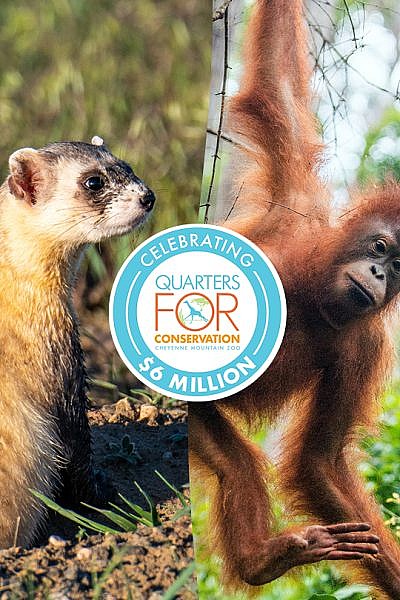
QUARTERS FOR CONSERVATION PROGRAM HELPS MEMBERS AND GUESTS CONTRIBUTE DIRECTLY TO FRONTLINE CONSERVATION ORGANIZATIONS WORLDWIDE – Cheyenne Mountain Zoo and its members and guests are celebrating a huge milestone, having raised $6 million for wildlife and wild places, since the Zoo’s Quarters for Conservation (Q4C) program launched in 2008.

Every visitor to the Zoo receives three ‘quarter’ tokens representing the 75¢ Q4C allocation from their admission fee. They can then show support for the legacy projects they love by placing their tokens in the corresponding slots in the Q4C kiosks near admissions.

Before launching Q4C in 2008, CMZoo was supporting conservation, but at a fraction of what is possible now. As more people visit the Zoo each year, the Zoo can contribute more money to conservation. In the past few years, CMZoo has collected approximately one million dollars every 20 months through Q4C. The Zoo’s membership, special events, admissions and EdVenture programs also contribute to conservation. CMZoo’s current Q4C beneficiary species include giraffe, Panama frogs, orangutans, black-footed ferrets, African elephants and black rhinos, Wyoming toads and Amur tigers.

About Our Current Q4C Legacy Projects

Q4C beneficiary species truly run the gamut, from 18-foot-tall giraffe in Africa to tiny toads in Wyoming.

Q4C supports Giraffe Conservation Foundation and their efforts to study, protect and grow wild giraffe populations. While CMZoo staff help raise awareness of giraffes’ silent extinction by inspiring guests at the Zoo, Q4C funds on-the-ground giraffe conservation efforts. CMZoo and the Kratt Family Fund (KFF) support efforts such as giraffe translocations to safer habitats, population monitoring and surveying, removal of illegal snare wires and veterinary treatment for giraffe and other wildlife injured by snares. They also provide veterinary support with vehicles and supplies. In addition, CMZoo’s contributions fund critical medications to treat injured animals, giving them a second chance at life.

Q4C also funds CMZoo’s on-site breeding programs for black-footed ferrets and Wyoming toads. These endangered prairie species were declared extinct in the wild in the 1980s and early 1990s, and are only around today because of decades of recovery efforts from U.S. Fish & Wildlife Service, zoos and partner organizations.

Wyoming toads are like so many amphibian species in decline all over the world, including Panamanian frogs, which also receive support thanks to Q4C funds and CMZoo staff support in the field. CMZoo staff members assist the Panama Amphibian Rescue and Conservation Project by sharing ideas and information from Wyoming toad breed-and-release efforts, and travel to Panama to help research strategies to reintroduce these endangered amphibians into their natural habitats.

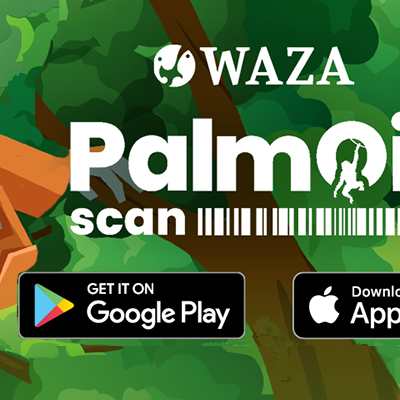
CMZoo’s work to save habitats for orangutans through advocacy for sustainable palm oil production is also largely supported by Q4C. Thanks to that financial support, CMZoo’s sustainable palm oil team consults staff at other conservation organizations on starting their own palm oil programs. The CMZoo sustainable palm oil team continues to focus on international work through the World Association of Zoos and Aquariums (WAZA). The team was instrumental in the creation of WAZA’s PalmOil Scan – a global free sustainable palm oil shopping smartphone app, which allows shoppers to scan the barcodes of items to learn whether producers have committed to using sustainable palm oil – and to choose to support companies that have committed to sourcing sustainable palm oil.

Through Q4C, CMZoo also supports Tsavo Trust – a conservation organization in Kenya that works to protect the last of the big tuskers, which are African elephants with tusks weighing more than 100 pounds, and Eastern black rhinos. CMZoo’s funds helped Tsavo Trust build out their headquarters and provide a clean water source for the local community, who are partners in conservation efforts. It also paid for vital infrastructure for aerial and ground vehicles that rangers use for surveillance that protects rhinos and elephants from illegal hunting, in addition to collecting data on how these endangered giants utilize the habitat.

The seventh Q4C legacy partner is Wildlife Conservation Society, whose dedicated staff work to protect and define secure habitats for wild Amur tigers in Eastern Russia. Amur tigers, previously known as Siberian tigers, are critically endangered. Their numbers in the wild continue to be treacherously low at around 500. CMZoo supports efforts to prevent human-wildlife conflicts as well as anti-poaching efforts and funding for field conservationists to study this species in the wild.

For more information about these projects and Quarters for Conservation, visit cmzoo.org/conservation.

About Cheyenne Mountain Zoo

Cheyenne Mountain Zoological Society was founded in 1926. Today, Cheyenne Mountain Zoo, America’s mountain Zoo, offers comprehensive education programs, exciting conservation efforts and truly fantastic animal experiences. In 2025, Cheyenne Mountain Zoo was voted #2 Best Zoo in North America and CMZoo’s Rocky Mountain Wild was named #2 Best Zoo Exhibit in North America by USA TODAY 10Best Readers’ Choice Awards. It is Cheyenne Mountain Zoo’s goal to help guests fall in love with animals and nature, and take action to protect them. Of the 237 zoos and aquariums accredited by the Association of Zoos and Aquariums (AZA), Cheyenne Mountain Zoo is one of just a few operating without tax support. Cheyenne Mountain Zoo depends on admissions, membership dues, special event attendance and donations for to fund animal care, conservation, Zoo operations and improvements.
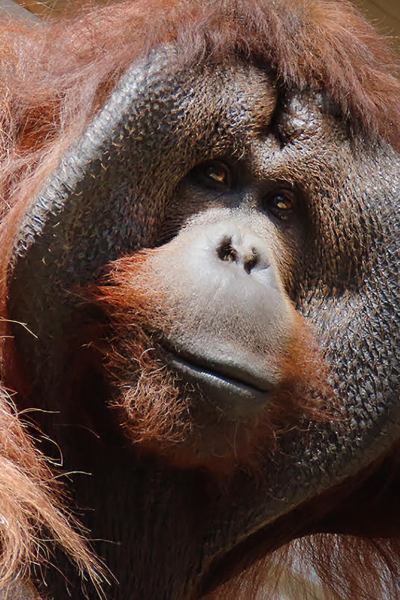
Join us for Red Ape Rally Day! If you are visiting Cheyenne Mountain Zoo on August 28, stop by Primate World to celebrate orangutan conservation. Advance tickets are required.

DATE: Thursday, August 28
TIME: 11 a.m. to 2 p.m.
WHERE:
Primate World

GET TICKETS

Activities for the whole family will create Zoo memories while raising awareness for orangutan conservation and sustainable palm oil.
— Build your own orangutan nest out of different materials.
— Stop by our photo booth, petition-signing table and coloring stations.
— Play a palm oil grocery game where you will learn about shopping for products containing sustainable palm oil.
— Watch special orangutan enrichment and a keeper talk at 1:30 p.m.

Why is orangutan conservation and sustainable palm oil awareness important?

Palm oil is an edible oil that can be found in about half of the products consumers purchase. Because of high demand, unsustainable palm oil production has resulted in deforestation across Southeast Asia, and other tropical areas, which means critically endangered species like orangutans are losing their homes.

However, boycotting palm oil is not the solution. When produced sustainably, palm oil is the most productive edible oil available. Oil palms – the trees that palm oil comes from – produce four to ten times more oil than alternatives like soy, olive, canola and coconut. Switching to these alternatives would cause even more deforestation in tropical areas.

Download the World Association of Zoos and Aquariums (WAZA) free mobile smartphone app, PalmOil Scan, from the Apple App Store or Google Play today. Just open your app, scan a product’s barcode, and see how that company ranks. If they haven’t committed to sustainable palm oil, consider instead supporting a similar company that has. This app was developed under the World Association of Zoos & Aquariums (WAZA) and regionally managed by Cheyenne Mountain Zoo. PalmOil Scan is available in the United States, Canada, the United Kingdom, Australia, New Zealand and Singapore.

If worldwide consumers show a preference for companies that source only sustainable palm oil, we can create a demand that other companies can’t ignore. By taking action together and contacting companies to ask that they only use 100% physical RSPO-certified palm oil, we can prevent more deforestation and help endangered animals recover in the wild.

Download the app today and learn more at cmzoo.org/palmoil.

GET TICKETS

Cheyenne Mountain Zoo and its members and guests are celebrating a huge milestone: $1 million raised for orangutan conservation. Over the years, funds allocated from Zoo membership revenue and daytime admissions have supported a variety of efforts that benefit critically endangered wild orangutans in Southeast Asia.

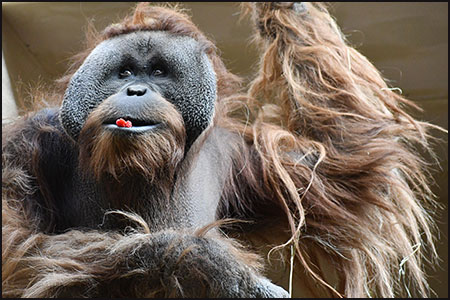
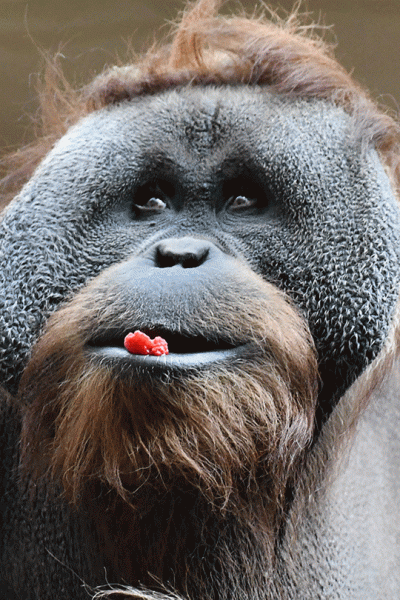
Male orangutan Baka portrait

Wild orangutans’ biggest threat is habitat destruction. Efforts funded by CMZoo’s supporters focus on preventing deforestation through global consumer empowerment, connecting and restoring wild orangutan habitats, and rescuing and rehabilitating displaced wild orangutans.

In 2021, CMZoo members voted in the annual Members-Only Conservation Vote to send $20,000 to support Hutan’s work to restore a wildlife corridor. In support of two established organizations working to save species in Southeast Asia, the funds helped the Hutan organization provide tools and funds to local women reforesting the Genting Wildlife Corridor, in Borneo. It also helped the Borneo Orangutan Survival Foundation (BOSF) repair orangutan rehabilitation islands damaged by a devastating flood.

The Hutan corridor is an important animal ‘wildway’ that will connect rainforest with a wildlife sanctuary potentially used by hundreds of species in the area, like orangutans and Asian forest elephants. The BOSF grant provides emergency funds to reopen islands used for orangutan housing and forest school prior to release.

In addition to funds raised through a portion of every Zoo membership, every visitor to the Zoo is making a direct contribution to conservation, through CMZoo’s Quarters for Conservation program (Q4C). Each Zoo guest receives three ‘quarter’ tokens representing the 75-cent Q4C allocation from their admission fee. They can then show support for the legacy projects they love by placing their tokens in the corresponding slots in the Q4C kiosks in the Zoo’s admissions area. Orangutans are one of CMZoo’s legacy beneficiary species, receiving support since Q4C was established in 2008.

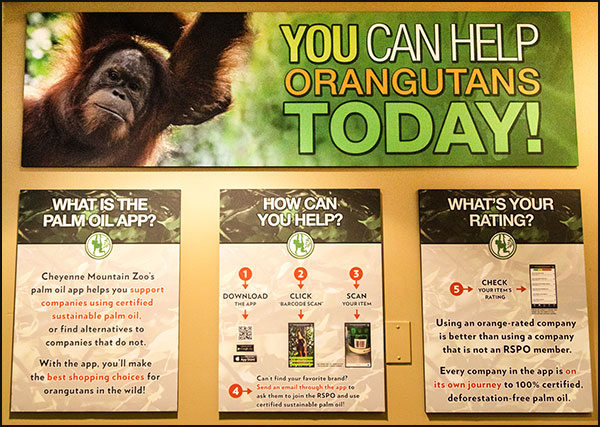
Sustainable Palm Oil signs in Primate World at Cheyenne Mountain Zoo

CMZoo has been a leader in sustainable palm oil advocacy for more than 15 years, encouraging numerous zoos and companies to join the Roundtable on Sustainable Palm Oil (RSPO) with increasing success. In 2014, CMZoo created a free mobile app to educate consumers in the U.S. and Canada. By 2022, more than 160,000 verified users were making better shopping choices with CMZoo’s palm oil shopping app. In 2023, that app design, database and user experience served as the foundation to launch a free global app, called PalmOil Scan, under the direction of the World Association of Zoos and Aquariums (WAZA), and in partnership with several zoos around the world.

Now, PalmOil Scan is available in the U.S., Canada, Australia, New Zealand, The United Kingdom and Singapore. The app has the potential to reach millions more people around the world.

Companies that continue to use unsustainable palm oil in their products need to see that consumers have the tools and knowledge to find out whether they value the habitats that so many endangered species depend on. Sustainable palm oil production is possible, and CMZoo’s work on sustainable palm oil advocacy, including the support on PalmOil Scan, gives consumers the power to hold companies to a higher standard.

Download PalmOil Scan for free in the Apple Store or on Google Play. To learn more about orangutan conservation and palm oil, visit cmzoo.org/palmoil.

Back to The Waterhole

With Mother’s Day around the corner, staff at Cheyenne Mountain Zoo are reflecting on one mother-daughter relationship that stands out: Bornean orangutans, Hadiah [huh-DEE-uh] and Ember.

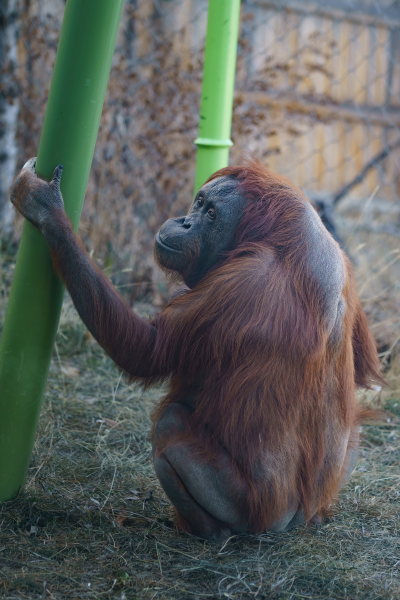
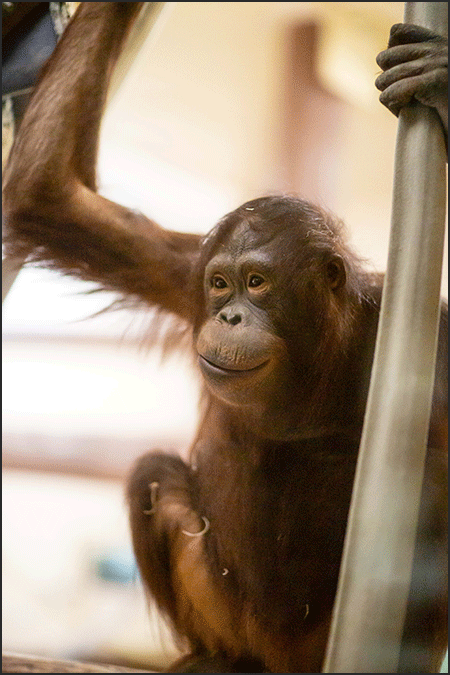
Sumatran orangutan, Ember
Bornean orangutan, Ember

“They’re incredibly close,” Ashton Asbury, animal keeper in Primate World, says. “Great apes are intelligent and complex beings, and we see different parenting types in each of them. Hadiah, as a mom to her only child, Ember, is a supportive, patient and rose-colored-glasses kind of mom.”

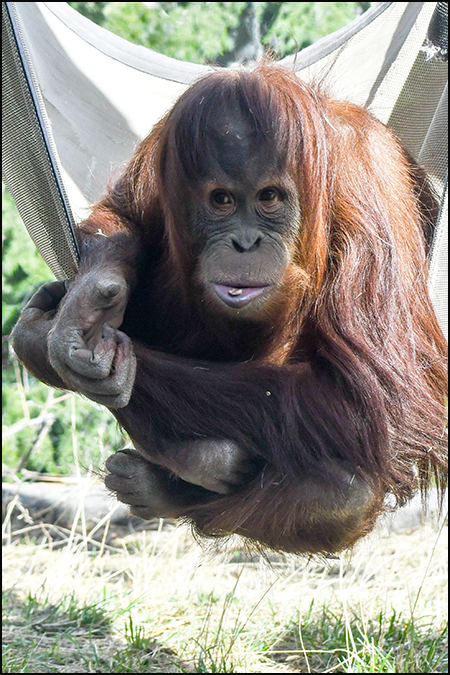
Ember is known for her in-your-face playfulness and high-energy approach to life. Her mom sometimes inadvertently finds herself in the path of her rambunctious nature, but she doesn’t seem to mind. After being the recipient of a rogue toy to the head, Hadiah has been seen handing the toy back to Ember patiently, and returning to her own activity without skipping a beat.

Often that activity is people watching.

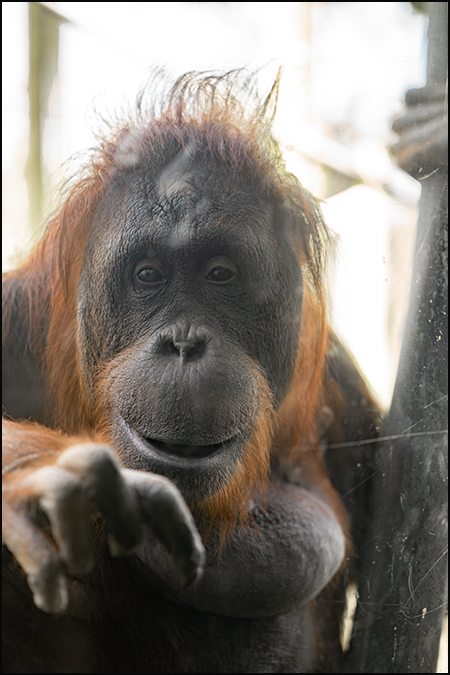
“Hadiah has connections with so many visitors and staff because she’s truly curious and recognizes people who return to see her,” Ashton says. “She’s got great facial recognition, and she’ll play with people through the glass. If she’s ever rolled over onto her back or folded her arms over her head to one side and looked at you upside down, she’s playing with you. She does that with her favorite humans and new guests who catch her eye.”

Orangutans are mostly solitary as adults, unless they are interacting for breeding or they have young with them, and many orangutan mothers are ready for their offspring to ‘spring off’ by around age seven or eight. Thirty-seven-year-old Hadiah is content with her daughter-turned-bestie, who is ten years old.

“These two still nest together every night,” Ashton says. “They eat together and play. It’s rare to see that kind of relationship in orangutans, when offspring are as old as Ember, and it really speaks to the respect and affection they have for each other.”

On the rare occasion that confident Ember feels unsure about something new, she runs to Hadiah, grabs her arms and wraps them around her. Despite their similar size, Hadiah occasionally still carries Ember.

“Their dynamic can be playful and outgoing, but also so patient and calm,” Izzy Dones, animal keeper in Primate World, says. “They’re usually together, but Ember and Hadiah also enjoy doing things separately sometimes. They’re both confident training and exploring separately, but, any time Hadiah is training with us, we’re ready with an activity for Ember nearby, because she’s going to want to do whatever Mom is doing.”

Hadiah grew up at the Zoo and was close with her own mother, Sabtu, until she passed away, in 2006. That strong family foundation seems to have shaped Hadiah’s parenting style.

“At least partly because of Hadiah’s unwavering support, Ember is one of the most confident and intelligent orangutans we’ve seen,” Izzy says. “She’s outgoing and curious about staff and guests, just like Hadiah, and she picks up training fast. She’s always pushing boundaries in a way that helps her grow, but still stays very close to Hadiah.”

Ember’s favorite enrichment activities include wearing fabric on her head, mimicking a behavior observed in wild orangutans who use leaves for shelter, like a hat or umbrella. She’s also a skilled problem-solver who enjoys dismantling enrichment items and ‘trading them’ through the mesh for snacks from keepers. She has learned that she gets one snack for every item she passes through the mesh, so instead of passing an assembled puzzle feeder, she takes it apart into several pieces – earning several snacks.

“Ember is really sharp,” Izzy says.

The apple didn’t fall far from the tree. Hadiah participates in cooperative care, like brushing and water-flossing her teeth, nail trims, target training, voluntary injection, abdominal ultrasound, scale training, ear and eye presentations, and more. Of course, through modeling behaviors learned by watching Mom, Ember is also a whiz at most of these, too.

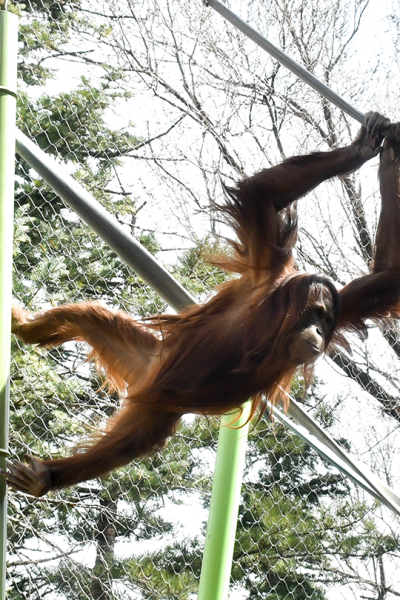
Not to be outdone by her vivacious daughter, Hadiah is learning new climbing behaviors, and her fascination with guests is building her confidence and strength to climb high in the orangutan yard.

“She likes to climb down like a sloth, and because she’s so outgoing, she seems to enjoy the guests’ reactions,” Izzy says. “She’ll hear guests ‘oohing’ at her while she climbs, and will stop and look over at them with excitement.”

When guests aren’t ‘oohing’ at her, she calls them over by knocking on the glass to get their attention. Visitors usually get the hint, and Hadiah presents opportunities to play, or brings a blanket over to the glass to make a nest to rest near them.

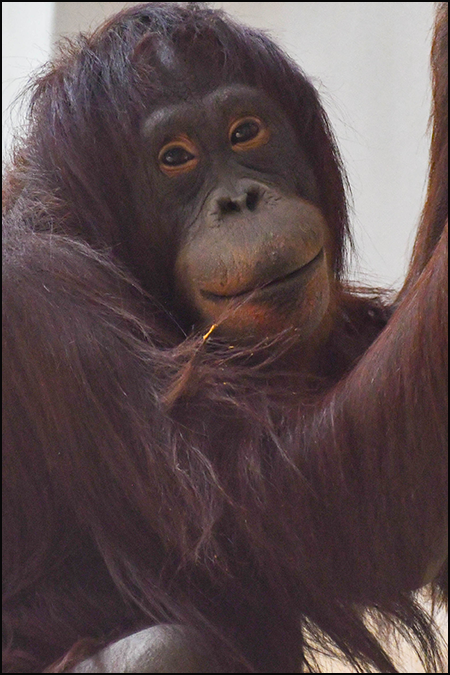
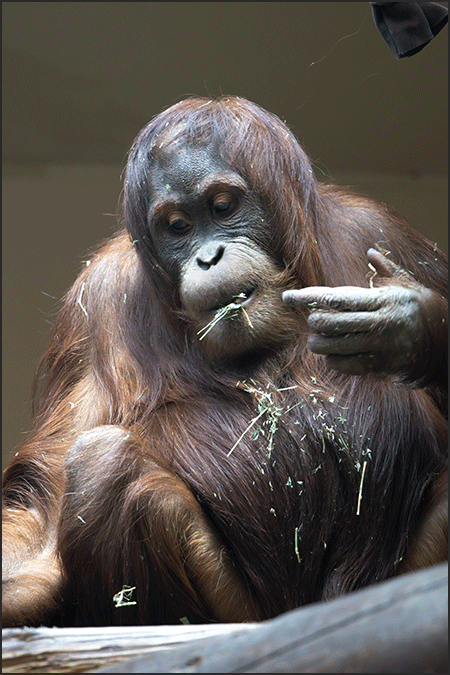
Bornean orangutan, Hadiah portrait
Bornean orangutan, Hadiah

Their “perfect day” includes novel training sessions, new spaces to explore and enrichment items like ice treats, bubbles, coconuts and even painting sessions. Hadiah is especially thoughtful with her artwork, while Ember seems to embrace the Jackson Pollock painting style.

As members of a critically endangered species, Hadiah and Ember play an important role in orangutan conservation.

“Most people won’t get the chance to see an orangutan in the wild,” Izzy says. “But when they meet Hadiah and Ember, they connect. They stop, they watch, and they feel seen by an animal. That connection makes all the difference.”

Every visit to CMZoo helps fund international efforts to save wild orangutan habitats, through the Zoo’s Quarters for Conservation (Q4C) program. “Orangu-fans” can save the rainforests from the comfort of their smartphone with a free global mobile app called PalmOil Scan.

Palm oil is an edible oil sourced in about half of consumer products. Unsustainable palm oil production results in deforestation in Indonesia and Malaysia – the only places where critically endangered orangutans live in the wild. Although the majority of palm oil production is in Southeast Asia, it has also expanded to other tropical areas, which means more animal species could lose the habitats they need to survive.

When produced sustainably, palm oil is four to ten times more productive than any other edible oil. Using PalmOil Scan, conscientious consumers can scan the barcodes on tens of thousands of products in the app’s extensive database (which is being updated and expanded continually) to see if they are produced by a company that has committed to sourcing sustainable palm oil. By choosing products made by companies that have committed to sustainable palm oil, consumers can show companies that they’re armed with the information they need to demand action for wildlife conservation.

Developed under the direction of the World Association of Zoos and Aquariums and regionally managed by CMZoo, in the U.S. and Canada. The PalmOil Scan is a global app that can also be downloaded in the UK, Australia and New Zealand, which are all managed by other partner zoos. The free app can be downloaded from the App Store and Google Play. Orangutan enthusiasts can learn more about palm oil, and download the free app before their next shopping trip, at cmzoo.org/palmoil.

Back to The Waterhole

Visitors to Primate World, at Cheyenne Mountain Zoo, may soon notice two crates in the orangutan yard. These crates are part of the Zoo’s careful preparations to help two iconic Sumatran orangutans, 6-year-old Kera and her mother, 37-year-old Sumagu, get ready for their next chapter.

Sumagu portrait, orangutan.

The mother-daughter duo is scheduled to move to another AZA-accredited zoo, likely later this summer, as part of a breeding recommendation through the Association of Zoos and Aquariums’ Species Survival Plan (SSP) for Sumatran orangutans.

Sumagu has a breeding recommendation with a male at another zoo, and keepers are working diligently to ensure the move is as smooth and low-stress as possible.

“Crate training is one of the more advanced behaviors we work on with our orangutans,” Ashton Asbury, Primate World animal keeper, says. “We’re teaching Kera and Sumagu to voluntarily enter the crates and to be comfortable spending time in them.”

Using positive reinforcement training, keepers are helping both orangutans associate the crates with rewards and calm experiences. In addition to watching for subtle behaviors, the team teaches the orangutans to signal when they’re ready to end a training session. This method allows Kera and Sumagu to feel empowered throughout the training process.

“Our goal is for them to enthusiastically enter the crates and allow the doors to close behind them,” Ashton says. “That way, when it’s time for the big move, it’s a familiar and positive experience.”

Thanks to this voluntary approach, neither orangutan will require sedation during their trip. Experienced animal transport professionals will make stops along the way to check on the great ape travelers, offering food and water, and making visual health checks. The teams also collaborate with AZA-accredited zoos along the way, in case the orangutans need care mid-trip.

Sumagu, who was born at CMZoo, will be stepping into a new world as she heads to her new home.

“We’re excited for Sumagu to have this new life experience,” Ashton says. “She’s such a wise and savvy orangutan. She’s very confident, and we’re encouraging her choice and control as she trains. She’s a great communicator. If she needs us to make adjustments, she’ll let us know.”

Sumagu’s daughter, Kera, is also preparing for this next stage in life. At her age, orangutans naturally begin to seek more independence, and Sumagu encourages that independence in Kera. To support this, Kera and Sumagu will travel in separate crates, and then settle into their new home together.

“It’s important for young female orangutans, like Kera, to observe their mothers raising another baby,” Ashton says. “She doesn’t have a breeding recommendation, but she could later. Young female great apes who get to be older siblings become more successful mothers later. Great apes’ offspring typically stay with their moms longer than any animal species, and learning how to be a mom from their own mom is the best-case scenario.”

Keepers at CMZoo will be working closely with the orangutans’ future animal care team, sharing training histories and behavioral nuances, which is essential for complex and intelligent animals like orangutans.

Sumagu portrait

“Kera is such a fun kid,” Ashton says. “She’s serious about orangutan things, like nest-building, but she’s also super engaging and outgoing with people. We will definitely miss both of them, but we’re proud to support this breeding recommendation that supports the population in human care, and continues to inspire conservation for wild orangutans.”

Fans of Kera and Sumagu, and all orangutans, can save the rainforests from the comfort of their smartphones with a free global mobile app called PalmOil Scan, available for free on the App Store and Google Play. It is available in the United States, Canada, the United Kingdom, Australia and New Zealand, with further expansion planned in the future. Orangutan enthusiasts can learn more about palm oil, and download the free app before their next shopping trip, at cmzoo.org/palmoil.

Palm oil is an edible oil that can be found in about half of consumer products. Unsustainable palm oil production results in deforestation in Indonesia and Malaysia, the only places where critically endangered orangutans live in the wild. Although the majority of palm oil production is in Southeast Asia, it has also expanded to other tropical areas, which means more animal species could lose the habitats they need to survive.

When produced sustainably, palm oil is 4 to 10 times more productive than any other edible oil. Using PalmOil Scan, conscientious consumers can scan the barcodes on tens of thousands of products in the app’s extensive database (which is being updated and expanded continually) to see if they are produced by a company that has committed to sourcing sustainable palm oil.

“Orangutans are incredibly intelligent and complex animals,” Ashton says. “Our animal care team knows these great apes really well, and we’re planning for the best opportunities for all of the orangutans in our care as these changes take place.”

Primate World is currently home to six orangutans: three Sumatran orangutans, including Kera and Sumagu, and three Bornean orangutans. When Kera and Sumagu move, male Sumatran orangutan, Baka, will continue his current lifestyle, with access to interactions through a safety barrier with Ember and Hadiah, mom-and-daughter Bornean orangutans. Tujoh, a male Bornean orangutan, will continue to have the same access.

Back to The Waterhole

Quarters for Conservation Legacy Project: Palm Oil Conservation
The Roundtable for Sustainable Palm Oil (RSPO) recognized Cheyenne Mountain Zoo’s collaborative palm oil conservation work at the RSPO annual conference in Bangkok last month. PalmOil Scan, a global mobile app that empowers consumers to choose companies that commit to using sustainable palm oil, won the RSPO Innovation Award.

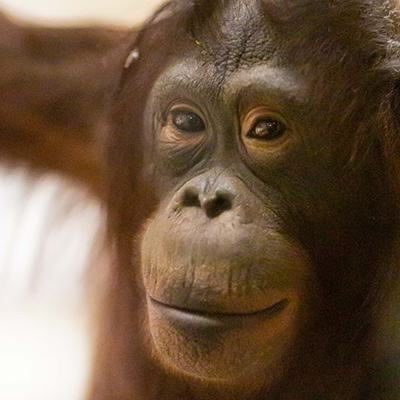
Orangutan portrait

The award acknowledges the work of World Association of Zoos and Aquariums and its members, Cheyenne Mountain Zoo, Chester Zoo, Auckland Zoo and Zoos South Australia, in developing the PalmOil Scan app.

PalmOil Scan is available in the United States, Canada, the United Kingdom, Australia and New Zealand. Learn more at cmzoo.org/palmoil and download the free mobile app before your next shopping trip in the Apple Store or Google Play.

Palm oil is an edible oil found in about half of the products consumers purchase. It is used in candy, soaps, cosmetics, pet food and cleaning products. Because of high demand, unsustainable palm oil production has resulted in deforestation across Southeast Asia, and other tropical areas, which means critically endangered species like orangutans, tigers and elephants, are losing their homes.

Orangutan portrait

However, when produced sustainably, palm oil is the most productive edible oil available. Oil palm trees produce four to ten times more oil than alternatives like soy, olive, canola and coconut. Switching to these alternatives would cause even more deforestation in tropical areas, which is why consumers must demand sustainable palm oil.

CMZoo has been a leader in sustainable palm oil advocacy for nearly 15 years. The Zoo launched a similar mobile app for consumers in the U.S. and Canada in 2014. More than 160,000 verified users have educated themselves by using CMZoo’s app. Its design, database and user experience served as the foundation for the design of PalmOil Scan, which has the potential to reach millions more people around the world.

Through Quarters for Conservation (Q4C), 75¢ from every admission and $25,000 from membership revenue, totaling more than $5 million since 2008, funds legacy programs – symbolized by the Q4C kiosks, where guests can place tokens representing their 75-cent contributions, in CMZoo’s admissions plaza. One long-time legacy conservation effort is palm oil education and advocacy for orangutan habitat preservation.

Back to The Waterhole

Adding animal demonstrations to your next Zoo day itinerary is one of the best ways to kick off the summer. Included with your regular daytime ticket, you’ll have access to multiple animal demonstrations throughout the day. From brachiating orangutans to a guinea pig parade, these demonstrations offer fun and educational experiences for our guests while also enriching and engaging our animals. Highlighting their natural behaviors and unique features, these demonstrations provide insight into some of the residents of CMZoo.
(Animal demonstrations are weather and animal permitting.)

Summer Schedule

9:30 a.m. — Penguin Keeper Talk in Water’s Edge: Africa
10 a.m. — Guinea Pig Parade in Water’s Edge: Africa (Tues., Wed., and Sun. only)
10 a.m. — Lion Enrichment in African Rift Valley (Tues. and Sat. only)
10 a.m. — Wolf Feeding in Rocky Mountain Wild (Thurs. and Sun. only)
10:45 a.m. — Caring for Elephants in Encounter Africa
11:15 a.m. — Orangutans are Awesome in Primate World
11:30 a.m. — Barn Owl Training in Scutes Family Gallery
11:30 a.m. — Alligator Feeding in Australia Walkabout (Mon. and Tues. only)
2:15 p.m. — Caring for Elephants in Encounter Africa
2:30 p.m. — Skunk Training in The Loft
3 p.m. — Treetop Acrobats in African Rift Valley at the colobus monkey exhibit (Fri., Sat., and Sun. only)
3:15 p.m. — Caring for Awesome Apes in Primate World
3:30 p.m. — Grizzly Demo in the temporary bear habitat above the tapir yard
4:15 p.m. — Meet the Hippos in Water’s Edge: Africa

Advance tickets are required and can be purchased at cmzoo.org.

Back to The Waterhole

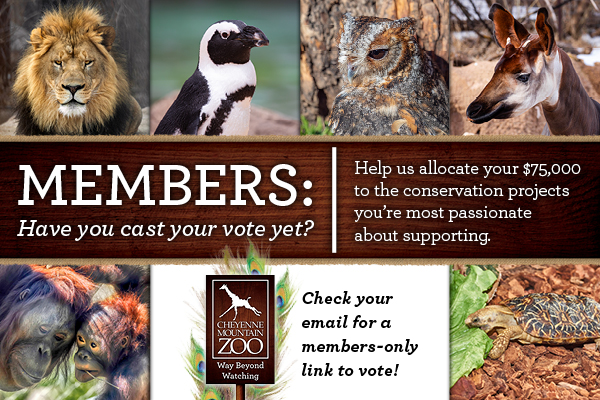
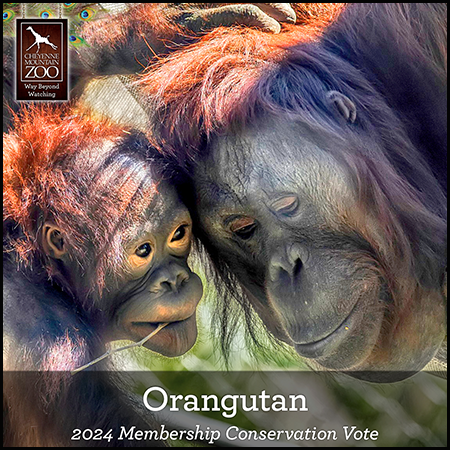
Last month, Cheyenne Mountain Zoo members cast their votes to help the Zoo decide how to spend $75,000 of member conservation funds among six conservation projects vying for members’ support. The three projects with the most votes received the full funding they requested. The number of votes received for the remaining three projects helped CMZoo decide how to distribute the remaining funds.

Every membership and every visit to the Zoo is conservation in action. From 2015 to 2024, including this year’s contributions, the program has provided $750,000 of membership revenue to support field conservation worldwide.

“I hope our members recognize what an impact they make for wildlife and wild places through these staff-championed conservation efforts,” Ashley Cioppa, CMZoo membership manager, says. “Our members’ annual investment in their Zoo memberships directly supports animals here in Colorado and all around the world. Plus, they give our staff the opportunity to reach more niche organizations and efforts that support their personal passions. Thank you, members!”

Each year, a total of $100,000 of membership revenue is contributed to conservation in two ways:

  • $25,000 to the Quarters for Conservation program, which in total contributes a million dollars on average every 18 months to CMZoo’s legacy conservation partners.
  • $75,000 to projects voted for by CMZoo members through this annual vote.

This year’s Member Conservation Vote top-ranked projects to fully fund are:

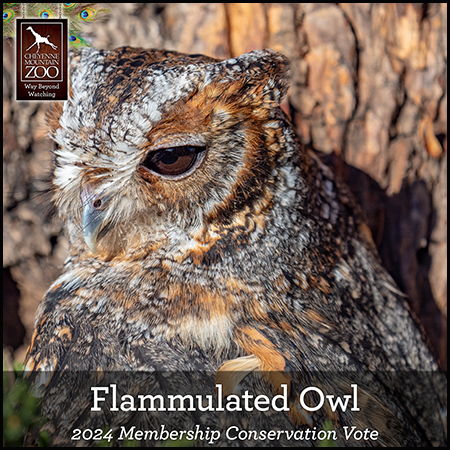
1. Track and protect FLAMMULATED OWLS in Colorado – $4,150
Purchase ten tracking tags that provide researchers with crucial migration data for these tiny owls. Migratory birds are currently facing many threats such as pollution, pesticides, habitat loss and collisions with human-made structures. The installation of two Motus towers at CMZoo and Fountain Creek Nature Center last year allows researchers the ability to track hundreds of local bird species in efforts to protect them. As a continuation of this project, a local researcher will utilize these towers to track ten flammulated owls, a species that lives right here in Colorado Springs, to learn about their migration patterns and use that information to help protect the species.


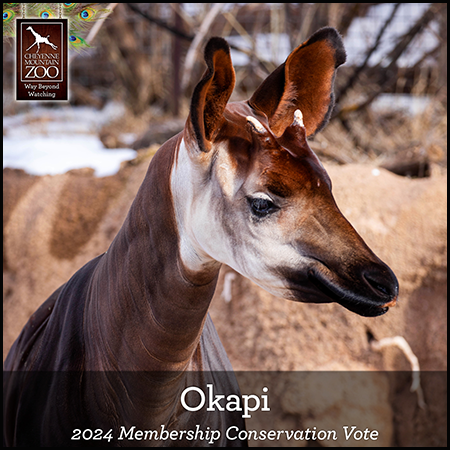
2. Support agroforestry to protect OKAPI habitat – $24,600
Provide farmers in the Democratic Republic of the Congo with sustainable agricultural resources. Okapi populations are facing a major threat of habit loss due to slash-and-burn agriculture and human settlement. In a continued partnership, the Okapi Conservation Project (OCP) will use these funds to provide farmers with tools, seeds, land plots and the education necessary to build and maintain sustainable agriculture and reforestation practices. In doing so, the local communities are empowered to produce their food sustainably and reduce their dependence on mining and poaching – leading to the long-term protection of okapi.


3. Help build a new island home for ORANGUTANS in Borneo – $17,642
Help provide the materials to construct a new, forested island home for non-releasable orangutans in Southeast Asia. Borneo Orangutan Survival (BOS) Foundation is an established organization that rescues, rehabilitates and releases orangutans back into their natural habitat. Unfortunately, a small percent of orangutans come to BOS with injuries, illnesses or other conditions that prevent them from being released into the wild safely. BOS houses and cares for them for the rest of their lives. Member funds will help provide the construction materials for a new orangutan island that will create a spacious and enriching forever home for three non-releasable orangutans currently residing with BOS.


With the remaining funds, CMZoo has decided to partially fund:

Protect PANCAKE TORTOISES through community conservation in Kenya
Conduct community awareness training and research to protect critically endangered tortoises and their habitat. Wild turtle and tortoise species are in the midst of a worldwide extinction crisis. The African pancake tortoise faces severe threats, not only from grassland habitat destruction used for farming, but also an additional threat of poaching for the pet trade. In a continued partnership, the Turtle Survival Alliance will protect and develop research strategies for a newly found pancake tortoise population, as well as establish additional awareness for the local communities surrounding this tortoise population.

Expand AFRICAN PENGUIN chick rearing capacity
Provide construction materials and equipment to rear penguin chicks. African penguins, found mainly in South Africa and Namibia, are facing threats from overfishing and climate change, which often results in penguin parents abandoning their chicks. Due to an exponential increase in egg and chick abandonment, the Southern African Foundation for the Conservation of Coastal Birds (SANCCOB) is looking to expand their chick-rearing facility through our ongoing partnership. This expansion will double their capacity of penguin chicks and eggs that they can rescue, rehabilitate, and release each year.

Support kids’ education camps to help protect AFRICAN LIONS
Help protect large carnivores by empowering a new generation in Kenya. Human-wildlife conflicts can occur between farmers and predators, such as lions, that may threaten local livestock. The education programs that Ewaso Lions will implement through this ongoing partnership will help to shift the attitude towards predators and allow Kenyan communities to more easily and efficiently coexist with wild carnivores by reducing the frequency of potential human-wildlife conflicts.

For more information about how to become a CMZoo member, and the many benefits that memberships provide, visit cmzoo.org/membership.

Back to The Waterhole

PALMOIL SCAN APPTM NOW AVAILABLE FOR CONSCIENTIOUS CONSUMERS IN AUSTRALIA AND NEW ZEALAND – Auckland Zoo and Zoos South Australia are the latest zoos joining Cheyenne Mountain Zoo (CMZoo) on a worldwide effort, led by the World Association of Zoos and Aquariums (WAZA), to empower consumers to advocate for wildlife with their shopping choices.

Smart shoppers can save the rainforests from the comfort of their smartphones with a free global mobile app called PalmOil Scan, available for free on the App Store and Google Play. It launched last year in the United States, Canada and United Kingdom – and is now available in Australia and New Zealand.

Zoos are stepping up to the task of managing the app’s shopping product database for consumers in different regions. Americans and Canadians lean on the support of Cheyenne Mountain Zoo. In the United Kingdom, it’s Chester Zoo. In Australia, Zoos South Australia is keeping the app going. In New Zealand, Auckland Zoo is in charge. So, no matter the longitude or latitude, consumers can easily make brand shopping choices that help wildlife and wild places.

“We’re excited to welcome Zoos South Australia and Auckland Zoo to the team managing the app,” said Tracey Gazibara, executive vice president at CMZoo and co-chair of the WAZA Palm Oil Subcommittee. “Now, on nearly half of the world’s continents, people have the power to advocate for animals with their shopping choices, and to make large companies listen to their demands for products made with sustainably produced palm oil.”

Palm oil is an edible oil that can be found in about half of the products consumers purchase. It is used in candy, soaps, cosmetics, pet food and even toilet paper. Because of high demand, unsustainable palm oil production has resulted in deforestation across Southeast Asia, and other tropical areas, which means critically endangered species like orangutans, tigers and elephants are losing their homes.

However, when produced sustainably, palm oil is the most productive edible oil available. Oil palms – the trees that palm oil comes from – produce four to ten times more oil than alternatives like soy, olive, canola and coconut. Switching to these alternatives would cause even more deforestation in tropical areas, which is why consumers must demand sustainable palm oil.

Using PalmOil Scan, conscientious consumers can scan the barcodes on tens of thousands of products in the app’s extensive database (which is being updated and expanded continually) to see if they are produced by a company that has committed to sourcing sustainable palm oil. The free app also has a search feature, so if consumers scan a product that isn’t orangutan-friendly, they can easily choose an alternative that is.

Companies that have previously relied on their customers’ lack of knowledge about unsustainable palm oil and its impact on orangutans, tigers, rhinos, and elephants will soon recognize their competitors have the edge on them.

“Companies that continue to use unsustainable palm oil in their products need to see that consumers have the tools and knowledge to find out whether they value the habitats that so many endangered species depend on,” said Gazibara. “Sustainable palm oil production is possible, and it is time for us all to hold companies to a higher standard.”

CMZoo supporters won’t be surprised to hear the Zoo is continuing its palm oil advocacy work. CMZoo has been a leader in sustainable palm oil advocacy for more than a decade. Under the direction of WAZA, CMZoo helped launch PalmOil Scan, in July 2022. The Zoo launched a similar mobile app for consumers in the U.S. and Canada in 2014. More than 160,000 verified users educated themselves by using CMZoo’s app. Its design, database and user experience served as the foundation for the design of PalmOil Scan, which has the potential to reach millions more people around the world.

“If worldwide consumers show preference for companies that source only sustainable palm oil, we can create a demand that other companies can’t ignore,” said Gazibara. “When more companies realize their potential customers will not stand for the use of unsustainable palm oil, we can prevent more deforestation and help endangered animals recover in the wild.”

To learn more about sustainable palm oil, and how the power of consumer choice can save critically endangered animals in Southeast Asia, visit cmzoo.org/palmoil.