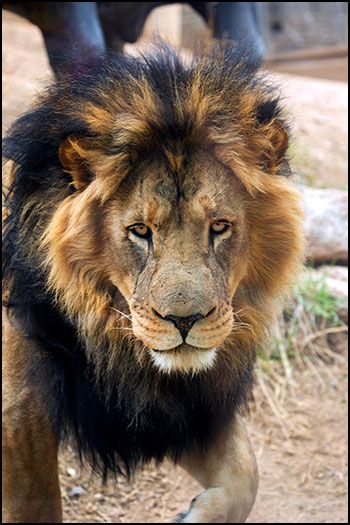
Most people who have been to Cheyenne Mountain Zoo have seen our African lions majestically gazing out over Colorado Springs from atop Pride Rock, or hanging out on the perches and heated floors in their Relaxation Room. Abuto, CMZoo’s 9-year-old African lion pride patriarch, is an amazing ambassador for his species, having formed countless connections with our guests and members.
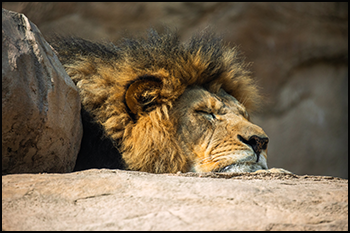
Abuto came to CMZoo in 2013, around the same time African Rift Valley lead keeper, Amy Schilz, came to the Zoo.

“We’ve been working together since he was a year old,” said Schilz. “Right away we started working on behaviors and training that still help us take great care of him as he deals with ongoing health issues.”

About four years ago, he started showing signs of illness. He is usually really energetic and can be seen roaring, running around and enthusiastically participating in training and enrichment. At around five years old, he started having ‘off days,’ when he seemed lethargic, which led his team to investigate what was going on.

At the time, Abuto participated in a voluntary blood draw that revealed he was in the beginning stages of kidney disease. While investigating further, Abuto’s team also discovered he has high blood pressure.

We’ve been monitoring Abuto’s issues closely and managing them with medications and diet. Abuto’s father had a rare form of kidney disease that can be hereditary. Chronic kidney disease is unfortunately prevalent in big cats. The disease is progressive and can’t be cured, so his team manages Abuto’s symptoms with diet, medications and fluids to keep him comfortable.

His symptoms subsided for a while, but over the last few months, Abuto has started to show the same signs as before that he is having an ‘off day’ here and there, and maybe isn’t feeling well. CMZoo’s veterinary team and Abuto’s care team in African Rift Valley has been performing frequent voluntary blood draws and blood pressure tests with Abuto to see what’s preventing him from feeling his best.

“We are seeing some of his kidney values climbing higher, which is unfortunate,” said Schilz. “We’re doing the best we can for Abuto, but kidney disease is something that affects big cats and domestic cats often. We’re monitoring him closely, because the levels are higher than they have been in the past, and we want to do everything we can to prevent them from increasing further.”

Abuto’s blood tests have shown the progression of his disease over the years, most recently indicating a significant jump in levels. His team is working to adjust his treatments with hopes they can manage his symptoms in this next stage of the disease.
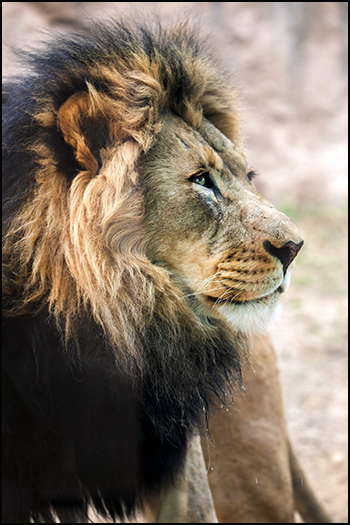
Abuto is the total package, from his gorgeous mane, to his impressive roars and his incredible intelligence. He, like most CMZoo animals, participates in voluntary training that allows his keepers to provide top-notch care for the 500-pound feline.

“He’s so smart,” said Schilz. “You can tell he likes participating in training. He gets really excited and runs over to train. He knows how to show us his mouth and teeth, so we can check on his dental health. He’ll also flop down on his side and show us his paws when we ask, so we can make sure he doesn’t have any cracks in his pads and his nails are a healthy length. He also voluntarily participates in blood draw training and blood pressure checks, so we can keep tabs on those long-term health issues he’s facing.”

How do you draw blood from a 500-pound lion? By asking him.

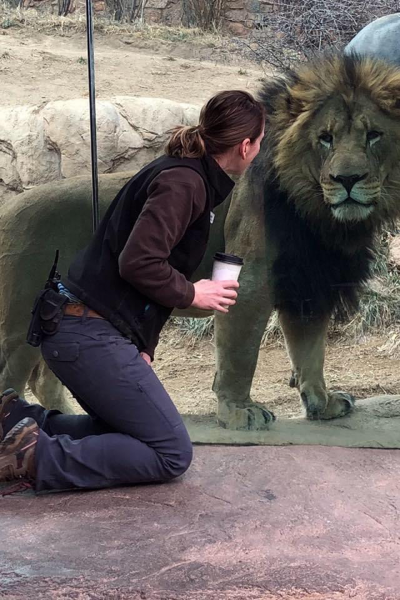
Abuto is trained to present his tail through a specially designed blood draw panel at the base of a training area by the Relaxation Room. During this training, his keepers open an access door for Abuto and leave it open, so he can choose to leave if he wants to. From the other side of the panel, Schilz, his primary trainer, asks him to enter the space and then cues him to adjust his body so his tail fits through the port. Abuto runs into the space and positions himself quickly, knowing he’s going to be engaging with Schilz and getting lots of rewards: tasty meatballs. Schilz sits on the other side of a protective barrier to Abuto’s left, while African Rift Valley keeper, Kayla Ringuette, and CMZoo veterinary technician, Brenda Cordova, sit behind fencing near his tail at the blood draw panel. They provide verbal cues, like, “touch” and “poke,” to let Abuto know they’re going to touch his tail and then draw blood. Abuto does the same behaviors for blood pressure tests, when he also presents his tail for the team to attach a quick-release blood pressure cuff.

“Abuto is just the absolute best,” said Schilz. “When we first see him in the mornings, he’ll make ‘baby calls’ like coos and little moans to us. He’s so chatty. It’s like he’s telling us all about his night. We’ve been working together for so long that he recognizes my voice. If he hears me laugh, even from the bottom of the hill, he’ll run over to see me. He’s so special to me, the team, our whole staff and so many of our guests. We’re making sure he’s getting the best possible care, and we are hopeful we can address these issues as they progress, just as we have helped him in the past.”

Keepers are tracking quality-of-life markers for Abuto, as they do for any animal with ongoing health conditions. Abuto’s keepers are tracking whether he shows any symptoms or behavioral changes, including lethargy, presenting a droopy jaw, has squinty eyes, or holds his head low – which could indicate he’s not feeling well. They’re also tracking whether he chooses to participate in training or perks up for keepers as he normally would. Along with blood tests, the long-term data will help his team adjust his treatments and make any future decisions necessary.

“Abuto is really special to us and has a huge piece of our hearts, so when he gets sick, we want to do everything we can to make him feel better,” said Schilz. “He’s in great hands with our vet team and our keeper team, and we know all of his fans will continue sending him well wishes for a quick turnaround.”

We will keep you posted on Abuto’s ongoing issues. Guests can visit him in African Rift Valley.
Back to The Waterhole


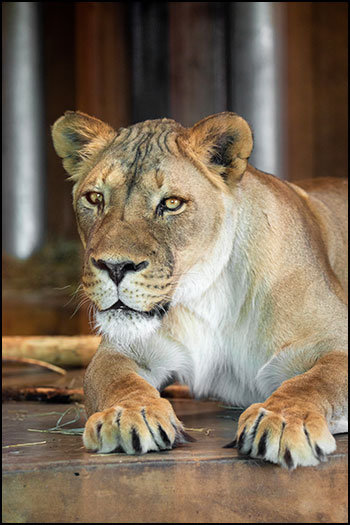
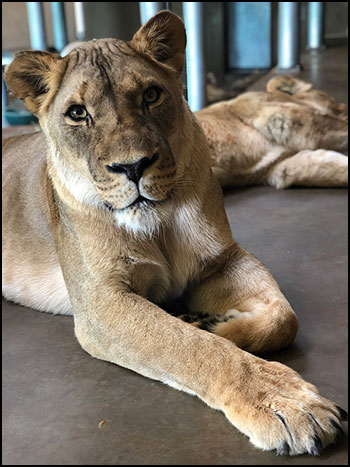
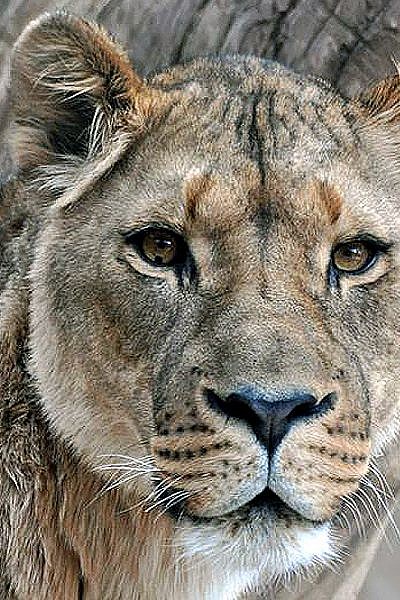
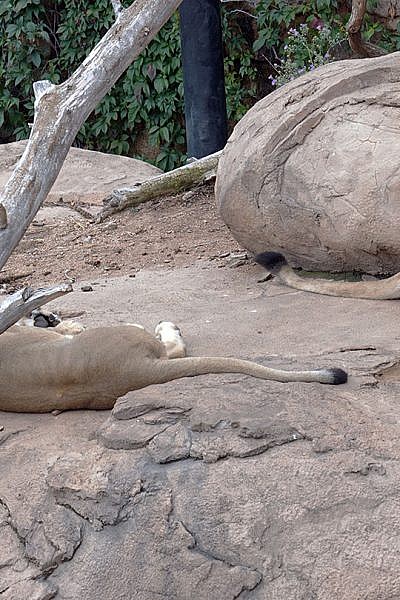
CMZoo’s animal care and veterinary teams are working hard to make Zwena, a 13-year-old African lioness who was born at CMZoo in 2007, as safe and comfortable as possible as she deals with increasing mobility issues. The 13-year-old sister to Lomela and aunt to Elsa, Boma and Aslan, has been showing symptoms that her team suspects may be due to neurological disease. The formerly agile lioness is now frequently unsteady on her paws.

“At this point we have performed many diagnostic tests to determine the cause of Zwena’s symptoms and have administered a variety of medications to potentially treat ‘treatable’ diseases,” said CMZoo Head Veterinarian, Dr. Jon Romano. “Now, our goal is to keep Zwena as comfortable as possible, so she can live her best life. Her keepers are dedicated to her care. We’ll continue tracking her quality of life markers. Right now, other than her mobility, they are all looking good.”

Keepers are tracking quality-of-life markers, as they do for any animal with health conditions. Those markers help identify trends that indicate her symptoms are worsening or her life is not fulfilling her needs as a lion. Over time, the data will help her care team make any future decisions necessary. Zwena’s four markers are social dynamics within the pride, mobility, appetite and vision.

“She follows us with her eyes, eats like a champion and still has healthy respect from the pride,” said Diana Miller, African Rift Valley keeper and Zwena’s primary trainer, who has worked with her for 8 years. “So, for now, we’re focused on maintaining those indicators and avoiding any injuries as a result of her decreased mobility. I just love her so much and want to give her the best life she has left.”

Zwena, known affectionately as “Z” by many CMZoo staff members, is well-loved and respected for her no-nonsense approach to building relationships with people.

“Zwena is a brave, sassy, playful lion with one of the best animal personalities I’ve ever known,” said Miller. “She isn’t shy about telling you how she feels about you. You have to earn her respect, so it’s like a rite of passage when ‘Z’ accepts you. She seems like she’s really tough, but she’s a nurturer, too. When her sister, Lomela, had the three cubs in 2015, Zwena was the first to lead them out into the main yard to play. She loves to play and pounce, and even playfully stalks keepers and guests, despite her mobility challenges. Those interactions with guests have made her an amazing animal ambassador for her species. I mean, who could forget a 300-pound lioness focusing on you like that?”

Her care team monitors her condition daily, and makes decisions about which spaces she can safely explore. On days she’s doing well, Zwena may be in the indoor relaxation room. When her unsteadiness is worse, it’s unsafe for her to explore the main lion yard, with its potentially dangerous drops from pride rock. The indoor lion relaxation room could also present potentially unsafe scenarios for Zwena when she’s unsteady, because of the high benches that she would likely attempt to jump to and from.

When keepers see she is less coordinated, she will spend her time in the behind-the-scenes outdoor ‘maternity yard,’ which will provide ample space for her to get safe exercise, fresh air and sunshine. She’ll also have access to off-exhibit indoor spaces where she can receive enrichment, participate in training and get lots of keeper attention.

“She’s not uncomfortable or suffering, and we want to keep her that way,” said Miller. “She’s mentally there, but she will sway or stumble as she walks, even on flat ground. We have seen her leaning against walls for stability or high-stepping over non-existent obstacles. These days, she more frequently half-jumps from low platforms and then pauses to steady herself before moving on, which could mean she’s not feeling confident about her mobility. So, we’re making adjustments to protect her from those environments that are no longer safe for her to navigate.”

Zwena’s symptoms have been intermittent since about 2015, but have recently become more chronic, so her care team is making changes now.

“Socializing is really important to lions, so we’re making sure Zwena still has time with her pride,” said Miller. “She and her sister, Lomela, are best buds. Even when it’s 90 degrees outside, we see them snuggling up together. They still play together, too. It is so fun to watch. Zwena is still living a fulfilling life, but she’s doing it in different spaces.”

Zwena will spend time with each member of her pride. At night, all four of the lions will share space together, to help Zwena maintain her respected position in the pride. Zwena’s vet and animal care team will continue exploring any new options available for keeping her safe and comfortable.

Back to The Waterhole


Every membership and every visit to the Zoo is conservation in action. Although Cheyenne Mountain Zoo members can’t visit right now, they’re actively participating in important efforts to help wild animals.

Since 2015, including this year’s contributions, the Member Conservation Vote has provided $450,000 of membership revenue to support field conservation worldwide. Each year, a total of $100,000 of membership revenue is contributed to conservation in two ways:

  • $25,000 to the Quarters for Conservation program, which in total contributes half a million dollars annually to CMZoo’s legacy conservation partners.
  • $75,000 to projects voted for by CMZoo members through this annual vote.

“Over the years, members have funded projects that support organizations working to save species on the brink of extinction in places like Ecuador, Kenya, South Africa, Southeast Asia, Australia and more,” said Dr. Liza Dadone, vice president of mission and programs at CMZoo. “These grants make a huge impact for the small-but-mighty organizations that are defending animals on the frontlines. Although the Zoo is temporarily closed until further notice, in an effort to help prevent the spread of COVID-19, this is one of the ways our conservation efforts are continuing, even during the closure.”

From the safety of their homes, members participated in the 2020 Member Conservation Vote through a private link distributed to members via email. The two projects with the most votes will receive the full funding they requested. The number of votes received for the remaining four projects will help CMZoo decide how to distribute the remaining funds.

In addition to being able to support smaller conservation projects around the world, the Member Conservation Vote also allows the Zoo to support immediate needs that might not fit into our annual Quarters for Conservation funding parameters. One such project is the Zoos Victoria Bushfire Emergency Wildlife Fund in Australia.

In February 2020, CMZoo members approved sending $20,000 to Zoos Victoria, in response to the devastating fires in Australia. The funds support long-term care for bushfire-impacted animals, including supplementary feeding and habitat restoration, in conjunction with the Australia Department of Environment, Land, Water and Planning, Parks Victoria, and associated recovery teams. Donations from Zoo employees, board members, docents and an internal Zoo donation matching program raised $6,900 in support of Zoos Victoria, making the collective donation $26,900.

The $20,000 donation came from the $75,000 allotted for membership conservation, leaving $55,000 for distribution among the projects nominated for the Member Conservation Vote.

This year, six projects were nominated in addition to the already approved Zoos Victoria support. Some projects, like building a wildlife corridor for lions, were brand-new. Others, like tracking mountain tapir, have received funding through this vote consistently for years.

“Considering everything going on in the world right now, it was especially important to us this year to engage our members in this vote and to remind them that they make a difference,” said Emma Repp-Maxwell, CMZoo membership manager. “We have been missing our members for more than a month, but we want them to know we’re grateful for their ongoing support, and that they’re still making a positive impact for wild animals through their memberships and through their participation in this vote.”

Drumroll, please. In order of member votes received, the 2020 projects receiving funding are:

Support a wildlife corridor for African lion – $5,600 fully funded

This funding will help map developing pipelines and highways and plan animal corridors before construction begins. It will also support data analysis and stakeholder meetings to get the right organizations involved in animal protection at the right time. Longtime conservation partner, Ewaso Lions, is hoping to protect lions by establishing wildlife corridors in northern Kenya. As more highways, railways, cities and pipelines are built in the heart of lion country, they hope to create the partnerships and infrastructure necessary to protect the many species that share and roam these lands as human influence expands.

Start an agroforestry project to protect Okapi habitat – $11,000 fully funded

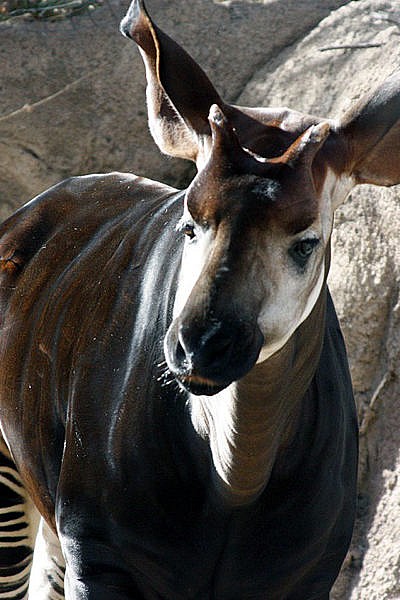
In a continued partnership with the Okapi Conservation Project, this grant will provide farmers with tools, seeds, natural fertilizers, and education in sustainable agriculture practices. In addition, funds would support reforestation in the region. Found in the Democratic Republic of Congo, the okapi is a mysterious member of the giraffe family that is threatened by poaching and slash-and-burn agriculture. This will empower local communities to produce food sustainably, safeguard water resources, and generate income while reducing economic dependence on mining and poaching, thus protecting okapi in the long run.

Observe tree kangaroos in their natural habitat – $7,500 fully funded

This grant will support the purchase of GPS tracking collars, camera traps and data loggers to better understand tree kangaroo behaviors, movements and habitat use. The Tree Kangaroo Conservation Program fosters wildlife and habitat conservation while supporting the livelihood of local communities in Papua New Guinea. Matschie’s tree kangaroos live high in the dense canopy of the cloud forests, hidden among thick moss that makes them very difficult to observe. The data collected through this observation project will be used to inform future habitat planning for tree kangaroo conservation.

Fund the banding and monitoring of East African crowned cranes – $11,000 fully funded

This grant will contribute to funding the first banding of 75 East African crowned crane chicks and support data collection about their behaviors and migration patterns to help inform future conservation efforts for this species. Found in Kenya, the East African crowned crane has seen a dramatic decrease in population over the last four years. The International Crane Foundation, Endangered Wildlife Trust and Leiden Conservation Foundation are collaborating to learn more about this species in order to stabilize its population.

Help track wild mountain tapir in Ecuador – $20,000 funded (partial funding awarded)

A continuation of past monitoring projects, these funds will support the GPS collaring of additional tapir in the wild and educational outreach for local schools. Found in Colombia, Ecuador, and the far north of Peru, only an estimated 2,500 mountain tapir remain in the wild. CMZoo is one of two zoos in North America that this species calls home. This project, based in Ecuador, has already yielded important data regarding the movement, behaviors and territory of this critically endangered species, which we hope will be used to protect its habitats.

For more information on CMZoo memberships, visit www.cmzoo.org/membership.

Back to The Waterhole


In humans, physical activity not only benefits physical health but mental health as well. At Cheyenne Mountain Zoo, the training and enrichment the animals can choose to participate in are also beneficial.

Research has shown that kids who have moderate physical activity in their day show increased attention, comprehension and learning ability, as our sponsor, Children’s Hospital Colorado explains in this article. The same is true for animals, which is why CMZoo keepers and trainers make daily enrichment and training a priority for the animals in their care, all with positive reinforcement.

“When we provide specific opportunities for animals to be physically active, we often see their overall activity level increase, even outside of the opportunities that we are providing,” said Rick Hester, Cheyenne Mountain Zoo animal behavior programs manager.

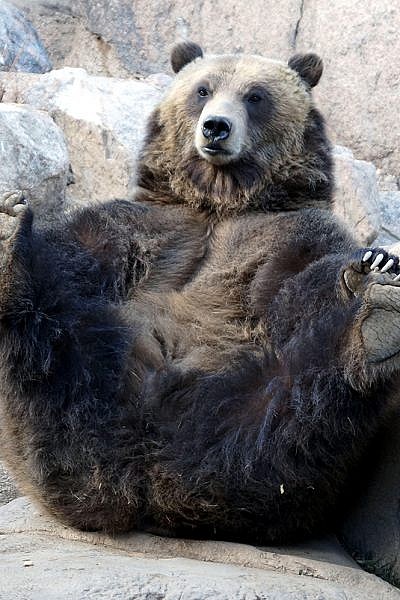
Emmett, CMZoo grizzly bear, consistently did a stretch on his own during interactions with keepers, which bears in the wild sometimes do.

“Emmett would sit down and hold his back legs with his front paws,” said Rebecca Zwicker, Rocky Mountain Wild animal care manager. “We saw him doing it so often that we started to incorporate it into his regular training and demonstrations, so our guests can see those natural behaviors. We call it the ‘yoga bear.’”

Over time, CMZoo grizzly bear, Digger, saw Emmett being rewarded for this behavior, and began imitating it, which his keepers of course rewarded.

Guests can see Emmett and Digger doing “yoga bear,” presenting their teeth for keepers to check and offering different parts of their bodies through a safe barrier, where keepers can perform health assessments and decide whether the bears might need veterinary care.

“Most of us know when our dog is excited to head out on a walk in the park, or is nervous about walking into the vet clinic,” said Hester. “Our animal keepers work hard to build trusting relationships with the animals in their care, so they also pick up on those insights from the animals.”

The African lion pride recently showed their keepers that a new and unusual enrichment activity got their approval, says African Rift Valley Keeper, Diana Miller, who has worked with the lions for six years.

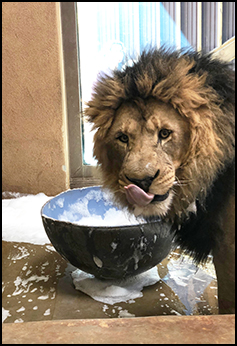
“The lions absolutely love bubble baths, and we didn’t realize that until this year,” Miller said. “It surprised us, because we know they don’t usually like getting in the water. But, because we recognize their behaviors, we realized pretty quickly that it was different when bubbles were involved. They absolutely love it. We know they love it, because they play enthusiastically for a long time whenever when we offer them the bubble bath enrichment, and it’s really fun for guests to see.”

For a full schedule of demonstrations and training sessions, visit www.cmzoo.org/shows.

    Once in a lifetime Opportunities

    Select your unique experience from the following options:

    • Meet & Greets – unique animal interactions year-round, with any one of our smaller animals listed below.
    • Animal Encounters – connect with amazing animals and their Keepers, plus options to feed many of the animals listed.
    • V.I.P. Tours – behind-the-scenes exclusive animal experiences that make memories for a lifetime!

    Encounters

    Opportunities to connect with amazing animals and their Keepers and a chance to feed any one of the animals below.
    Note: All Encounters do not have any age restrictions unless otherwise noted, however children under 12 years of age must be accompanied by an adult.

Cost:

Tour prices are dependent upon the season.
Member discount: $50 off total tour cost. Group must have at least one active Zoo member on the tour to receive discount.

Summer ( May – August ) : $2,250 for up to (5) five people
Fall ( September – November ) : $2,000 for up to (5) five people
Winter ( December – February ) : $1,750 for up to (5) five people
Spring ( March – April ) : $2,000 for up to (5) five people

Zoo members give $75,000 to projects in Colorado Springs and worldwide

Colorado Springs, Colo. – Each year, Cheyenne Mountain Zoo members vote to select which CMZoo staff-championed conservation projects will receive funding. This year, $75,000 was allocated to support projects in the Democratic Republic of Congo, Ecuador, Kenya, Laos, Vietnam, and right here, in Colorado Springs.

Since 2015, Cheyenne Mountain Zoo member conservation grants have provided $375,000 of membership revenue to support field conservation worldwide. These funds are contributed directly by the Zoo’s members, as a part of their membership fees.

“This funding allows us to stay nimble in supporting frontline conservation efforts,” said Dr. Liza Dadone, vice president of mission and programs at Cheyenne Mountain Zoo. “Our legacy conservation partners, which receive support through our Quarters for Conservation funding, receive our long-term support. These staff-championed member-vote projects can support more emergent needs, like Save Vietnam’s Wildlife’s immediate need to care for 168 pangolins rescued from illegal wildlife trade.”

CMZoo members voted for their choice of eight nominated projects in March. The three projects that received the most votes received the full funding requested. Taking member votes and other indicators into consideration, a committee of CMZoo staff members determined how to distribute the remainder of the annual contribution.

“Our members are invested in these conservation efforts,” said Emmaline Repp-Maxwell, CMZoo membership manager. “This vote provides them the opportunity to help decide which projects receive funding that their membership fees support. By helping members connect with a specific cause, they realize their impact, and hopefully continue to take an interest in that cause. We work to help people make connections that inspire them to take action.”

The top three 2019 Member Conservation Vote winners, which will receive full funding, are:

African Lions – $3,000
A continued partnership, the Ewaso ‘Lion Kids Camp’ educates Kenyan children of pastoral families in ways to avoid lion predation of their livestock. Without the help of local communities, African lions could be extinct in the wild within 20 years. This funding will help support a youth camp designed to connect these children to the local wildlife and nature, encouraging them to protect and champion big cats.

Pollinator Gardens for Five Local Schools – $15,000
Pollinators, like butterflies, birds and bees, are incredibly important to a healthy habitat and help fertilize many of the plants, fruits and vegetables we enjoy. This program helps to teach students the importance of protecting pollinators by building a garden they nurture and grow. In 2018, members voted to support three Colorado Springs schools’ pollinator gardens, which are being established now, in 2019. Because CMZoo members voted this project in the top two for the last two years, CMZoo will offer an additional two grants, for a total of five new gardens, for $3,000 each. The region from which applicants may be considered will be expanded to include communities that neighbor Colorado Springs.

Mountain Tapir – $26,566
Found in Columbia, Ecuador and the far north of Peru, only 2,500 mountain tapir remain in the wild. CMZoo is one of two zoos in North America that this species calls home. A continuation of past monitoring projects, these funds would support the radio collaring of five additional tapirs in the wild, and collaboration with community education programs. This project, based in Ecuador, has already yielded important information regarding the movement, behaviors and territory of this critically endangered species. That data is vital in proving which areas of wilderness need protection if this species is to survive.

The remainder of the $75,000 grant fund was distributed to support three additional projects:

Save Vietnam’s Wildlife’s Emergency Pangolin Care – $5,000
Found in Africa and Asia, pangolins are the most trafficked animals in the world. Because they are also threatened by deforestation, all eight species of the pangolin are considered threatened with extinction (two of which are critically endangered). Save Vietnam’s Wildlife focuses on the recovery and release of native species confiscated in the illegal wildlife trade. This contribution is allocated for emergency funding to assist in the care of 168 recently confiscated pangolins, the largest group confiscated to date. These funds will help provide veterinary care until the pangolins are re-released.

Okapi Conservation Project – $15,000
Found in the heart of the Democratic Republic of Congo, and one of the most biologically diverse areas in all of Africa, okapi have only been known to science since 1901. Threatened by habitat destruction, mining, poaching and civil unrest, there may be as few as 10,000 left in the wild. Through the Okapi Conservation Project, this funding would support a community outreach program for World Okapi Day to promote local education and co-existence between okapi, their habitat and local villages. This project is co-supported by four other zoos.

Project Anoulak – $11,250
Based in the Annamite Mountains of Laos, Project Anoulak works to conserve and study wildlife in the Nakai-Nam Theun National Protected Area. One of the most important and biodiverse forests left in the region, it is threatened by unsustainable harvesting and farming practices, as well as illegal poaching. This funding will purchase the equipment needed to continue their critical conservation monitoring and research.

Of the $100,000 of conservation funding annually raised through membership revenue, $25,000 goes to Quarters for Conservation legacy projects and $75,000 goes to annual Member Conservation Vote grants.

About Cheyenne Mountain Zoo

Cheyenne Mountain Zoological Society was founded in 1926. Today, Cheyenne Mountain Zoo, America’s mountain Zoo, offers comprehensive education programs, exciting conservation efforts and truly fantastic animal experiences. In 2019, Cheyenne Mountain Zoo was voted #6 Best Zoo in North America and CMZoo’s Rocky Mountain Wild was named #5 Best Zoo Exhibit in North America by USA TODAY 10Best Readers’ Choice Awards. It is Cheyenne Mountain Zoo’s goal to help guests fall in love with animals and nature, and take action to protect them. Of the 233 zoos and aquariums accredited by the Association of Zoos and Aquariums (AZA), Cheyenne Mountain Zoo is one of the few operating without tax support. Cheyenne Mountain Zoo depends on admissions, membership dues, special event attendance and donations for funding.

Since 2015, the Cheyenne Mountain Zoo Member Conservation Grants has provided $300,000 of membership revenue to support field conservation worldwide. Last year, members voted to fund projects from Central Asia to right here in Colorado. Once again, it is time for members to help CMZoo decide which staff-championed conservation projects will receive full funding.

It also allows the Zoo to support immediate needs that might not fit into our annual Quarters for Conservation donations. One such member-elected conservation effort was providing emergency care for radiated tortoises that had been confiscated from the pet trade in Madagascar. The emergency pangolin project up for vote this year is another example.

“These conservation grants help our Zoo support really impactful conservation projects around the world,” said Dr.Liza Dadone, vice president of mission and programs, and head veterinarian at Cheyenne Mountain Zoo. “Most of the projects have a connection to species that live at Cheyenne Mountain Zoo and often involve wildlife that are on the brink of extinction.”

A team of CMZoo employees forms the committee that spends months reviewing the staff-nominated conservation projects to select proposals with the greatest potential impact. The committee narrows the number of applicants down to a small group for the member vote. This year, there are eight projects for members to consider.

“It’s an amazing opportunity for members to make a direct positive impact in the wild because they get to vote on which grants get fully funded,” said Emma Repp-Maxwell, CMZoo membership manager. “It’s also a way for our staff to get support for conservation projects in our back yard and around the world.”

The three projects that receive the most votes will be fully funded. CMZoo will determine how to distribute the remainder of the annual $75,000 Member Conservation Grants among the remaining five projects.

Of the $100,000 of conservation funding annually raised through membership revenue, $25,000 goes to Quarters for Conservation legacy projects and $75,000 goes to these annual conservation grants.

“Our Zoo members are directly helping wildlife and make these conservation grants possible,” said Repp-Maxwell. “Every vote for these grants and every visit is directly helping our Zoo help wildlife.”


Learn about the individual staff-championed projects up for members’ consideration below, and click here to find out about becoming a Cheyenne Mountain Zoo member.


2019 CMZoo Member Vote Conservation Projects

African Lions – $3,000
A continued partnership, the Ewaso ‘Lion Kids Camp’ educates Kenyan children of pastoral families in ways to avoid lion predation of their livestock. Without the help of local communities, African lions could be extinct in the wild within 20 years. This funding would help support a youth camp designed to connect these children to the local wildlife and nature, encouraging them to protect and champion big cats.

Project Anoulak (white-cheeked gibbon, Asian otter, saola, etc.) – $11,250
Based in the Annamite Mountains of Laos, Project Anoulak works to conserve and study wildlife in the Nakai-Nam Theun National Protected Area. One of the most important and biodiverse forests left in the region, it is threatened by unsustainable harvesting and farming practices, as well as illegal poaching. This funding will purchase the equipment needed to continue their critical conservation monitoring and research.

Golden Lion Tamarin – $16,466
Urban expansion in their native Brazil has reduced golden lion tamarin habitat by 98 percent. While re-introduction programs have been successful, the survival of this species will rely on habitat restoration, protection and expansion. Through a local partner, these funds will support the planting and care of two acres of forest for three years. By connecting fragmented forests in protected areas and working with local communities, golden lion tamarins’ population and habitat will continue to grow and succeed.

Mountain Tapir – $26,566
Found in Columbia, Ecuador and the far north of Peru, only 2,000 mountain tapirs remain in the wild. CMZoo is one of two zoos in North America that this species calls home. A continuation of past monitoring projects, these funds would support the radio collaring of five additional tapirs in the wild. This project, based in Ecuador, has already yielded important information regarding the movement, behaviors and territory of this critically endangered species. That data is vital in proving which areas of wilderness need protection if this species is to survive.

Saola Working Group – $5,000
Found in the Annamite Mountains of Laos and Vietnam, the saola, nicknamed the ‘Asian unicorn,’ is one of the rarest large animals on earth. Scientifically discovered in 1992, their main threat is not deforestation, but commercial poaching and snare hunting. Because not much is known about this elusive species, this funding will purchase 25 camera traps to continue to monitor and research the forests they call home.

Pollinator Garden for Local Schools – $9,000
Pollinators, like butterflies, birds and bees, are incredibly important to a healthy habitat and help fertilize many of the plants, fruits and vegetables we enjoy. For the second year in a row, Cheyenne Mountain Zoo will provide pollinator grants to three local elementary schools for $3,000 each. This program will help teach students the importance of protecting pollinators by building a garden they nurture and grow.

Pangolins – $5,000
Found in Africa and Asia, pangolins are the most trafficked animals in the world. Because they are also threatened by deforestation, all eight species of the pangolin are considered threatened with extinction (two of which are critically endangered). Save Vietnam’s Wildlife focuses on the recovery and release of native species confiscated in the illegal wildlife trade. They are seeking emergency funding to assist in the care of 168 recently confiscated pangolins, the largest group confiscated to date. These funds would help provide veterinary care until they are re-released.

Okapi – $6,000
Found in the heart of the Democratic Republic of Congo, and one of the most biologically diverse areas in all of Africa, okapis have only been known to science since 1901. Threatened by habitat destruction, mining, poaching and civil unrest, there may be as few as 10,000 left in the wild. Through the Okapi Conservation Project, this funding would support a community outreach program for World Okapi Day to promote local education and co-existence between okapis, their habitat and local villages. This projected is co-supported by four other zoos.