Waterhole picture
 
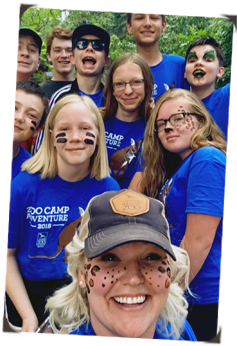
It may feel like spring just arrived, but it is time to start planning for summer vacation! With Zoo Camp options for kindergarten through 12th grade, there is truly an adventure for everyone.

New this year: each camp week has an over-arching theme that all grade levels will explore in their own adventurous ways (more about that below). There are also new ways for families to get involved with camp this year, featuring a few “Flock Parties” during the evenings. We are very excited about these new opportunities and can’t wait for summer to start!

An example of an over-arching theme for a week is “Critter Construction,” focusing on all the ways animals can be architects and build amazing structures.

  • The kindergarten group will spend this week discovering Beastly Builders components of a mini animal exhibit; then spend a day collaborating with other CMZ camp groups to assemble their creations into one dynamic diorama of Cheyenne Mountain Zoo!
  • 1st/2nd grade campers will focus on Structures for Species, exploring what animals prefer in a dwelling. Do they build their own? Do they take over other homes? Campers will also get a hand at building their own structures!
  • 3rd/4th grade camp for this week will look at Animal Architects, like those phenomenal animal builders: birds and beavers. Then, the campers become architects themselves!
  • 5th/6th graders will become Eco Engineers, building structures that can help animals survive in the wild. Sometimes these structures are man-made (like some penguin nests) and others are created by nature (like kelp forests).

Waterhole picture
Even teens can attend Zoo Camp. 7th through 12th graders get the opportunity to discover what it is like being a part of the CMZoo community. Learning directly from seasoned Zoo teens, these camps focus on peer engagement and diverse Zoo experiences.

All these options (plus a few more for each age group), more information, and registration can be found at cmzoo.org/summercamp. Be sure to sign your child up for the grade they are entering in the fall. Summer camps are very popular and space is limited, so sign up your camper today!
 
 
Back to The Waterhole Home Page


Which plants attract early pollinators? Which will help you conserve water? What kind of maintenance should you make a priority this time of year? CMZoo’s horticulture team answers all of these questions and more.

In anticipation of Mother’s Day, we’re celebrating some of the animal matriarchs who live with their offspring at CMZoo. Take a walk down memory lane as we remember their adorable babies and check in with the moms and their growing offspring today.

Providing excellent health care for the hundreds of animals at Cheyenne Mountain Zoo comes in many forms. Depending on their individual needs, animals might receive special diets, exercise plans, laser therapy treatments, vaccines, medications and more. Their health care plans often involve injections, both proactively in the form of annual vaccinations, and reactively with medications that can help them through an illness or injury.

Most CMZoo animals participate in voluntary injection training, designed to help keepers and animals prepare for and reduce stress involved with real injections when necessary. Some CMZoo animals participate in their own health care by also taking part in voluntary blood draws. During injection and blood draw training, the animals have the opportunity to walk away at any time but typically choose to stay and participate. These blood draws allow vets to test animals for any issues and respond to them accurately. The blood draws also contribute to national and international research projects that benefit countless species in human care and in the wild.

Through these voluntary blood draws, CMZoo is able to contribute to a giraffe blood plasma bank. The plasma bank is shared with other AZA-accredited institutions, and can help giraffe calves who are struggling to survive in their first days.


Just as Children’s Hospital Colorado provides tips to help children overcome the fear of shots, CMZoo Animal Behavior Programs Manager Rick Hester shared his approach to helping CMZoo’s animals respond comfortably to necessary injections and blood draws.
 

  • Teach prerequisite skills first.
    Before we ever get to needles, we teach animals to present various body parts to us, hold still, and allow us to touch them with various benign objects, like our hand, a key, or a stick. These are some of the necessary skills for them to succeed when we need to give a real injection or perform a blood draw.
  • Arrange the environment.
    We look at the overall environment and arrange everything for the animal to be successful. A comfortable place to sit or stand, an easy way for us to deliver food treats, limiting noise or other distractions if possible — these are all examples of ways we arrange the environment for success.
  • Find the right reinforcers.
    Our training program focuses on positive reinforcement techniques. To be successful, we need to have the right reinforcers, depending on the animal and depending on the behavior we are teaching. For behaviors like holding still for an injection or a blood draw, we use high-value food items such as fruit snacks for an orangutan, marshmallows for an African elephant, or chicken for an African lion.
  • Celebrate small steps towards the goal.
    We would rarely be successful if we expected an animal to present its shoulder and let us give them a vaccination during our very first training session! We reinforce small approximations (what some might call “baby steps”) to get them to the final goal. For example, they could start by presenting their shoulder to a keeper’s hand, then a stick or a pen, then finally a syringe. We reinforce each successful step or approximation and move forward to the next as the animal performs each step confidently. This style of teaching provides the animal with a lot of information about how to be successful and builds their confidence quickly.
  • Prepare the site.
    For some species, we apply ice to the injection site prior to giving a vaccination or performing a blood draw. This helps reduce the response to the needle poke for some animals.
  • Follow the animals’ lead.
    Do we have to give the injection in the shoulder if an individual seems more comfortable presenting a hip or leg? We let the animal’s behavior influence what the final goal looks like in all of our training. In this way, our training is a dialogue between humans and animals, helping to set both up for success.

Children’s Hospital Colorado is a year-round sponsor of Cheyenne Mountain Zoo.


CMZoo continues work to repopulate Wyoming toads, listed as extinct in the wild

As amphibians face mass extinction, Cheyenne Mountain Zoo’s conservation team works to repopulate the Wyoming toad. Hear from Field Conservation Coordinator, Jeff Baughman, about what’s contributing to the widespread eradication, what CMZoo is doing to try to stop it, and how you can help.

In March, CMZoo howler monkey, Charlie, became a first-time-mom. We checked in with CMZoo lead keeper, Michelle Salido, for an update on the baby and to hear the story of the afternoon Charlie went into labor on exhibit.


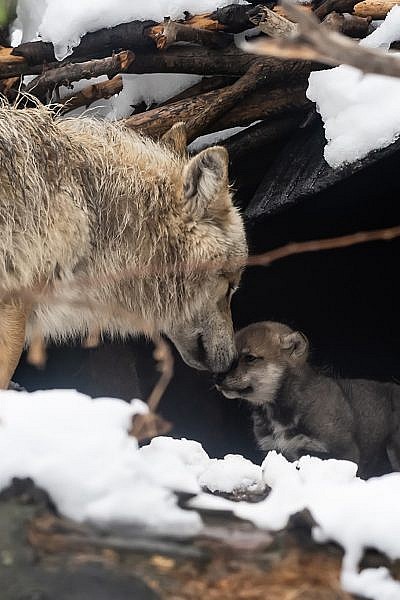
Colorado Springs, Colo. – A Mexican wolf pup was born at 5:10 a.m. Friday, April 19, 2019 to second-time parents, Luna and Navarro, to the excitement of Cheyenne Mountain Zoo staff and guests. The pup appears to be strong, and Luna is exhibiting quality maternal instincts.

“It’s very squirmy and snuggly with Luna, and has already grown a lot since it was born on Friday, which is a good sign,” said Dina Bredahl, Rocky Mountain Wild animal manager. “It’s got a really cute full, round belly and dark fur. Mexican wolves grow up to have sandy, gray fur, but their pups are born with dark fur.”

The Rocky Mountain Wild animal care team wasn’t sure how many pups Luna was carrying, and watched for a full 24 hours after the first pup was born before concluding that the pup was a singleton. The newborn pup joins the existing wolf pack consisting of the two parents, Luna and Navarro, and nearly one-year-old sisters Bluestem, Hope and Shadow, and brother Phoenix, who were born May 8 and 9, 2018.

“Wolf packs in the wild will stay together as new litters join the pack, so we don’t see any need to separate the older siblings from this new pup,” said Bredahl. “It’s a win-win for all. The yearlings get to observe Luna with a young pup, which helps them gain experience they can use if they become parents later in life. The single pup benefits because it has a larger pack to learn from and bond with, instead of just its two parents.”

A couple of hours before Luna gave birth early Friday morning, the yearlings were seen on camera in the den nuzzling and cuddling with her.

“It was really cool to see the one-year-olds observing Luna’s behavior, probably noticing something was going on and wondering what was about to happen,” said Bredahl. “Every individual pup makes an impact on the survival of the species, because the Mexican wolf population is so small. Even in human care, we rarely intervene with wolves, so we’re cautiously optimistic that this pup will grow into a healthy adult that can contribute to the long-term survival of Mexican wolves.”

The birth is not only incredibly exciting for the Zoo staff, who have been actively working to successfully breed the species for many years, but it is also highly significant for the future of the species. It is possible that this pup could go on to help repopulate the species in the wild.

For now, Luna is caring for the pup in a cozy underground den within the wolf exhibit. A camera mounted inside the den is connected to a monitor in the guest viewing area, so everyone who visits the Zoo will be able to see live footage of mom and baby at the exhibit.

“From time to time, we see Luna move around outside of the den, carrying the pup with her,” said Bredahl. “We didn’t see that with her litter last year, but that’s probably because this individual pup is so much more ‘portable’ than a full litter. In the wild, mothers will sometimes move their pups from one den to another. Luna has multiple dens in her exhibit, so she’s taking advantage of that and finding the most comfortable spot.”

Cheyenne Mountain Zoo will share photos and video clips of mom and pup, as they become available, on Facebook, Instagram, YouTube and The Waterhole, the Zoo’s monthly e-newsletter.

For many years, the Zoo housed a bachelor pack of wolves, but within the past eight years, the Association of Zoos and Aquariums’ (AZA’s) Species Survival Plan (SSP) has placed various breeding pairs at Cheyenne Mountain Zoo with the hopes of offspring. Until Luna and Navarro, none of the breeding pairs were successful. When they are older, it is possible that Luna’s pups could be released to help provide genetic diversity in the wild.

The birth of this pup is significant because there are currently only 131 Mexican wolves in the wild, and only about 300 in human care. Until the 1900s, the Mexican wolf thrived throughout central Mexico, Arizona, New Mexico and western Texas. But by the 1950s, the species was virtually eradicated, with the last known wild wolf in the U.S. shot in 1970. When the Endangered Species Act went into effect in 1973, it led to the Mexican wolf being declared an endangered subspecies. Their number has since been increasing through captive breeding programs.

The population of Mexican wolves in human care at Association of Zoos and Aquariums (AZA)-accredited zoos is an important part of the plan to repopulate the species in the wild. The Mexican Wolf Recovery Program is run by U.S. Fish & Wildlife Service, with cooperation from the AZA Mexican Wolf Species Survival Plan. Cheyenne Mountain Zoo has been a participant in the program since 1994.

About Cheyenne Mountain Zoo

Cheyenne Mountain Zoological Society was founded in 1926. Today, Cheyenne Mountain Zoo, America’s only mountain zoo, offers comprehensive education programs, exciting conservation efforts and truly fantastic animal experiences. It is Cheyenne Mountain Zoo’s hope that guests fall in love with animals and nature, and take action to protect them. Of the 233 zoos and aquariums accredited by the Association of Zoos and Aquariums (AZA), Cheyenne Mountain Zoo is one of just ten operating without tax support. Cheyenne Mountain Zoo depends on admissions, membership dues, special event attendance and donations for funding.
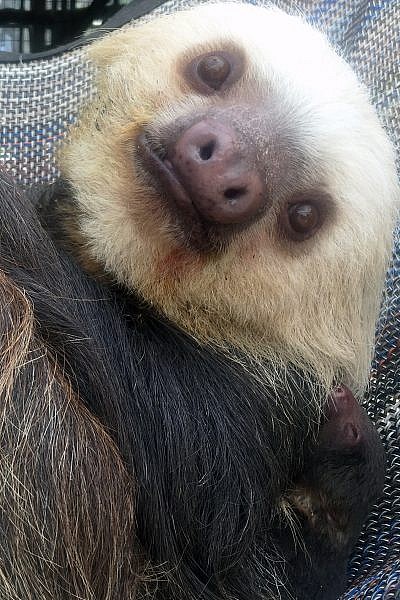
Four-mile walk/run fundraiser offers once-a-year views from Shrine Road

Cheyenne Mountain Zoo hosts its 11th annual Run to the Shrine Saturday, May 18. Online pre-registration saves participants five dollars per registration, and closes May 15, 2019. The annual Run to the Shrine fundraiser is the only day of the year foot traffic is allowed on the road to the Will Rogers Shrine of the Sun.

The 4-mile up-and-back course offers breathtaking views of Colorado Springs, Garden of the Gods, Pikes Peak as they wind by roaring lions and more through the Zoo and up to the Shrine. The challenging course, with a nearly 1,000-foot elevation gain, is good practice for competitive runners gearing up for summer races, and a fun challenge for weekend warriors and families. Runners and walkers are welcome, and jogging strollers equipped with safety features are allowed on the course.

Registration includes Zoo admission for the day, a commemorative performance T-shirt featuring Dusty, CMZoo meerkat matriarch, and access to a post-event celebration at the Zoo’s Lodge at Moose Lake. All proceeds help feed and care for Cheyenne Mountain Zoo’s animals. Since the Zoo doesn’t receive any tax support, community events like Run to the Shrine help keep the zoo “running.”

Fast Facts

Run to the Shrine at Cheyenne Mountain Zoo
Saturday, May 18, 2019

4-mile run/walk
7:30 a.m. registration, 8:30 a.m. race start
Carpooling and use of rideshare services are strongly encouraged.
https://www.cmzoo.org/run.

Run to the Shrine is sponsored by Children’s Hospital Colorado and Colorado Springs Pediatric Dentistry.

Colorado Springs, Colo. – This morning, a team of Cheyenne Mountain Zoo staff used specialized equipment to successfully assist Malaika, a 33-year-old African elephant, who was found lying on her side during an overnight check. If an elephant can’t get up on its own and is down for too long, it can cause stress to its internal organs and can be fatal. The team responded in the early-morning hours to mobilize a specialized crane-and-hoist system in the barn to help the elephant to her feet, since she was unable to stand on her own.

The team was made up of more than 20 cross-discipline Zoo staff members, including Malaika’s animal keepers, veterinary staff, maintenance and grounds personnel, The Colorado Springs Fire Department Heavy Rescue team, Broadmoor Fire Department, and more.

The Zoo’s emergency response team was able to use the barn’s hoist system to help Malaika into a sternal position (on her belly, with legs in a better position to stand). Malaika was then able to stand on her own, with the hoist strap still in place for support, at 6:47 a.m. Since then, her care team, including her keepers and veterinary staff, have been monitoring her for any additional medical concerns. She is drinking electrolyte water, eating some of her favorite treats, and taking medication for inflammation and pain.

Malaika has a history of not being able to get back up from laying down, and had to be rescued once before, on Jan. 1, 2018. Some elephants are able to lie down and get back up with no problem, but some, like Malaika, don’t ever lie down and instead just lean on objects for rest. This is partially due to a life-long issue with bowing and lack of strength in her back right leg, which is worsening as she ages.

Because of Malaika’s history, Zoo staff monitor her throughout the day and with checks every two hours overnight. Our monitoring system shows that Malaika went down around 3:45 a.m., from what appears to be a leg wobble during a deep sleep. She was discovered down during the 5 a.m. check. A core Zoo team was assembled at the elephant barn between 5:30 and 5:45 a.m., with a full team on-site by 6 a.m. Protocols were immediately put into place to help her stand.

The Zoo cares for an aging female elephant herd, so the barn is equipped with state-of-the-art equipment that helps address the inevitable complications that come with multi-ton animals that need medical assistance. Equipment includes a remote video surveillance system for animal care staff to monitor the elephants, the crane-and-hoist system that can lift a disabled elephant and a care system that provides a safe area for weighing, veterinary care and husbandry training. Outdoor wellness features of the exhibit include an exercise path, built-in enrichment activities, a pool and a spacious vacation yard, where our elephants can take time to roam and explore by themselves.

Zoo staff performs drills to practice and test protocols for situations like these. The last “down elephant” drill occurred in January 2019, which is likely one reason the procedure to help Malaika today ran as successfully as it did.


About Cheyenne Mountain Zoo

Cheyenne Mountain Zoological Society was founded in 1926. Today, Cheyenne Mountain Zoo, America’s only mountain zoo, offers comprehensive education programs, exciting conservation efforts and truly fantastic animal experiences. It is Cheyenne Mountain Zoo’s hope that guests fall in love with animals and nature, and take action to protect them. Of the 233 zoos and aquariums accredited by the Association of Zoos and Aquariums (AZA), Cheyenne Mountain Zoo is one of just ten operating without tax support. Cheyenne Mountain Zoo depends on admissions, membership dues, special event attendance and donations for funding.
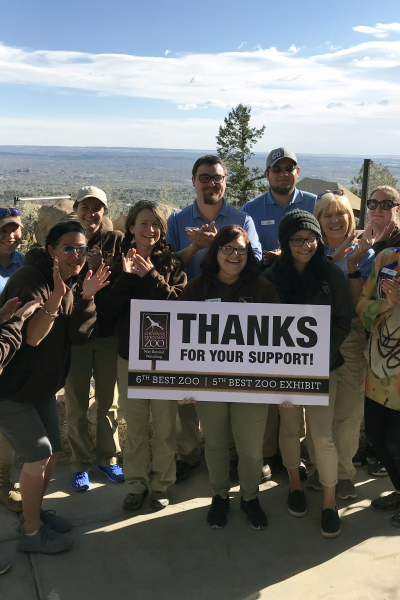
Colorado Springs, Colo. – The first day of spring was still hours away when we welcomed a special springtime arrival of our own.

Three-year-old howler monkey Charlie gave birth Tuesday, March 19 at 3:45 p.m., much to the delight of her keepers, who say mom and baby are bonding quickly and appear to be in good health.

Charlie gave birth to her yet unnamed baby, whose gender likely won’t be confirmed for months, in their exhibit in Monkey Pavilion. The baby appeared to be strong immediately after the birth, and Charlie’s maternal instinct was evident within the hour. Within moments of her baby’s birth, Charlie was cradling and grooming the baby, even softly patting the back of the baby’s head as she held it.

“We watch for certain indicators that the baby is strong,” said Cheyenne Mountain Zoo senior lead keeper Michelle Salido, who was there during the birth. “We like to see them grasp on to their mother’s fur and for their tails to wrap around their mother’s arms or nearby branches. Nursing is the ultimate sign that the mother and baby are doing well. We’re seeing all of those things, so we’re excited it’s going so well.”

Charlie and her baby will remain in their exhibit in Monkey Pavilion, where guests can view them any day of the week. Charlie’s mate, Howie, a three-year-old black howler monkey, who was in the habitat with Charlie during the birth, is in the same space as Charlie and the baby, but seems most content keeping his distance for now.

Charlie and Howie were recommended to breed based on their genetics as part of the Black Howler Monkey Species Survival Plan, managed by the Association of Zoos & Aquariums. This baby’s birth is contributing to a program that is working to help guarantee 100 years of genetic diversity for the species in accredited organizations.

Keepers will keep a close eye on Charlie and her baby, and will be happy to share their joy with members and guests who come to visit.

“It’s unusual for howler monkeys to give birth during the day, and it’s unusual that all three of her primary keepers are in one place at one time to witness it,” said Salido. “It was a really special family moment.”


About Cheyenne Mountain Zoo

Cheyenne Mountain Zoological Society was founded in 1926. Today, Cheyenne Mountain Zoo, America’s only mountain zoo, offers comprehensive education programs, exciting conservation efforts and truly fantastic animal experiences. It is Cheyenne Mountain Zoo’s hope that guests fall in love with animals and nature, and take action to protect them. Of the 233 zoos and aquariums accredited by the Association of Zoos and Aquariums (AZA), Cheyenne Mountain Zoo is one of just ten operating without tax support. Cheyenne Mountain Zoo depends on admissions, membership dues, special event attendance and donations for funding.