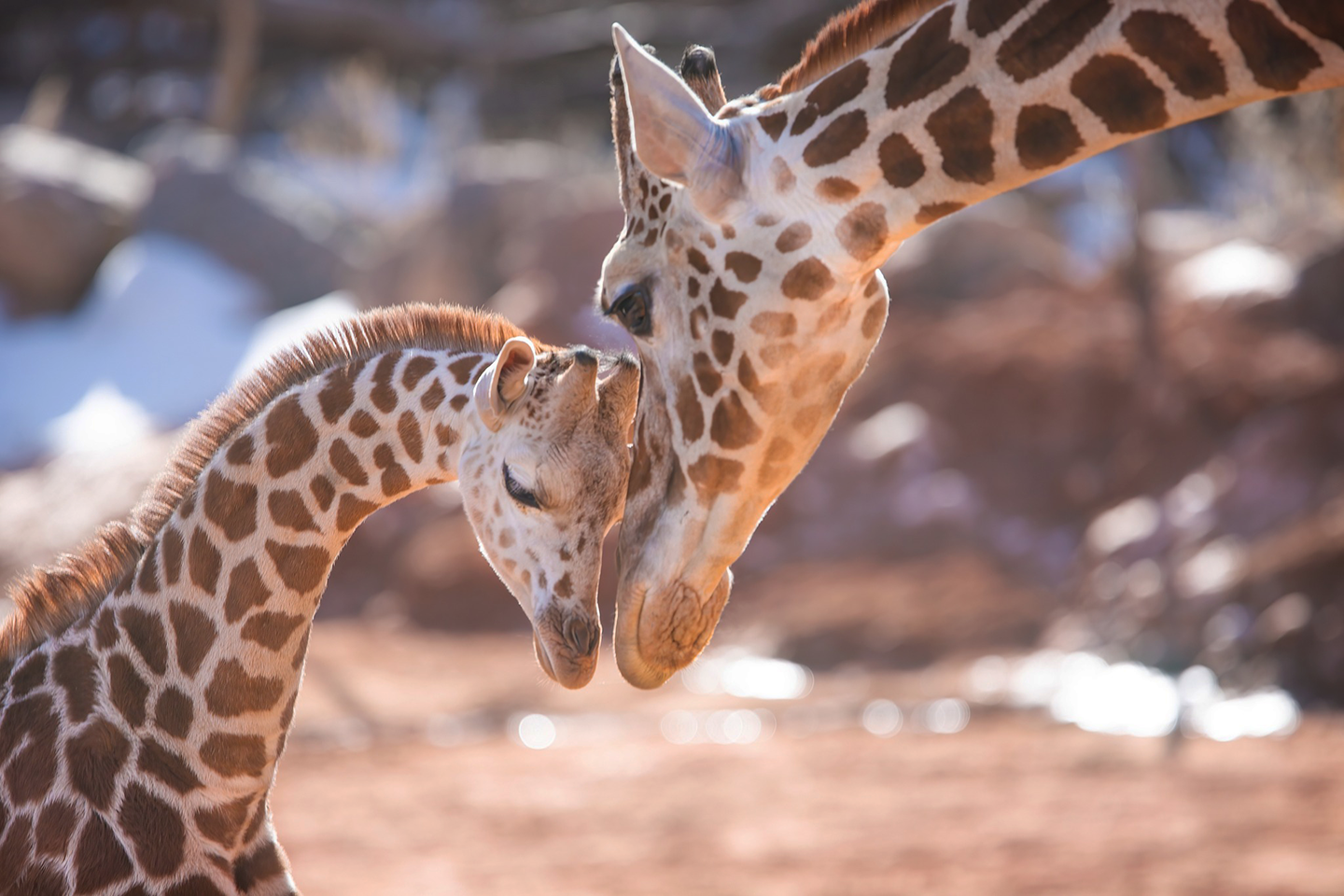
Cheyenne Mountain Zoo established The International Center for the Care and Conservation of Giraffe (The Giraffe Center) in 2022. With three full-time employees, The Giraffe Center is a concentrated effort by CMZoo to consolidate resources, expand educational programs to improve and enrich the lives of giraffe in human care throughout the world, and inspire conservation action.

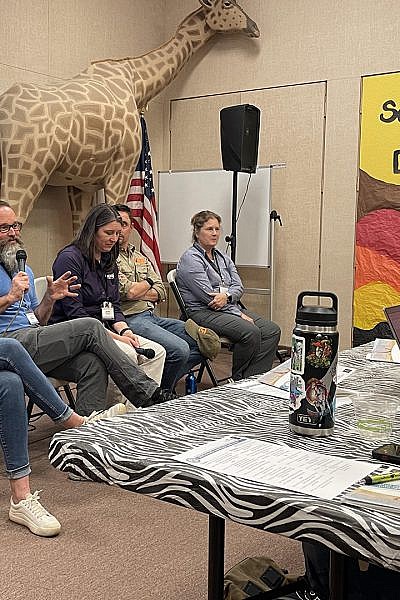
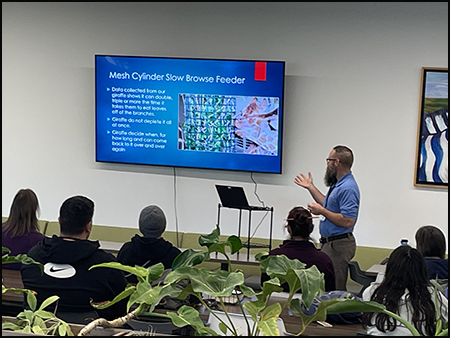
Giraffe Okapi Conference 2025 breakout session with Cheyenne Mountain Zoo Browse Manager Jason Bredahl

In January 2025, experts from around the world gathered at The Living Desert Zoo and Gardens, in Palm Springs, California, for The Giraffe Center’s Giraffe and Okapi Conference. More than 100 specialists, keepers, conservationists and researchers from 11 countries attended the four-day conference to share their experiences and expertise in giraffe and okapi care.

“It was truly inspiring and fulfilling to see professionals from all aspects of giraffe and okapi care come together to share and learn from each other,” Amy Schilz, senior animal behaviorist at The Giraffe Center, says.

The momentum of giraffe and okapi care conferences had slowed in recent years, and The Giraffe Center team saw an opportunity to revive the exchange of ideas among giraffe and okapi professionals. Attendees, speakers and presenters gathered from around the world, including the U.S., Brazil, Canada, Belgium, England, Namibia, Kenya, the United Arab Emirates, Iran, Australia and the Netherlands.

This rich diversity meant attendees had access to a range of topics on improving the lives of giraffe and okapis in human care. They explored wild giraffe eating habits, and nutritionists discussed how different food types affect physiology. Experts shared insights for incorporating more browse into giraffe diets, and then led an open panel where attendees could pose questions on any aspect of giraffe and okapi care. Another panel focused on creating a full lifestyle of positive reinforcement for giraffe in human care, as opposed to creating sporadic enrichment opportunities.

One of the highlights of the conference was ‘Browse Day,’ when breakout groups discussed securing browse (natural tree branches and leaves), improving enrichment and feeding tactics, growing browse farms and identifying toxic plants. Jason Bredahl, CMZoo’s curator of environmental enhancements, presented at Browse Day.

“I keep telling people, ‘browse is the way,” Jason says. “As animal care professionals, we always want to improve the lives of our animals. CMZoo has dedicated full-time employees, including me, to study how to do that, and this conference allows us to share the methods and data with others who can improve their animals’ lives.”

The data shows, basically, that for CMZoo’s giraffe herd, nothing beats browse. Jason describes the herd seeing browse like a dog when its owner comes home from work. They drop whatever they’re doing and beeline for the browse, even excitedly taking it out of staff members’ hands before they can hang it for them. Khalid, CMZoo’s breeding bull, enjoys stripping bark and leaves from branches so much that staff jokes that he’s just leaving ‘browse bones.’

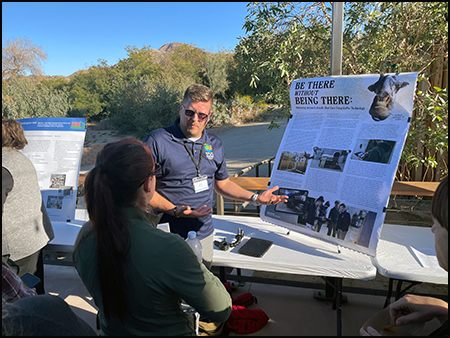
Giraffe Okapi Conference 2025 poster presentation projects

Browse is more than fun for giraffe; it’s mentally and physically stimulating for the herd – and nutritious. To enjoy this giraffe-approved meal, they must travel to multiple browse locations and then spend time working to strip leaves and branches. Animals want to work for rewards, and eating browse is much more difficult and enriching for an animal, compared to scooping hay from a feeder. At the conference, attendees got insights that CMZoo’s environmental enhancements team has worked for years to study. They returned to their home herds with a head start, guidance on how to make it work at their own facilities and a support system.

Attendees also gained valuable insight into okapi care and conservation, hearing firsthand from conservationists who work directly with okapis in the wild.

“I remember walking by a group at the end of the night, and hearing one of the okapi conservationists tell stories of his field experiences to the okapi caretakers,” Amy says. “That was the moment for me. It reinforced how important it is for us to all meet, share and do this work with each other’s support.”

The conference fostered important senses of camaraderie and support among attendees.

“My favorite thing was watching a room full of people who barely knew each other become friends,” Amy says. “Now, if they have a challenge, they have a support system to reach out to. That kind of professional network is invaluable, especially for those who are newer to the field. Shared knowledge ultimately improves care for okapi and giraffe all over the world – and that’s what we all want.”

Looking ahead, The Giraffe Center will co-host a specialized workshop at West Midlands Safari Park in England in July. This hands-on event will focus on giraffe behavior and training, continuing the commitment to advancing best practices in giraffe care.

For more information on professional memberships, workshops and more, available for giraffe and okapi care teams, visit giraffecenter.cmzoo.org

Back to The Waterhole

CMZOO IS NOMINATED FOR BEST ZOO IN THE U.S. BY USA TODAY’s 10BEST READERS’ CHOICE AWARDS. SUPPORTERS CAN VOTE DAILY AT WWW.CMZOO.ORG/VOTE – Cheyenne Mountain Zoo wants you to vote for Omo – or Emmett, or Wednesday, or Chewy, or Cora! For the ninth consecutive year, Cheyenne Mountain Zoo is nominated for Best Zoo in the U.S. in USA TODAY’s 10Best Readers’ Choice Awards. Supporters can vote daily through Mon., March 10 at cmzoo.org/vote.

A vote for CMZoo is a vote for your favorite animal, because a high ranking elevates the entire Zoo – and Colorado Springs.

10 reasons to vote for CMZoo in this top-ten contest:

  1. America’s mountain Zoo is one of only a few nonprofit zoos accredited by the Association of Zoo and Aquariums (AZA) that does not receive any tax support. Zoo improvements, operations, animal care and field conservation are funded through admissions, memberships, programs, donations and grants.
  2. CMZoo’s International Center for the Care and Conservation of Giraffe connects giraffe care teams across the globe to resources, best practices, trainings and emergency care, improving and even saving the lives of countless giraffe.
  3. Nearly 800,000 people visit the Zoo each year. While visiting the Zoo, guests to the Pikes Peak region also patronize Colorado Springs’ local lodging, restaurants and tourism attractions.
  4. Understanding its unique opportunity to connect people to native, rare and endangered animals, CMZoo aims to make every visit inspiring. The Zoo does that by designing animal homes that bring guests closer than ever to species from all over the world, and right here in Colorado.
  5. It’s one of the few zoos in the country where guests can see an Alaska moose, Atka, who was orphaned in the wild in 2020 when CMZoo took him in.
    CMZoo is home to Mochi, one of only three mountain tapirs in human care in the country.
  6. Through keeper talks and animal demonstrations during daily visits, special events just for the grown-ups, small-group tours, camps, birthday parties, and more, Colorado Springs’ Zoo works to make everyone welcome to tap into their inner child and explore the mountain at their own pace.
  7. In 2024, CMZoo celebrated raising $5 million for frontline conservation efforts, including over a million dollars for African elephant and black rhino conservation.
  8. Its latest AZA accreditation was historic. In nearly 50 years of AZA accreditations, CMZoo was only the fourth organization to earn a completely ‘clean’ report, which means there wasn’t a single major or minor concern reported.
  9. In the past year, the Zoo welcomed a red panda, snow leopard, baby sloth and more to the family, while continuing its important work breeding and releasing critically endangered native black-footed ferrets and Wyoming toads. 2024 was the most successful black-footed ferret breeding year ever.
  10. Anyone who has made eye contact with a tiger, pet a wallaby, felt the roar of an African lion, hand-fed a giraffe or walked alongside an African penguin knows how special our hometown Zoo is. This friendly competition amongst zoos nationwide is an excellent way to show your support.

    Voting continues now through 10 a.m. MT on Mon., March 10. Supporters can vote every day at cmzoo.org/vote.

    VOTE NOW

Get to know the newest little star in Scutes Family Gallery! Born on December 18, Aysan’s baby sloth is already capturing hearts. This sweet baby has been spending quality time bonding with mom in Scutes Family Gallery, where guests can now catch a glimpse of the cuddly duo as they share precious moments together.

Back to The Waterhole

Construction in admissions plaza, African Rift Valley and the historic road through the Zoo are well underway. Join Cheyenne Mountain Zoo President & CEO, Bob Chastain, for a first look at our ambitious vision for the future.

Constructing a state-of-the-art giraffe habitat and care center with beautiful and functional guest spaces – including a gift shop, café and admissions plaza – on the side of a mountain is no easy feat. Join us for behind-the-scenes looks as the construction team makes progress, shares innovations and overcomes obstacles in a video series called, Bob’s Blueprints: Building a World-Class Zoo.

The Zoo will continue to share major construction updates in The Waterhole newsletter and on social channels. Bob’s Blueprints video series focuses on even more specific construction tactics and challenges, as well as up-close looks at animal improvements and guest experience features. If you want to ‘get in the weeds’ of construction with us, sign up to receive exclusive details not shared in our newsletter or on social media via email at cmzoo.org/BobsBlueprints.

Pack your patience next time you visit the Zoo and lean in to embrace the adventure of this historic chapter for the Zoo. We’re committed to giving guests access to all animals they would see on a normal visit during construction. Guests will still be able to visit African lions, feed giraffe and see some of the smaller animals in African Rift Valley. As construction shifts locations, routes to animals will change. Look out for directions on signs, and please ask for help when you visit.

Back to The Waterhole

Teen Summer Program participants with My Big Backyard animals

Cheyenne Mountain Zoo’s highly competitive Summer Teen Program application period opens on Sat., Feb. 1. The three-month program takes a unique approach to fostering nature stewardship and inspiring young people to take part in protecting the wild world. Soon, it will welcome new and returning participants for summer 2025.

Applications for the program for sixth through 12th graders open Sat., Feb. 1 at cmzoo.org/teenprograms. Applications will only be accepted for 10 days, so nature-loving teenagers should start considering the program now.

After orientation on May 17 and 18, the program runs from May 27 to Aug. 8, 2025. Summer Teen Program participants work alongside CMZoo staff to interact with animals, guests, keepers and each other. Lynn Joseph has been in the Teen Program since summer 2021, and in 2025 she intends to return as a Junior Zoo Keeper and a Teen Leader. She is also a member of the Zoo’s Youth Leadership Action Board, which serves the Teen Program similarly to how a student council would serve a school.

Teen Summer Program participant with barn owl Hoosier

“I’ve been able to grow and learn social skills, gain confidence in public speaking and become a stronger leader,” Lynn says. “The Teen Program is an amazing space to be myself, learn how I operate and make mistakes. I’ve learned how to teach, how to be taught and how to connect with people. I’ve made really valuable friendships in this program, and nothing makes me happier.”

In addition to gaining valuable experience working at CMZoo, teen participants learn to be nature’s best stewards with life-changing experiences off Zoo grounds, in Colorado’s wild spaces. Teens can expect educational, inspirational experiences and mentorship that offer a platform to unearth their passions and discover more about their strengths. Teens are mentored by staff and peers as they learn to be leaders and advocates for wildlife and wild places.

Teen Summer participants walking together

“Ultimately, we hope these experiences connect the hands, the heart and the mind to the natural world, so these teens will defend and advocate for the wild places and wild animals of our world,” Austin Kennedy, CMZoo Extended Education Supervisor in the EdVenture department, says. “We focus on leadership training, animal husbandry, interpretation and public speaking, empowerment, life skills and so much more.”

EdVenture staff recommends purchasing an application as soon as possible when they open so teens have ample time to read through, draft, and submit applications. There is an application fee of $25 per applicant. Once that has been paid, a link will be automatically sent to the email used to submit during purchase. The applications must be submitted by 11:59 p.m. MST on Mon., Feb. 10, 2025. No late applications will be accepted.

After the application period, EdVenture staff conducts interviews with selected candidates. Around 100 applicants are accepted to the summer program. CMZoo’s Summer Teen Program is a tuition-based experience, and scholarships are available. Email [email protected] with any questions.

Back to The Waterhole

Cheyenne Mountain Zoo is celebrating the arrival of a captivating new resident, Valens [VAL-inz], a 5-year-old male snow leopard.

With his big fluffy paws, mesmerizing tail and cautious-yet-inquisitive personality, Valens is living up to his species’ nickname: Ghost Cat. Snow leopards are known for their elusive and stealthy nature, and Valens embodies those traits with a cautious approach to his new surroundings.

“When he’s unsure, he does this adorable hiding behavior that we call his ‘elusive snow leopard mode,’” Basia Dann, lead animal keeper in Asian Highlands, says. “He moves really slowly and stays close to the ground, but his ears stay forward, which means he’s curious and not afraid. You can see he’s carefully assessing everything around him so meticulously.”

Valens is full grown, weighing around 70 pounds, with, “the biggest paws I’ve ever seen on a leopard,” according to Basia. He has also made an impression with his huge, fluffy and animated tail that seems to be in constant motion.

Animal care teams carefully and patiently managed Valens’ journey to his new home to help him settle in confidently. Asian Highland keepers worked with Valens’ former keepers at Central Park Zoo to learn about his favorite enrichment items, foods and hangout spots, which they incorporated into his new habitat to give him a sense of familiarity.

As a naturally cautious animal, they give him the time and space to adjust on his terms and schedule. Valens arrived at CMZoo just before Thanksgiving and started exploring in guest view in early January.

“He’s making great progress, and there’s no rush,” Basia says. “We’re following his lead. He has started training and taking food directly from keepers, as well as exploring more of his yard. We’re proud of him, and we’re going to continue setting up his environment to be comfortable and full of choices for him.”

Guests can visit Valens in Asian Highlands at CMZoo. While he continues to acclimate, he’ll have access to behind-the-scenes indoor dens and outdoor spaces where he’s visible to guests, giving him the choice to explore at his own pace. Keep an eye on the caves and doorways in the south leopard yard, inside the Asian Highlands archway, where he’s likely to be hanging out. Lucky guests might catch a glimpse of him strutting proudly with his latest treat.

“It’s wonderful to have a snow leopard on the mountain,” Basia says. “They are incredible cats, and I’m excited for him to continue getting more comfortable, so he can help us inspire more people to care about his wild counterparts and their habitats.”

Native to the rugged mountain ranges of Central Asia, snow leopards are perfectly adapted to their cold, high-altitude habitats. Their thick fur and long tails help keep them warm, while their oversized paws act like snowshoes, allowing them to navigate deep snow and ice with ease. Known as “ghosts of the mountains,” they are incredibly elusive in the wild, which makes encounters with them a truly magical experience. Discover more about snow leopards at CMZoo

Back to The Waterhole

Mexican spotted owl, photo credit: Ceeanna Zulla, USDA Forest Service.
Photo Credit: Ceeanna Zulla, USDA Forest Service

In 2023, Zoo members voted to fund GPS trackers that U.S. Fish & Wildlife and the USDA Forest Service are using to study Mexican spotted owls in New Mexico and Arizona.

They hope to learn what sort of habitat features Mexican spotted owls are using to nest, and what they are avoiding. The data collected will help them determine how best to protect the species and their habitat.

This is the first study to use GPS tags on Mexican spotted owls. The improved technology allows conservationists to collect high quality data – tracking owls’ locations every hour throughout the night for multiple months through the breeding season.

So far, they have GPS tagged 43 Mexican spotted owls in the study locations. They track data during the owls’ nesting season, collecting one to two months of data per bird.

Mexican spotted owl, credit: Ceeanna Zulla, USDA Forest Service.
Photo Credit: Ceeanna Zulla, USDA Forest Service

Conservationists recently reported interesting results: a few of the tagged owls were using ’disturbed areas,’ which can include parts of the forest disturbed by timber cuts, fire and insect-related tree mortality. These initial findings could lead conservationists to believe that the owls may prefer mixed-use forest habitat – rather than needed pristine, untouched forests to thrive.

It seems that some of the owls actually prefer forests that are used by humans and animals. These are still very wild forests, but they are used responsibly for lumber, and they benefit from selective thinning for wildfire mitigation. If researchers conclude that owls prefer these sites, more of the forest could be mitigated against wildfires and used for sustainable lumber, while still supporting the owls. By tagging the owls, researchers know their current locations, and mitigation and lumber work could avoid their nesting habitats and seasons.

Back to The Waterhole

As we had hoped, all six participating Colorado Supreme Court justices unanimously ruled in our favor. In June 2023, the Nonhuman Rights Project (NhRP/NRP) filed a frivolous lawsuit aiming to remove the Zoo’s five aging African elephants from Cheyenne Mountain Zoo. The lawsuit was dismissed, and NhRP appealed that decision by taking it to the Supreme Court in June 2024. Today, the Colorado Supreme Court rejected the contentions of NhRP that there was any legal basis to move our beloved elephants away from Colorado Springs.

While we’re happy with this outcome, we are disappointed that it ever came to this. For the past 19 months, we’ve been subjected to their misrepresented attacks, and we’ve wasted valuable time and money responding to them in courts and in the court of public opinion.

NhRP has attempted this same lawsuit with several other reputable zoos. NhRP lost their case in New York. They lost in California. They were dismissed in Colorado Springs and Hawaii. Now they have officially lost in Colorado. If they continue this route – with us or with other reputable zoos – we hope people will remember that NhRP is abusing court systems to fundraise and to pay for ‘legal fees,’ as they claimed in a recent social media video – a.k.a. their salaries.

The courts have proven now five times that their approach isn’t reasonable, but they continue to take it. It seems their real goal is to manipulate people into donating to their cause by incessantly publicizing sensational court cases with relentless calls for supporters to donate.

The Colorado Supreme Court opinion states, “We are not alone in rejecting NRP’s attempt to extend the great writ to nonhuman animals. NRP has commenced similar legal proceedings in many other states on behalf of elephants and chimpanzees living in zoos and other facilities. Every one of its petitions for writ of habeas corpus has been denied for the same or very similar reasons.”

Some of our supporters were surprised that NhRP chose to attack Cheyenne Mountain Zoo, of all places. We have consistently ranked as a top-five zoo in the nation by popular vote. Last year, we celebrated raising $5 million for frontline conservation efforts, including over a million dollars for African elephants. Our national recognition as a leader in animal care and conservation is likely what drew their attention to us. Our latest accreditation was historic. In nearly 50 years of AZA accreditations, CMZoo was only the fourth organization to earn a completely ‘clean’ report, which means there wasn’t a single major or minor concern reported – including in the strenuous review of our elephant care program.

While NhRP was collecting funds and wasting taxpayer dollars in our county and state’s highest courts, we were busy at work, growing our in-house veterinary team to three full-time veterinarians and funding a team of experienced animal care professionals to focus solely on the cutting edge of animal care in accredited zoos. We were also embarking on an historic upgrade to our giraffe habitat, including construction of a giraffe center that’s going to revolutionize giraffe care for our profession for decades to come.

And finally, we were busy saving animals. Because a portion of every Zoo admission goes to field conservation, our members and guests surpassed raising one million dollars for elephant conservation while we were fighting to protect our elephants at home.

About Cheyenne Mountain Zoo

Cheyenne Mountain Zoological Society was founded in 1926. Today, Cheyenne Mountain Zoo, America’s mountain Zoo, offers comprehensive education programs, exciting conservation efforts and truly fantastic animal experiences. In 2024, Cheyenne Mountain Zoo was voted #5 Best Zoo in North America and CMZoo’s Rocky Mountain Wild was named #2 Best Zoo Exhibit in North America by USA TODAY’s 10Best Readers’ Choice Awards. It is Cheyenne Mountain Zoo’s goal to help guests fall in love with animals and nature, and take action to protect them. Since 2008, CMZoo’s Quarters for Conservation program has raised more than $5 million dedicated to frontline conservation efforts around the world. Of the 237 zoos and aquariums accredited by the Association of Zoos and Aquariums (AZA), Cheyenne Mountain Zoo is one of just a few operating without tax support. Cheyenne Mountain Zoo depends on admissions, membership dues, special event attendance and donations for funding.

CHEYENNE MOUNTAIN ZOO WELCOMES SLOTH BABY – Cheyenne Mountain Zoo is thrilled to announce the arrival of a New Year’s baby: a Hoffmann’s two-toed sloth. Some call sloth babies ‘pups,’ ‘infants,’ or even ‘slow-bies.’ Everyone can agree to calling this wee one ‘adorable.’ With its dark brown eyes and a perfect pinkish-brown furless face, its cuteness is out of this world.

The baby, born on Dec. 18, seems strong, and has been learning to traverse Mom’s tummy. While its mom, Aysan, hangs upside down, her baby sprawls right-side-up on her belly, with its four long limbs wrapped around her torso.

“I love the way it lifts its head out of her chest fur and slowly looks around, just kind of taking it all in,” Amber Callen-Ward, lead keeper in Scutes Family Gallery, says. “Aysan has been a great first-time mom, grooming the baby by licking its face, which is so sweet. She and the baby have been bonding well. The baby is nursing, clinging to her and taking little bites of solid foods we offer.”

The two-week-old sloth is already trying pieces of plantain, romaine lettuce, zucchini and cucumber, but gets its main source of nutrients from nursing.

9-year-old Aysan’s care team knew she was pregnant. Thanks to their trusting relationship with Aysan, and Aysan’s voluntary participation in her own health care, they had been monitoring the baby’s development via ultrasounds and x-rays for the past few months.

Aysan moved to CMZoo on a breeding recommendation by the Hoffmann’s Two-Toed Sloth Species Survival Plan, with Bosco, the Zoo’s long-time male sloth, in June 2023. Sloth gestation typically lasts 11 to 12 months, so some things can happen quickly for sloths!

Bosco, a 32-year-old male Hoffmann’s two-toed sloth, became a second-time dad with this baby’s arrival. His first daughter, 5-year-old Bean, lives in The Loft at Cheyenne Mountain Zoo. Bean and Bosco are visible to guests who might need to process this baby excitement with a sloth visit right away.

While mom and baby bond for the first month or so, they’ll be behind the scenes in Scutes Family Gallery. Once they are visible to guests, CMZoo will share that news. The baby’s sex has not been identified, and there are no plans for a name yet. Stay tuned to Cheyenne Mountain Zoo’s social media channels for sloth pup-dates!

The next time you visit Cheyenne Mountain Zoo, you could see some changes to your admissions process. Zoo members and guests should watch for directional and instructional signs that will be in place when we make the shift from our former admissions process to our new temporary process, tentatively scheduled for early January.

These changes are necessary to proceed to the next phase of construction, making way for an incredible new admissions experience, new giraffe barn, expanded giraffe yard and more. (Get more information on the exciting improvements here.)

Follow this three-step guide to the new admissions process:

STEP 1. TICKET SCAN – Park at the Zoo at your ticketed time, and get your tickets scanned at an admissions booth.

New admission booth front view 2025

• Advance, timed tickets are still required for members and guests.
• Look for the sign that says “Step 1: Ticket Scan” at the Zoo entrance.
• We’ll stamp your hand to document your scanned tickets.

STEP 2. STAMP CHECK – Walk past the former drive-in entrance towards the iconic Elevation Sign.

Walkway crosswalk to elevation sign front area of Zoo 2025

• Look for the sign that says, “Step 2: Stamp Check” and get your hand stamp checked by staff.

STEP 3. WELCOME GATES – Take a right behind the Elevation Sign, and head towards the Welcome Gates into our temporary Zoo entrance.

Front entry gate walk up area

That’s it! You’re in the Zoo.

Past the gates:
On your left, our temporary Gift Shop at the Cabin is open for souvenirs and stroller/mobility rentals.
Straight ahead, you’ll see an updated map.
On your right, visit the restrooms, catch The Mountaineer Sky Ride (weather permitting) and purchase Sky Ride, animal feeding and carousel tickets. There is no access to animal exhibits this way.
Turn left to visit Water’s Edge: Africa and Primate World, and to access the rest of the Zoo!

When you’re all safari-ed out, return to these gates to exit the Zoo.

Pro Tips:

• Once you’re in the Zoo, you’ll enjoy a regular visit – just in a different order. If you prefer to have a plan before you go, check our daily animal demonstration schedule and consider your route on our website. See the schedule at cmzoo.org/visit and an updated map at cmzoo.org/map, once we make the switch.

• Look out for updated signs and maps to direct you to all of your favorite animals. Even during construction, all animal exhibits are open, with changes to some viewing areas (assuming no unusual circumstances, like weather or veterinary procedures).

• Ask for help! We want you to have the best experience every time you visit. Please ask any staff member for assistance if you need help finding your way.

• With the Zoo entrance now at a different location, your Zoo day could begin differently, or you could walk directly to the giraffe herd and start your Zoo adventure there.

If you want to visit the giraffe herd first, consider this route:
1. Head uphill toward Grizzly Grill, past Water’s Edge: Africa and Rocky Mountain goats.
2. At Grizzly Grill, walk towards the playhill, tapir and Encounter Africa.
3. Turn right after the tapir yard, and go down the Colobus monkey tower stairs or elevator, or the African Rift Valley ramp to the giraffe.
4. After feeding the giraffe, you can follow your familiar counter-clockwise route through the Zoo, ending up back at the new entrance/exit.

We appreciate your patience and support as we navigate inconveniences necessary for improvements. Our staff is working hard to make your visit enjoyable, and to make sure your favorite animals will be visible as normal during construction.

Get Tickets

Back to The Waterhole