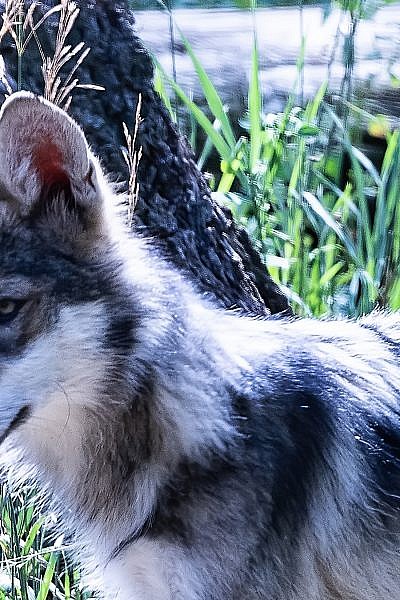
Cheyenne Mountain Zoo is home to a pack of seven Mexican wolves, and we support the restoration of a similar species – the gray wolf – to our state’s wild places on the Western Slope. Cheyenne Mountain Zoo has a long history of working to restore and relocate species, including black-footed ferrets, Wyoming toads, Mexican wolves, giraffe in Uganda, amphibians in Panama, and more. As an organization that contributes to the survival of species around the world, this is an exciting chance for Colorado residents to help restore a species that once roamed free, right here at home.

“We support restoring the natural balance by helping wild animal populations return to protected wild places,” said Dr. Liza Dadone, vice president of mission and programs at Cheyenne Mountain Zoo. “We see our role in this issue as trusted wolf experts and animal advocates. We want to help by addressing common misconceptions about wolves, based on our extensive experiences with them. We also feel compelled to raise awareness of this petition, so our community has the information needed, so Coloradoans can decide if reintroduction of wolves is right for our state.”

The Rocky Mountain Wolf Project is currently leading the way on collecting signatures on petitions throughout the state, with hopes to bring this issue to a public vote for the November 2020 general election. The petition is actively underway until Dec. 8, 2019.

As part of Cheyenne Mountain Zoo’s effort to educate the public about the ecological benefits of these once-thriving Colorado animals, Rocky Mountain Wolf Project’s beautiful and informative art exhibit, “Living with Wolves,” is on display at Primate World through November 2019. The art display helps dispel myths about the dangers of wolves.
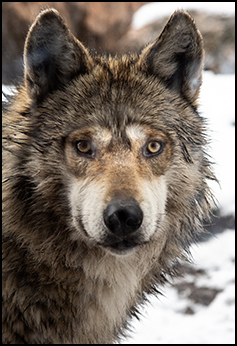
A common concern about the reintroduction of wolves to Colorado is about the safety of people who might encounter a wolf while enjoying time in nature. Unlike mountain lions and other predators found in wild and populated areas throughout Colorado, a wolf’s natural reaction to human presence is to retreat.

“Due to inaccurate portrayals of wolves in movies and other popular culture, some people may not know that wolves instinctively avoid human contact,” said Dadone. “When our keepers go into the enclosure with our pack of Mexican wolves to clean and replenish food, water and enrichment items, the wolves typically get as far away from them as possible. It’s a natural instinct that we like to see, as the hope for our wolves is that their offspring are one day restored to the wild to support their dwindling wild population.”

The Rocky Mountain Wolf Project reports that since 1900, there have been only two possible cases of a wolf-related human fatality in North America, and no cases in the lower 48 states.

This is a complex issue, especially for farmers and ranchers in the regions proposed for reintroduction. As caretakers of animals, we understand that farmers and ranchers care for their animals and have invested generations of energy into them. We also know that both compensation for their livestock and mitigation strategies are essential if wolves are restored to Colorado. We encourage these open conversations, as we hope they will lead to solutions that benefit wildlife, wild places, and the people who live near them.

There is evidence of wolves’ positive impact on restoring balance in struggling ecosystems, too. Some may be familiar with the reintroduction of wolves to Yellowstone National Park, in 1995. The National Park’s elk population had grown to levels not healthy for the ecosystem, due to the absence of predators, like the wolf. The elk drastically reduced the number of trees and shrubs that prevent erosion and serve the rest of the ecosystem.

Birds lost habitats, as a result of the fauna’s inability to grow to maturity. The water temperature in streams rose, due to a lack of shade from trees and shrubs, which made them uninhabitable for fish and other aquatic species. Without competition from wolves, coyote populations increased, which reduced the number of small mammals in the area that served as a food source for many smaller predators, like foxes.

Since reintroducing the wolf, Yellowstone National Park’s elk population has decreased and become healthier. The wolves single out the weak, old, sick and young elk, leaving the strongest elk to reproduce and carry on healthy genetic lines. The Rocky Mountain Wolf Project also says the wolves’ presence near waterways reduced the negative impact elk had on streams, trees and shrubs and the animals that live there, simply by redirecting the elk. Coyote numbers have decreased, creating a better balance and more available food sources for foxes, badgers, weasels and raptors, which share their prey.

Until the 1940s, when wolves were eradicated from Colorado’s wild places, wolves thrived in the Rocky Mountain State. The last wolf was shot in 1945, as a result of an extermination campaign that didn’t consider the wolves’ important role in our delicate mountain ecosystem. While an occasional “lone wolf” has migrated into our state, wolves have not been able to establish a population in our state in over 70 years.

As an apex predator, their presence at the top of the food chain in Colorado is vital, as it is in Yellowstone National Park. Western Colorado, where the Rocky Mountain Wolf Project seeks to reintroduce wolves, has more than 15 million acres of public land with an abundance of wild prey for hunters and wolves.

Guests can stop by Wolf Woods to sign the petition, and visit the art exhibit at Primate World to learn more about the incredible gray wolf and the positive impacts its presence could make on our state. There are also Rocky Mountain Wolf Project representatives throughout Colorado, who are collecting signatures. Look out for the Rocky Mountain Wolf Project logo and a person with a clipboard to share your opinion or to support the effort to bring this issue to a public vote.
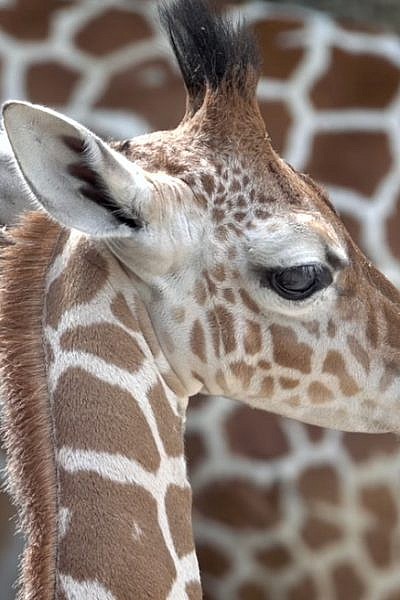
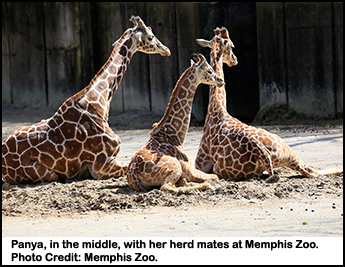
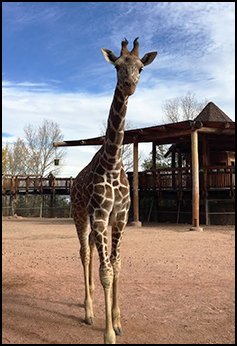
On Monday, Sept. 23, CMZoo giraffe lovers said a heartfelt goodbye to two-year-old Rae, a reticulated giraffe who moved from CMZoo to Lincoln Park Zoo, in Chicago, Ill. That same day, two-year-old female reticulated giraffe, Panya, joined the CMZoo herd from Memphis Zoo, on a breeding recommendation from the Association of Zoos and Aquariums (AZA) Species Survival Plan (SSP).

“We were pleasantly surprised because about 20 minutes after she came into the barn from her transport, she took food from us,” said Rachael Hahn, African Rift Valley animal keeper. “That’s not something we anticipated, but she took a few pieces of elm browse and some lettuce right away. That was a really exciting indication that it could be a smooth transition for her into her new home and herd.”

The name ‘Panya’ comes from the Swahili word for ‘mouse.’ Memphis Zoo keepers tell CMZoo that Panya was the one of the smallest calves they have ever seen, weighing in at just about 95 pounds at birth.

With tips from giraffe keepers, when visitors can meet Panya they should quickly be able to identify her. The first clue is her stature.

“She is adorable and really tiny. She’s even smaller than Rae,” said Amy Schilz, senior lead animal keeper in African Rift Valley. “Fans should be able to easily identify her in the herd, because she has a fuzzy young-giraffe coat, short legs and a tall body, like [29-year-old female CMZoo giraffe] Riyadh and spot patterns similar to Mahali [16-year-old male CMZoo giraffe], with lots of white splotches in her spots. She also has really long tail hair, for now, since the rest of the giraffe herd haven’t ‘styled’ it yet.”

Panya’s keepers at Memphis Zoo describe her demeanor as, “a mixture of personality. She can be very timid at times, but also has a curious side, often watching intently as her keepers work in nearby stalls. She is sassy and full of attitude, as well.”

CMZoo giraffe keepers have observed Panya getting excited and spreading her feet to play a little bit, which may be interpreted as a sign of nervousness, so keepers are taking the introduction to the herd slowly and carefully.

“She’s doing really well, getting to know us and the herd while she completes her quarantine period in the barn,” said Hahn. “She can see and smell all of the other giraffe from her current space, and [17-year-old] Msichana, one of our female giraffe, is spending some time with her. Msichana historically has been a good companion, so we chose her to help Panya settle in. Female giraffe are herd animals, and usually prefer to have a buddy.”

Quarantine periods last about a month. Msichana and Panya are sharing a space for about 30 minutes at a time, for now. Keepers will work to increase that time together over the coming days.

“We’re following her lead, like we do with all of our animals, so we’re moving at her pace,” said Hahn. “She’s telling us that a new place, new keepers and a new herd are enough for now. We wanted to give her a little more time to settle in, which we know our giraffe fans will understand.”

“The SSP looks at the genetics of all giraffe in AZA-accredited zoos, and Panya is a great match for our breeding bull, Khalid,” said Schilz. “Hopefully she’ll join our herd as a breeding member and will someday have a calf of her own. We’re really excited for her to be a part of our herd, and for everyone to meet her.”

Guests can already come and see Panya in her quarantine area of the giraffe barn. Stay tuned to CMZoo’s social media channels to learn when visitors can come and meet Panya with the rest of the herd, in African Rift Valley at Cheyenne Mountain Zoo.

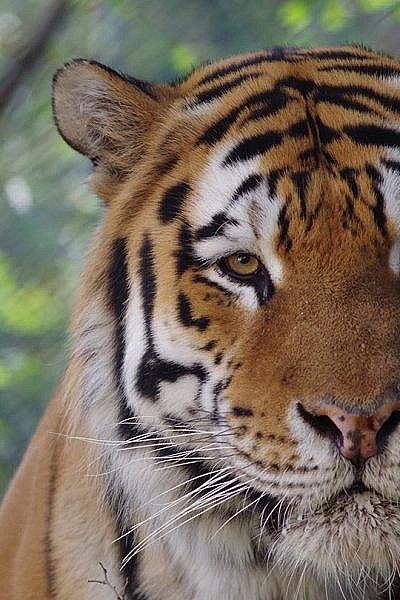
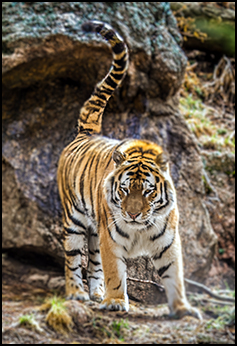
Cheyenne Mountain Zoo will soon bid a heartfelt farewell to Thimbu [TIM-boo], a nine-year-old Amur tiger with a freckled nose and an ‘aww-inspiring’ way of adorably rolling on his back in the tall grasses of Asian Highlands.

As part of a breeding recommendation from the Amur tiger Species Survival Plan (SSP), Thimbu is moving to Bramble Park Zoo – an Association of Zoos and Aquariums-accredited zoo, in Watertown, South Dakota – in late October 2019.

“He’s just the loveliest tiger and a wonderful example of why we need to continue to protect and preserve his species,” said Rebecca Zwicker, Asian Highlands animal care manager. “With this difficult-but-important move, we will be doing our part to do just that.”

Thimbu – affectionately known as “Thim,” by his keepers – needs to relocate as part of the SSP’s plan to introduce a female Amur tiger, Savelii, to CMZoo Amur tiger, Chewy, later this year. To learn more about CMZoo’s upcoming Amur leopard and Amur tiger SSP breeding efforts, read this September 2019 article.

In anticipation of his move, Thim’s keepers shared some insights about his personality, a few of their favorite memories with him and their hopes for his future.

“He’s notoriously sleepy in the morning,” said Basia Dann, Asian Highlands animal keeper. “One of my favorite Thim times is when we go to greet him in the morning. He’s usually rolling around on his back and doing his morning stretch routine.”

Another morning favorite of Thim’s? The smell of coffee.

“One of my favorite memories with Thim was when we first learned that a sure way for him to chuff [a quick outward breath through the teeth, which is an indication of contentment and sometimes known as a tiger ‘hello’] was to give him a whiff of our coffee,” said Dann. “He’s a cat after my own heart! Sleepy mornings with him are the best.”

Like many scent-driven big cats, Thimbu’s attention isn’t only aroused by the smell of coffee. Keepers found one of Thim’s favorite training motivators and enriching items was a popular perfume.

“His very favorite thing is Amber Romance perfume from Victoria’s Secret,” said Dann. “One time I was training him, and he noticed a spot where we had sprayed the perfume and he left the training session to go over and rub and roll in the perfume. He even licked it off the wall.”

Because tigers and big cats like to scent mark, the perfume is almost irresistible to Thimbu, and trainers spray it to reward him and encourage him to investigate new enrichment items that engage him mentally and physically. Thim doesn’t need much encouragement to be physically active, though, once he’s had his morning stretch.

Thimbu’s keepers and fans throughout Colorado will miss seeing him at Cheyenne Mountain Zoo. But, they know his relocation is an important move for the survival of Amur tigers, which are endangered, with the latest wild count around only 500.

As Thimbu makes the trip to Bramble Park Zoo, he will be accompanied by one of his keepers, who will work with his new team of keepers to help him make a smooth transition to his new home. Keepers at Cheyenne Mountain Zoo and Bramble Park Zoo have been in regular contact to share information about Thimbu that will help this resilient tiger settle in comfortably.

“This move means that even more people will get to see him in all his majesty, and fall in love with tigers because of him,” said Dann. “He’s truly the whole package. I hope Bramble Park Zoo supporters go to the zoo especially to see him and watch him take on this new experience with bravery and resilience, as he always has with us.”

Cheyenne Mountain Zoo guests can visit Thimbu, and wish him well on his next adventure, through mid-to-late October.

Did you know each year up to 75,000 pounds of broken or unwanted crayons are thrown away and end up in U.S. landfills?

Crayons are made of paraffin wax, a by-product of petroleum or crude oil, which negatively impacts wildlife where drilling occurs. Crayons can also leave a waxy sludge in landfills, which doesn’t decompose for decades.

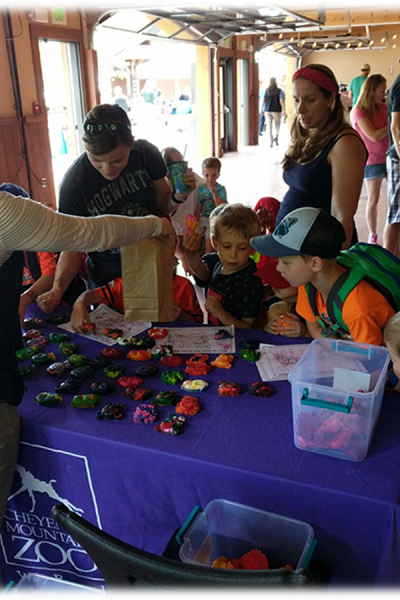
Throughout the new school year, instead of throwing away used crayons, Cheyenne Mountain Zoo guests can donate them. CMZoo’s Coloring for Conservation team makes Coloring Critters: animal-shaped crayons made from recycled crayons.

The demand for crayons is astonishing. In the United States alone, more than 12 million new crayons are made every day! This translates into nearly 120,000 pounds or 60 tons of new crayons each day (100 crayons equal approximately one pound). What can you do to help prevent all these crayons from ending up in landfills?

Participants who stop by the Coloring for Conservation booth at one of the below events can give a donation of crayons, pick up a recycled crayon to take home or color at the Zoo with a recycled crayon.

The Coloring for Conservation booth will be available to accept crayon donations during International Vulture Awareness Day at the Zoo, on Saturday, Sept. 7, from 10 a.m. to 2 p.m. Keep an eye out for more opportunities to donate your own crayons and receive a Coloring Critter at upcoming animal awareness days at the Zoo.

On these designated days, Coloring Critters will also be available for you to take home! So, bring used crayons to our booth, learn how we create Coloring Critters, make a donation to conservation and take home a colorful wax animal-shaped crayon. It’s a fun and creative way to help animals and the environment.

In humans, physical activity not only benefits physical health but mental health as well. At Cheyenne Mountain Zoo, the training and enrichment the animals can choose to participate in are also beneficial.

Research has shown that kids who have moderate physical activity in their day show increased attention, comprehension and learning ability, as our sponsor, Children’s Hospital Colorado explains in this article. The same is true for animals, which is why CMZoo keepers and trainers make daily enrichment and training a priority for the animals in their care, all with positive reinforcement.

“When we provide specific opportunities for animals to be physically active, we often see their overall activity level increase, even outside of the opportunities that we are providing,” said Rick Hester, Cheyenne Mountain Zoo animal behavior programs manager.

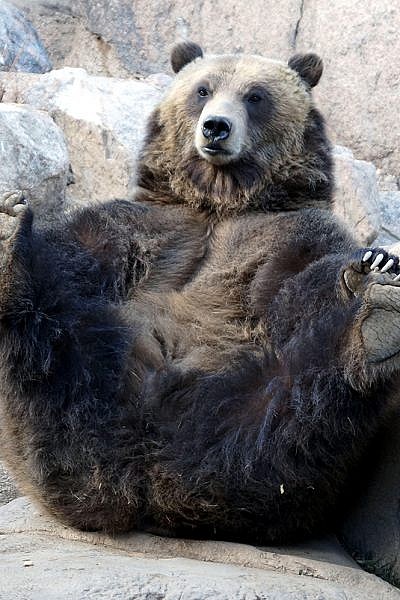
Emmett, CMZoo grizzly bear, consistently did a stretch on his own during interactions with keepers, which bears in the wild sometimes do.

“Emmett would sit down and hold his back legs with his front paws,” said Rebecca Zwicker, Rocky Mountain Wild animal care manager. “We saw him doing it so often that we started to incorporate it into his regular training and demonstrations, so our guests can see those natural behaviors. We call it the ‘yoga bear.’”

Over time, CMZoo grizzly bear, Digger, saw Emmett being rewarded for this behavior, and began imitating it, which his keepers of course rewarded.

Guests can see Emmett and Digger doing “yoga bear,” presenting their teeth for keepers to check and offering different parts of their bodies through a safe barrier, where keepers can perform health assessments and decide whether the bears might need veterinary care.

“Most of us know when our dog is excited to head out on a walk in the park, or is nervous about walking into the vet clinic,” said Hester. “Our animal keepers work hard to build trusting relationships with the animals in their care, so they also pick up on those insights from the animals.”

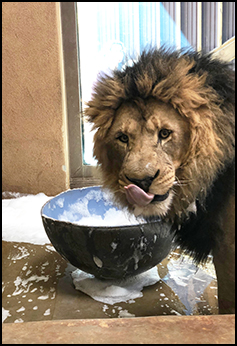
The African lion pride recently showed their keepers that a new and unusual enrichment activity got their approval, says African Rift Valley Keeper, Diana Miller, who has worked with the lions for six years.

“The lions absolutely love bubble baths, and we didn’t realize that until this year,” Miller said. “It surprised us, because we know they don’t usually like getting in the water. But, because we recognize their behaviors, we realized pretty quickly that it was different when bubbles were involved. They absolutely love it. We know they love it, because they play enthusiastically for a long time whenever when we offer them the bubble bath enrichment, and it’s really fun for guests to see.”

For a full schedule of demonstrations and training sessions, visit www.cmzoo.org/shows.

When you think of vultures, chances are you don’t picture heroic, beacons of hope contributing to a strong and healthy ecosystem. That’s because vultures sometimes get a bad rap in our society, often depicted negatively due to their scavenger status. Cheyenne Mountain Zoo has been supporting vulture conservation in various ways since 2009, including currently as a Quarters for Conservation (Q4C) animal beneficiary. Senior Lead Keeper, Jenyva Fox, has been hard at work changing the way guests perceive and understand vultures – in part by organizing International Vulture Awareness Day (IVAD), celebrated annually at CMZoo, on the first Saturday in September. This year, vulture keepers will host activities from 10 a.m. to 2 p.m. on Saturday, Sept. 7.

“The foods that vultures eat, including decaying carcasses, may not be the most appetizing to us, but they are still very important members of the animal kingdom,” said Fox. “The message we try to share with guests is that vultures are the MVPs of keeping our environment clean and safe from the spread of diseases.”

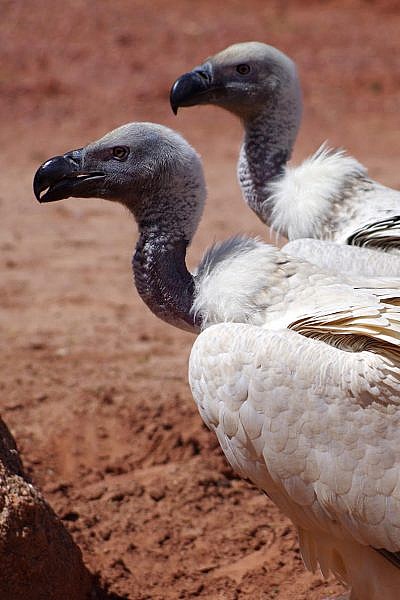
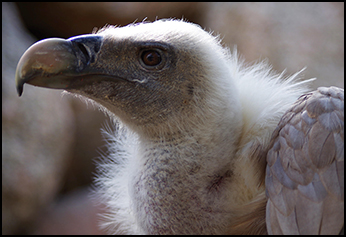
This message is a bit easier to convey when you have three charismatic and interesting vultures to serve as animal ambassadors, helping to educate thousands of guests every year. Fox, along with a team of other keepers, cares for two African Cape vultures, Godric and Hedwig, and Nesher, a Eurasian griffon vulture.

Situated atop new perching that overlooks African Rift Valley, these three raptors survey both guests and animals alike during the warm months of the year. Godric, a 5-year-old male, is curious and friendly.

“Godric loves to swoop into the zebra yard during training sessions, just to check in on the keepers and see what we’re up to,” Fox said. “He’s developed a real bond with us since he arrived almost two years ago.”

Fox says that Godric has helped fellow Cape vulture, Hedwig, to build more confidence, making her braver and more outgoing.

“Hedwig is known for her confidence in the giraffe yard,” Fox said. “She’ll walk among the giraffe, bathe in the waterhole and has even found a great perching spot on top of the giraffe statue in the main yard.”

Nearing 30 years old, Nesher, on the other hand, prefers her routine, opting instead to hang back along the Safari Trail, in a more private location below the Zoo’s main road in African Rift Valley.

“Nesher was hand-raised by vulture conservationists in Israel, so she feels right at home with people,” Fox said. “This could explain why her favorite pastime is people-watching. If you want to see Nesher, your best bet is to walk along the new stroller ramp and look down. You’ll most likely find her looking up at you from that rocky, shaded space.”

Developing connections with Godric, Hedwig or Nesher makes it easier for guests to learn about the contributions vultures make in the natural world. These misunderstood and disparaged birds are nature’s clean-up crew, largely helpful in preventing the spread of disease. Their unique appearance and adaptations serve a greater purpose.

Their iconic bald heads actually prevent bacteria from sticking to their skin, an important adaptation for such a mobile animal. Preventing the spread of bacteria is key when you’re a vulture, which is why some species urinate on their own legs, killing carcass bacteria in the process. No need to panic if you get up close to a vulture, though, because they also bathe regularly – both in the water and the sun. The UV rays from the sun kill the pathogens in their feathers after feeding.

“The thing that makes them the most amazing is that they have very strong stomach acids that kill diseases and bacteria in the food they eat,” said Fox. “This is why they don’t get sick like other scavengers could.”

Sadly, all of these physiological tools aren’t enough to overcome poisoning, which is the species’ largest threat to survival. Misconceptions about vultures, such as being mystical, fortune-telling beings, are partially accountable for vulture poisonings. Ironically, it’s their very scavenger nature that most often leads to their death. Vultures’ very presence points rangers in the direction of animals that have recently been poached. In an effort to hide their misdoings, poachers will poison the carcasses to try and stave off the rangers.

Through the eyes of a conservationist like Fox, saving vultures is closely linked to saving several other endangered or critically endangered species. Efforts to protect these animals in the wild are, therefore, especially vital. This is why CMZoo has joined forces with the AZA African Vulture SAFE (Saving Animals From Extinction) program and the Vulture Conservation Program, commonly known as VulPro.

SAFE programs are made up of Association of Zoos and Aquariums (AZA)-accredited member organizations that help facilitate and guide united conservation efforts for several endangered species, including elephants, giraffe and orangutans. The vulture SAFE program hit the ground running when it got its start in 2018 and hasn’t stopped since. In comparison to other SAFE programs, the African vulture effort is unique in that it works to conserve six species, as opposed to a singular one. This is because all six species of vulture face very similar threats to survival, so strategies that help one species can also help the other five.

VulPro, a field partner of the vulture SAFE program, helps address captive breeding and reintroduction of vultures, as well as the rehabilitation of injured or poisoned vultures. The Zoo has supported vulture conservation by supporting VulPro for over a decade now, contributing nearly $90,000 to the South African non-profit over the years.

Before becoming a member of the African Vulture SAFE steering committee, Fox was heavily involved in raising awareness for these often misunderstood birds. One way she built excitement for vultures was by helping to establish International Vulture Awareness Day (IVAD), and bring the program to Cheyenne Mountain Zoo. The international celebration began in 2009, and has been celebrated right here in Colorado Springs ever since.

“We started celebrating IVAD before many other animal celebration days were in the works,” recalled Fox. “IVAD was around before World Lion Day or World Elephant Day. When the celebration began, the idea of having one day a year focused on one animal’s conservation was relatively new to the Zoo world. IVAD became a necessity because these birds were in trouble, and we didn’t (and still don’t) have a beloved children’s character or even a well-known or respected animal at the helm. People weren’t as interested in saving them.”

From the beginning, Fox knew this would be an uphill battle. Luckily, the mountainous landscape at the Zoo prepared her for such a challenge. She decided the best way to get people interested in vulture conservation was to lean into the preconceived notions about vultures that people already had. IVAD activities, such as making “vulture vomit” and hosting “scavenger” hunts quickly became crowd favorites, especially among the younger visitors.

“Taking vultures’ traits and characteristics and making them into fun activities is a way to grow appreciation for vultures and what they do for us,” Fox said. “Every September, I’m just amazed at how many kids are excited to learn about vultures. Each year, people are more aware, and actively look for them in the exhibit. That’s something that never used to happen. I think part of what’s spurred this increased interest is their inclusion in the Q4C kiosks down at the admissions plaza. It warms my heart to think that we’ve been able to inspire others to care about and want to protect vultures.”

This year, Fox and other keepers will host the 11th annual vulture celebration on Saturday, September 7 from 10 a.m. to 2 p.m. in African Rift Valley and Encounter Africa. Guests can expect the same hands-on activities they have grown to know and love, like vomit-making, stomach juice experiments and condor “surgery.” Our own vultures, Godric, Hedwig and Nesher, will be there, of course, ready to leave kids of all ages in awe of the many wonders vultures provide our ecosystem.

TWO-YEAR-OLD RAE SETS OFF FOR LINCOLN PARK ZOO IN SEPTEMBER

In September 2019, Rae, two-year-old CMZoo reticulated giraffe, will be embarking on her next adventure as an animal ambassador at Lincoln Park Zoo, in Chicago, Ill. The daughter of Msitu and Khalid, and sister of newborn, Viv, and six-year-old, Emy, who now lives in Peoria, Ill., will be dearly missed by CMZoo staff and giraffe fans. But, as she joins a new herd, she will have the opportunity to reach and inspire a new group of people who are sure to fall in love with the curious and social giraffe, as so many did during her time at CMZoo.

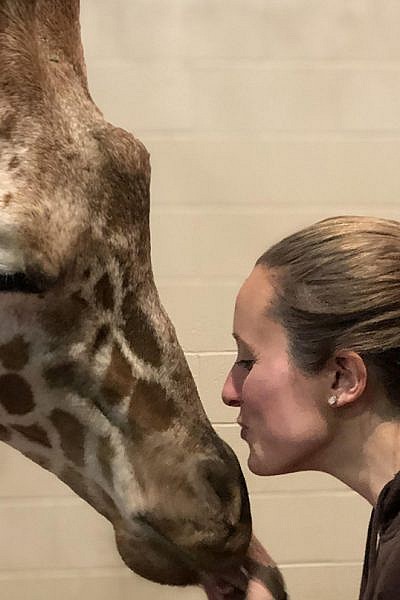
In anticipation of Rae’s move, Kayla Ringuette, a CMZoo giraffe keeper who has a special bond with Rae, shared some of her favorite memories of Rae.

“We didn’t have live cameras for Rae’s birth in 2017, so I was the first keeper to meet her,” said Ringuette. “Once Rae started taking food when she was a few months old, I would feed her every opportunity I got in order to build our relationship before asking her to do behaviors. I may have gotten carried away, since she was the first animal I’ve ever trained that had no prior training history with people. I think it’s because of that relationship building that she follows me around everywhere I go. I actually created a montage of pictures where you can see every other giraffe doing something in the background, interacting with enrichment or browse, and she’s right nearby staring at me.”

Over the next two years, Ringuette and Rae continued to develop a trusting relationship, which Ringuette says is in large part because of Rae’s natural curiosity about people.

“Rae was eager to interact with keepers and staff right from the very beginning,” Ringuette said. “In training sessions, she is always really curious. She likes to sniff at hoof trimmings on the barn floor after we do our routine hoof work with the herd. We’ve even had to stop a training session because she refused to stop sniffing the person’s gloves while they were trying to work on her feet. We eventually realized we didn’t need food to reinforce her behaviors during those trainings, because she would rather smell the trainer’s gloves.”

As Ringuette and her fellow keepers continued building relationships with Rae, her trust in them stood out, especially in one memory Ringuette recalls of Rae’s first time going into a narrow area of the barn, called a chute. Making sure the giraffe are comfortable in this area is extremely important. If a giraffe ever needs medical attention or needs to be transported, they need to be comfortable in this space. The chute isn’t as wide open as the rest of the barn, which can make the giraffe unsure.

“One of my favorite memories is the first time Rae came into the chute,” Ringuette said. “The chute can be kind of a scary place for a giraffe going through it for the first time. You’re asking this naturally skittish animal to enter a space alone, where they can’t see very well because of the blind corners. Even after being able to investigate the area with mom, Msitu, Rae still wasn’t comfortable. I decided to try walking her through myself while I reinforced her with food, and it worked! Building trust with an animal to the point that they will follow you into an uncertain place that they wouldn’t even go into with their mom was the most rewarding experience I could ask for as her caretaker.”

Rae has spent a lot of her time with herd mate, Bailey, a seven-year-old female who is equally as energetic and curious about people.

“They’ve always been mischievous together, testing off-limits areas of the yard and running around, making the rest of the herd excitable,” Ringuette said. “Bailey is our other really social giraffe, so it’s typically one of them breathing on your neck from the other side of the barrier, when you’re focusing on something else.”

Rae’s outgoing demeanor is sure to serve her species well, as an ambassador that makes connections with people, which we hope will inspire them to take action to protect their relatives in the wild.

“Her gregarious nature makes people fall in love immediately, since it seems like she is picking you out of a crowd,” Ringuette said. “She makes you feel very special. Creating connections with people is ultimately her job, and she’s so great at it.”

As part of the Species Survival Plan (SSP), Rae will join Lincoln Park Zoo female giraffe, 21-year-old Etana, and a young male giraffe, Finely, who is three. Under the same recommendation, a female giraffe who could breed with Khalid will join CMZoo’s herd later in the month.

“I will miss my little shadow, but I have very high hopes for this girl in her new home,” Ringuette said. “She is a rockstar with training, and she is already such a great ambassador to her species at two years old, that she is going to make many guests fall in love with her for the rest of her life in her new home.”

Guests are welcome to come and visit Rae to share their well wishes before her move, every day of the week at Cheyenne Mountain Zoo.

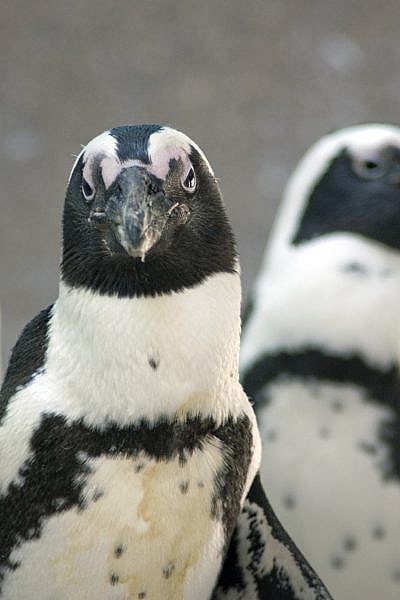
New Hippo and Penguin Exhibit to Open This Fall – Water’s Edge: Africa Animal Care Manager, Jeremy Dillon, shares the latest from the hippo and penguin exhibit, set to open this fall.

Have you noticed a few new faces and interesting accents around CMZoo lately? Get to know some of our visiting keepers, from Melbourne Zoo, in Australia, and hear about their favorite experiences from their time with us!

IT’S MORE THAN JUST AN EXCUSE TO GET DIRTY

Did you know that there is an international day dedicated to celebrating mud? June 29 is International Mud Day, and it’s more than just an excuse to get really, really dirty.

International Mud Day may not seem to have an obvious connection to animals or zoos, but connecting kids with nature allows them to become stronger environmental stewards who are capable of changing the world someday. Mud Day is definitely making those connections and fostering those stewards.

International Mud Day started because a school in Australia and a school in Nepal wanted to create a day where kids from two different worlds could play in nature at the same time. The kids from Nepal could not afford to get a set of clothes dirty, so the Australian students raised funds and sent clothes so they could play together on the same day. That was ten years ago. Now, groups all over the world celebrate International Mud Day, including Cheyenne Mountain Zoo’s summer camp and teen program participants.

This year, summer campers spent an entire week dedicated to mud! Playing mud games, creating mud crafts, making mud enrichment for animals and more. You name it, the campers successfully incorporated mud into it, every day.

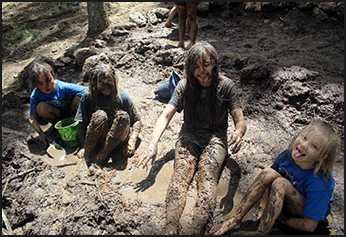
The teen program spent several days creating mud activities and helping to prepare the famous CMZoo Mud Pit for Friday’s finale of mud week. Campers and teens celebrated Mud Day on Friday, June 28 this year and spent the entire day on the Zoo’s Nature Trail splashing and “bathing,” throwing, and wearing mud from three cascading mud pools.

Kids from four to seventeen years old participated in this celebration of nature play, with each age group interacting in the exact same ways: making face paint, plopping it onto a friend’s head, and trying to get their shirts and shorts as muddy as possible. Kids end up with mud in their ears, mouths and hair, and enjoy every minute of it.

If you are interested in learning more about International Mud Day or are looking for ways to celebrate it next year, please visit https://worldforumfoundation.org/workinggroups/nature/mud-day/.
 
Back to The Waterhole Home Page