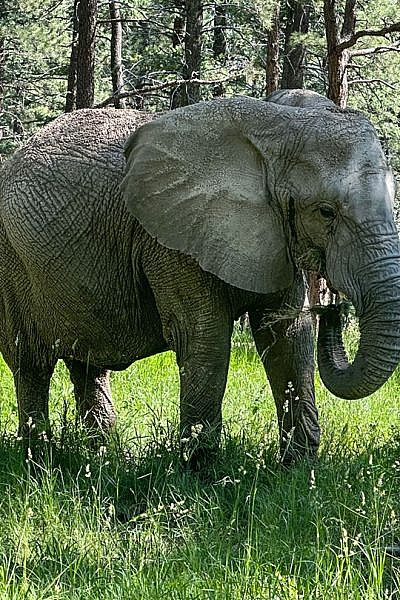

In Encounter Africa at Cheyenne Mountain Zoo, five beloved female African elephants, affectionately referred to as the Golden Girls, are aging with dignity and the support of their dedicated care team. Missy, LouLou, Kimba, Lucky and Jambo each has unique needs, care plans and preferences.
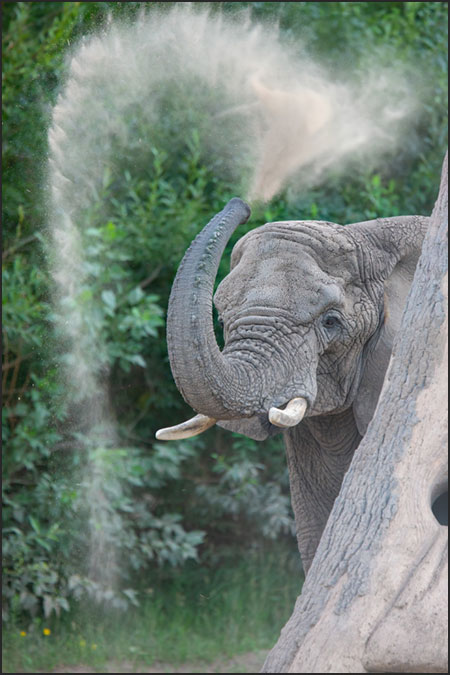
“Because we’re so in-tune with their subtle behaviors as individuals, we can tell what they enjoy and when they need support,” Ilana Cobban, Encounter Africa animal care manager, says. Ilana has worked with the elephants at CMZoo for 23 years. “I love how playful they still are in their old age. They like play-sparring with each other, mud wallowing, training and participating in demonstrations and feeding opportunities with guests, and engaging with enrichment regularly.”
When building the Wilgruen Elephant Center, CMZoo saw a need in the zoo community to create a program especially for female African elephants beyond their breeding years. The facility has various substrate floors, training areas and an overhead crane system that can lift an elephant to its feet if it can’t get up on its own.
CMZoo’s expert elephant care team has a combined 65 years of experience, with four full-time keepers on most days to care for the five elephants, supported by three full-time board-certified veterinarians. The herd participates in cooperative blood draws, laser therapy, tusk, tooth and foot care, and more.
“All of the girls participate in elephant yoga at whatever level is comfortable for them,” Ilana says. “They get excited when it’s their turn to train. Missy, our eldest, will trot over to participate. They do exercises like downward dog – we call it ‘downward elephant’ – and stretch their legs, heads and trunks. Over the years, we’ve seen their flexibility improve in some ways, but some of their long-term mobility issues will inevitably worsen with age. We make adjustments so they can participate comfortably. The poses are good for the elephants, and they allow us to visually check and treat any issues.”
Lucky, 46, is very playful and seizes opportunities when they arise. She’s been known to ask Kimba, who she lives with, to share her food, and will even snag a puzzle feeder from another elephant’s space. Lucky has arthritis in her right rear knee. She doesn’t always bend that knee when she walks, but she bends her knee during physical therapy. She’s developing arthritis in her front right ankle, so she cooperatively receives laser therapy to reduce inflammation and improve circulation. She also takes pain and anti-inflammation medications, and has a big sand mound that she uses to rest and lie down.
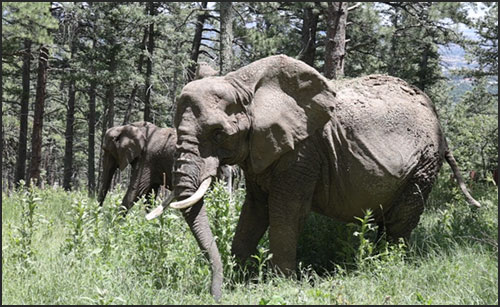
The team studies all of the elephants’ behaviors, tracks quality-of-life indicators and adjusts their care programs to provide more of what they positively respond to. Some of them love to wallow in giant mud puddles or get baths and others like to give themselves sand baths. Foraging for food is a big part of an elephant’s day. Their food is provided in puzzle feeders to mentally stimulate them, in addition to other enrichment, training and exploring. Their food is also hung high to encourage them to stretch, and it is dispersed throughout their yards and spaces to encourage more movement.
“They get produce and hay, but their favorite is tree branches,” Ilana says. “We have two employees dedicated to collecting healthy species of branches from our community for the elephants and other animals. They eat the leaves and branches, and they love to debark tree stumps and logs with their toes and trunks.”
Missy, 56, is the second oldest female African elephant in human care in facilities accredited by the Association of Zoos and Aquariums. She’s still the fastest to respond to enrichment and training opportunities.
“She’s fearless,” Ilana says. “She’s the oldest, but she’s still the quickest, and she doesn’t hesitate to remind the herd that she’s the boss.”
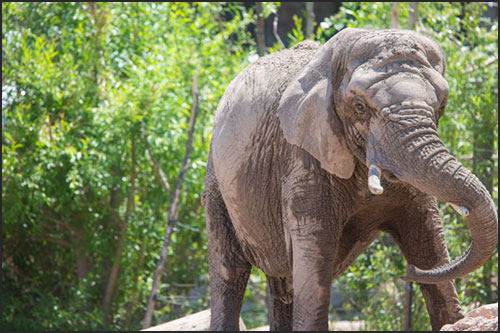
Elephants have six sets of four molars throughout their lives. Because of Missy’s advanced age, she is on her last set of two molars, so her team brought in a hay shredder to chop her food into easier-to-chew bites. Normal for any aging animal, Missy has lost weight over the last year and experienced drier skin. She receives nutritional supplements, like beet pulp and orchard grass pellets, and participates in bubble baths, which have helped moisturize her aging skin.
Kimba, 48, is known as the ‘foodie’ in the group. She loves few things more than food. She’s also incredibly loyal to Lucky, who she has lived with for more than 40 years. Kimba has been prone to colic. Her team has tried many different treatments, but has not identified a long-term solution for her. They’re continuing to seek input from their wide network of elephant care professionals. They also try different diets, supplements, exercises and treatments, while tracking how she responds. Her colic occurs without an apparent pattern, and has increased in frequency recently. She has more good days than bad, overall, and her care team tracks data closely.
“Kimba’s body condition and bloodwork results are good, and she’s socializing with other elephants, exercising, eating, drinking and participating in training sessions, which are all good quality-of-life indicators,” Ilana says. “Her bloodwork tests for stress indicators, among other things, and we don’t see that she’s stressed in those results or in her behavior.”
As incredibly intelligent animals, elephants need diversity. Multiple times per day, the Golden Girls move between yards and indoor spaces, where they find new opportunities to stimulate their bodies and minds. They also have access to a trek walk and a ‘vacation yard’ – a 2-acre forested field they can explore for as long as they want when temperatures are safe for them to stay outside. The trek and vacation yard are away from guest areas, but are distantly visible from the elephant boardwalk. If you see trees rocking for no apparent reason, there’s likely an elephant is knocking it around.
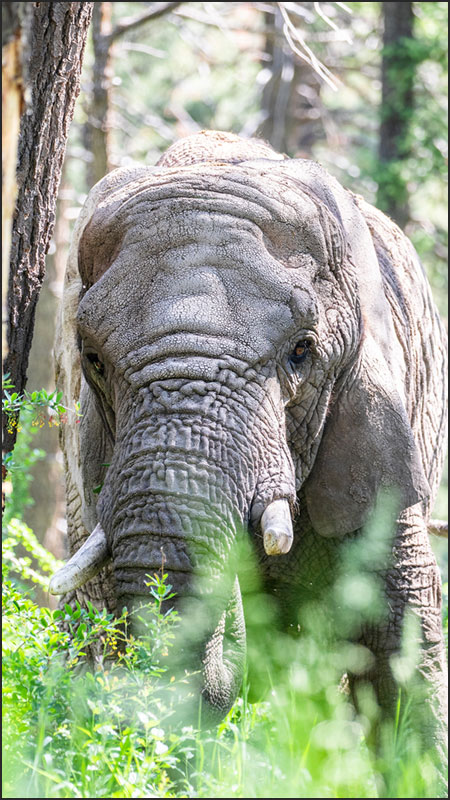
Wild female elephants are commonly known to live in herds, but the ladies at CMZoo have shown their team that they prefer a different setup. LouLou and Missy share space, Jambo prefers to interact with other elephants from her own space, and Lucky and Kimba live together.
“These elephants didn’t grow up in large herds, so we provide environments and social setups based on their preferences,” Ilana says. “We have offered them a variety of group settings, but this is the setup they want. We believe in customizing their care. They deserve to be given that choice.”
Jambo, 42, is an enthusiastic, large elephant for her age. Although she prefers her own space, she is incredibly tactile with other elephants. She often reaches into other elephants’ spaces to interact with her trunk, and playfully spars and flaps her big ears at the elephants. She’s been known to sneak her trunk into other elephants’ mouths to see what they’re eating. Jambo is in good health, but experiences occasional bloating. To combat it, she gets elephant-sized quantities of Gas-X: 20 cherry-flavored tablets at once.
LouLou, 43, is one of the most playful and social elephants. She is incredibly curious about Jumbe, CMZoo’s Eastern black rhino, and likes to be near him at the fence line, sometimes tossing sand in his direction. LouLou, like Jambo, also receives Gas-X as a preventative measure, because she has experienced bloating in the past. Otherwise, she seems to be in great health.
“We love these elephants, and we’ll keep supporting them, relying on what works for them as individuals, and trying new things,” Ilana says. “They’re fulfilled here, and we believe they’re living their best lives in their home. We’re realistic that all of our Golden Girls are into their bonus years, and we’re committed to their compassionate care.”
If you’ve ever visited #CMZoo and the African elephants, you can consider yourself a conservation warrior. Through CMZoo’s Quarters for Conservation program, 75¢ of every admission goes to conservation partners. Tsavo Trust – a field-based non-profit that uses aerial surveillance and on-the-ground field efforts to protect elephants, rhinos and other wildlife in Tsavo National Park, the largest national park in Kenya – is a legacy Q4C recipient. Small change makes a big difference. Since 2008, those quarters have added up to more than $6 million for conservation, with more than $1 million supporting elephant and rhino conservation.