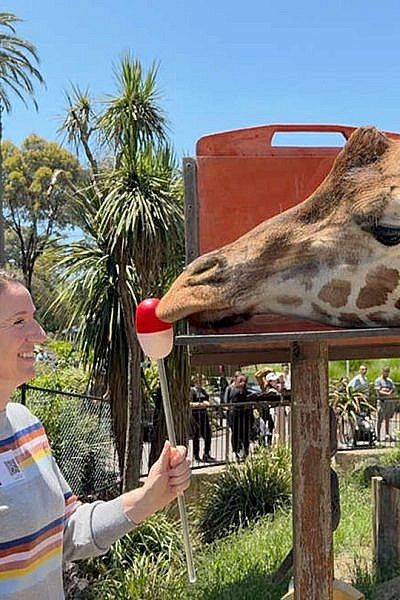

Written by Amy Schilz, senior animal behaviorist at the International Center for the Care and Conservation of Giraffe
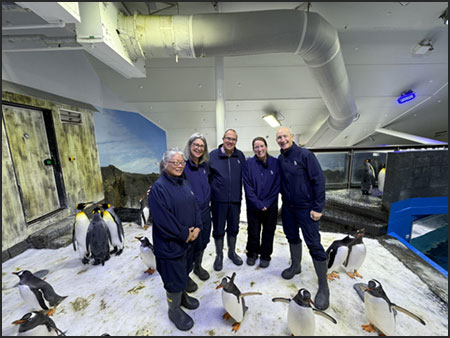
As a senior animal behaviorist for Cheyenne Mountain Zoo’s International Center for the Care and Conservation of Giraffe (the Giraffe Center), I have the incredible opportunity to participate in a wide range of exciting and meaningful initiatives. On any given day, I might help clean a giraffe stall, assist with drawing blood from a giraffe’s jugular vein, mentor a trainer in another state via video call or help coordinate the international transport of a giraffe to support AZA’s Species Survival Plan goals. I love collaborating with others to solve the complex challenges facing giraffe conservation. Some days, I truly have to pinch myself—because this job (quirks and all!) feels almost too good to be true.
One of the things that makes this role especially meaningful is the Giraffe Center’s partnership with Behavior Works, an organization dedicated to improving quality of life for all learners through the science of behavior change. This collaboration allows us to remain at the forefront of giraffe training, using the least intrusive, most positive and most effective strategies to teach essential medical behaviors such as hoof care, ultrasounds, x-rays, blood draws and injections. For the past few years, I’ve been fortunate to serve as a dual training consultant for Behavior Works and CMZoo’s Giraffe Center. Together, we’ve helped caretakers make lasting improvements in giraffe care and training practices.
When Bianca Papadapoulos, animal training coordinator with Zoos Victoria, in Australia, and Behavior Works consultant, reached out to ask if I would present as a keynote speaker at the Australasian Society of Zoo Keeping’s Animal Training Conference, I jumped at the opportunity. I knew it would be the perfect chance not only to highlight the work being done at CMZoo’s Giraffe Center, but also to learn from an incredible community of behavior professionals in Australia.
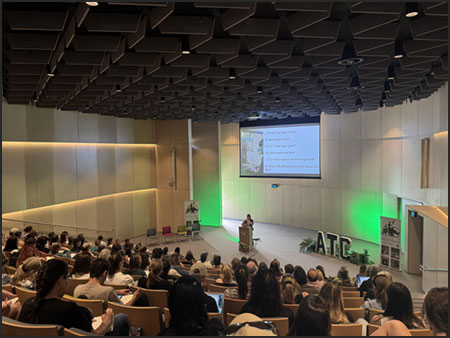
In November, I traveled to Sydney, Australia. I spent two inspiring weeks ‘Down Under’ with an exceptional group of conference hosts, keynote speakers and more than 240 attendees. I presented a 90-minute lecture on The Modern Approach to Animal Training and led four workshops throughout the week focused on Reading Animal Behavior. It was a true honor to present alongside fellow keynote speakers and personal training idols, including Ken Ramirez of the Karen Prior Academy, Tim Sullivan from Brookfield Zoo, and Dr. Susan Friedman from Behavior Works.
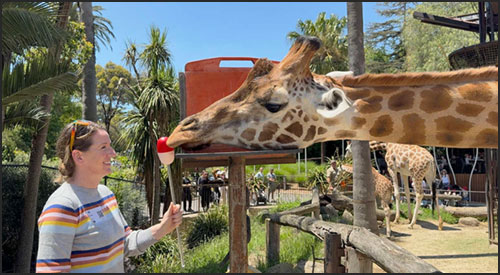
After the conference, I flew with the Behavior Works team to Melbourne, where the CMZ giraffe team has long-standing relationships with the zookeepers at Melbourne Zoo. Over the years, many of their giraffe keepers have attended workshops at the Giraffe Center or participated in extended keeper exchanges at our zoo. After more than a decade of collaboration, it’s always exciting to see what they’re working on. During my visit, I had the chance to observe their impressive voluntary head x-ray training program, which allows keepers to monitor giraffe dental health. They even invited me to practice training one of their giraffe who is already well established in the behavior.
While spending time with giraffe is always a highlight, I also had the chance to experience some truly unforgettable wildlife encounters in Australia. I saw a massive colony of flying foxes, watched a wombat forage in the wild, spotted a koala lounging in a eucalyptus tree and observed cockatoos soaring overhead. Seeing animals in the wild always inspires me to stay hard at work making animals’ lives better in human care. Many people never get to experience these animals in the wild, and it’s our honor to help them feel that same inspiration by visiting animals at CMZoo.
My favorite experience, though, was feeding a quokka at Melbourne Zoo. If you don’t know what a quokka is, I highly recommend looking it up immediately—I promise even a single photo will make your day.
All in all, it was an incredible experience. I’m deeply grateful to Bianca Papadapoulos, Susan Friedman and the team at Behavior Works, the conference organizers and our friends at Melbourne Zoo and Taronga Zoo for the opportunities, collaboration and warm hospitality they shared with me.
In addition, I am incredibly thankful for the constant support of my home team at Cheyenne Mountain Zoo. Every single person shows up and steps up for me, whether it’s covering my responsibilities while I’m away or leadership wholeheartedly supporting my outreach, enrichment and professional growth. I couldn’t do this work without you, and I’m endlessly grateful to call you my team. You are truly my heroes.