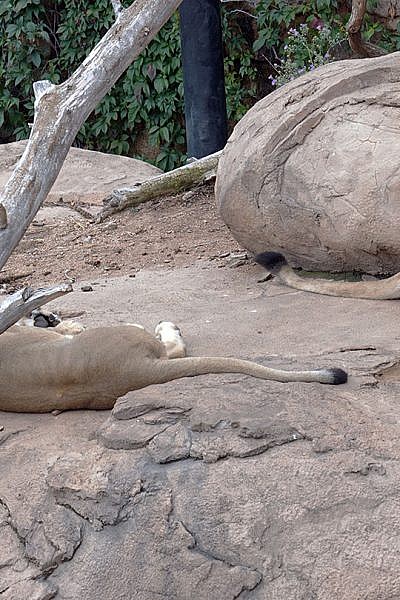
CMZoo’s animal care and veterinary teams are working hard to make Zwena, a 13-year-old African lioness who was born at CMZoo in 2007, as safe and comfortable as possible as she deals with increasing mobility issues. The 13-year-old sister to Lomela and aunt to Elsa, Boma and Aslan, has been showing symptoms that her team suspects may be due to neurological disease. The formerly agile lioness is now frequently unsteady on her paws.
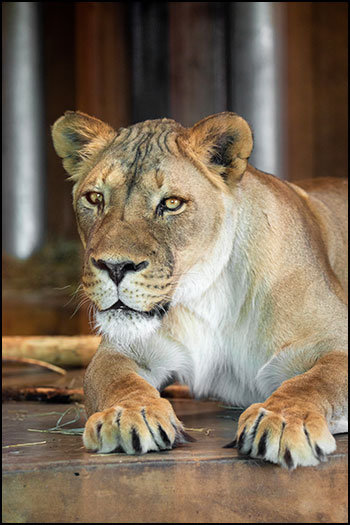
“At this point we have performed many diagnostic tests to determine the cause of Zwena’s symptoms and have administered a variety of medications to potentially treat ‘treatable’ diseases,” said CMZoo Head Veterinarian, Dr. Jon Romano. “Now, our goal is to keep Zwena as comfortable as possible, so she can live her best life. Her keepers are dedicated to her care. We’ll continue tracking her quality of life markers. Right now, other than her mobility, they are all looking good.”

Keepers are tracking quality-of-life markers, as they do for any animal with health conditions. Those markers help identify trends that indicate her symptoms are worsening or her life is not fulfilling her needs as a lion. Over time, the data will help her care team make any future decisions necessary. Zwena’s four markers are social dynamics within the pride, mobility, appetite and vision.

“She follows us with her eyes, eats like a champion and still has healthy respect from the pride,” said Diana Miller, African Rift Valley keeper and Zwena’s primary trainer, who has worked with her for 8 years. “So, for now, we’re focused on maintaining those indicators and avoiding any injuries as a result of her decreased mobility. I just love her so much and want to give her the best life she has left.”

Zwena, known affectionately as “Z” by many CMZoo staff members, is well-loved and respected for her no-nonsense approach to building relationships with people.

“Zwena is a brave, sassy, playful lion with one of the best animal personalities I’ve ever known,” said Miller. “She isn’t shy about telling you how she feels about you. You have to earn her respect, so it’s like a rite of passage when ‘Z’ accepts you. She seems like she’s really tough, but she’s a nurturer, too. When her sister, Lomela, had the three cubs in 2015, Zwena was the first to lead them out into the main yard to play. She loves to play and pounce, and even playfully stalks keepers and guests, despite her mobility challenges. Those interactions with guests have made her an amazing animal ambassador for her species. I mean, who could forget a 300-pound lioness focusing on you like that?”

Her care team monitors her condition daily, and makes decisions about which spaces she can safely explore. On days she’s doing well, Zwena may be in the indoor relaxation room. When her unsteadiness is worse, it’s unsafe for her to explore the main lion yard, with its potentially dangerous drops from pride rock. The indoor lion relaxation room could also present potentially unsafe scenarios for Zwena when she’s unsteady, because of the high benches that she would likely attempt to jump to and from.
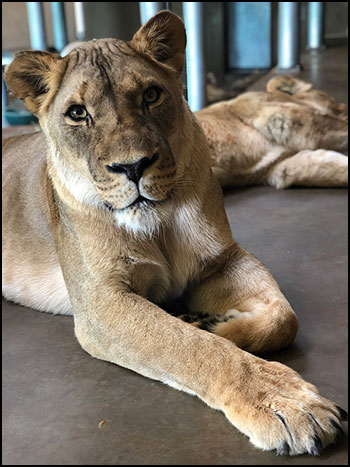
When keepers see she is less coordinated, she will spend her time in the behind-the-scenes outdoor ‘maternity yard,’ which will provide ample space for her to get safe exercise, fresh air and sunshine. She’ll also have access to off-exhibit indoor spaces where she can receive enrichment, participate in training and get lots of keeper attention.

“She’s not uncomfortable or suffering, and we want to keep her that way,” said Miller. “She’s mentally there, but she will sway or stumble as she walks, even on flat ground. We have seen her leaning against walls for stability or high-stepping over non-existent obstacles. These days, she more frequently half-jumps from low platforms and then pauses to steady herself before moving on, which could mean she’s not feeling confident about her mobility. So, we’re making adjustments to protect her from those environments that are no longer safe for her to navigate.”

Zwena’s symptoms have been intermittent since about 2015, but have recently become more chronic, so her care team is making changes now.

“Socializing is really important to lions, so we’re making sure Zwena still has time with her pride,” said Miller. “She and her sister, Lomela, are best buds. Even when it’s 90 degrees outside, we see them snuggling up together. They still play together, too. It is so fun to watch. Zwena is still living a fulfilling life, but she’s doing it in different spaces.”

Zwena will spend time with each member of her pride. At night, all four of the lions will share space together, to help Zwena maintain her respected position in the pride. Zwena’s vet and animal care team will continue exploring any new options available for keeping her safe and comfortable.
Back to The Waterhole


Children’s Hospital Colorado, our year-round sponsor, offers helpful guidance for helping children cope with stress and anxiety related to the ‘new normal’ of life during the coronavirus pandemic. In addition to a recent blog, they will be hosting a virtual talk on the topic, just for members and fans of Cheyenne Mountain Zoo, on Friday, May 8. (See all the details on the talk at the end of this article.)

Similarly, Cheyenne Mountain Zoo’s animal care department has found ways to help the animals in their care stay engaged and healthy, despite the changes in their daily lives.

“We’re working to help them feel as little interruption to their normal routines as possible,” said Jeff Halter, vice president of animal care. “Our animals are participating in training, husbandry behaviors, enrichment activities and daily interactions with their keepers. Through our Abnormally Normal series on social media, they’re participating in keeper talks and demonstrations. But, we can tell they know there’s something important missing from their normal lives: our guests and members.”

In May 2019, more than 80,000 people visited Cheyenne Mountain Zoo. Going from an average of 2,500 visitors per day to none has been an adjustment for everyone – including most of the animals. We told you last month about how the great apes of Primate World have shown us they miss guests, and they’re not the only ones.

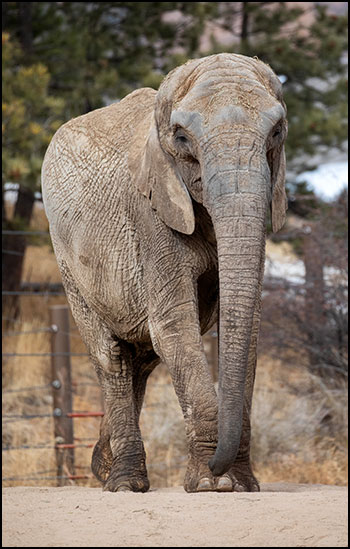
The African elephants have noticed a difference in their routines, too. The elephant herd of six females usually stays in groups of two or sometimes three in various areas of the yard and barn. One of those groups is Missy and LouLou.

“When we first closed, the elephants were used to their regularly scheduled feeding experience with guests, which always takes place right after the elephant demonstration,” said Stacey Smith, elephant and rhino keeper in Encounter Africa. “LouLou would see Missy going to the demo yard, so LouLou would head over to the elephant ‘snack time’ area in anticipation of her time with guests. After completing Missy’s training, we keepers would call for LouLou for her time to train in the demo yard. This only happened a few times, but LouLou would hesitate at the ‘snack time’ area, seemingly disappointed that there wasn’t a line of guests waiting to give her attention and treats.”

Keepers have been getting creative with ways to keep the animals in their care mentally and physically enriched. To replace keeper talks, giraffe keepers say they’re doing more frequent training and providing more enrichment items. The elephants are continuing daily training and foot care in the demonstration yards, and recently enjoyed a whole watermelon each for Easter. Last week, the elephants got special tree trunks and a mud wallow, which they thoroughly enjoyed in a light spring rain.

“Since we’ve been closed almost six weeks now, they’re getting more used to this new routine and not having those 30-minute snack times with guests,” said Smith. “We don’t offer those snack time experiences in the winter, either, so it’s not entirely new for the elephants. We’ve been providing extra enrichment and training so they’re staying engaged, but I’m sure they’ll be excited to get that time back with people once we reopen.”

However, not all animals seem to notice a lack of guest interactions in their daily lives. Keepers say the CMZoo pack of seven Mexican wolves, for example, isn’t experiencing much out of the ordinary. The wolf pack, unlike most animals at CMZoo, doesn’t participate in training or interact with guests. The wolf exhibit is expansive and the guest viewing area has one-way glass, so the wolves don’t see as much of our guests than most other animals. They are intentionally kept as wild as possible because the hope is that their future offspring could be released to supplement the endangered species in the wild.

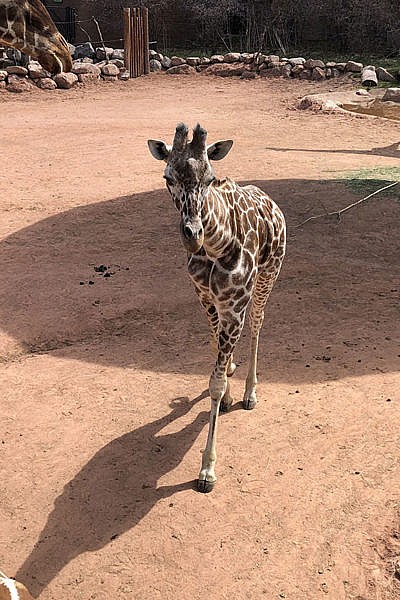
Most members of CMZoo’s reticulated giraffe herd of 16 seem to miss guests and get particularly interested in the staff who visit them – with or without lettuce. The giraffe boardwalk in African Rift Valley puts giraffe and guests face-to-face during daily lettuce feeding opportunities, so most of the giraffe are used to interacting with large numbers of people.

One member of the CMZoo giraffe herd may be benefitting from the quiet time, though. Panya, a 2-year-old reticulated giraffe who joined the CMZoo herd in September, recently started spending time with the full herd after slowly meeting various members over the winter.

“Panya has been shyer than a lot of our herd members,” said Kayla Ringuette, African Rift Valley keeper who works closely with Panya. “Because of the closure, we’ve been able to help Panya gain confidence in the big yard more quickly than we might have been able to with guests, because she has been pretty hesitant in the past.”

Panya began her introductions to the herd in the barn, over the winter. She started going outside in mid-April with some of the herd and later in the month with the whole herd.

“While the majority of our herd definitely misses guests, this time has allowed Panya to get really comfortable with the yard and the herd, which could have been intimidating for her with large numbers of people,” Ringuette said. “When we reopen she’ll be confident in the yard with the herd, and she’ll be ready to meet our awesome herd fans. If there is a silver lining, it’s that Panya got this extra time she’s using to adjust. She’s doing so well.”

Animals can be an inspiration during difficult times, showing us how they adapt to changes and show resilience through challenges. We’re working to continue fostering connections between our members and guests and the animals they love.

The Zoo is embracing its role as a community resource, even while we can’t invite our community inside our gates. Through online activity videos, keeper talks, animal demonstrations and moments of #CMZooZen, our team continues to reach our fans and inspire a love for animals and the natural world. CMZoo’s social media platforms are buzzing with our timely series called Abnormally Normal.

Although we’re temporarily closed, we’re permanently committed to caring for our animals and keeping you connected to our mission, our animals and the natural world. It’s definitely an abnormal time in the world, but we’re providing special glimpses at how normal things are at the Zoo. Follow our Abnormally Normal Video Series on Facebook and YouTube! As always, our guests are enjoying the giraffe herd remotely, using our two live streaming Giraffe Cams overlooking the outdoor yard.

In effort to serve as a continued resource for children and families during these uncertain times, Children’s Hospital Colorado is hosting a live webinar on Friday, May 8 at 12 p.m. MT. Dr. Jessica Hawks, clinical child and adolescent psychologist at Children’s Hospital Colorado, will be presenting on the topic of COVID-19 and Mental Health. Dr. Hawks will describe unique challenges children, teens and parents are facing during the COVID-19 crisis, how parents can talk to their kids about COVID-19, warning signs that a child or teen may be experiencing mental health concerns, and how children, teens and parents can best cope during this difficult time. Time will be reserved for Q&A to address any specific questions families may have regarding this topic. Click this link on Friday, May 8, 2020 at 12 p.m. to join the live webinar on Zoom, hosted by Children’s Hospital Colorado: https://ucdenver.zoom.us/j/95899621728.

Back to The Waterhole


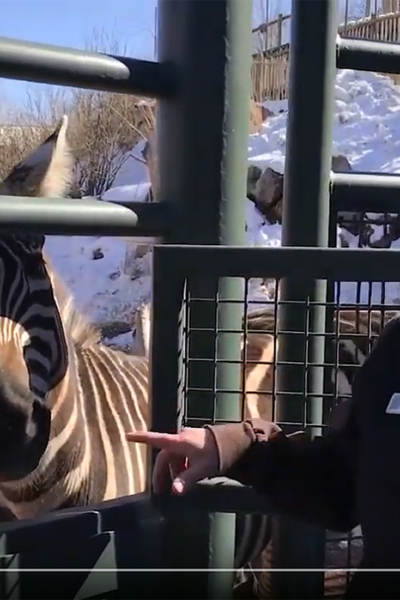
African Rift Valley Senior Lead Keeper, Jenyva, introduces us to the CMZoo zebra brothers, Wembe and Mugambi, and walks us through their training and husbandry behaviors.

Back to The Waterhole


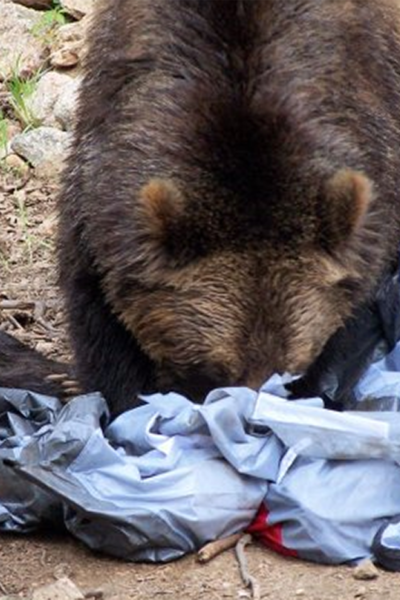
American black bears in Colorado will start coming out of hibernation soon, and they’ll be hungry after a winter in the den. Although we don’t have any native species of black bears at Cheyenne Mountain Zoo, we’re advocates for doing all we can to keep wild animals wild. No matter the species, it’s never a good idea to feed a wild animal – on purpose or by accident. In some cases, feeding wildlife is illegal.

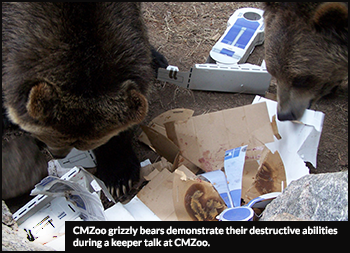
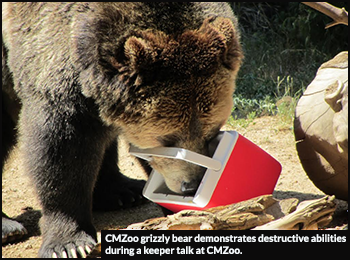
Early risers can make a difference and save bear lives. When it’s trash day, put trash out the morning of pick-up. We have bear-safe trash receptacles throughout the Zoo, and similar models are available for residential properties. If you don’t want to invest in a bear-safe trash receptacle, keeping your trash cans in a garage or shed is a good option to help keep bears out of trouble. Bears think garbage smells amazing and if they can get into it, they will.

“With five toes on each paw, bears are incredibly dexterous,” said Rebecca Zwicker, Rocky Mountain Wild animal manager. “Over time, they learn how to use their dexterity to open doors and containers, so it’s up to us to stay one step ahead of them.”

Bears also love birdfeeders. They love sunflower seeds and other seeds, and especially love hummingbird food. When a bear eats from a birdfeeder, it’s probably going to destroy that bird feeder and eat all of the food you bought for the birds. Also, once they find a food source, they’ll often come back to that area, which creates a potential for surprise visits in your backyard. Take bird feeders down at night when bears are most active, or just hang bird feeders in the winter, when the bears are asleep and the birds are really searching for food.

Black bears can smell a meal from up to 20 miles away. Once they smell and find a campsite, they’ll start searching for food. When you’re camping, keep food outside of your tent, so you’re not inviting bears to investigate your sleeping quarters. Keep food locked in a bear-safe container or hang your food from a rope, high off the ground and away from something a bear could climb. Bears are attracted to things like s’mores and meat, but also toothpaste and coffee. If it smells interesting, a bear wants to check it out.

“Bears are intelligent, and they have really great memories,” said Zwicker. “Once they’ve found a source of something yummy, you can bet they’ll be back for more.”

Once a bear comes into human spaces, they’re given the term ‘nuisance bear.’ They’re tracked and usually only get a few ‘strikes’ before they have to be killed, or in some rare cases relocated. That’s why it’s so important that we help prevent opportunities for them to become a nuisance.

“Seeing a bear in the wild is magical,” said Zwicker. “Their presence is part of what makes Colorado so special, but it’s up to us humans to protect these curious creatures from themselves. If you can follow these simple tips, you could save a bear’s life.”

Back to The Waterhole


For giraffe, hoof health is vital to overall health. As the zoo profession evolves to further embrace animal husbandry training, and new veterinary technologies allow for better diagnostics, Cheyenne Mountain Zoo is working to improve the future of giraffe care.

“Horses have been domesticated for thousands of years, and the mantra has been ‘no hoof, no horse,’ meaning the overall health of a horse is connected to the health of its hooves. More and more, we’re embracing that for giraffe,” said Dr. Liza Dadone, vice president of mission and programs at CMZoo. “We don’t yet have all the answers, but we have seen that hoof overgrowth changes how the foot supports the weight of a one-ton body. When an animal distributes that much weight differently because of hoof overgrowth, it can have a huge impact on their joints, ligaments and bones.”

Giraffe hooves grow continuously throughout a giraffe’s life. Ongoing hoof maintenance can help prevent issues commonly associated with hoof overgrowth, like lameness and early onset arthritis. Training giraffe to voluntarily participate in hoof maintenance makes preventive care possible, hopefully avoiding these ailments for future generations of giraffe.

Because it’s such an integral part of CMZoo’s work today, some may be surprised to learn that giraffe hoof care is still in its pioneering phase.

“Before our training program started in 2013, we had limited options for managing hoof overgrowth,” said Dr. Dadone. “We also didn’t fully understand what a ‘normal’ giraffe hoof should look like, because we didn’t have consistent access to the underside of the hoof. Training giraffe to participate in their health care has been a total game changer in the level of care we can provide.”

In the last ten years, CMZoo’s Zoo-wide training programs have flourished. The giraffe care team has been recognized nationally for its training success. In just two years, the giraffe care team, led by Animal Care Manager, Jason Bredahl, and Lead Giraffe Keeper, Amy Schilz, developed safety and training protocols and trained the entire herd of giraffe for front foot hoof trims and x-rays.

“It was unheard of,” said Dr. Dadone. “The giraffe were way smarter than we had given them credit for, and this training gave us opportunities to provide ongoing care without anesthesia.”
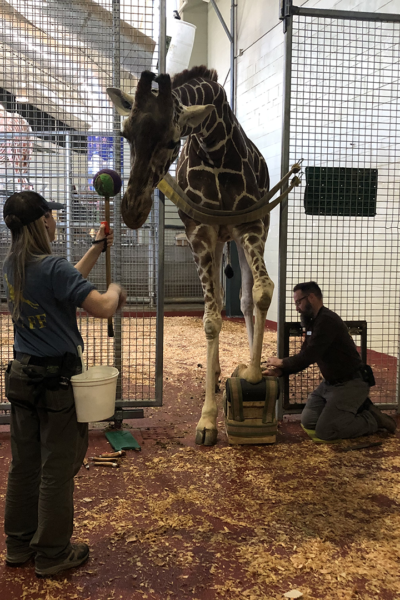
Hoof care training techniques include asking the animal to voluntarily approach the team, then lift, position and hold its foot so staff can access it safely.

When working around the feet of a 17-foot-tall, one-ton animal, human safety is crucial. The team developed co-working communication that allows one person to train and keep the giraffe’s attention while the other person performs a hoof trim (or other necessary hoof work). Staff learned which kinds of barriers would best protect them and provide adequate access while working safely around giraffe feet. They also studied behaviors in the giraffe so they could recognize when a giraffe might need a break from hoof work.
Zoo campers fingerpainting
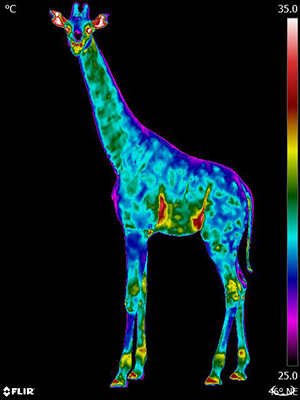
Once the herd trained to receive x-rays, the care team found that arthritis, ligament injuries, bone damage, and sometimes fractures were present at a rate they weren’t expecting. This discovery led the team to establish a program that included routine front foot x-rays, thermography, visual assessments and monthly hoof trims.

“We can more accurately diagnose and manage giraffe foot health with less invasive procedures, thanks to training,” said Dr. Dadone. “Now that we know giraffe are prone to these issues, we prioritize training of animals from an early age. The goal is that every giraffe, from one year of age, can have its front feet handled and can receive baseline x-rays. The hope is that we can help the next generation of giraffe avoid some of the issues our older giraffe might be experiencing.”

Young giraffe, like Viv, born at CMZoo in July 2019, start training to participate in their care from an early age. Nearly 8-month-old Viv already participates in prerequisite training that will lead to hoof care training. Her keepers say she is shift-trained, which means she will voluntarily move to another area of the barn or outdoor yard when asked. Viv also shifts into ‘the chute,’ which is a narrow part of the indoor barn that some giraffe move through to receive hoof care and other care.

She participates in target training, as well, which means she will touch her nose to a target held by her trainers. For hoof care or x-ray training, target training helps trainers communicate the very specific location the animal is being asked to move to. Likewise, the target helps animals understand what’s being asked of them.

Viv’s keepers have taught her a ‘back up’ command, which helps Viv get into position for hoof care, among other things. They recently started training Viv to get comfortable with being touched, beginning with her shoulders. Once she’s comfortable with being touched on the shoulders, they will continue progress to eventually touch her hooves, which will get Viv even closer to receiving ongoing hoof care.

As CMZoo’s giraffe care team continues finding new ways to improve the health of animals in their care, they learn from and share best practices with the wider giraffe care community. They do this by attending conferences, hosting CMZoo’s annual giraffe care workshops, and through studies, programs and partnerships with Equine Lameness Prevention Organization, Colorado State University Veterinary Teaching Hospital, Giraffe Conservation Foundation and more.

Back to The Waterhole


Seasonal illnesses, like influenza, can wreak havoc on humans this time of year. But, did you know great apes, like orangutans and gorillas, are also susceptible to the flu virus, which impacts an estimated 3 million humans annually?

As Cheyenne Mountain Zoo’s year-round sponsor, Children’s Hospital Colorado, provides tips for staying healthy during flu season, Primate World keepers take steps each year to help great apes stay as healthy as possible.

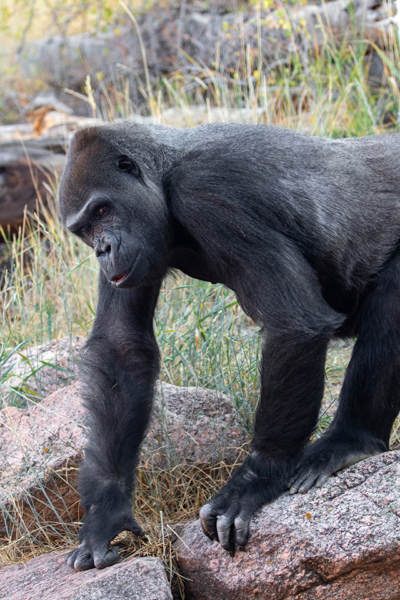
“The great apes are the most susceptible to illnesses that impact human primates, like you and me,” said Dina Bredahl, senior lead keeper in Primate World. “Any primate at the Zoo can catch illnesses from humans, but the risk is increased for great apes because they’re so similar to humans. Orangutans share 97 percent of the same DNA as humans.”
Orangutan Kera doing injection training
To protect the Bornean and Sumatran orangutans and the Western lowland gorillas at CMZoo, the apes receive the flu vaccine. The flu vaccine is administered by injection, which the Primate World residents train to accept voluntarily. Flu shots are available each fall, but injection training continues throughout the year nearly every day. The training can take months and requires the apes to build upon the trust they have in their keepers. Some of them choose not to participate in injection training, or may not be at a point in their training that keepers feel confident a real injection won’t derail the progress.

“We rely on ‘herd immunity’ to protect the population, so not every single great ape will receive a flu shot,” said Bredahl. “As long as a majority of the gorillas and orangutans receive the vaccine, we drastically reduce their overall risk.”

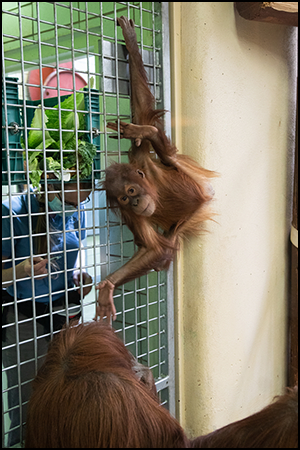
One example is one-year-old Sumatran orangutan, Kera. Little Kera was at a point in her training that her primary keeper thought a real first-time ‘poke’ might risk a regression in her training. Because the majority of the other primates were further along in training, Kera didn’t receive a shot during the fall flu shot clinic. However, her primary trainer continued training, and Kera has made incredible progress. So much progress, in fact, that she gets excited for the training.

“We’ll use a syringe that doesn’t have a needle, so they get used to seeing the shape and being touched with it,” said Bredahl. “Eventually, we move on to a dull needle, so it looks more similar to the needle we’d use for an actual injection. Kera’s trainer has been so successful that Kera now knows if she presents her hip and then holds still for a moment for the pretend injection, she’ll get a special reward. She presents her hip pretty enthusiastically, which is adorable and impressive since she’s still just an infant!”

Keepers also take steps to avoid transmitting diseases to the great apes.

“Primate World keepers receive flu shots yearly to protect ourselves and the great apes in our care,” said Bredahl. “We also wear medical masks when we prepare their food or are in close protected proximity to them. We wash our hands constantly and practice good hygiene before and after we handle anything they’ll touch or eat.”

Guests can visit CMZoo’s three Bornean orangutans, three Sumatran orangutans and five Western lowland gorillas – and can even see their training during scheduled demonstrations – in Primate World.

Back to The Waterhole


Male Canada moose, Tahoma portrait
As the oldest Canada moose in human care in the United States, CMZoo’s 12-year-old male, Tahoma, has received specialized care for years. Until recently, his issues – including arthritis in his limbs and spine, and an on-and-off cough – haven’t seemed to decrease his long-term quality of life.

Now, Tahoma is showing signs that his pain is increasing, so keepers and CMZoo veterinary staff are working to keep him comfortable for his remaining time. Tahoma’s care team says he’s still eating well, which is a good sign.

Because moose are rare in human care, there’s widely varying data about their average life expectancy. The range we have seen from reputable sources is from 5 to 15 years. But, they have been known to decline quickly once issues become widespread, like this.

“We’ve seen a general slowing down in Tahoma over the last several weeks,” said Rocky Mountain Wild Animal Keeper Allison Rosing. “Specifically, he’s dealing with a significant arthritis-related limp in his front left leg, which he’s been compensating for by shifting weight to his right leg. Because he’s putting more weight on his right leg, we’re seeing inflammation in his right knee. We’ve also seen him ‘hiking’ his head up when he walks, to lessen the weight on his left leg.”

X-rays on Tahoma show severe arthritis in his left leg and other limbs, and advancing arthritis in his spine. His care team has been managing his arthritis for a few years, but recently it seems to be advancing more aggressively.

“We know we’re not going to be able to correct any of this for him, but we can do things to make him more comfortable,” said Rosing. “We’re managing his pain by increasing his anti-inflammatory medications, pain medications and laser therapy sessions. We’re also providing more spaces for him to lie down and rest.”

His team moved some large branches, which he’d previously enjoyed sparring with, out of his barn to make space for a big pile of pine shavings that he can lie on.

“He loves it,” said Basia Dann, Rocky Mountain Wild animal keeper. “He comes in to his barn every night and curls up in his pine shavings.”

Tahoma receives laser therapy on his joints three times per week. Laser therapy is thought to reduce pain and inflammation. Keepers have noticed his limp improving since starting the more frequent therapy regimen.

“Lately he seems more willing to come over and train, which is great because it gives us more opportunities to give him his medications, lots of love and special treats,” said Dann. “In addition to the laser therapy, we have vet appointments with him weekly, so we can track the progression of his issues and make adjustments to his treatment quickly.”

Tahoma’s keepers offer his oral medications – which Tahoma doesn’t seem to enjoy taking – with treats like bananas, kiwi and rye crackers with honey and molasses.

“There’s not a lot known about moose in human care, because there are so few of them,” said Dann. “We’re tracking Tahoma’s issues and overall quality of life, so we can help him stay comfortable for as long as we can, and so we can share information with other organizations whose moose could benefit from it.”

We will continue to keep Tahoma as comfortable as possible while continuing to track multiple factors for his overall quality of life. Stay tuned for more updates on Tahoma as we have them.

 
Back to The Waterhole


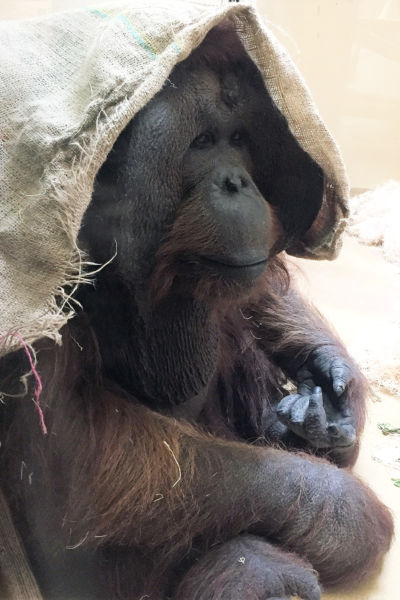
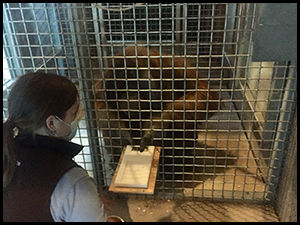
Tujoh, a 25-year-old male Bornean orangutan, recently made CMZoo husbandry training history. Tujoh and his primary trainer, Amy Tuchman, successfully completed a voluntary electrocardiogram (EKG) – a test that measures the electrical activity of the heart.

As Tujoh ages, Tuchman and the rest of his care team are looking for ways to take advantage of new technologies to diagnose medical issues common in great apes, like cardiovascular disease.

“It’s especially prevalent in middle-aged male great apes, and all of our guys in Primate World fall into that category,” said Tuchman. “This device allows us to monitor them as often as we like. Early detection could be the difference between life and death, especially for a big guy like Tujoh.”

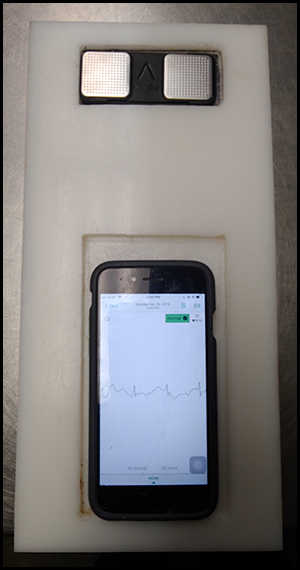
This new pocket-sized equipment is a welcome advancement for 340-pound Tujoh, who Tuchman describes as a “straight-A student.” The test requires Tujoh to place his two index fingers through the protective barrier between him and Tuchman, onto the quarter-sized metal discs that take the reading. Then, he needs to keep his fingers on the discs with consistent pressure for thirty seconds, continuously.

It only took Tujoh a month to learn how to successfully complete the test. Perhaps that’s in part thanks to his intense focus. Tuchman says Tujoh likes to maintain direct eye contact with her throughout the training.

“He learns incredibly fast,” said Tuchman. “He already knew a ‘hold’ cue, and we built the behavior from there. Once he was sitting on the other side of the mesh from me, I held up my finger and asked him to touch his finger to mine. He’d never done it before, but he got it right away.”

Tuchman cleans Tujoh’s two fingertips before he places them onto the device to ensure the best connection for the reading.

“Now he holds out each finger individually for me to clean before we start, like he’s getting a manicure,” said Tuchman, with a laugh. “He learns how to do something, and he remembers every step you’ve asked of him. Then, he wants to do it that exact way every single time.”

As with most behavior training, the trainers learn from the animals, too.

“The device is made for humans, so we needed to customize how we could present it in a way that allowed trainers to be hands-free to reward his participation,” said Tuchman. “We also needed to securely present it at a level that he could access it while sitting and relaxed on the other side of the protective barrier between us, so we could get an accurate reading.”

Compared to the oversized and complicated readers of the past, these test results will likely be more accurate, because the testing equipment and overall experience are less invasive, thus less stressful for Tujoh.

“It’s still sensitive equipment,” said Tuchman. “That’s a good thing because we know it’s picking up the tiniest abnormalities for us to track, but it also requires a lot of patience and participation from Tujoh to complete the test.”

Tuchman and her team were inspired to pursue the ability to provide regular EKGs for the great apes in their care and attended a conference with Great Ape Heart Project – a coordinated clinical approach targeting cardiovascular disease across all four non-human great ape taxa: gorillas, orangutans, chimpanzees and bonobos. Studies have shown cardiovascular disease is a primary cause of mortality among great apes.

“I’m the primary keeper for Goma [28-year-old Western lowland silverback] and Tujoh, so I was interested in learning how other zoos are managing cardiac care, what tools are available and what we could do to improve our great apes’ cardiac care,” said Tuchman. “Any little improvement we can make to monitor their cardiac health and stay ahead of any issues will be really important.”

Tuchman and her team will share Tujoh’s data with Great Ape Heart Project so they can learn and share data that benefits great apes in human care around the world. They will also continue training with other great apes at Cheyenne Mountain Zoo to utilize this life-saving, non-invasive diagnostic tool with as many participants as possible.

 
Back to The Waterhole


We often tell stories about animals who have been brought together on breeding recommendations, like CMZoo North American porcupines, Kale and Quilliam, or Mexican wolves, Luna and Navarro. With the annual celebration of love just around the corner, we’re taking a closer look at how animal matches are made and how zoos work together to help species survive, long before the howdies begin.

“In a nutshell, Species Survival Plans support healthy genetics in animals in human care,” said Ashley Arimborgo, CMZoo registrar, who often oversees the coordination between Zoos that are transferring animals on breeding recommendations to and from Cheyenne Mountain Zoo. “Species Survival Plans contribute to the success of an assurance population of animal ambassadors that advocate for their wild relatives, and inspire people to support important conservation efforts.”
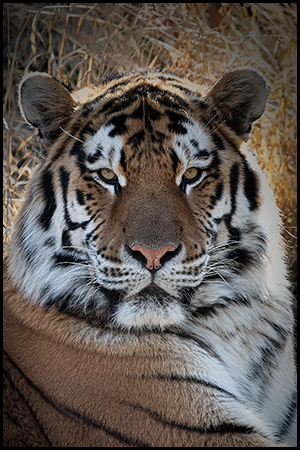
Amur tiger portrait
The Association of Zoos and Aquariums (AZA) is the standard-setting accreditation organization for zoos and aquariums in the U.S. The AZA champions Species Survival Plans (SSP) managed by SSP coordinators. SSP coordinators are professional volunteers who often work at AZA-accredited organizations, but don’t work for the AZA.

SSP coordinators work with Taxon Advisory Groups (TAG) which track five-year population projections for their respective species, including population trends for animals in human care and in the wild. Also instrumental in the matchmaking process are studbook keepers. They track the genetic data of each animal in human care (at organizations participating in SSPs) and bridge gaps in documentation. That data is collected and presented in graph form, with the most unrelated animals of the same species being the most valuable potential matches.

“It’s a pretty complicated process, but the matches are largely data-driven and based on genetics, health and age,” said Arimborgo.

Every two or three years, SSPs release species-specific breeding and transfer draft plans. Organizations that have animals impacted by the plan – known as holding institutions – provide input including whether or not the organization would like to transfer an animal or host animals to breed. Then, the plan is finalized and published to the participating organizations. Holding institutions work together to arrange animal transportation.

“It’s not unusual to see a big shuffle in a single species among participating organizations when a new plan is released,” said Arimborgo. “We saw that in the fall with Amur tigers because of new recommendations. Thimbu went to Rosamond Gifford Zoo on a breeding recommendation, and Savelii came to us on a match with Chewy.”

The SSP also tracks trends and genetics to address future potential pitfalls to a species’ survival. They may find one species has an abundance of older females and younger males, which could determine urgency of breeding or breeding prevention.

The team also works together to track available housing for future populations. If one species grows quickly, organizations participating in the SSP may run out of room to house additional individuals.

One example of that is the Mexican wolf. In the last two years, Luna and Navarro, CMZoo Mexican wolves who were introduced on an SSP breeding recommendation, welcomed six pups to their pack. One pup, Lupa, moved to an organization in Arizona in November 2018. The remaining seven Mexican wolves have brought CMZoo’s wolf habitat to its maximum capacity. Since other participating organizations don’t have room for more wolves either, the male and female wolves will live in separate areas during breeding season this year.

Beyond that, it’s up to each individual zoo to manage introductions and breeding interactions.

“The SSP breeding recommendations don’t typically take an animal’s individual personality or preferences into account.” said Arimborgo. “The keepers and management staff factor in individual histories as well as behaviors when introductions start taking place. Through careful observations and training, trust can be built and the stage can be set for the animals to be most successful. ”

 
Back to The Waterhole


CMZoo North American porcupines, Kale and Quilliam, were united in late 2018 on a breeding recommendation. Rocky Mountain Wild Keeper, Allison Rosing, gives an update on how the two are getting along and how Kale is participating in training, in case any porcupettes (baby porcupines) are in our future!