One of the oldest elephants in the U.S. becomes a true “Golden Girl”


COLORADO SPRINGS, Colo. –
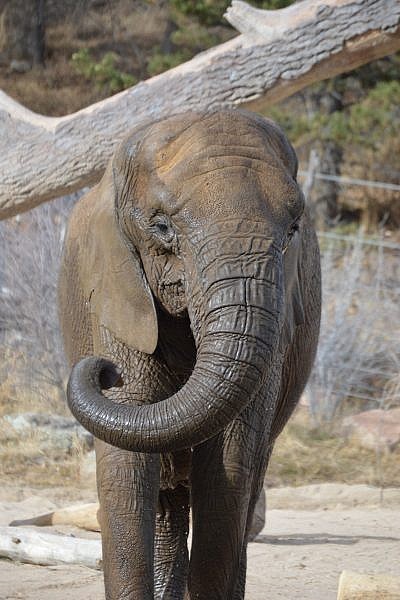
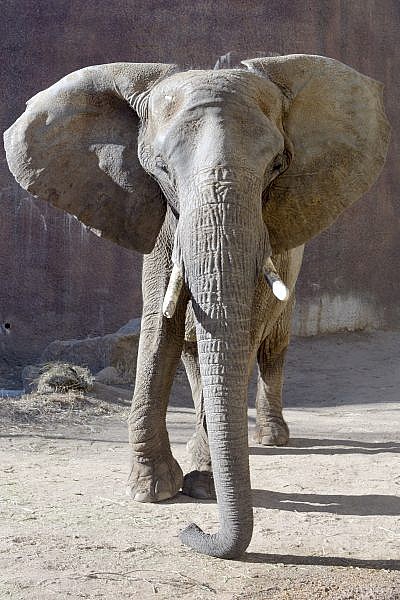
Cheyenne Mountain Zoo is inviting media and the public to celebrate our oldest resident’s 50th birthday. Children’s Hospital Colorado is presenting the birthday party for Missy, a female African elephant, who will have the opportunity to participate in special birthday enrichment activities, including an elephant-sized birthday cake. Guests can take free photos in our elephant-themed photo booth, learn about Missy and the CMZoo African elephant herd of six aging females during a keeper demonstration, participate in paid feeding opportunities with Missy, and more.

Missy has surpassed the median life expectancy (MLE) for her fellow female African elephants living in zoos accredited by the Association of Zoos & Aquariums. At 50, she has surpassed the MLE by about 12 years, and it’s possible that she could continue to thrive for many more years. Missy is in good health, and is one of the fastest power-walkers in the herd. Her keepers describe her as, “patient but demanding, kind of like you’d expect a ‘Golden Girl’ to be.” She is one of the oldest African elephants currently living in the U.S.

WHO – Missy, CMZoo African elephant
CMZoo guests, members and staff
Children’s Hospital Colorado

WHAT – A birthday party to celebrate Missy’s 50th birthday

WHERE – Cheyenne Mountain Zoo’s Encounter Africa Exhibit

WHEN – Sunday, June 30, 2019
10 a.m. to 12 p.m.

SCHEDULE
(Subject to Missy’s choice to participate or not)

10 a.m. to 12 p.m.
Write a “Message to Missy,” take a free photo with elephant-themed props at Children’s Hospital Colorado’s photo booth, and learn about African elephants from our CMZoo Docents with elephant biofacts.

10:10 a.m.
Missy and her best friend, LouLou, have the opportunity to enjoy special birthday enrichment activities in the main elephant yard.

10:45 a.m.
Keepers Caring for Elephants Demonstration

11 to 11:30 a.m.
Elephant Feeding Opportunities with Missy
($10 to $15 per feeding)

11:30 a.m. to 12 p.m.
Join us in singing ‘Happy Birthday’ to Missy, as she enjoys an elephant-sized birthday cake, made with her favorite snacks.


About Cheyenne Mountain Zoo

Cheyenne Mountain Zoological Society was founded in 1926. Today, Cheyenne Mountain Zoo, America’s mountain Zoo, offers comprehensive education programs, exciting conservation efforts and truly fantastic animal experiences. In 2019, Cheyenne Mountain Zoo was voted #6 Best Zoo in North America and CMZoo’s Rocky Mountain Wild was named #5 Best Zoo Exhibit in North America by USA TODAY 10Best Readers’ Choice Awards. It is Cheyenne Mountain Zoo’s goal to help guests fall in love with animals and nature, and take action to protect them. Of the 233 zoos and aquariums accredited by the Association of Zoos and Aquariums (AZA), Cheyenne Mountain Zoo is one of just a few operating without tax support. Cheyenne Mountain Zoo depends on admissions, membership dues, special event attendance and donations for funding.
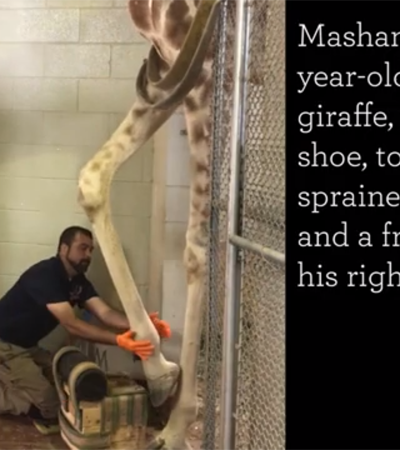
Mashama, 9-year-old reticulated giraffe, is known for his outgoing personality and energetic presence in the Cheyenne Mountain Zoo giraffe herd. Lately, though, Mashama has been dealing with some foot and leg issues.

“We’ve discovered that Mashama has sprained ligaments and a fracture in his right foot,” said Dr. Liza Dadone, CMZoo head veterinarian and VP of mission and programs. “Combine those issues with a ligament strain in his right front wrist [that looks like the right front knee], which preceded the fracture, and we have a pretty complex case to solve.”

Mashama’s care team saw him limping after he stumbled during an especially playful day in the main yard a few months ago, and took x-rays of his foot. The x-rays revealed no significant damage, so his care team began to administer pain medications and moved him to a sand stall to let a perceived muscle strain heal with rest, over time. After a couple of weeks of normally effective sand stall rest for Mashama, the team noticed he wasn’t improving as much as they would have liked to see, so they performed additional testing.

Those tests revealed that he had developed a fracture in his right front foot. CMZoo’s veterinary team, keepers, trainers and animal care managers have been working together with outside partner organizations to consider every possible treatment for Mashama.

One of those treatments is a customized ”shoe” that adheres to his right front hoof. CMZoo regularly works with specialized farriers from the Zoo Hoofstock Trim Program (ZHTP), a subspecialty of the Equine Lameness Prevention Organization. The ZHTP team built Mashama a custom “shoe” in early April 2019 that seemed to help stabilize the foot fracture while it healed. Almost immediately, from the time the shoe was in place, Mashama appeared to be putting more weight on his right front foot, indicating he was much more comfortable. After several weeks of healing, he was able to access an outside side yard, which has smoother terrain than the main yard.

Earlier this month, Mashama’s shoe came unglued and had to be removed. The team built him a second shoe and applied it mid-May.

In the accompanying video from May 15, 2019, Mashama receives his new shoe. Steve Foxworth, CMZoo’s farrier expert, from ZHTP, explains the shoe’s design and material, and Mashama’s team displays his incredible participatory behaviors that allow them to care for him in situations like this.


“Two months into this path, he’s looking better and better,” said Dadone. “We are by no means out of the woods, but we’re seeing improvements and will continue exploring other options that will help Mashama address the issues in his wrist and foot. A fracture and a sprained ligament could go on to cause significant health problems for him, if we’re unable to stop their progression.”

Because Mashama is such an exemplary participant in his own health care, he is trained for blood draws. His comfort level with blood draws makes him an ideal candidate to receive IV injection treatments that could help him.

“One option we’re considering is an equine medication we’ve used in other giraffe that increases bone density,” said Dadone. “The drug is administered intravenously and must be absorbed in the affected areas for ten minutes. This drug could reverse the course of his injuries, but it’s not easy to administer.”

Staff would need to apply a tourniquet to Mashama’s leg and administer the drug through an IV into the lower portion of his right front leg – giving the most deteriorated bones the best opportunity to absorb the drug. The tourniquet would need to stay in place for ten minutes. That’s a long time to ask an energetic and curious animal like Mashama to stay still.

“Normally, we need to anesthetize an animal to administer this drug,” said Dadone. “But since Mashama is such a rockstar at training, we’re going to see if he’ll participate in training to stay still for that long. It’s always a last resort to anesthetize an adult giraffe, because there are more potential risks than with other animals, so keeping him awake for the procedure would be best.”

Another option is stem cell treatments to help reduce inflammation and speed healing in his foot bones and sprained wrist joint. CMZoo has successfully used this treatment with other giraffe in the herd, but again, the treatment process is complicated. Stem cells have to be administered through the jugular vein in the neck, and have to be kept at a very cold temperature, which would be an unusual sensation for Mashama.

“We’re not quite there yet, but it’s an option. It’s on the experimental side, but we have seen it help in a small number of cases at our Zoo and a few others,” said Dadone. “We’ve tried laser therapy, hoof trims and sand stall rest, to no avail for him. The shoes are offering some comfort and relief, but we’re looking at all options to help him recover long-term.”

Mashama’s team of CMZoo vets, keepers, trainers and staff will continue working to test solutions for him. For now, the new rubber shoes appear to be helping Mashama walk and stand more comfortably, and he’ll return to the outdoor yard with the rest of the herd when his care team decides it doesn’t pose a risk of further injury for him.

We’ll keep you updated on Mashama’s progress, and hope to see him soon return to his former playful self with the success of these potential treatments.

In anticipation of Mother’s Day, we’re celebrating some of the animal matriarchs who live with their offspring at CMZoo. Take a walk down memory lane as we remember their adorable babies and check in with the moms and their growing offspring today.

Providing excellent health care for the hundreds of animals at Cheyenne Mountain Zoo comes in many forms. Depending on their individual needs, animals might receive special diets, exercise plans, laser therapy treatments, vaccines, medications and more. Their health care plans often involve injections, both proactively in the form of annual vaccinations, and reactively with medications that can help them through an illness or injury.

Most CMZoo animals participate in voluntary injection training, designed to help keepers and animals prepare for and reduce stress involved with real injections when necessary. Some CMZoo animals participate in their own health care by also taking part in voluntary blood draws. During injection and blood draw training, the animals have the opportunity to walk away at any time but typically choose to stay and participate. These blood draws allow vets to test animals for any issues and respond to them accurately. The blood draws also contribute to national and international research projects that benefit countless species in human care and in the wild.

Through these voluntary blood draws, CMZoo is able to contribute to a giraffe blood plasma bank. The plasma bank is shared with other AZA-accredited institutions, and can help giraffe calves who are struggling to survive in their first days.


Just as Children’s Hospital Colorado provides tips to help children overcome the fear of shots, CMZoo Animal Behavior Programs Manager Rick Hester shared his approach to helping CMZoo’s animals respond comfortably to necessary injections and blood draws.
 

  • Teach prerequisite skills first.
    Before we ever get to needles, we teach animals to present various body parts to us, hold still, and allow us to touch them with various benign objects, like our hand, a key, or a stick. These are some of the necessary skills for them to succeed when we need to give a real injection or perform a blood draw.
  • Arrange the environment.
    We look at the overall environment and arrange everything for the animal to be successful. A comfortable place to sit or stand, an easy way for us to deliver food treats, limiting noise or other distractions if possible — these are all examples of ways we arrange the environment for success.
  • Find the right reinforcers.
    Our training program focuses on positive reinforcement techniques. To be successful, we need to have the right reinforcers, depending on the animal and depending on the behavior we are teaching. For behaviors like holding still for an injection or a blood draw, we use high-value food items such as fruit snacks for an orangutan, marshmallows for an African elephant, or chicken for an African lion.
  • Celebrate small steps towards the goal.
    We would rarely be successful if we expected an animal to present its shoulder and let us give them a vaccination during our very first training session! We reinforce small approximations (what some might call “baby steps”) to get them to the final goal. For example, they could start by presenting their shoulder to a keeper’s hand, then a stick or a pen, then finally a syringe. We reinforce each successful step or approximation and move forward to the next as the animal performs each step confidently. This style of teaching provides the animal with a lot of information about how to be successful and builds their confidence quickly.
  • Prepare the site.
    For some species, we apply ice to the injection site prior to giving a vaccination or performing a blood draw. This helps reduce the response to the needle poke for some animals.
  • Follow the animals’ lead.
    Do we have to give the injection in the shoulder if an individual seems more comfortable presenting a hip or leg? We let the animal’s behavior influence what the final goal looks like in all of our training. In this way, our training is a dialogue between humans and animals, helping to set both up for success.

Children’s Hospital Colorado is a year-round sponsor of Cheyenne Mountain Zoo.


Colorado Springs, Colo. – This morning, a team of Cheyenne Mountain Zoo staff used specialized equipment to successfully assist Malaika, a 33-year-old African elephant, who was found lying on her side during an overnight check. If an elephant can’t get up on its own and is down for too long, it can cause stress to its internal organs and can be fatal. The team responded in the early-morning hours to mobilize a specialized crane-and-hoist system in the barn to help the elephant to her feet, since she was unable to stand on her own.

The team was made up of more than 20 cross-discipline Zoo staff members, including Malaika’s animal keepers, veterinary staff, maintenance and grounds personnel, The Colorado Springs Fire Department Heavy Rescue team, Broadmoor Fire Department, and more.

The Zoo’s emergency response team was able to use the barn’s hoist system to help Malaika into a sternal position (on her belly, with legs in a better position to stand). Malaika was then able to stand on her own, with the hoist strap still in place for support, at 6:47 a.m. Since then, her care team, including her keepers and veterinary staff, have been monitoring her for any additional medical concerns. She is drinking electrolyte water, eating some of her favorite treats, and taking medication for inflammation and pain.

Malaika has a history of not being able to get back up from laying down, and had to be rescued once before, on Jan. 1, 2018. Some elephants are able to lie down and get back up with no problem, but some, like Malaika, don’t ever lie down and instead just lean on objects for rest. This is partially due to a life-long issue with bowing and lack of strength in her back right leg, which is worsening as she ages.

Because of Malaika’s history, Zoo staff monitor her throughout the day and with checks every two hours overnight. Our monitoring system shows that Malaika went down around 3:45 a.m., from what appears to be a leg wobble during a deep sleep. She was discovered down during the 5 a.m. check. A core Zoo team was assembled at the elephant barn between 5:30 and 5:45 a.m., with a full team on-site by 6 a.m. Protocols were immediately put into place to help her stand.

The Zoo cares for an aging female elephant herd, so the barn is equipped with state-of-the-art equipment that helps address the inevitable complications that come with multi-ton animals that need medical assistance. Equipment includes a remote video surveillance system for animal care staff to monitor the elephants, the crane-and-hoist system that can lift a disabled elephant and a care system that provides a safe area for weighing, veterinary care and husbandry training. Outdoor wellness features of the exhibit include an exercise path, built-in enrichment activities, a pool and a spacious vacation yard, where our elephants can take time to roam and explore by themselves.

Zoo staff performs drills to practice and test protocols for situations like these. The last “down elephant” drill occurred in January 2019, which is likely one reason the procedure to help Malaika today ran as successfully as it did.


About Cheyenne Mountain Zoo

Cheyenne Mountain Zoological Society was founded in 1926. Today, Cheyenne Mountain Zoo, America’s only mountain zoo, offers comprehensive education programs, exciting conservation efforts and truly fantastic animal experiences. It is Cheyenne Mountain Zoo’s hope that guests fall in love with animals and nature, and take action to protect them. Of the 233 zoos and aquariums accredited by the Association of Zoos and Aquariums (AZA), Cheyenne Mountain Zoo is one of just ten operating without tax support. Cheyenne Mountain Zoo depends on admissions, membership dues, special event attendance and donations for funding.
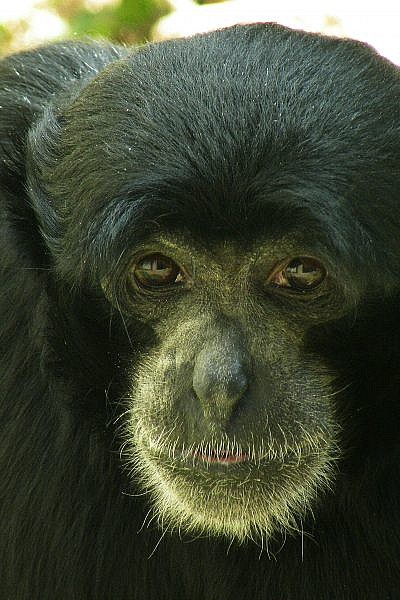
Eve is a vocal, active, seven-year-old female siamang gibbon who lives in Primate World at Cheyenne Mountain Zoo. She came to the Zoo nearly two years ago, as a non-breeding companion partner for Wayan, who is 11 years old. Now, she is adjusting to another major life change, and is demonstrating her species’ resiliency, once again.

When she arrived, she was shy and unsure. Through naturally developing into an adult, building trust with her keepers and bonding with Wayan, she has become the dominant partner, as female siamangs often are.

Eve and Wayan didn’t warm up to each other right away. After months of introductions, one day keepers noticed them swinging and singing together on either sides of their glass barrier – in place to give the two siamangs space and time to acclimate to each other. Seeing this promising interaction prompted keepers to open the door between them.

“They bonded pretty immediately from that point, grooming each other and singing duets together,” Dina Bredahl, CMZoo Primate World animal care manager said. “Forming that great bond with Wayan helped her become a confident animal.”

In early March 2019, keepers noticed normally-active Eve was not using her left foot or leg. Under anesthesia, CMZoo vet staff did a comprehensive exam including radiographs, and determined she needed immediate and extensive treatment.

That same night, Dr. Matt Johnston, Dr. Rebecca Webb and Dr. Sarah Marvel, from Colorado State University Veterinary Teaching Hospital, joined our vet team for an after-hours surgery that saved Eve’s life. Surgeons and staff decided Eve’s only chance at recovery would unfortunately mean her leg would have to be amputated. During surgery, they discovered a blood clot in her left femoral artery. The blood clot was blocking circulation from the mid-thigh down, causing irreparable damage to the tissue in her leg and foot.

As with humans, there are many possible causes for a blood clot in an animal. Unfortunately, there’s no way to know a blood clot is present until immediate action needs to be taken. After 12 days of recovery, Eve rejoined her exhibit partner Wayan, and the two of them have reunited well.

“It has been incredible to see how quickly she’s adjusted to her new situation,” Bredahl said. In the video accompanying this article, Eve can be seen swinging through her indoor and outdoor exhibits with finesse.

Lesser apes are extremely resourceful and resilient. Other organizations that house gibbons that have lost limbs have observed that they still have an excellent quality of life.

Animals don’t seem to suffer the emotional trauma that humans sometimes suffer associated with this kind of change, and will quickly find new ways to navigate their environments and thrive when they lose limbs.

The two gibbons sleep cuddled up together every night. The two nights she was back in her exhibit, but still separate from Wayan to make sure she had recovered adequately and was taking her medications, they slept together on either side of the mesh ‘howdy door.’ Just like during their initial successful introduction, they began swinging and singing together on either side of the glass. When keepers witnessed that, they knew it was time to bring the two back into the same space.

“For about the first 30 minutes, Wayan seemed unsure of her. Her new modes of mobility and the fact that she’s shaved from the surgery probably contributed to that,” Bredahl said. “After a few moments, Wayan was fine if she came and sat with him on the big platform, but in other places in their exhibit, he wanted to ease into the reintroduction more.”

For primates, the more dominant partner receives the most grooming. The more submissive animals groom to appease them and show them respect. Wayan and Eve have already adjusted to Eve’s new way of life, and Wayan is picking up right where he left off.

“She gets most of the grooming,” Bredahl said. “The only difference is that he grooms mostly her head and shoulders now. She’ll lie down and he sits next to her on a platform and will groom her from anywhere from five to 30 minutes. It’s relaxation time.”

One thing that hasn’t changed is her interactions with people. Despite experiencing unfamiliar examinations in unfamiliar settings during her recovery, which can be detrimental to animals’ relationships with their keepers, Eve’s trust in her Primate World keepers is reestablishing quickly.

Eve can be found swinging through her exhibit with Wayan in Primate World, where guests can visit her any day of the week.

Cheyenne Mountain Zoo is home to a very special Bornean orangutan named Hadiah. 22-year-old Hadiah is mom to four-year-old Ember and has called Cheyenne Mountain Zoo home since she was born here on June 8, 1996. With her gentle affection and engaging demeanor, she is a legendary guest and staff favorite.

She makes eye contact, cuddles and plays with her daughter, holds her hands up against the glass to meet guests’ hands on the other side, seems to love attention from keepers, and becomes super-focused any time a guest shows her a video on a phone or tablet from the other side of the glass.

Guests often wonder what similarities they share with Hadiah and her fellow great apes in Primate World. One experience Hadiah shares with many humans is that she takes medications every day for her allergies.

Hadiah has respiratory disease related to allergies which makes her prone to secondary infections in her airways. The disease was likely inherited from her parents who both had it. Early research suggests that some respiratory disease in orangutans may resemble cystic fibrosis in humans. CMZoo staff and vets have worked with many specialists including zoo veterinarians and MDs from around the country to help keep her healthy. Based on her allergy testing results and medical work-ups, Hadiah gets immunotherapy treatments which are administered as drops under her tongue each day. Additionally, she receives daily nebulizer treatments that sometimes include antibiotics and saline to help her better breathe and avoid complications.

Hadiah’s allergies and respiratory disease have been under CMZoo management for years, and they seem to be overall working well to keep her from getting sick. Human or ape, breathing issues can be treated in a variety of ways. Children’s Hospital Colorado, CMZoo year-round sponsor, recently shared this article to help us humans navigate the various respiratory issues and treatments to consider.

The nebulizer that staff uses with Hadiah is the same type as many humans use to treat colds, asthma or other respiratory illness, but the process is a little different. Primate World keepers administer the treatment and provide positive reinforcement as Hadiah inhales medication from the nebulizer through a protected mesh barrier.

Click the video below to see how Hadiah and her keepers work together to administer respiratory treatments that help maintain Hadiah’s respiratory health.


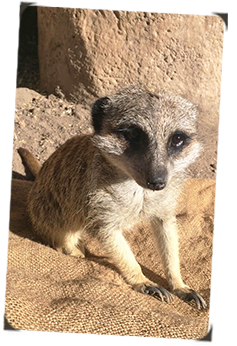
IT’S ALL ABOUT BALANCE FOR AGING MEERKAT BOMANI

Our meerkat population grew three times last year with the addition of three litters of pups. If one of the eldest CMZoo meerkats, Bomani, is any indication, they have long and healthy lives ahead of them. Bomani, a 13-year-old male slender-tailed meerkat, has lived at Cheyenne Mountain Zoo with his two brothers, Akantse and Sekitimi, since he was born here in April 2005.

When you weigh less than two-and-a-half pounds and live across the way from six African elephants, it could be easy to feel overlooked. Not so for Bomani, who lives the bachelor life with his brothers, snacking on crunchy treats, playing games, guarding the mob from perceived predators and receiving special attention from CMZoo vet staff and keepers who make sure this aging Encounter Africa resident is as healthy and comfortable as possible for as long as possible.

In March 2015, during a routine wellness exam, CMZoo vets discovered that Bomani was in early stages of heart failure, which was causing fluid to build up in his chest.

“Because his heart doesn’t pump the blood correctly into the rest of his body, fluid tends to gather in his chest,” said Jeremy Dillon, animal care manager. “He’s on a medicine regimen that helps him process the fluid, but it doesn’t help enough to prevent the fluid build-up from putting pressure on his chest and lungs, which we’ve noticed causes labored breathing and slows him down.”

To alleviate the pressure on Bomani’s lungs and other organs, vets drain his chest cavity about once every three weeks. Until the end of last year, he had been undergoing the treatment about once every six weeks. Before that, he received the treatment about once a year, as a response. In the last couple of months, as fluid builds more rapidly lately, vets are intervening more proactively and more regularly.

“The entire process takes about an hour,” Dillon said. “He’s crate-trained for instances like this, so it’s not stressful for him to be transported from his exhibit up to the vet clinic. We put some of his favorite treats in the crate, and he climbs right in. The vet team gives him anesthesia while he’s calm and comfortable in his crate. Then they bring him out to drain the fluid and return him to his crate to recover. So far, he’s done really well with the procedure and goes back in with his brothers without any issues.”

Over the last four years, vet and animal care staff have maintained flexibility with Bomani’s treatment.

“We realize he’s getting up there in age, so we always want to be sure that the procedures he’s receiving are worth his while,” Dillon said. “Right now, his energy, appetite and breathing are better after he receives the treatment, but we recognize that might not always be the case. Of course, he’s so loved and we want him around, but we ultimately want what’s best for Bomani, and that’s his quality of life.”

Dillon says Bomani loves to play, almost with the energy level of a young meerkat. He’s easily distinguished from his brothers, because he was born missing his left ear, which keepers say has never appeared to impair him. He runs around the exhibit, digging and diving into tunnels, ripping up enrichment items like brown paper sacks and paper towel rolls, or snacking on crickets and cockroaches that he has retrieved from a puzzle ball. He shows signs of aging, but Bomani still takes his sentry duty seriously. Dillon says Bomani diligently protects his mob when it’s his turn to stand guard, in case of overhead predatory birds or other perceived threats, and making impressive alarm calls when he needs to rally the troops.

It’s a delicate balance, providing medical care for aging animals. But vets, keepers and animal care managers will continue to follow Bomani’s lead, observing his behavior, monitoring his health and adjusting his treatment so he can enjoy as much life as he can, as comfortably as he can.

Guests can visit Bomani 365 days a year in the west meerkat exhibit of Encounter Africa.

Animal Encounter

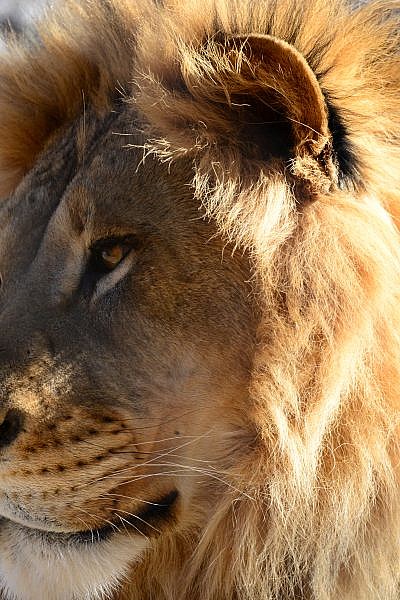
Abuto, Cheyenne Mountain Zoo’s seven-year-old male African lion, often wows guests with his remarkable roar, striking mane and impressive intelligence. He has many roles, including ambassador, inspiration and patriarch. Abuto is father to males Aslan and Boma, and to female Elsa, who were all born at Cheyenne Mountain Zoo on June 25, 2015. Their mother, Lomela, and her sister, Zwena, are both eleven years old – and complete the CMZoo pride of six.

Abuto and the rest of the pride serve an important ambassador role here at CMZoo, helping to connect our guests to wild African lions. The wild lion population has declined by 43 percent in the last 20 years, and experts predict they will be extinct in the next 20 years. Working to prevent conflict between ranchers and lions, which often results in lion fatalities, EWASO Lions is one of CMZoo’s Kenyan conservation partners that provides local communities with education, training and guidance on conservation practices that help both people and wildlife.

Our pride inspired Cheyenne Mountain Zoo members to send $16,000 to EWASO Lions last year. Through their programming, Kenyans who depend on their livestock and agriculture to survive learn to use tools that create healthy, safe barriers between themselves and the lions who live nearby.

Support from CMZoo members went specifically to EWASO Lions’ Lion Kids Camp. Kenyan children who grow up in close proximity to wildlife often have perceptions shaped by negative observations or encounters, such as a lion hunting their family’s livestock. Through a combination of wildlife education, safari experiences and a conservation-themed curriculum, EWASO Lions is educating and inspiring the next generation of wildlife conservationists to help save wild African lions, with Cheyenne Mountain Zoo’s support.

For more information on EWASO Lions, click here.

Click the video below to learn more about Abuto, and how his behavioral training is helping him contribute to his own long-term care.

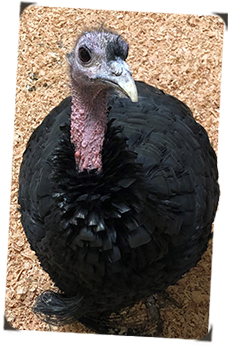
Guests and staff alike are enamored with CMZoo living legend Laredo, a Rio Grande turkey. At nearly 18 years old, Laredo is the oldest documented living turkey in the United States, and probably in the world. The average lifespan of a turkey is between five and seven years.

Despite his unbelievable age, 19-pound, three-foot-tall Laredo’s keepers say he’s in excellent condition. Turkeys have a keel, which is like a human sternum that’s centered in the chest. In healthy turkeys, the keel is surrounded by healthy muscle and fat and protrudes only slightly.

“We can tell he’s healthy because when he chooses to let us do physical assessments, we can feel that area is full and strong,” said Kevin Pellow, animal keeper in The Loft and My Big Backyard. “When a bird starts losing weight or feathers, it’s usually a sign something needs to be addressed.”

People often ask about Laredo’s secret for a long and healthy life, and although we like to joke that corn flakes must be magic snacks, the truth is, Laredo is protected from predators and gets assistance that his wild relatives don’t receive. A stable weight through a consistently available and healthy diet, managed aches and pains, socialization and a beak trim when necessary seem to make up the recipe for a happy turkey life.

“Most birds in human care need some kind of beak trim or beak care about every three months,” Pellow said. “For Laredo, we’ve only had to perform one beak trim ever. It’s a sign that Laredo is interacting with enough enrichment that he doesn’t need help there. It’s a good indicator of how active he still is, which means he must be feeling good.”

Laredo’s need for specialized care is minimal, especially considering his age. He takes medication to help control pain in his legs and feet, which is compared to an ibuprofen for people. Keepers say Laredo likes to take his medicine in mini peanut butter sandwiches or grapes, and that he shows no signs of slowing down.

“On a recent snow day, the chickens wanted to stay inside in their coop, so we gave Laredo the choice to go into his yard or into the chicken yard,” Pellow said. “Later, we found Laredo playing out in the chicken yard, stomping in the melted snow and galloping around.”

Laredo’s many admirers in addition to his keepers at CMZoo include Hannah Bragg, CMZoo graphic designer, Donna Greenfield, grants and development officer, and Tiffani Clark, development officer. They visit Laredo as often as they can, and say he has a calming effect on them. A new video of Laredo having a snack or cooing at a chicken brings ear-to-ear smiles to their faces. The descriptors “handsome” and “charming” are used without limitation. It’s clear Laredo has a CMZoo staff fan club. Maybe that’s why Pellow says Laredo might have a little extra appreciation for himself.

“He likes to look at himself in the mirror,” Pellow said with a laugh. “He’s kind of narcissistic that way. He can be territorial, too. It depends on which chickens want to come into his yard, because sometimes he lets his favorite chickens come into his barn, sleep near him and share his food.”

Although he’s somewhat skittish and leery of people, Laredo is a unique animal to visit next time you visit Cheyenne Mountain Zoo.

“If you talk to him softly, tell him he’s beautiful, and act calmly around him, he may let you feed him with help from a keeper,” said Pellow. “We’re working on it.”

Guests can visit Laredo any day of the year in My Big Backyard, near The Loft and Asian Highlands at Cheyenne Mountain Zoo.