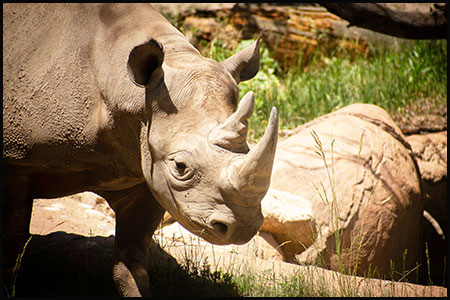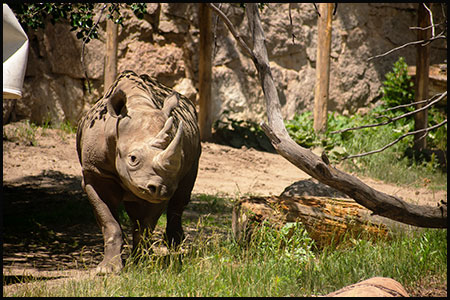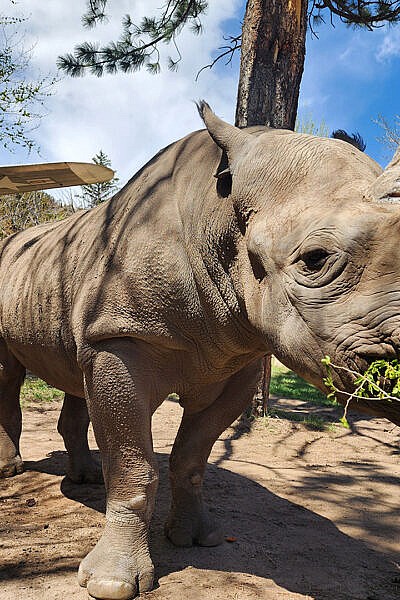
Jumbe, a 21-year-old Eastern black rhino at Cheyenne Mountain Zoo, continues to navigate a significant health challenge with the support of his care and veterinary teams. In May, a blood test revealed concerning iron saturation levels indicating a condition known as iron overload disorder.
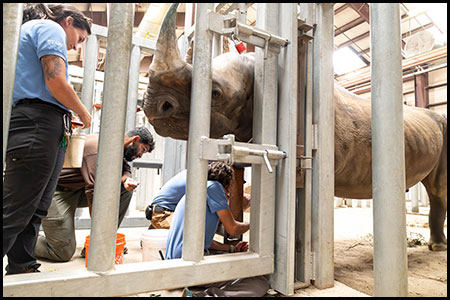
Blood draw training with black rhino, Jumbe

Despite the diagnosis, Jumbe remains in good spirits. He consistently interacts with his keepers, participates in training and daily guest feedings, and shows no clinical signs of discomfort. His liver and kidney levels, along with other critical markers, are being closely monitored and remain within normal ranges.

This ailment is well documented among black rhinos in human care, affecting about one-third of the population. However, treatment options and results are limited. Iron overload can lead to serious health issues, potentially damaging vital organs and posing a risk of fatal complications over time.

Black rhinos are particularly susceptible to iron overload due to their unique metabolic processes. Knowing this, Jumbe’s care team has always tailored his diet to minimize iron absorption. Following his diagnosis, they made further adjustments to Jumbe’s diet, with support from the Black Rhino Nutrition Advisory Group.

By June, follow-up bloodwork showed a 10 percent improvement in Jumbe’s iron levels. But, his most recent results, in early August, revealed a return to the original high levels. Unfortunately, diet controls alone don’t seem to be working for Jumbe.

So, Jumbe’s care team is focused on voluntary large-volume blood draws as a supplementary treatment, while continuing diet controls. Phlebotomy isn’t new to Jumbe or his team. He has long been an expert in voluntary blood draw behaviors.

“This is a great example of why it’s so important to establish trained voluntary behaviors before you need to rely on them,” Ilana Cobban, Encounter Africa animal care manager says. “He has been blood-draw trained for many years, so he’s comfortable and confident with the setup. When he was first diagnosed, we started increasing the frequency of his blood draw training sessions. Since mid-August, we’ve been successfully drawing large volumes of blood weekly, and Jumbe has been adjusting amazingly.”

During large-volume blood draws, the team aims to collect at least 100 milliliters (mLs)
or about 3.5 fluid ounces per session, in a carefully controlled manner. The team has to be precise with the needle and acutely tuned-in to Jumbe’s behaviors for each session to be successful. They draw multiple vials of blood during a session, but limit themselves to one needle insertion for Jumbe’s comfort. It takes three keepers, meticulous coordination and a lot of Jumbe-specific knowledge.
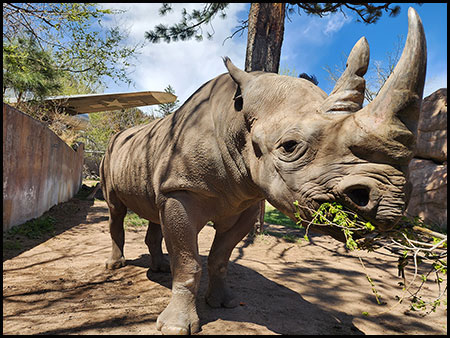
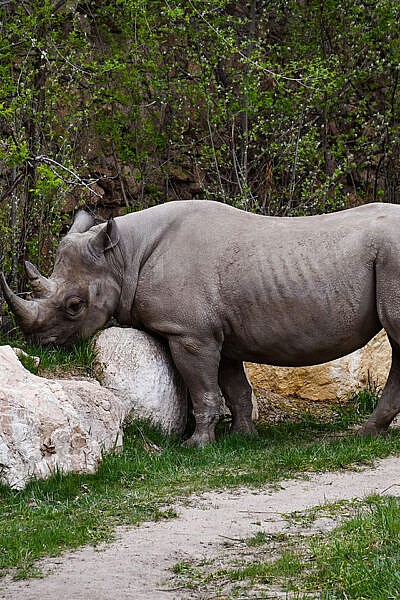
Black rhino, Jumbe up-close

“We have a trainer, a ‘brusher’ and a ‘mechanic’ during the blood draws,” Ilana says. “The trainer stands at Jumbe’s head, giving him training cues and reinforcing his participation with yummy snacks. They also watch Jumbe’s face and upper body for any behaviors – like a twitch – that might indicate we need to finish soon. The brusher is at Jumbe’s feet with the mechanic, brushing his opposite front leg, so he has a familiar and positive sensation, and a distraction from the sensation of the blood draw. The mechanic does the blood draw from underneath a metal port where Jumbe rests his chin. The three of us are constantly communicating with each other and with Jumbe about what’s happening now and what’s happening next.”

The median life expectancy for Eastern black rhinos in human care, according to the Association of Zoos and Aquariums, is 19 years, and Jumbe is 21. The team remains cautiously optimistic, exploring every possible avenue to support his health and well-being.

“We want to give Jumbe every chance to live a long, comfortable and fulfilling life,” Ilana says. “Because this treatment requires his voluntary participation, we will know if he doesn’t want to participate in a session. With a disease like this, we know it could take a turn at any moment, but for now, he’s enjoying life, and we’re determined to help him in the best ways possible.”

Guests can visit Jumbe in Encounter Africa, and participate in paid rhino feedings daily at noon through September. In October, feedings will be available on Saturdays and Sundays, weather permitting. These feeding opportunities give people a rare chance to hand-feed a rhino, and their payment supports the Zoo’s frontline black rhino and African elephant conservation partner, Tsavo Trust, in Kenya.
Back to The Waterhole

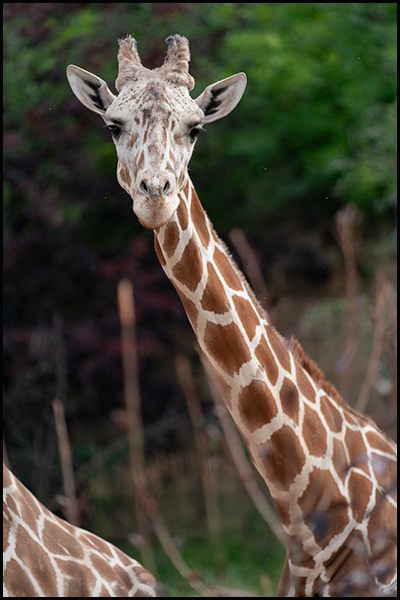
Khalid, CMZoo’s 16-year-old breeding bull giraffe, may be considered aging for an intact male giraffe in human care. But, at 16, he’s tackling new training routines and locations with the enthusiasm, confidence and consistency of a much younger giraffe.

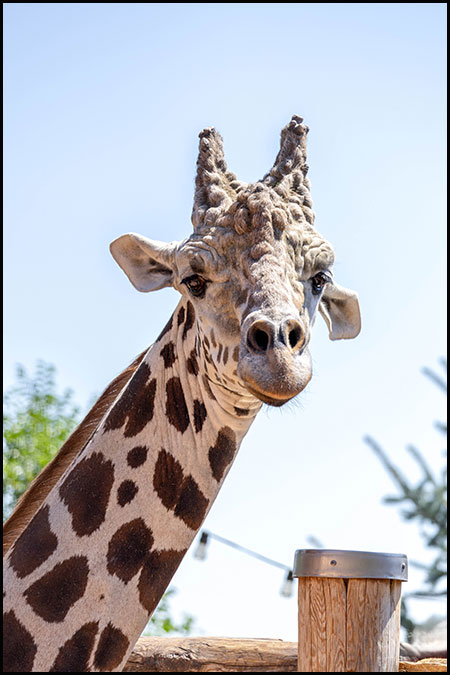
Giraffe male, Khalid portrait

The trusting relationships he has built with his keepers, along with the confidence he has in his environment, set him up for success as he and his keepers adjust his care plan to address issues into his golden years. Recently, Khalid has been experiencing some discomfort, particularly when standing on certain surfaces or at specific angles. Keepers have noticed him shifting his weight unusually and being less interested in participating in hoof care.

“We know him really well, so we can pick up on his subtle ways of communicating that he’s not confident in a certain space, even if he previously has been,” says Kelsey Newman, senior animal keeper in African Rift Valley. “We can also tell if he’s walking slightly differently, or if we need to brainstorm new ways to train with him so he’s more comfortable.”

Shortly after Khalid came to CMZoo, his team recognized a kink in his neck that his team addressed by training him to voluntarily stretch his neck when asked. He also received chiropractic care and laser therapy for his neck. He still participates in neck stretches, and his team keeps that history in mind while adjusting his routine as he ages.

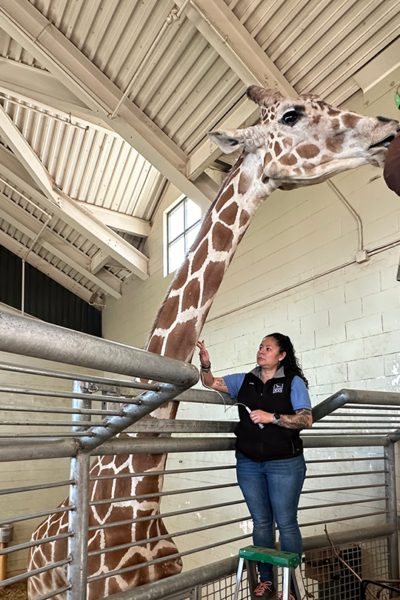
Most giraffe in the CMZoo herd participate in hoof care in a barn stall where keepers are standing on the same floor as the giraffe. In that space, the giraffe walk up to a giraffe-chest-high fire hose connected to two metal doors. The hose prevents the giraffe from entering space with humans, for safety reasons. The open metal doors allow the giraffe to lift one front foot up and place it on a resting block, where keepers can trim hooves or address other issues.

Khalid has participated in voluntary hoof care sessions for many years, but the amount of time he was willing to participate in those sessions became shorter over time. His care team discussed elements in the training area that could be distracting him, or whether they needed to ask him to participate more or less frequently, or if he was physically uncomfortable during sessions.

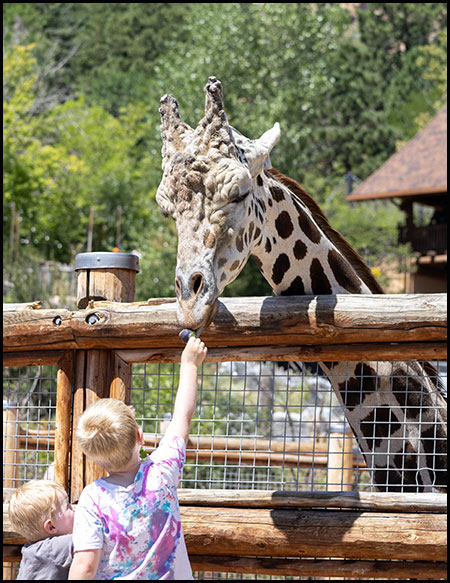
Giraffe male, Khalid taking lettuce from a guest.

“When we’re standing on the ground, and he gets a reward for training, we ask him to lean his big body forward to lower his head to get his treat from our hand,” Kelsey says. “You can see how if your front feet were already tender, leaning forward on one of those front feet would make you feel a little unsure. He told us he didn’t feel confident doing that by slowly taking a step back and looking at us as if to say, ‘I’ll do something else if you want, but I don’t like that one.’”

Rather than pushing through, they invited Khalid to participate in his familiar training routine in a different location known as ‘the chute,’ at the back of the giraffe barn. The chute has a platform, so keepers can get face-to-face with giraffe. The chute also has metal barriers on either side, so keepers are safe up high and down by his giant feet, but Khalid can still exit the training whenever he wants. Two sets of keepers work with Khalid at the chute. Two keepers work on his feet while two are up high on the platform, reinforcing his good behaviors without having to ask him to bend down.

Thanks to this tailored setup for Khalid, he participates in hoof trims more often, which is making his hooves and legs more comfortable. He also receives oral pain and anti-inflammatory medications, delivered on his favorite honey-and-lettuce roll-up.

“I keep joking that he prefers the setup in the chute because he has the full attention of four keepers, instead of just two,” Kelsey says. “He’s a giant sweetheart. Sometimes he asks for face scratches from certain people, and I’m honored to say I’m one of them. He’ll put his giant face into your torso and lean in for a good scratch. It’s the best.”

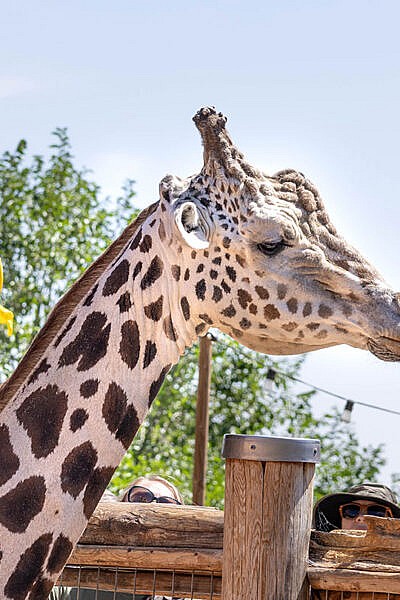
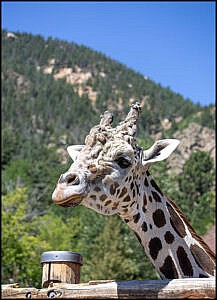
Speaking of faces, Khalid’s is unlike any other at the Zoo. Many visitors ask if Khalid’s face is so bumpy, compared to the rest of the giraffe, because he’s old. But the bumps on Khalid’s face are natural calcium deposits that form as testosterone-producing males reach maturity. The adaptation developed to protect males competing for territory in the wild.

During battle, male giraffe use their heads, and more specifically, they use their ossicones. They swing their heads with incredible force thanks to their long, muscly necks, right into their opponents. To protect their eyes and brains from the offensive impact, they grow thick ‘helmets’ around their ossicones and heads.

In addition to hoof care, medication and a good dose of face scratches from his keepers, Khalid’s care plan includes lots of movement. Although Khalid prefers not to explore the big yard (he’s been offered the chance many times, and consistently chooses not to go into that space), he explores a series of connected spaces and outdoor yards, set up with environmental enrichment that encourages him to take long strides and keep those big legs moving.

Giraffe male, Khalid portrait

One surefire way to get Khalid moving is to invite him anywhere near Bailey, his most recent breeding partner in the herd. Bailey and Khalid are parents to 2-year-old BB, who recently moved to Denver Zoo Conservation Alliance, and 1-year-old Wednesday, who still lives with the herd.

As a breeding bull, Khalid has helped bring seven giraffe calves into the world, also including 5-year-old Viv, who still lives at CMZoo. When calves are born, Khalid quietly observes from another stall. When the opportunity is right, he usually reaches over the stall fence to give his new calf a good sniff, and usually a big lick on the head.

“Khalid is an icon here at the Zoo, and he does so much for his species, both by inspiring countless people to care for giraffe, and by contributing to the population in human care,” Kelsey says. “We’re going to do everything we can to help Khalid step into his golden years with dignity and comfort, because we want him to be able to continue his work in both of those departments.”

Visitors can see Khalid, and hand-feed him lettuce, in the side yard or barn in African Rift Valley. Exciting improvements are underway at CMZoo! This means normal routes to guests’ favorite animals may be different, but visitors can still see all animals at the Zoo! Watch for signs for alternate routes.

Back to The Waterhole

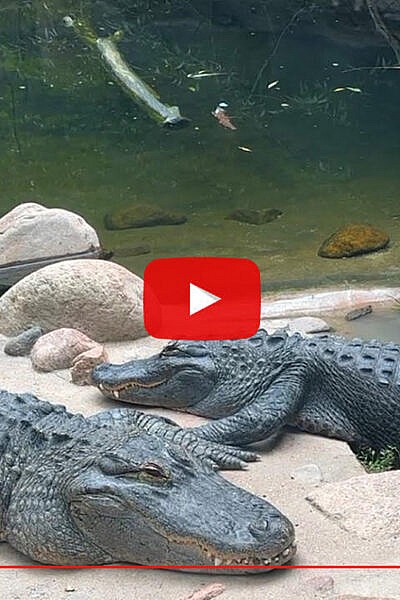
Australia Walkabout is home to two American alligators, Tommy and Sally. Both regularly participate in voluntary training sessions, including target and touch training, which allow the alligators to choose to participate in their health care while keepers perform general health checks.

As ambush predators, alligators have unique adaptations that help them blend into their surroundings and strike swiftly when prey approaches. Their eyes are positioned high on their heads, enabling them to remain submerged while still keeping watch above the surface. Alligators can have about 80 teeth in their mouth at a time and can go through 2,000 to 3,000 teeth in their lifetime.

Tommy and Sally are great ambassadors for their species, educating guests about the crucial role alligators play in maintaining balance in the ecosystem.

Back to The Waterhole

Cheyenne Mountain Zoo’s 21-year-old Eastern black rhino, Jumbe, and his team are working together to address a new health concern for the 2,700-pound sweetheart. A recent routine blood test revealed iron saturation in his blood had risen to concerning levels.

Up-close black rhino Jumbe

Jumbe seems to be feeling well, and he isn’t showing any clinical signs of discomfort. Along with monitoring his iron metabolism status, the team is also monitoring his liver and kidney levels, among other things. All of those levels are within normal ranges.

Jumbe has surpassed the median life expectancy for his species in human care, according to the Association of Zoos and Aquariums, by two years. His team remains cautiously optimistic about his future and is exploring every avenue to help Jumbe. This condition, called iron overload disorder, can damage organs and potentially lead to fatal consequences over time.

Because black rhinos are predisposed to developing this condition, his diet was initially formulated to minimize, as much as possible, over-absorption of iron. Since the diagnosis, the care team has implemented further changes in Jumbe’s diet. The goal is to see if they can minimize iron absorption even further, based on new findings and recommendations from the Black Rhino Nutrition Advisory Group. This month, his bloodwork shows a 10 percent improvement. Despite this recent result, which is moving in the right direction, his iron levels are still high.

Iron overload disease affects around one-third of black rhinos in human care, and while there’s a lot of research underway, there are unfortunately no guaranteed remedies. The team continues to closely monitor Jumbe, conducting regular voluntary blood collection to track his progress.

“By training for these voluntary husbandry behaviors proactively and when an animal is healthy, we can better care for them when conditions like this arise,” Dr. Eric Klaphake, CMZoo head veterinarian, says. “These blood draws not only revealed an issue we needed to address, but they could also be a part of the treatment.”

Some zoos have been able to address iron overload disorder in rhinos by increasing blood draws as a treatment. By removing iron-saturated blood, new replacement red blood cells can create additional places for iron in the blood to bind to, and thereby decrease the amount of iron that would otherwise enter into tissues where it can cause damage.

“This could be an option for Jumbe, but we want to see if we can correct it without asking him to participate in more frequent and longer blood draw sessions first,” Dr. Eric says. “Of course, it would be done in volumes that are realistic for Jumbe’s well-being. This is only an option if it doesn’t reduce his quality of life, and he continues to show us he’s happy to participate in the longer blood draw sessions.”

Black rhino Jumbe outside

Jumbe participates in voluntary blood draw sessions regularly with his care team, including Ilana Cobban, Encounter Africa animal care manager, CMZoo’s veterinary team and other animal keepers on his team. Jumbe and Ilana have worked together for 12 years.

“What’s wonderful about Jumbe?” Ilana says. “Everything. He has a calm and gentle demeanor that you wouldn’t typically assign to a rhino. He’s happy to stand nearby and get scratches while I talk to him, or roll around in a good mud wallow, or trot over to a fence to greet the elephants next door. He’s also a great student. He is fantastic at training, so I’m really hopeful that’s going to serve him well as we face this together.”

Dr. Eric and his team have also consulted extensively with rhino experts and researched the latest findings in animal nutrition and veterinary medicine, although finding an effective solution specific to rhinos remains challenging.

“We’re consulting with other experts, including the veterinary and nutrition advisors for the Eastern black rhino Species Survival Plan,” Dr. Eric says. “We have the best of the best on Jumbe’s case, including his care team who have built trusting relationships with Jumbe that will allow us to try new things to help him.”

Dr. Eric and his colleagues have explored various treatment options, including considering treatments for this disease in human and avian medicine, which unfortunately have not been effective in treating rhinos with this disorder.

Guests can make a direct, up-close connection with Jumbe at daily rhino feeding sessions. His distinctive pointy, prehensile top lip, a distinctive feature of Eastern black rhinos, allows him to delicately accept food offerings from visitors. At noon every day from March through October (weather – and Jumbe – permitting), guests can line up in Encounter Africa for a paid opportunity to hand-feed Jumbe. By extending his top lip to wrap it around the produce being offered, he gently accepts it – and usually leaves guests with a slobbery goodbye and a lifelong memory.

Jumbe’s snack times also help guests make a direct connection with rhino conservation. The $10 cost to participate supports CMZoo’s black rhino and African elephant conservation partner, Tsavo Trust.

As Jumbe’s health journey evolves, CMZoo will share updates.

Back to The Waterhole

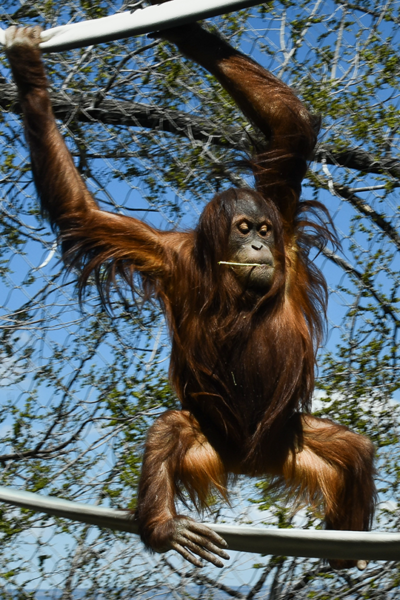
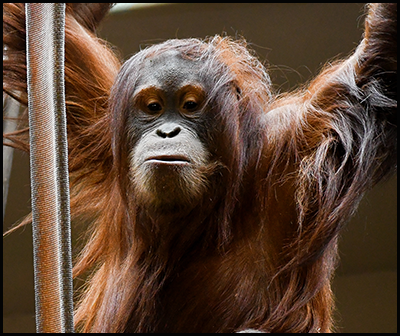
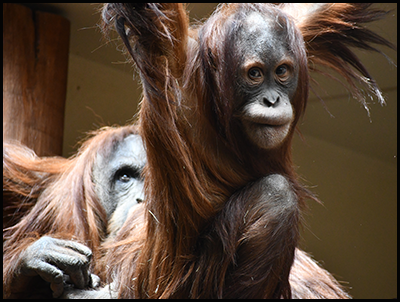
The youngest ape in Primate World, 6-year-old Kera, puts the “I” in “independence,” according to Animal Keeper Izzy Dones, who works with Kera in Primate World. Kera is one of six orangutans in Primate World, and one of three Sumatran orangutans, along with her mom, Sumagu, and her dad, Baka-Keri.

“I think her independence comes from Sumagu,” Izzy says. “Sumagu really beats to the rhythm of her own drum. She will let you know if she wants to come over to train or if today is not the day. It’s like she has seen it all and knows exactly what she wants, and I love that.”

Orangutans learn through behavior modeling, and Kera is an astute observer.

“When Kera was really young, Sumagu participated in voluntary training with us and Kera watched closely and mirrored her mom’s behaviors,” Izzy says. “Kera learned a lot of her body presentations and stationing that way, which we teach so she can voluntarily participate in her own health care.”

Clever Kera is a whiz at husbandry training. She does an open-mouth presentation so keepers can brush her teeth. A recent dental check revealed another sign the baby orangutan is growing up. She lost her first baby teeth!

“If she’s near the window, guests can open their mouths and show her their teeth, and she’ll usually show them hers,” Izzy says. “She just lost her first two teeth in February, so you might be able to see where she has lost her two middle bottom teeth and her new ones are growing in.”

Kera is also smart enough to know that her behaviors are valuable to her keepers – valuable enough to earn her yummy treats. One behavior, called “trading,” allows keepers to ask the great apes to bring them something from their dens, like small reusable PVC tubes that keepers stash food in. When those tubes are empty, keepers ask for them back.

“Some mornings, I’ll come in and she’s waiting at the fence with a pile of theses tubes she has collected and she’s ready to trade,” Izzy says. “She’s like, ‘Okay you can have these, but only for the right treat and only one at a time.’ She’ll even tear items, like blankets, into smaller pieces so she has more pieces to trade. Her dad does that, too, so we think she learned that little hack from watching him. The more pieces you have to trade, the more treats you get. It makes sense.”

Playful and curious, young Kera loves interacting with guests and keepers. One of her favorite activities is to play tug-of-war. She picks up a blanket and brings a corner of it to the fence so a keeper can pull it through the mesh, and Kera pulls with all of her little orangutan might.

“Kera plays with guests, too,” Izzy says. “She loves to climb up on a rope and swing towards the glass where guests are watching her. She gets really excited when guests start interacting with her. She’s also curious to see what people have in their bags. She’ll get up high and try to look into people’s purses, which always makes me laugh.”

As an ambassador for her species, Kera is a pro. She naturally seeks opportunities to interact and make connections with guests, which inspire them to take action to protect her wild counterparts.

Orangutans are critically endangered, in part because of deforestation to build palm oil plantations in their native habitats. Palm oil is an edible oil found in about half of the products consumers purchase. It is used in candy, soaps, cosmetics, pet food and cleaning products. Because of high demand, unsustainable palm oil production has resulted in deforestation across Southeast Asia, and other tropical areas around the world, which means critically endangered species like orangutans, tigers and elephants are losing their homes.

However, when produced sustainably, palm oil is the most productive edible oil available. Oil palms – the trees that palm oil comes from – produce four to ten times more oil than alternatives like soy, olive, canola and coconut. Switching to these alternatives would cause even more deforestation in tropical areas, which is why consumers must demand sustainable palm oil.

Cheyenne Mountain Zoo, under the direction of the World Association of Zoos and Aquariums (WAZA), helped launch a free global mobile app, called PalmOil Scan, that gives everyone the power to advocate for orangutans’ dwindling wild habitats with their shopping choices, and to make large companies listen to their demands for sustainably produced palm oil.

The free smartphone app empowers consumers to make informed, environmentally-friendly shopping decisions, just by scanning the barcode on a product to see if that company has committed to sourcing sustainable palm oil. PalmOil Scan is available on the Apple App Store and Google Play in the U.S., Canada, the U.K., New Zealand and Australia, with plans to expand to more countries around the world. Learn more at cmzoo.org/palmoil.

Back to The Waterhole

Amur leopard brothers, Basha and Mango, are quickly growing in size and skill. The 9-month-old brothers are about the same size as their parents, Anya and Anadyr, and eagerly participate in fun enrichment and important training sessions.

While there aren’t any current plans for Basha and Mango to leave CMZoo, their care team is working alongside other zoos and partners to develop a program designed to successfully prepare big cats for transportation to a new accredited facility, if and when the need arises. Basha and Mango are helping spearhead that program, which Asian Highlands keepers will share with other zoos for the welfare of all big cats on the move. Basha and Mango currently still spend most of their time with their mother, Anya. As part of this program, they are also starting to explore spaces without her and participating in voluntarily crate training.

Amur leopards are widely known as the rarest big cats on the planet. Only around 100 individuals remain in the wilds of Eastern Russia and China. CMZoo’s four Amur leopards represent four percent of the wild population. Helping Basha and Mango master the skills needed to successfully adapt to a new home in the future will hopefully give them the opportunity to breed and have families of their own, increasing the number of Amur leopards in the world.

Back to The Waterhole

If you’ve ever wondered if animals have blood types, you’re not the only one! The International Center for the Care and Conservation of Giraffe, at Cheyenne Mountain Zoo (The Giraffe Center), recently teamed up with Dr. Lily Parkinson, clinical veterinarian at Brookfield Zoo Chicago, and several more giraffe care teams to help find out. Dr. Parkinson is leading a study to see if giraffe have different blood types and if it is common for giraffe to have compatible blood types.

“In small animal emergency medicine, blood typing is common knowledge,” said Brenda Cordova, RVT, hospital manager at Cheyenne Mountain Zoo. “In our larger zoo animals, we’ve never really had the opportunity to find out, because we haven’t had as much access to test their blood on a large scale like this. Now that so many giraffe are trained to participate in voluntary blood draws, this could lead to some really exciting discoveries that help us fine-tune giraffe care even more.”

Dr. Parkinson says different molecules that live on the surface of red blood cells make one blood type different from another – in people and in animals. An animal’s immune system can attack anything it perceives is a ‘foreign invader.’ If the immune system detects different molecules on transfused blood cells, the body might attack those red blood cells and destroy them.

Typically, before a blood transfusion, care teams will draw the recipient’s blood and mix it with a drop of already processed plasma from the donor. Veterinary teams will watch for reactions between the two bloods and move ahead if there are no obvious negative reactions.

“Many people know about the incredible nationwide giraffe plasma bank that can help treat newborn giraffe calves that need extra help,” said Dr. Parkinson. “The findings from this blood typing study could take that science another step further to help us give these calves the most compatible and helpful plasma transfusions.”

This study hopes to reveal how to test giraffe for compatible blood types. If giraffe do have different blood types, giraffe care teams could do additional testing to have better confirmations that a donor’s blood isn’t going to harm the recipient.

To achieve dependable findings in a study like this, you need a lot of data. In this case, that requires a lot of giraffe willing to donate their blood. Dr. Parkinson reached out to Amy Schilz, senior animal behaviorist at The Giraffe Center and giraffe care co-manager at Cheyenne Mountain Zoo, to help her enlist volunteers.

“When Dr. Lily reached out for potential contributors for this study, it was a perfect example of how The Giraffe Center can serve as a central resource for all things giraffe care,” said Schilz. “Because we have worked with so many giraffe care teams across the country, we already knew which herds are trained to give blood voluntarily, and we knew how to get everyone together for this important study that supports what we all want: to take the best care possible of giraffe.”

A few phone calls and a multi-zoo video conference later, 13 zoos accredited by the Association of Zoos and Aquariums and one private facility were on board to contribute to the study. In the end, around 60 giraffe voluntarily submitted blood for the study.

Seven of those samples came from giraffe at Cheyenne Mountain Zoo. Schilz, the giraffe care team in African Rift Valley and the CMZoo veterinary team came together over a few days to gather those samples, leaning on their established training and relationships with the long-necked donors named Mashama, Msitu, Twiga, Bailey, Laikipia, Muziki and 1-year-old Wednesday.

“This was Wednesday’s first time giving blood, and she was incredible,” said Schliz. “There was a hush that fell over the barn when we saw her approach her team with such trust and remain completely unbothered throughout the session. This little giraffe is already making a big impact. We are so impressed with her.”

The blood draw sessions are voluntary and the participating giraffe at CMZoo are eager to earn the reinforcers – usually yummy rye crackers – they receive during training sessions. They can choose to walk away at any time, and our veterinary technicians use a specialized blood draw setup so the needle falls out if the giraffe walks away.

“It goes to show how important it is to proactively train for these volunteer behaviors,” said Cordova. “Training allows us to take the best care of the animals as individuals, and it also allows us to respond to these calls to contribute to the greater giraffe community’s shared knowledge.”

As giraffe care teams learn more about blood typing for giraffe, CMZoo will share updates.

Back to The Waterhole

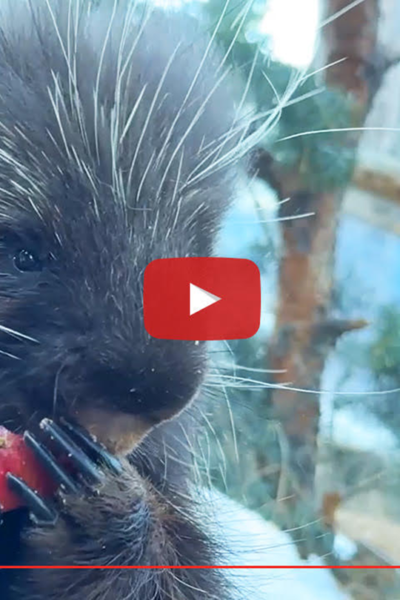
Roger, 4-year-old North American porcupine, has some impressive “quill-ities.” His gentle, curious and friendly nature directly contributes to Roger’s important training behaviors, adorable enrichment and strong relationship with his keepers. Mastering behaviors like target training, stationing and injection training plays a big role in how keepers can best care for Roger now and in the future. Visit Roger in Rocky Mountain Wild during your next visit to CMZoo!

Back to The Waterhole

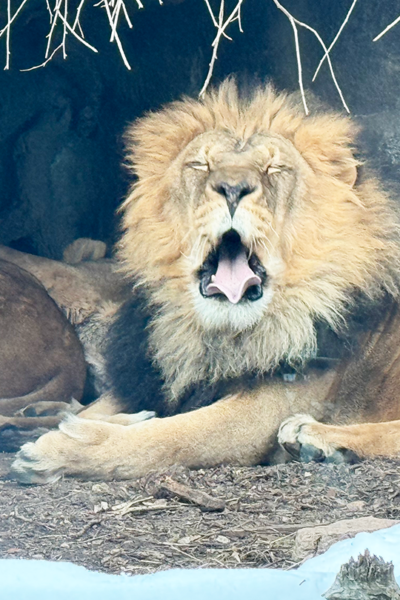
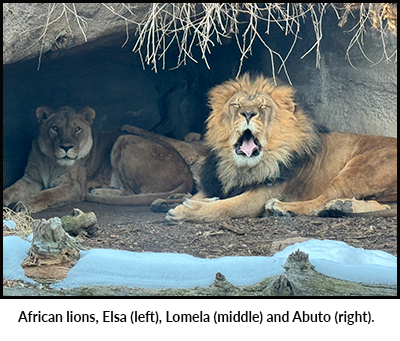
African lions are working through a delicate transition in African Rift Valley. The lion keepers’ long-term goal is to provide healthy groupings and vital social interactions for the four related big cats, with Lomela, the mother, bridging the gap for her family.

Aging parents, Abuto (12) and Lomela (16), their daughter, Elsa (8), and their son, Aslan (8), make up the African lion pride at Cheyenne Mountain Zoo. In April 2023, Aslan’s and Elsa’s brother, Boma, moved to San Diego Zoo Safari Park. When Boma and Aslan were about a year-and-a-half old, Abuto told them it was time to go on their own, so the boys formed a coalition and lived together. After Boma began showing signs that he was ready for his own pride last year, which is typical for male lions around that age, CMZoo worked with the Association of Zoos and Aquariums’ (AZA) African Lion Species Survival Plan to find Boma a pride of female lions to live with.

After Boma’s departure from CMZoo, the African lion care team began ‘howdies’ between Elsa and Aslan, so Aslan could have another lion to spend social time with. After their interactions with a protective barrier between them didn’t produce the outcome keepers hoped for, the team started weighing other options.

“We didn’t see anything necessarily alarming between Elsa and Aslan during their howdies, but we didn’t see the calm and interested behaviors we wanted to see,” said Savannah Woods, animal keeper in African Rift Valley. “Re-introducing lions can be dangerous. When you’re deciding whether to give these massive animals access to each other, you want to have the right indications that they’re going to be safe.”

The keepers’ next option was to see if Lomela and Aslan could be re-introduced. It wasn’t their first option because of Lomela’s age and the reality that she might not be around for a lot longer. She has reached the median life expectancy for African lions in human care, according to the AZA.

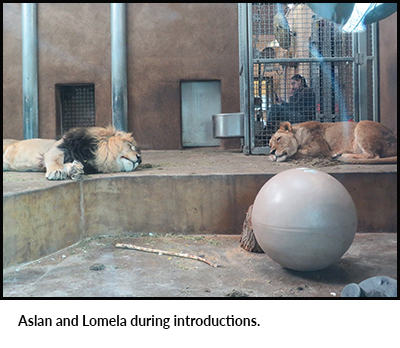
Lomela and Aslan started howdies a few months ago, and in early February, after seeing several good interactions, the two started sharing space.

“Lomela is calm and assertive, which is what Aslan needs so he can re-learn what is acceptable behavior around female lions,” said Woods. “He is more interested in her than she is in him, so he’ll approach her to smell her, and she will let him get close until she decides she wants more space. Then, she’ll typically hiss or bark at him, and he will back off. He’s being respectful, and she’s communicating really well.”

As introductions continue, the mother and son have been comfortable sharing space. They’re often seen drinking water, engaging with enrichment individually and sleeping in separate areas of the same room, which are signs of comfort.

In a recent introduction, Aslan approached Lomela while she was lying down, and she hissed at him to give her more space. Because he’s getting more comfortable, he’s also testing new limits, and she is responding with new communication methods – in this case, a roar and a single swat to his face. He backed off right away, and they both laid back down. About 30 seconds later, Lomela moved closer to Aslan to get a drink of water, and he watched her calmly without moving. The two are continuing to learn how to interact in ways they’re both comfortable with.

“Their actions can seem a little intense sometimes, but that is just how they communicate,” said Woods. “We will have someone monitoring them during introductions, until we’re confident they’ve developed good social skills together. This new setup doesn’t come without risk, but we have to trust them to continue communicating because, long-term, having these social opportunities is best for the pride. We’re really proud of their progress, and glad we can provide new social opportunities.”

Because of Lomela’s age, keepers will continue to work on howdies between Elsa and Aslan. That plan will likely have Lomela sharing space with Elsa on one side of a protective barrier and Aslan on the other. Lomela’s presence is calming for Elsa, so keepers are leaning on Lomela to help her kids feel comfortable around each other. Unfortunately, aging Lomela won’t always be here to help her family get along, so they’re taking advantage of the time they have with her leadership.

“We’re grateful for Lomela’s leadership and we’re hopeful about the interactions we’ve seen so far,” said Woods. “We appreciate everyone sending the pride their best wishes as they move through these new chapters.”

Back to The Waterhole


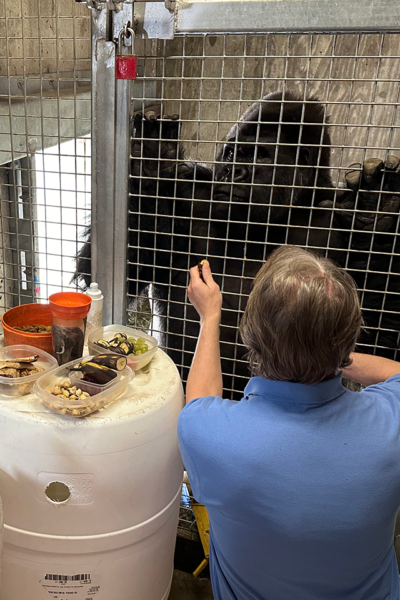
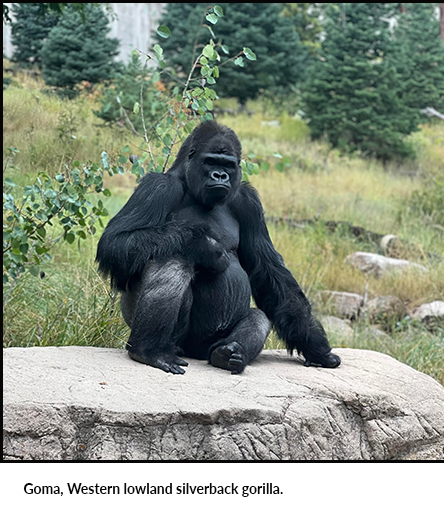
A charcuterie board fit for a king sits in the human side of a gorilla den. Peanuts, grapes, bananas, primate biscuits and handmade peanut butter-and-oatmeal roll-ups are lined up next to a souvenir CMZoo cup of juice, ready to reward an impressive set of skills. The goodies are for the king of Primate World – Cheyenne Mountain Zoo’s much-loved male Western lowland gorilla, Goma.

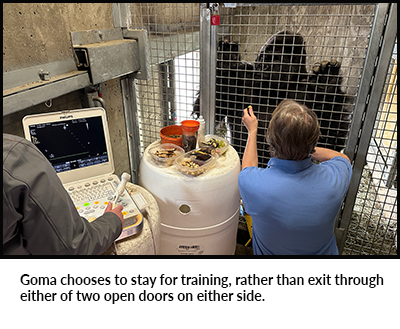
Just beyond the spread of sweet and savory snacks, on the gorilla side of the den, a blue plastic stool sits in a room covered in comfy hay with two open doors on either side. One brightly backlit door leads to the yard, where the sun is shining brightly on a warm February day. On the other side of the second door, CMZoo’s gorilla troop members, Asha, Kwisha, Roxie and Goma are lounging, foraging, building nests and interacting with guests through glass.

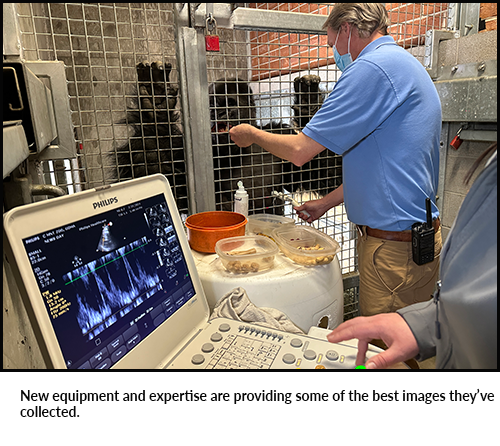
February is Heart Month and today is another heart health monitoring day, so a veterinary cardiologist is on site. Heart health is important regardless of age or species. CMZoo partner, Children’s Hospital Colorado, cares for some of the world’s smallest cardiac patients, while CMZoo cares for one of the biggest.

Goma will be 33 years old on March 31, and the median life expectancy for male Western lowland gorillas in human care, according to the Association of Zoos and Aquariums is 32.7 years. Unfortunately, heart disease is prevalent in older male great apes. Goma has heart disease and takes oral medication to prevent its progression. His disease is under control and his care team monitors his health with regular cardiac ultrasound readings provided by the local experts at North Springs Veterinary Referral Center.

As the cardiologist follows Primate World Lead Keeper Jon Wild into the room, a commanding but tentative presence joins them from the other side of the mesh. It’s Goma, and he knows those tasty treats are for him.

“Hi there,” Wild says softly to the 435-pound silverback, who is taking his time scanning the room, his big brown eyes intently studying the faces beaming back at him. “We have some extra people in here today, don’t we? You’re okay. Do you want to come over here and do some ultrasound training with us? Just sit here on your stool, and we’ll get started.”

Goma isn’t hesitant about Wild, the cardiologist, the equipment or the observing keeper in the room. He’s familiar with this setup; he just did this a few days ago. It’s the two people here to learn about his training and take photos that he’s not so sure about. Wild reassures Goma, and Goma quickly settles onto his light blue spool seat, scooching up to the mesh for a refreshing gulp of juice.

Goma is comfortable, even with the new visitors, because his care team has earned his trust through years of relationship building. Goma established this ultrasound behavior previously, so once Goma got to know Wild, who has 22 years of experience working with great apes and has worked at CMZoo for over a year, they started building upon it. The most important part of Goma’s participation in the ultrasounds is sitting still – either on his stool or on the ground – with his chest close enough that Wild can slip the probe through the mesh onto Goma’s chest.

The sessions’ length is up to Goma. Sometimes they’re five minutes and sometimes they last over an hour. Wild communicates to Goma to reposition or to bring his chest closer to the mesh, and Goma sits still. Wild and the cardiologist communicate about the image on the ultrasound screen and where to move the probe to get the best views. All the while, Goma sits patiently and gets treats from Wild. But, there’s one element that sensitive Goma, who is a great student, isn’t shy about protesting.

“He doesn’t care for the ultrasound gel,” said Wild. “Some animals enjoy it and they rub it all over themselves, some don’t seem to notice, and Goma tolerates it, but not right away. We can’t figure out why. It doesn’t have a smell, and it isn’t menthol or textured. We warm up the gel so it isn’t cold. When he sees the gel bottle, he’ll lean slightly back and side-eye it until I present the best reward – his peanut-butter and oatmeal roll-ups or juice.”

Once Goma agrees to let the gel touch his skin for the first time, he’s fine with it, but he is welcome to have a moment to communicate he’d rather not endure it at the beginning of each session. He’s a smart gorilla, and he negotiates throughout sessions. Sometimes he offers a more simple behavior compared to presenting his chest, like offering his shoulder or opening his mouth, to see if that will elicit a reward. If he wants to stop, he can always walk away, but that doesn’t happen often.

“We’re asking him to choose this over whatever he’s engaged in,” said Wild. “That’s why the high-value snacks are so important. The experience has to be his most rewarding option, which means having his favorite foods and knowing he’s in control. He also needs to be comfortable with the team. When we started working with this cardiologist, we introduced them while she gave him snacks and juice and talked to him so he could get used to her voice. We got lucky because Goma really likes her.”

His care team is excited about the images Goma has allowed them to collect on ultrasound. They say the equipment and expertise they have access to now is providing some of the best images they have been able to collect.

Making sure Goma’s medication is working is the top priority, but the images serve another purpose. CMZoo shares Goma’s heart health updates, images and medication regimen with the Great Ape Heart Project – a collection of great ape keepers and veterinarians who use this data to learn more about gorillas’ and orangutans’ hearts and share that with people who care for apes. That shared greater depth of knowledge can provide caregivers more treatment options and proven solutions for the great apes in their stewardship.

About 20 minutes into Goma’s session, another curious face appears in the room. This time, it’s not a person, it’s 31-year-old Asha, who is Goma’s number-one in the troop.

“She wants a turn,” said Wild, gesturing toward Asha. “Most of our great apes participate in some kind of heart monitoring, whether that’s EKG readings or blood pressure monitoring through their fingertips, or ultrasounds. Asha is also working on an ultrasound behavior on her belly.”

Asha, who has a breeding recommendation with Goma, is eager to train with Wild. But, Goma is the dominant animal in the group, so Asha doesn’t interfere beyond glancing toward Wild and Goma to make sure they have noticed her playing with a few little pieces of hay in the doorway to the den. Once Goma is finished training, Asha comes into the den and Wild places the probe on her abdomen, but doesn’t see anything exciting. Asha and Goma have been seen breeding, but there’s no evidence it has been successful.

CMZoo will continue to share updates as the group continues to train, bond and grow as a cohesive group.

Back to The Waterhole