Which plants attract early pollinators? Which will help you conserve water? What kind of maintenance should you make a priority this time of year? CMZoo’s horticulture team answers all of these questions and more.


With keeper talks and animal demonstrations throughout the day, The Loft provides hands-on and up-close opportunities with smaller animals like tortoises, skunks, snakes, lizards and more. My Big Backyard is home to chickens, bunnies and a treehouse that’s home to lots of amphibians and invertebrates.
What you may not know is that with a little planning, your afternoon at the Zoo could foster lifelong memories, connections and inspiration. Read on to learn about private animal encounters, animal painting experiences, and keeper-led educational programs that will inspire children of all ages to appreciate the little animals of the world who are so vital to our planet’s complex ecosystems.
Animal Encounters
Have you ever been to the Zoo, visited our three-banded armadillo, Frida, and thought, “I wonder what it would be like to feed her?” With an animal encounter, guests can meet reptiles, birds or mammals from The Loft or My Big Backyard up close. With a keeper’s help, guests prepare animal diets, feed the animals, and even help train them. Plus, you can feel good knowing the fee helps support the care of the animals that inspire conservation action, right here at Cheyenne Mountain Zoo. Visit cmzoo.org/encounter for more information and a full list of animals who can choose to participate.

Animal Art Experiences
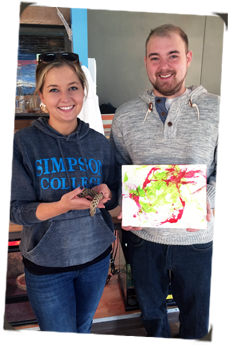
It’s no secret that there are several animal artists at the Zoo, and their art is available for purchase online or from their habitats. But, did you know that you can set up an experience to be a part of the painting process from start to finish? Animal art painting experiences allow you to help a keeper train an animal and decide which paint colors will adorn your very own modern art masterpiece, sure to spark conversation. To learn more about animal encounters and painting opportunities, visit cmzoo.org/LoftEncounters.
Animal Care 101 and Backyard Exploration Classes
Maybe you are thinking about bringing a new pet rabbit into your home. Does a backyard chicken coop sound superb, but you’re not quite sure where to start? Or, are you curious about the native birds that live in Colorado and want the chance to learn how to spot them?
The Loft and My Big Backyard have many classes just like these, perfect for a unique afternoon activity. Whether you are curious about to how to care for an animal or want a nature-based Zoo experience, there are options for both! You can even choose to sign up for classes when they occur, or get some friends and family together and schedule your own private program! Visit cmzoo.org/AnimalCare101 to learn more about animal care classes at Cheyenne Mountain Zoo.
Colorado Springs, CO – Cheyenne Mountain Zoo has been in what is known among the staff as “sprint mode” for the past three days to ensure that guests are able to visit again, starting Saturday. The Zoo will reopen for members at 8 a.m. and for the general public at 9 a.m. on Sat., Aug. 11 after being closed following an unprecedented hail storm on Monday afternoon. The storm caused guest and staff injuries, animal injuries and deaths, and extensive property damage.
Although permanent repairs will take many months to complete, the Zoo will be ready to welcome guests back on Saturday, thanks to temporary short-term fixes like tarps and plywood to cover the spaces where skylights used to be.
The Sky Ride will be one of the few features of the Zoo that will not be ready for guests on Saturday, due to the strict inspection protocols necessary to ensure safety before resuming rides.
Animal keepers have been asked to get animals ready to resume “life as normal,” which involves restarting the natural behavior demonstrations that are usually a draw for guests to watch. Tomorrow, the demos will be for “Zoo family” only, but will serve as an important step toward getting routines back to normal for both animals and staff.
Undrivable guest vehicles in the main parking lot are dwindling from nearly 400 immediately after the storm on Monday down to less than 40 today. Vehicles have been towed to one corner of the south parking lot, which will allow us to finish removing broken glass and other debris from the pavement in preparation for guests on Saturday. The remaining vehicles will be allowed to stay at the Zoo until 8 a.m. on Tuesday. If they are still unclaimed, they will be towed to a monitored facility at the owner’s expense.
Cheyenne Mountain Zoo is a 501(c)(3) non-profit organization that receives no tax support, which is unusual among zoos accredited by the Association of Zoos and Aquariums.
About Cheyenne Mountain Zoo
Cheyenne Mountain Zoological Society was founded in 1926. Today, Cheyenne Mountain Zoo, America’s ONLY mountain zoo, offers comprehensive education programs, exciting conservation efforts and truly fantastic animal experiences. It is Cheyenne Mountain Zoo’s hope that guests fall in love with animals and nature, and take action to protect them. Of the 230 zoos and aquariums accredited by the Association of Zoos and Aquariums (AZA), Cheyenne Mountain Zoo is one of just nine operating without tax support. Cheyenne Mountain Zoo depends on admissions, membership dues and donations for funding.
Colorado Springs, CO – Cheyenne Mountain Zoo is in full assessment and recovery mode today after an unprecedented storm caused human and animal injuries, including two animal deaths, and major vehicle and infrastructure damage throughout the property. The staff is operating under their typical incident command system for emergencies to address the most urgent needs for both animals and operations, all while dealing with heartbreak from two animal deaths and personal property damage.
Although severe weather was expected in the area on Monday afternoon, the baseball-sized hail came with none of the usual weather warnings. It began out of the blue, causing Zoo guests, staff and animals to scramble to find shelter. Many Zoo guests were injured – some were transported to the hospital, and some were treated and released on scene. Three Zoo employees were injured seriously enough to be transported to the hospital, and more staff injuries are still being reported today.
All of the Zoo’s animals have permanent shelter, but just as there were humans injured while trying to get to shelter, some animals were injured, as well. At this time, the Zoo is heartbroken to confirm the loss of 13-year-old Cape vulture, Motswari, and 4-year-old Muscovy duck, Daisy. Other potential animal injuries are still being assessed by animal care staff and our veterinary team.
Cheyenne Mountain Zoo has been accredited by the Association of Zoos and Aquariums for 35 years, and abides by their rigorous requirements for animal care and safety. The Zoo is also regulated, as all zoos are, by the United States Department of Agriculture, which routinely performs inspections. Cheyenne Mountain Zoo meets, or in many cases exceeds, all requirements.
When the hail hit, the Zoo’s incident command system immediately acted upon their training and made sure guests were safe in the buildings where they sought shelter. Skylights throughout the Zoo were actively damaged during the storm, and therefore, even in “safe areas,” staff was actively engaged in ensuring guest safety. In addition, animal staff attempted to assist any animals who needed help to seek shelter, but ultimately, human life-safety had to be our first priority. A number of staff were injured trying to help animals; the number and extent of those injuries are still being determined.
Even animals that use their on-exhibit dens and shelters on a daily basis were prone to confusion by the fast onset of the storm, and also suffered confusion by the onslaught of hail. Just as there were injuries to guests who were caught unaware, there were also injuries to some animals.
Zoo staff would like to thank all of the members of the community for their outpouring of support, both offers of manual labor volunteers and financial contributions. For now, staff is managing all work that needs to be completed, but if we are able to accept volunteers in the future, we will make an announcement through our social media networks.
The Zoo’s summer camps have been canceled for the remainder of the week, and full refunds will be issued.
The Zoo is closed to the public today, and staff is assessing whether the closure will need to continue into the coming days. More information will be shared on animal injuries and a potential reopening date as it becomes available.
About Cheyenne Mountain Zoo
Cheyenne Mountain Zoological Society was founded in 1926. Today, Cheyenne Mountain Zoo, America’s ONLY mountain zoo, offers comprehensive education programs, exciting conservation efforts and truly fantastic animal experiences. It is Cheyenne Mountain Zoo’s hope that guests fall in love with animals and nature, and take action to protect them. Of the 230 zoos and aquariums accredited by the Association of Zoos and Aquariums (AZA), Cheyenne Mountain Zoo is one of just nine operating without tax support. Cheyenne Mountain Zoo depends on admissions, membership dues and donations for funding.
— Realistic full-scale drill will require 2 p.m. closure on Thursday, Nov. 9, 2017 —
November 8, 2017, Colorado Springs, CO – Although many people in the Pikes Peak region consider fire danger a thing of the past when the temperatures begin to drop, there is actually still a high risk for wildland fires during the fall and winter months. Because of this, Cheyenne Mountain Zoo plans to run a realistic, full-scale wildland fire safety drill on Thursday, November 9, 2017. The Zoo will close to guests at 2 p.m., with the last admission at 1 p.m.
The Zoo will also conduct an overnight power-outage drill to test their cold-weather emergency preparedness on Thursday night. This may result in temporary website outage from Thursday evening through around noon on Friday.
“Monthly safety drills are a requirement of the accreditation we receive from the Association of Zoos and Aquariums, “ said Bob Chastain, president and CEO of Cheyenne Mountain Zoo. “While we run a wildland fire drill every year to ensure we have a workable plan, we are going all out this year to ensure maximum realistic circumstances and staging. In order to accomplish that, we also have to simulate the fact that guests would not be in the Zoo if danger was eminent.”
The Zoo’s fire plan was developed in conjunction with local fire departments and is regularly reviewed and updated as needed. Through this partnership, the Zoo and local fire experts have identified several safe zones on Zoo grounds for animals. These safe zones are buildings made of fire-resistant materials (concrete block, metal, etc.) that contain fire suppression systems and have been fire-mitigated. In the case of a fire emergency, animals would be moved to these locations and a team of trained Zoo personnel would be stationed on-site to care for the animals.
The Zoo’s fire plan takes into account that moving some animals could be more dangerous and stressful on them than keeping them as safe as possible in place. It could also be logistically impossible to move some species on short notice. (For example, there are less than a handful of companies in the U.S. that can transport giraffes.) Many of the exhibits have defensible spaces that contain sprinkler systems and are buffered by sidewalks, roads, dirt fields and ponds, and the safest decision would be to keep them where they are.
In the case of a fire emergency, the Zoo would also use many of the same techniques the fire department would use to prepare neighborhoods before the fire would reach Zoo grounds – foam, wet lines, dry lines, removal of flammables and preparation of the entrance and egress for fire personnel.
About Cheyenne Mountain Zoo
The Cheyenne Mountain Zoological Society was founded in 1926. Today, Cheyenne Mountain Zoo, America’s ONLY mountain zoo, offers comprehensive education programs, exciting conservation efforts and truly fantastic animal experiences. It is Cheyenne Mountain Zoo’s hope that guests fall in love with animals and nature, and take action to protect them. Of the 233 zoos and aquariums accredited by the Association of Zoos and Aquariums (AZA), Cheyenne Mountain Zoo is one of just ten operating without tax support. Cheyenne Mountain Zoo depends on admissions, membership dues and donations for funding.