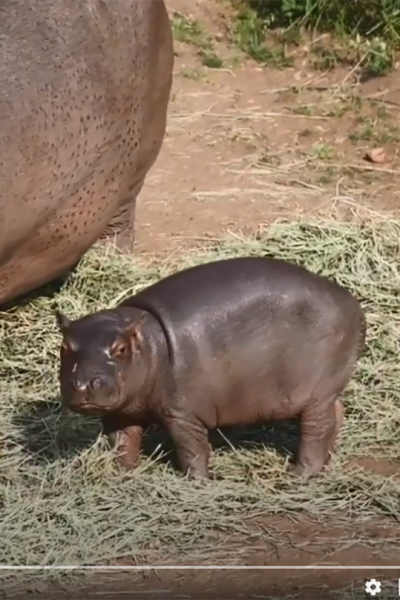
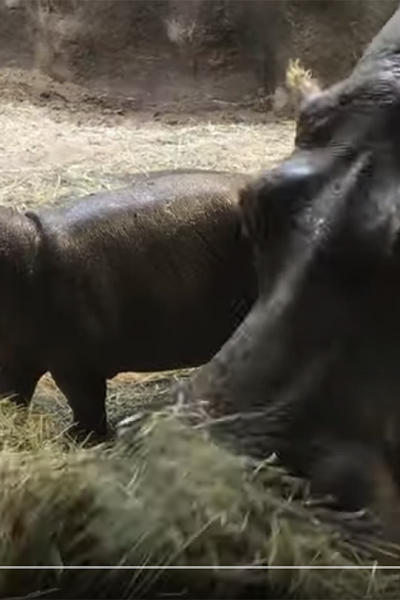
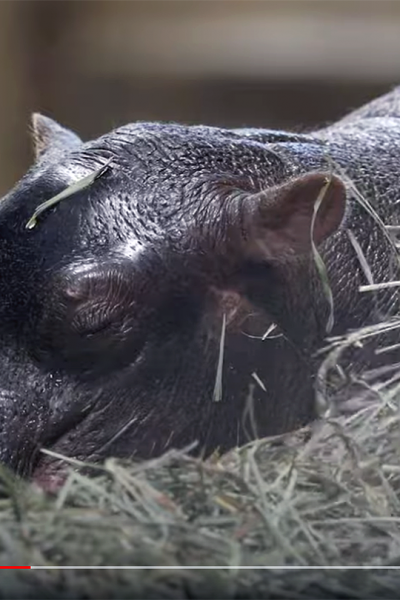
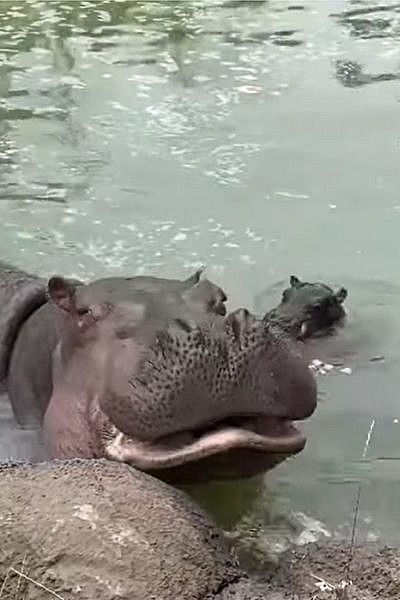
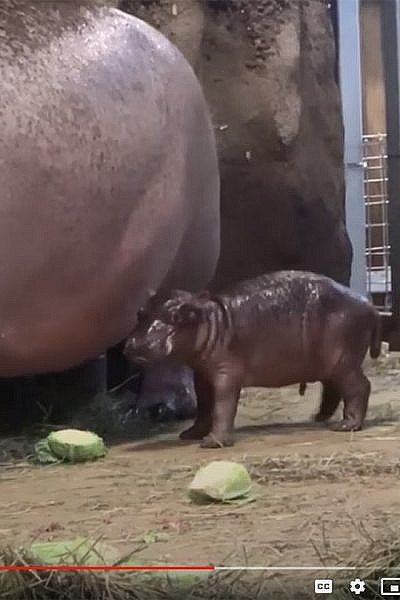
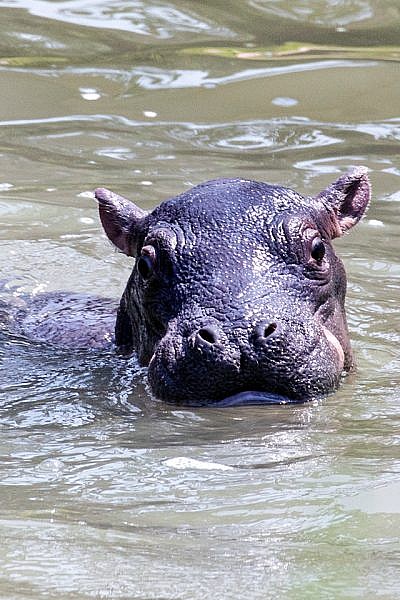
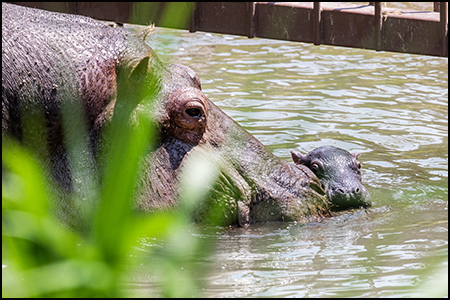
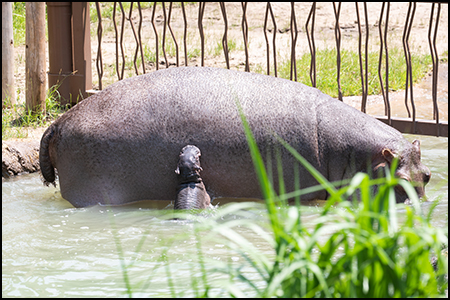
Zambezi’s mini-me is learning how to hippo! At eight weeks old, the little calf is still nursing, but that doesn’t stop him from attempting to eat hay, just like mom. The pair have been spending more time on land, both early in the morning and late in the afternoon. Hippo-ing is a lot of work when you’re a little guy, so naps are required in between bouts of mimicking mom. We’re loving his signature sleepy ‘plop!’
As a celebration of all the hard work and dedication our employees put in every day, Zoo management has decided to give the honor of naming the calf to our staff. We’re in the final stages of choosing that name, and we will share it with you, as soon as it’s final!
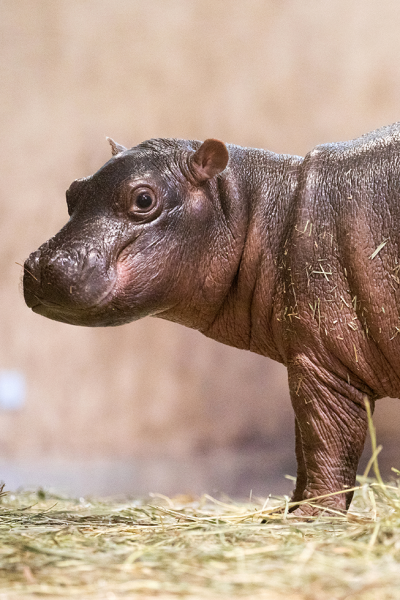
Join us for a 5-week check-in with our beloved baby boy hippo. He and his mom, Zambezi, continue to bond well, and have even been exploring the main hippo yard together. Little baby hippo is weighing in at more than 160 pounds now! He’s gaining about a pound a day.
He’s also starting to grow his tusks and is beginning to interact with his keeper team. Water’s Edge: Africa lead keeper, Phil, fills us in on the latest from the hippo building, where baby and Zambezi have been joining him for afternoon meals daily.
The team is working on choosing a name for the baby hippo, and we’ll share that as soon as we can.
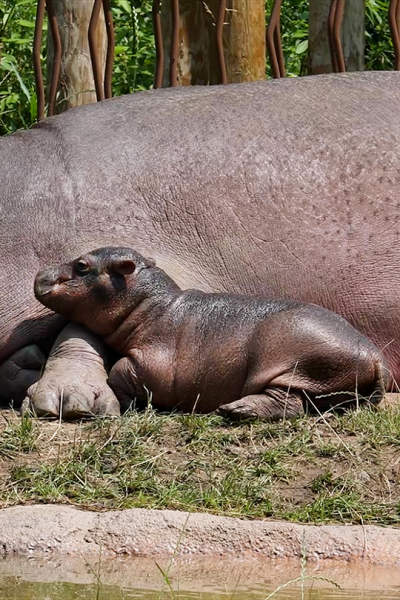
Napping can be tough when you have a newborn! Zambezi is clearly a great mom, always keeping a watchful eye on her little one in between quick winks. Her 3-and-a-half week old calf is great at power napping right alongside her, when not exploring his new, great big world. Once Zambezi decides that naptime is over, the pair enter the water and swim off to their preferred nursing spot. A mother’s work is never done.
THREE-WEEK OLD BABY HIPPO’S DAD CELEBRATES WITH A BLUE WATERMELON SMASH – Cheyenne Mountain Zoo today announced their newest bundle of joy – a three-week-old Nile hippo – is a boy! To celebrate, 18-year-old first-time Nile hippo dad, Biko, smashed a watermelon with the insides dyed blue, with animal-safe food coloring. Enjoy this video, for an up-close view of the smashing good time!
Baby hippo facts:
– Born July 20
– Mom: Zambezi (zam-BEE-zee)
– Dad: Biko (BEE-koh)
– First hippo born at Cheyenne Mountain Zoo in 32 years
– Baby weighs 115 pounds
– Guests can visit mom and baby in Water’s Edge: Africa, the Zoo’s newest exhibit
– Advance tickets to the Zoo are required and available at cmzoo.org/visit
About Water’s Edge: Africa
Water’s Edge: Africa opened in June 2020, with brand-new homes for hippos, African penguins, ring-tailed lemurs, warthogs, pink-backed pelicans and more. Hippo breeding was a key focus of the exhibit’s design, which includes a hippo river loop that can be separated to create mom-and-baby nurseries. Guests can get face-to-face with hippos at their knife-edge pool, or get a bird’s-eye view of them in their yards from a giant rope suspension bridge. The exhibit also has an off-exhibit pool, which can be used if Zambezi’s care team sees she’d like more privacy with her calf.
About Nile Hippos
Only 30 organizations accredited by the Association of Zoos and Aquariums in North America, including Cheyenne Mountain Zoo, house hippos. The International Union for Conservation of Nature (IUCN) Red List categorizes Nile hippopotamuses as a species vulnerable to extinction in the wild, estimating 125,000 to 150,000 remain in their native habitats. The primary threats are habitat loss and illegal and unregulated hunting. Hippos are hunted for their meat and for their ivory canine teeth.
As first-time parents, Biko’s and Zambezi’s offspring represents an important contribution to the population of hippos in human care. The Nile Hippopotamus Species Survival Plan manages the population’s breeding recommendations to achieve the highest possible genetic diversity in the pool. More about Nile hippos at CMZoo.
About Cheyenne Mountain Zoo
Cheyenne Mountain Zoological Society was founded in 1926. Today, Cheyenne Mountain Zoo, America’s mountain Zoo, offers comprehensive education programs, exciting conservation efforts and truly fantastic animal experiences. In 2021, Cheyenne Mountain Zoo was voted #4 Best Zoo in North America and CMZoo’s Rocky Mountain Wild was named #3 Best Zoo Exhibit in North America by USA TODAY 10Best Readers’ Choice Awards. It is Cheyenne Mountain Zoo’s goal to help guests fall in love with animals and nature, and take action to protect them. Of the 233 zoos and aquariums accredited by the Association of Zoos and Aquariums (AZA), Cheyenne Mountain Zoo is one of very few operating without tax support. Cheyenne Mountain Zoo depends on admissions, membership dues, special event attendance and donations for funding.
Ladies and gentlemen, the time has arrived for the baby hippo sex reveal! Water’s Edge: Africa Lead Keeper, Philip, is joined by the calf’s father, Biko, to mark the special occasion. The commissary team at #CMZoo prepared a special treat for the 18-year-old hippo dad; a watermelon with the insides dyed with animal-safe food coloring to indicate the sex of the baby. What color will it be? Watch this for the ‘smashing’ reveal!
Itty bitty little hippo is ready for a nap! After a long day of swimming with mom and exploring its brand-new world, our 2-and-a-half week old hippo looks ready for a nap as mom, Zambezi, eats her dinner. Although the baby is still only nursing, it seems to be learning lots from mom, including trying to eat hay!
Zambezi and her two-week-old calf are popping up to say hello for #TooCuteTuesday! #KeeperCam
The hippo building in Water’s Edge: Africa is open to the public as a ‘quiet zone.’ While Zambezi and her baby bond, the two can sometimes be difficult to spot, but if you’re patient, you are likely to catch a glimpse. Viewing depends on where Zambezi decides to spend time with the baby, or if we need to move them to a private area to clean the exhibit. The baby’s sex has not been identified and there are no naming plans at this point, but we will share that information as soon as we know more!
First-time Nile hippo mom, Zambezi, welcomed her calf to the world on Tuesday, July 20, 2021. Since then, keepers have seen her embrace her new role with ease. Her baby is growing and spending lots of time napping in the shallows of Water’s Edge: Africa’s hippo pools with mom. Hear from lead Water’s Edge keeper, Philip, about the sweet moments keepers have seen between the pair, and see the baby splash into the water and have the most adorable yawn we’ve ever seen.
Zambezi and baby can be difficult to spot in their early days, as they bond in the exhibit, which is open to the public as a ‘quiet zone,’ for now. The baby’s sex has not been identified and there are no naming plans at this point, but we will share that information as soon as we know more!
With a final push, a little splash and some adorable baby hippo ear wiggles, 28-year-old Cheyenne Mountain Zoo Nile hippopotamus, Zambezi (zam-BEE-zee), welcomed her first calf on Tues. July 20. At 1:57 p.m., the baby hippo popped up from underwater, bobbed up and down, and swam right over to meet its mom. As long as things continue to go well for Zambezi and her baby, the hippo building will be open and guests can visit them in Water’s Edge: Africa right away. If Zambezi or the baby show signs they need more quiet time, the Zoo will close the area temporarily.
“It was an incredible moment to see this beautiful baby join our family,” said Philip Waugh, lead keeper at Water’s Edge: Africa. “Zambezi’s a first-time mom, but she knew just what to do. As soon as she delivered the calf, she turned around to greet it and started helping it to shallow water. I’m so proud of her.”
The brand-new buoyant bundle of joy is the first hippo born at CMZoo in 32 years. The moment brought eagerly awaiting CMZoo staff members to happy tears as the baby Nile hippo – a species vulnerable to extinction in the wild – made its debut. So far, mom and baby appear to be healthy and bonding well. Staff will continue monitoring the two hippos regularly and won’t separate mom and baby for an exam unless they think it’s medically necessary.
3,200-pound Zambezi is a well-known member of the CMZoo family, famous for her laid-back demeanor and loud hippo ‘laughs.’ She first came to CMZoo from Denver Zoo, in 1993. In June 2020, Biko (BEE-koh), a now 18-year-old long-legged male Nile hippo, joined the CMZoo hippo herd on a breeding recommendation with Zambezi and her sister, Kasai (kuh-SIGH). Biko and Zambezi took a shining to each other nearly immediately.
“Like any new couple, their first ‘dates’ had a few awkward moments, but once they connected, it was full-on hippo love,” said Waugh. “The two of them wanted to be together constantly, and we accommodated! They would do a hippo breeding ‘dance’ where they would swim nose-to-rear in a circle. We also saw them taking turns resting their heads on each other’s rear ends for little pool naps. They made it clear they liked each other. We saw their first successful breeding in November.”
Eight months later – a normal full-term gestation for Nile hippos – their little one is finally here. Normal newborn hippos can weigh between 40 and 80 pounds, and this calf appears to be in that range. Because there are no immediate plans to physically check the baby, its sex likely won’t be known for some time. The Zoo will make plans to name the baby after its one-month birthday, following Zoo tradition.
Although Zambezi’s care team was pretty sure she was pregnant, it was scientifically difficult to substantiate, so the team decided to wait and see instead of sharing the pregnancy news. Weight gain is not a reliable way to check for hippo pregnancy, because their daily weight regularly fluctuates by about 100 pounds. Ultimately, Zambezi’s pregnancy tests – including fecal samples and voluntary ultrasounds – were inconclusive. But, there’s no denying it now!
This baby is the fourth member of the hippo herd at CMZoo, and the fourth baby born at Water’s Edge: Africa since April. On April 26, ring-tailed lemur, Rogue, welcomed her first baby. On July 11, Rogue’s sister, Allagash, gave birth to twins. All first-time moms and their offspring are doing great. More about new babies at CMZoo.
(Please note, this video below includes footage of the live birth in the water.)
About Water’s Edge: Africa
Water’s Edge: Africa opened in June 2020, with brand-new homes for hippos, African penguins, ring-tailed lemurs, warthogs, pink-backed pelicans and more. Hippo breeding was a key focus of the exhibit’s design, which includes a hippo river loop that can be separated to create mom-and-baby nurseries. Guests can get face-to-face with hippos at their knife-edge pool, or get a bird’s-eye view of them in their yards from a giant rope suspension bridge. The exhibit also has an off-exhibit pool, which can be used if Zambezi’s care team sees she’d like more privacy with her calf.
About Nile Hippos
Only 30 organizations accredited by the Association of Zoos and Aquariums in North America, including Cheyenne Mountain Zoo, house hippos. The International Union for Conservation of Nature (IUCN) Red List categorizes Nile hippopotamuses as a species vulnerable to extinction in the wild, estimating 125,000 to 150,000 remain in their native habitats. The primary threats are habitat loss and illegal and unregulated hunting. Hippos are hunted for their meat and for their ivory canine teeth.
As first-time parents, Biko’s and Zambezi’s offspring represents an important contribution to the population of hippos in human care. The Nile Hippopotamus Species Survival Plan manages the population’s breeding recommendations to achieve the highest possible genetic diversity in the pool. More about Nile hippos at CMZoo.
About Cheyenne Mountain Zoo
Cheyenne Mountain Zoological Society was founded in 1926. Today, Cheyenne Mountain Zoo, America’s mountain Zoo, offers comprehensive education programs, exciting conservation efforts and truly fantastic animal experiences. In 2021, Cheyenne Mountain Zoo was voted #4 Best Zoo in North America and CMZoo’s Rocky Mountain Wild was named #3 Best Zoo Exhibit in North America by USA TODAY 10Best Readers’ Choice Awards. It is Cheyenne Mountain Zoo’s goal to help guests fall in love with animals and nature, and take action to protect them. Of the 233 zoos and aquariums accredited by the Association of Zoos and Aquariums (AZA), Cheyenne Mountain Zoo is one of very few operating without tax support. Cheyenne Mountain Zoo depends on admissions, membership dues, special event attendance and donations for funding.