We have exciting baby news!

Two of our skunks recently had kits! Isabel and Padfoot are each raising a litter of seven baby skunks. That’s fourteen tiny bundles of cuteness keeping their paws full. The two litters arrived exactly two weeks apart. The babies are often busy nursing, sleeping and curiously nuzzling one another. Isabel, Padfoot, and all the little ones appear to be doing well. It won’t be long before these kits are full of energy and exploring their home in The Loft. Until then, the best time to see them is during our skunk training demonstrations in The Loft. The demonstrations take place on Monday, Wednesday, Thursday, Saturday and Sunday at 2:30 p.m.

These skunks will head to other AZA zoos when they’re mature and independent in the coming months. At their new homes, they’ll represent their wild counterparts and help even more people learn to love and appreciate skunks.

Back to The Waterhole

Our penguin chick isn’t so tiny anymore! Hatched on April 8, this little one is already nearing the two-month mark, and growing fast! It still lives in the nest box with Captain and Pearl, and it already weighs about 5 pounds, nearly the size of an adult African penguin. Keepers check on the chick daily and do regular weigh-ins to track its progress. The chick is very alert and loves to chirp loudly to make sure Captain, Pearl and everyone else in the penguin building knows when it’s time for a snack. Stay tuned for more penguin chick updates on social media!

Back to The Waterhole

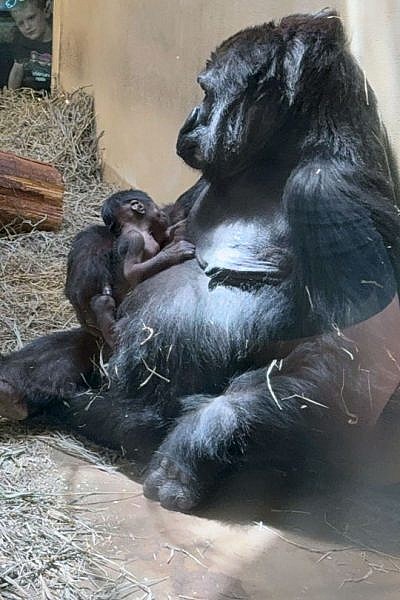
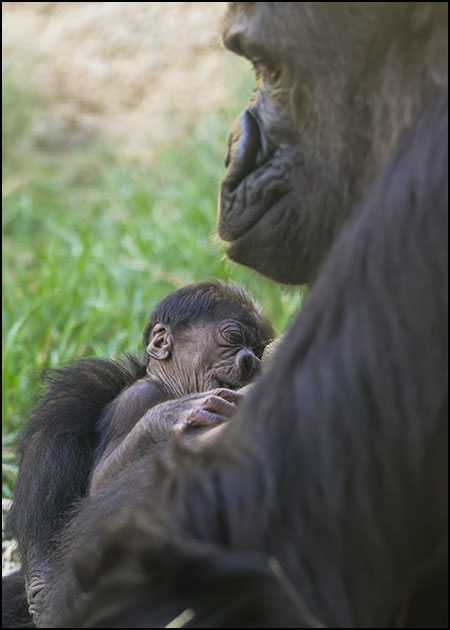
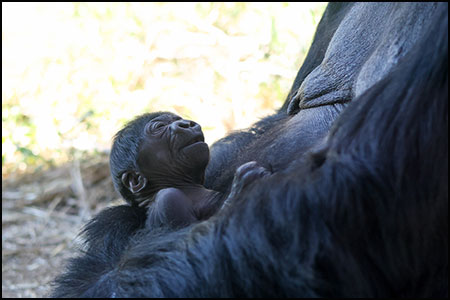
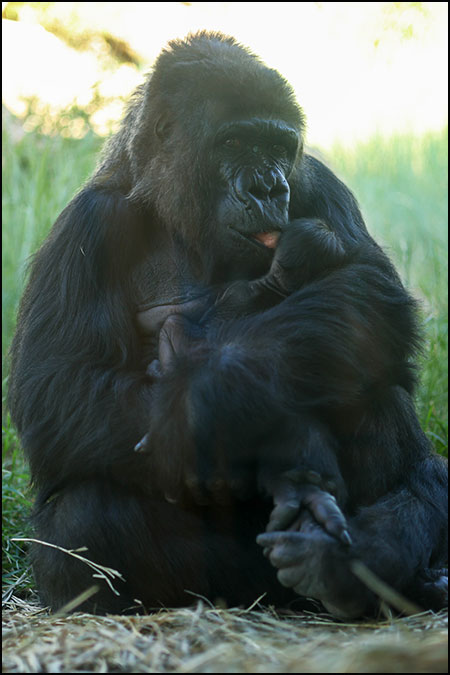
Mother’s Day is extra special in Primate World, at Cheyenne Mountain Zoo, this year. Asha, a 32-year-old critically endangered Western lowland gorilla, is pregnant. She is due between mid-May and the end of July.

Western Lowland gorilla Asha,

“It has been nearly 13 years since a gorilla was born here, so many visitors will get to experience this for the first time, along with our silverback, Goma, who will become a first-time dad with this little one,” Jon Wild, lead animal keeper in Primate World, says. “It’s not Asha’s first time, and she has been a great mom in the past.”

Asha is mom to two gorillas who have moved on to other troops now: 12-year-old male, Dembe, who lives at North Carolina Zoo, and 18-year-old female, Tumani, who lives at Audubon Zoo, in New Orleans.

Asha was born at CMZoo on Oct. 5, 1992. Thirty-four-year-old Goma moved to CMZoo, in 2016, on a breeding recommendation from the Western Lowland Gorilla Species Survival Plan, supported by Association of Zoos and Aquariums-accredited organizations, including CMZoo.

Before he came to CMZoo, Goma lived with a bachelor troop, so he had to learn how to lead a troop of females. As an experienced mom, Asha helped Goma learn how to breed.

“Since Goma moved here, nine years ago, the gorilla care team has been working to integrate him into the troop, and the troop has been helping him learn to lead as a silverback, with this pregnancy as a goal,” Wild says. “It’s incredibly exciting to see the gorillas achieve a healthy cohesive troop dynamic, and knowing there’s a baby on the way makes it even more meaningful to see this family grow.”

Asha’s previous experiences have helped Goma learn, and they have helped her care team provide prenatal check-ups throughout her pregnancy. Asha participates in cooperative care, like ultrasounds that have revealed a healthily growing baby. The Zoo first confirmed her pregnancy in December 2024 with a positive urine pregnancy test.

“Asha is super smart, and she approaches a training panel and presents her stomach so we can touch it with the ultrasound wand,” Wild says. “She’ll stand and get training rewards for participating, and her methods of presenting her stomach to us are adorable.”

Western Lowland gorilla Asha

During ultrasounds, Asha stands next to the mesh training panel and leans her stomach sideways against the mesh, with her arms outstretched above her. Keepers, from the other side of the protective barrier, slip an ultrasound wand through the mesh and press it against her abdomen. Animal keepers say the ultrasound gel is often off-putting for animals – even if they warm it up. Animals typically don’t like the texture, but Asha doesn’t mind. She participates in the ultrasound sessions for around 30 minutes, and is free to leave the sessions any time she pleases. She offers her belly to keepers in a more ‘theatrical’ way, too.

“She has an especially graceful stomach presentation, where she lifts one leg straight up against the mesh, like a ballerina, so we can position the wand on the underside of her round tummy,” Wild says. “Guests get a real kick out of seeing that, and it gives us great wand placement options to see the baby moving around.”

Gorilla gestation typically lasts eight-and-a-half months. As long as Asha and her baby continue to do well, guests can visit her in Primate World. When she gives birth, the Zoo will share updates.

Gorilla babies are typically on their mothers for the first year, taking time to crawl, explore and play periodically. In the first 15 days, the gorilla care team will be looking for the baby to hit milestones that indicate good development, including grasping onto its mother, nursing, holding its head up independently, making eye contact and following movement with its eyes.

In its first month, they’ll look for the baby to smile, laugh quietly, roll over from its stomach to its back, initiate soft play and start teething.

Western Lowland gorilla Asha, side portrait pregnant May 2025

Western lowland gorillas are critically endangered in the wild, and their numbers continue to decrease in the wild. Gorilla fans can help preserve wild gorilla habitats by recycling small electronic devices and cell phones at CMZoo.

In addition to disease and poaching, gorillas face habitat loss due to logging for agricultural use, human settlements and mining. Many of the West African lowland forests and swamps that these animals call home are also natural deposits of coltan, a mineral used in cell phones and other electronics. Due to the ever-increasing demand for cell phones across the world, the destruction of these gorillas’ habitats for mining purposes has unfortunately increased.

Coltan is recyclable, and by donating old cell phones, we can help supply valuable coltan for future phone production. Guests can bring electronics to CMZoo admissions or Primate World, where there’s a recycling collection bin near the gorillas’ indoor dens. CMZoo will send them to Eco-Cell, an organization that recycles the phones, as well as tablets, smart watches, Bluetooth devices, GPS devices, e-readers, digital cameras, handheld gaming systems and their accessories.

About Cheyenne Mountain Zoo

Cheyenne Mountain Zoological Society was founded in 1926. Today, Cheyenne Mountain Zoo, America’s mountain Zoo, offers comprehensive education programs, exciting conservation efforts and truly fantastic animal experiences. In 2025, Cheyenne Mountain Zoo was voted #2 Best Zoo in North America and CMZoo’s Rocky Mountain Wild was named #2 Best Zoo Exhibit in North America by USA TODAY 10Best Readers’ Choice Awards. It is Cheyenne Mountain Zoo’s goal to help guests fall in love with animals and nature, and take action to protect them. Since 2008, CMZoo’s Quarters for Conservation program has raised more than $5 million dedicated to frontline conservation efforts around the world. Of the 237 zoos and aquariums accredited by the Association of Zoos and Aquariums (AZA), Cheyenne Mountain Zoo is one of just a few operating without tax support. Cheyenne Mountain Zoo depends on admissions, membership dues, special event attendance and donations for funding.
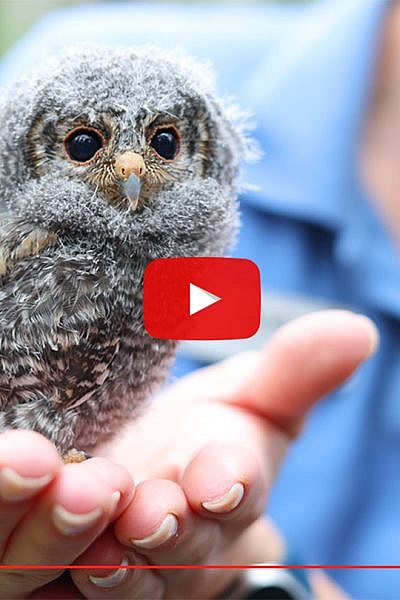
Three sets of fuzzy ears and wide, curious eyes recently joined the CMZoo family! These tiny ring-tailed lemur babies are already turning heads with their inquisitive expressions and snuggles on Allagash.

While they’re still nursing, they’re also beginning to explore some solid foods. The pups cling tightly to Allagash but are starting to show signs of independence. Allagash’s adult daughter, Anja, seems especially curious about the little ones and has even started helping with grooming duties.

According to the Lemur Conservation Foundation, lemurs are among the most threatened groups of mammals. The International Union for the Conservation of Nature (IUCN) estimates that more than 95 percent of lemurs face extinction in the next 20 years. Ring-tailed lemurs are endangered, according to the IUCN. Hercules has had breeding recommendations with Allagash and Rogue as part of the ring-tailed lemur Species Survival Plan, managed cooperatively by members of Association of Zoos and Aquariums-accredited facilities, like CMZoo.

Guests can see the babies right away, on Lemur Island in the hippo area, in Water’s Edge Africa!

Back to The Waterhole

Last month, Cheyenne Mountain Zoo members cast their votes to help the Zoo decide how to spend $75,000 of member conservation funds among staff-championed conservation projects vying for members’ support. The three projects with the most votes received the full funding they requested.

Every membership and every visit to the Zoo is conservation in action. From 2015 to 2025, the program has provided $825,000 of membership revenue to support field conservation worldwide.

“Our members make a big impact for wildlife and wild places,” Ashley Cioppa, CMZoo membership manager, says. “Our members’ annual investment in their Zoo memberships directly supports animals here in Colorado and all around the world. Plus, they give our staff the opportunity to reach more niche organizations and projects that support their conservation passions. Thank you, members!”

Each year, CMZoo membership revenue contributes a total of $100,000 to conservation in two ways:

  • $25,000 to the Quarters for Conservation program, which in total contributes a million dollars on average every 18 months to CMZoo’s legacy conservation partners.
  • $75,000 to projects voted for by CMZoo members through this annual vote.

This year’s Members-Only Conservation Vote top-ranked projects to fully fund are:

1) FOSTER, RAISE, AND RELEASE AFRICAN PENGUINS – $38,271
Member funding will provide an incubator, veterinary care and rehabilitation support for wild African penguin chicks and adults. African penguins, found mainly in South Africa and Namibia, face significant threats from overfishing, oil spills and disease outbreaks. As a result, penguin parents are abandoning their chicks due to lack of food and other weather-related factors. The Southern African Foundation for the Conservation of Coastal Birds (SANCCOB )will use these funds to rescue abandoned penguin eggs, chicks and adults needing intervention and rehabilitation at their South Africa facility. The goal is to release as many rescued penguins as possible back into the wild to bolster the rapidly declining African penguin population.


2) SUPPORT LEADERSHIP TRAINING FOR KENYAN WOMEN CONSERVATIONISTS AND RESTORE HABITAT FOR AFRICAN LIONS – $17,000
Support will empower Samburu (a region in Northern Kenya) women to improve their community’s livelihoods and help protect lions. Ewaso Lions implements several programs to help protect lions. One of these programs is The Mama Simbas (which means “Mothers of Lions”). The group consists of Samburu women trained to help alleviate human- wildlife conflicts, which typically occur between farmers and predators that may threaten local livestock. Ewaso Lions will use these funds to provide leadership training to the women of The Mama Simbas program. This training will give the women new tools to help shift attitudes towards predators, allowing Kenyan communities to coexist more easily and efficiently with wild carnivores. Funds will also support the restoration of grassland habitat.


3) PROTECT EGYPTIAN TORTOISES THROUGH COMMUNITY CONSERVATION IN EGYPT- $19,729
Member support will fund local community guards and provide tracking tags to protect Egyptian tortoises. Wild turtles and tortoises are facing a worldwide extinction crisis. The Egyptian tortoise faces severe threats from habitat destruction due to farming and poaching for the pet trade. The Turtle Survival Alliance will use funds to deploy tracking tags to gather data and gain an understanding of how tortoises interact with each other and their environment, as well as population dynamics. Community guards will help address immediate threats to the species by physically protecting the most vital tortoise populations and their habitat.

With Mother’s Day around the corner, staff at Cheyenne Mountain Zoo are reflecting on one mother-daughter relationship that stands out: Bornean orangutans, Hadiah [huh-DEE-uh] and Ember.

Sumatran orangutan, Ember
Bornean orangutan, Ember

“They’re incredibly close,” Ashton Asbury, animal keeper in Primate World, says. “Great apes are intelligent and complex beings, and we see different parenting types in each of them. Hadiah, as a mom to her only child, Ember, is a supportive, patient and rose-colored-glasses kind of mom.”

Ember is known for her in-your-face playfulness and high-energy approach to life. Her mom sometimes inadvertently finds herself in the path of her rambunctious nature, but she doesn’t seem to mind. After being the recipient of a rogue toy to the head, Hadiah has been seen handing the toy back to Ember patiently, and returning to her own activity without skipping a beat.

Often that activity is people watching.

“Hadiah has connections with so many visitors and staff because she’s truly curious and recognizes people who return to see her,” Ashton says. “She’s got great facial recognition, and she’ll play with people through the glass. If she’s ever rolled over onto her back or folded her arms over her head to one side and looked at you upside down, she’s playing with you. She does that with her favorite humans and new guests who catch her eye.”

Orangutans are mostly solitary as adults, unless they are interacting for breeding or they have young with them, and many orangutan mothers are ready for their offspring to ‘spring off’ by around age seven or eight. Thirty-seven-year-old Hadiah is content with her daughter-turned-bestie, who is ten years old.

“These two still nest together every night,” Ashton says. “They eat together and play. It’s rare to see that kind of relationship in orangutans, when offspring are as old as Ember, and it really speaks to the respect and affection they have for each other.”

On the rare occasion that confident Ember feels unsure about something new, she runs to Hadiah, grabs her arms and wraps them around her. Despite their similar size, Hadiah occasionally still carries Ember.

“Their dynamic can be playful and outgoing, but also so patient and calm,” Izzy Dones, animal keeper in Primate World, says. “They’re usually together, but Ember and Hadiah also enjoy doing things separately sometimes. They’re both confident training and exploring separately, but, any time Hadiah is training with us, we’re ready with an activity for Ember nearby, because she’s going to want to do whatever Mom is doing.”

Hadiah grew up at the Zoo and was close with her own mother, Sabtu, until she passed away, in 2006. That strong family foundation seems to have shaped Hadiah’s parenting style.

“At least partly because of Hadiah’s unwavering support, Ember is one of the most confident and intelligent orangutans we’ve seen,” Izzy says. “She’s outgoing and curious about staff and guests, just like Hadiah, and she picks up training fast. She’s always pushing boundaries in a way that helps her grow, but still stays very close to Hadiah.”

Ember’s favorite enrichment activities include wearing fabric on her head, mimicking a behavior observed in wild orangutans who use leaves for shelter, like a hat or umbrella. She’s also a skilled problem-solver who enjoys dismantling enrichment items and ‘trading them’ through the mesh for snacks from keepers. She has learned that she gets one snack for every item she passes through the mesh, so instead of passing an assembled puzzle feeder, she takes it apart into several pieces – earning several snacks.

“Ember is really sharp,” Izzy says.

The apple didn’t fall far from the tree. Hadiah participates in cooperative care, like brushing and water-flossing her teeth, nail trims, target training, voluntary injection, abdominal ultrasound, scale training, ear and eye presentations, and more. Of course, through modeling behaviors learned by watching Mom, Ember is also a whiz at most of these, too.

Not to be outdone by her vivacious daughter, Hadiah is learning new climbing behaviors, and her fascination with guests is building her confidence and strength to climb high in the orangutan yard.

“She likes to climb down like a sloth, and because she’s so outgoing, she seems to enjoy the guests’ reactions,” Izzy says. “She’ll hear guests ‘oohing’ at her while she climbs, and will stop and look over at them with excitement.”

When guests aren’t ‘oohing’ at her, she calls them over by knocking on the glass to get their attention. Visitors usually get the hint, and Hadiah presents opportunities to play, or brings a blanket over to the glass to make a nest to rest near them.

Bornean orangutan, Hadiah portrait
Bornean orangutan, Hadiah

Their “perfect day” includes novel training sessions, new spaces to explore and enrichment items like ice treats, bubbles, coconuts and even painting sessions. Hadiah is especially thoughtful with her artwork, while Ember seems to embrace the Jackson Pollock painting style.

As members of a critically endangered species, Hadiah and Ember play an important role in orangutan conservation.

“Most people won’t get the chance to see an orangutan in the wild,” Izzy says. “But when they meet Hadiah and Ember, they connect. They stop, they watch, and they feel seen by an animal. That connection makes all the difference.”

Every visit to CMZoo helps fund international efforts to save wild orangutan habitats, through the Zoo’s Quarters for Conservation (Q4C) program. “Orangu-fans” can save the rainforests from the comfort of their smartphone with a free global mobile app called PalmOil Scan.

Palm oil is an edible oil sourced in about half of consumer products. Unsustainable palm oil production results in deforestation in Indonesia and Malaysia – the only places where critically endangered orangutans live in the wild. Although the majority of palm oil production is in Southeast Asia, it has also expanded to other tropical areas, which means more animal species could lose the habitats they need to survive.

When produced sustainably, palm oil is four to ten times more productive than any other edible oil. Using PalmOil Scan, conscientious consumers can scan the barcodes on tens of thousands of products in the app’s extensive database (which is being updated and expanded continually) to see if they are produced by a company that has committed to sourcing sustainable palm oil. By choosing products made by companies that have committed to sustainable palm oil, consumers can show companies that they’re armed with the information they need to demand action for wildlife conservation.

Developed under the direction of the World Association of Zoos and Aquariums and regionally managed by CMZoo, in the U.S. and Canada. The PalmOil Scan is a global app that can also be downloaded in the UK, Australia and New Zealand, which are all managed by other partner zoos. The free app can be downloaded from the App Store and Google Play. Orangutan enthusiasts can learn more about palm oil, and download the free app before their next shopping trip, at cmzoo.org/palmoil.

Back to The Waterhole

Waddle we do with all this cuteness? A tiny, fluffy African penguin chick made its grand debut at Cheyenne Mountain Zoo in early April! This little one is growing up big and strong. At just 22 days old, the chick weighs 983 grams!

Its care team monitors and weighs it every few days. This little one is an important ambassador for African penguins.

In 2024, African penguins were officially uplisted to ‘critically endangered’ on the International Union for Conservation of Nature (IUCN) Red List, with the number of wild breeding pairs falling below 10,000. If current trends continue, these charismatic birds could be extinct in the wild by 2035.

Since 2010, CMZoo guests and members have contributed more than $159,675 to Southern African Foundation for the Conservation of Coastal Birds (SANCCOB) in support of African penguin conservation. In 2020, the Zoo deepened its commitment by joining AZA SAFE (Saving Animals From Extinction) African Penguin, a collaborative program supported by the Association of Zoos and Aquariums.

Every visit to CMZoo is conservation in action. Guests visiting CMZoo can see African penguins up close, including this new chick, knowing their visit helps support a future for this species in the wild.

Keep an eye (and ear) out for the chick in the penguin building in Water’s Edge Africa. While it’s usually snuggled in the nest, you might see it wriggle out, or hear it peeping.

Stay tuned for updates!

Back to The Waterhole

IN PARTNERSHIP WITH CHILDREN’S HOSPITAL COLORADO – Summer is around the corner, and many families are planning activities to keep the kids active, healthy and inspired. Cheyenne Mountain Zoo’s partners at Children’s Hospital Colorado offer expert tips for incorporating gratitude into children’s daily lives, and CMZoo’s horticulture team says creating a family garden provides ample opportunities in nature.

Horticulture Staff tending to Plant Sale plants

“Having a backyard or patio garden means you can have quick access to a peaceful place, without needing to make a whole day of it,” Zach Groskopf, horticulture technician at CMZoo, says. “Planting and nurturing a garden allows you to slow down and breathe deep in nature, without requiring reservations or a road trip.”

Gardening provides endless memories, education and screen-free time in the calming presence of nature, and seeing something thrive under your care can be extremely gratifying. The size of space available doesn’t matter. Plus, by planting native and Colorado-friendly plants that feed butterflies, hummingbirds, bees and other pollinators, gardeners can help wildlife that is/are vital to our ecosystems.

CMZoo’s horticulture team has a variety of native and Colorado-friendly plants, veggies, herbs and shrubs available this year at CMZoo’s annual Plant Sale, Thurs., May 16 through Sat., May 18. Penstemon (beartongue), gaillardia (blanket flower), purple prairie flower, butterfly bush, silver lace vine, columbine, basil, cilantro, kale, tomatoes, peppers, cabbage and more will be available for purchase.

Plant Sale plants on a table during the sale

“The columbine is my personal favorite flower because they’re beautiful, and they’re resilient,” Zach says. “I keep bees, and these flowers make the most delicious honey, too. The columbines at the Plant Sale are special because we grew all of them from columbine seeds collected from all around the Zoo.”

There are no reservations or Zoo tickets required to attend the Plant Sale, which will be open from 9 a.m. to 5 p.m. on Thurs., May 16 and Fri., May 17 and 9 a.m. to 4 p.m. on Sat., May 18 – when the Zoo closes early for Run to the Shrine. Plants will be available on a first-come first-served basis, so don’t be late! The sale has been known to sell out early in previous years.

This year, the Zoo’s fundraising Plant Sale will be in the Zoo parking lot. Keep an eye out for signs directing you to the sale as you drive into guest parking. This year’s Plant Sale is in-person only. There will be no online shopping or shipping options available. Come out to the Zoo and chat with our expert horticulturists about which plants will work best in your garden, and feel good knowing you’re supporting the ongoing beautification of the Zoo with your purchases.

Back to The Waterhole

Water’s Edge Africa at Cheyenne Mountain Zoo is home to three wide-eyed, stripe-tailed and utterly adorable ring-tailed lemur pups! The leading lady of Lemur Island, 12-year-old ring-tailed lemur matriarch, Allagash, has her hands full.

Ring-tailed lemur Allagash with new pups April, 2025

She’s caring for all three bundles of joy, born on Thurs., March 20, 2025, but she didn’t give birth to all three. Rogue, Allagash’s sister, also gave birth on March 20, and Allagash has accepted Rogue’s offspring as her own.

Lemur conspiracies (what a group of lemurs is called) are matriarchal, and Allagash has led the CMZoo troop since its early days. The dominant female’s offspring are typically second-in-command, followed in rank by any other females, with males at the bottom of the social ranks. When Allagash and Rogue had their babies on the same day, staff saw that complex hierarchy in action.

The day after the births, chasing ensued on Lemur Island, and Rogue was displaced. During a chase, Rogue was separated from her offspring. Staff attempted to reunite them, but Rogue did not accept the baby. Allagash immediately accepted the baby when staff presented it to her.

Since then, in efforts to reestablish peace and safety for the troop, staff have kept Rogue separated by mesh from the rest of the lemur group. Staff are monitoring all lemurs closely, and have seen calm interactions through mesh between the group and Rogue. They have seen Rogue grooming Allagash (a sign of calm respect and bonding between the sisters) and the babies. Rogue and the troop often choose to sleep next to each other on either sides of the mesh. Staff hope to begin taking steps to reunite the troop in the future.

All three babies are consistently nursing and clinging to Allagash. Both of those behaviors indicate the pups are healthy and bonding well, and they’re growing like wildflowers!

“The babies are quite active while climbing on Allagash, which makes her kind of like a lemur jungle gym for the little ones,” Michael Barnas, animal keeper in Water’s Edge, says. “While two are nursing, the other rides on her back, and they rotate positions to nurse.”

Watch a short video of Allagash and the three new pups

The babies are typically attached to Allagash while they’re this little. At four weeks old, they are getting more curious about the world around them. They have started venturing off Allagash for brief moments, onto tree branches and their dad, Hercules. They seem to really enjoy jumping up and down in the sunshine, too. One baby recently jumped from Allagash’s torso to her face.

“Allagash looked a little surprised at its landing spot and gently moved the baby from her nose to her neck, where it quickly settled in for another nap,” Michael says. “She’s a great mom, and the babies seem strong. In between rotating nursing opportunities, she rotates grooming them, which is important for their bonds and cleanliness.”

Leaning on their trusting relationship with Allagash, keepers have been able to monitor Mom and the pups by asking Allagash to come over to them for visual checks. The little ones are starting to recognize things, notably other lemurs and their keepers. The sexes of the babies have not been identified, and there are no plans to name the babies yet. CMZoo will share updates on its social media channels as the team learns more about them. As long as all continues to go well for the lemurs, guests can see them right away.

The seven lemurs are all visible on Lemur Island. They take turns exploring spaces on either side of the mesh ‘nursery’ on the inside portion of the island, and Rogue explores the outdoor section of Lemur Island on warm and sunny days.

According to the Lemur Conservation Foundation, lemurs are among the most threatened groups of mammals. The International Union for the Conservation of Nature (IUCN) estimates that over 95 percent of lemurs face extinction in the next 20 years. Ring-tailed lemurs are endangered, according to the IUCN. Hercules has breeding recommendations with Allagash and Rogue, as part of the ring-tailed lemur Species Survival Plan, managed cooperatively by members of Association of Zoos and Aquariums-accredited facilities, like CMZoo.

Lemur gestation lasts about 135 days. Newborn lemurs typically cling closely to the mother for about two weeks, then will start to ride on her back. After about a month, young lemurs will start exploring more independently and are typically fully weaned at about five or six months.

HE WAS THE SECOND-OLDEST MALE GIRAFFE IN HUMAN CARE IN THE COUNTRY WHEN HE PASSED – Cheyenne Mountain Zoo staff and giraffe fans are reflecting on the life of a legendary giraffe, Mahali [ma-HAUL-ee]. After an age-related decline in his health, Mahali’s care team made the difficult but compassionate decision to euthanize him on Thurs., April 10. Mahali was the second-oldest male reticulated giraffe in Association of Zoos and Aquariums facilities in the country at 22 years old.

Mahali, male reticulated giraffe looking at the camera

Mahali’s team remembers him as self-assured and particular, and they’re most grateful for what he taught them. Later in life, Mahali experienced foot and leg issues that affected his mobility. In 2017 and 2020, Mahali went under anesthesia to receive treatments, and those procedures helped him heal and return to a good quality of life. In 2023, his care team decided to avoid future risky anesthesia, and focus on helping Mahali live well as an old giraffe by making environmental accommodations for him.

“Mahali changed the way we think about caring for aging giraffe,” Rick Hester, CMZoo animal behaviors curator, says. “It’s not often you have the opportunity to work with a male giraffe this old, and once we understood each other, we could try all sorts of accommodations to help him age comfortably.”

Mahali advanced giraffe care by allowing his team to glue orthopedic shoes to his hooves, and by helping his team understand quality-of-life measurements that made sense for him as an old giraffe, as opposed to a young giraffe. A good quality of life for an aging giraffe includes having comfortable places to rest, participating in husbandry training, socializing with giraffe friends, eating well, being able to lie down and stand up, and traversing all terrains.

When keepers noticed Mahali was ‘saying no’ to training consistently around 2017, Amy Schilz, senior animal behaviorist at the International Center for the Care and Conservation of Giraffe at CMZoo, asked Rick to put his decade of animal training experience to the test with Mahali. After Mahali developed a communicative and trusting relationship with Rick, it was game on.

Even in a busy barn, Rick could call out, ‘Hey, Mahali,’ in a low monotone voice. Mahali’s eyes would sharpen focus, his ears would perk up, and he’d start scanning the crowd. Once he spotted Rick, he’d walk right over. Rick and Amy worked consistently together with Mahali’s training, and Mahali learned to trust that he was in control with these humans, who were going to notice his subtle communication cues.

Mahali, male reticulated giraffe outside

“Mahali had special needs, and what worked for the rest of the herd wasn’t working for him as he aged, so we worked to find the right nuance for Mahali,” Rick says. “When we were together, we were really focused on each other, and Mahali responded well for many years.”

Rick and Mahali stayed focused on each other for Mahali’s remaining years, perfecting the animal-human communication that all CMZoo animal trainers strive for, to provide excellent cooperative care for an animal. Thanks to his dedicated team, Mahali got many more years of quality health, and giraffe fans got many more years of Mahali.

“Mahali was a rascal in his younger years,” Amy says. Amy worked with Mahali for 12 years. “Some might remember we used to sell lettuce for giraffe feedings near the railing of the giraffe yard. We moved it because Mahali could reach over the railing, and he kept nudging staff to give him lettuce, like, ‘Hey, I see what you have there.’”

As Mahali grew up, his confidence was on full display. His team described him as ‘tactile.’ He was known for pulling on keepers’ shirts or pushing other giraffe out of his way to be the center of keepers’ attention. If Mahali didn’t want to move, he wasn’t moving. At the end of the day, when keepers welcomed giraffe to the barn from the yard, he would sometimes opt for a few more hours outside.

“He had a great last day,” Jason Bredahl, CMZoo curator of animal environments and former giraffe animal care manager, says. Jason was present for Mahali’s entire life. “He went out into the yard with an enthusiasm we hadn’t seen in a few days. He soaked up the sunshine and ate lettuce and tree branches while socializing with his herd and our guests. We’re proud of the ‘bonus years’ we’ve been able to give Mahali, and we’re grateful for all the guests he has inspired and animal welfare he has taught us. It’s always hard when we know it’s time to say goodbye, but it’s also our final act of compassion and stewardship for our animals.”

Mahali was the first giraffe calf born in the current giraffe barn, hours before Mother’s Day in May 2003. As the Zoo makes progress on its giraffe habitat expansion and a new 12,000 square-foot giraffe building, giraffe staff say they will take the lessons Mahali taught them to their new giraffe center, and share with keepers around the world through the International Center for the Care and Conservation of Giraffe’s workshops, information sharing and consultations. His legacy will live on in every giraffe that gets to live old well.

About Cheyenne Mountain Zoo

Cheyenne Mountain Zoological Society was founded in 1926. Today, Cheyenne Mountain Zoo, America’s mountain Zoo, offers comprehensive education programs, exciting conservation efforts and truly fantastic animal experiences. In 2025, Cheyenne Mountain Zoo was voted #2 Best Zoo in North America and CMZoo’s Rocky Mountain Wild was named #2 Best Zoo Exhibit in North America by USA TODAY 10Best Readers’ Choice Awards. It is Cheyenne Mountain Zoo’s goal to help guests fall in love with animals and nature, and take action to protect them. Since 2008, CMZoo’s Quarters for Conservation program has raised more than $5 million dedicated to frontline conservation efforts around the world. Of the 237 zoos and aquariums accredited by the Association of Zoos and Aquariums (AZA), Cheyenne Mountain Zoo is one of just a few operating without tax support. Cheyenne Mountain Zoo depends on admissions, membership dues, special event attendance and donations for funding.