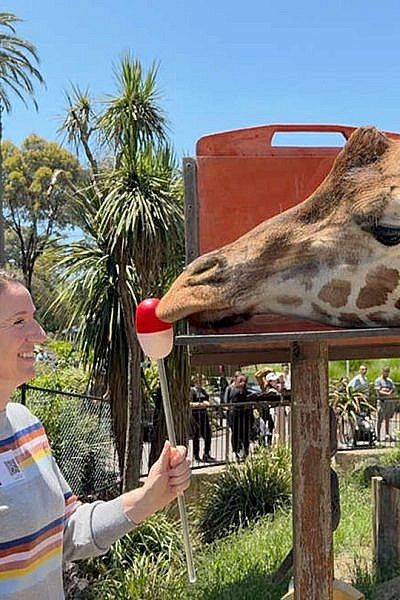
Say hello to Jasiri, a 5-year-old reticulated giraffe who recently arrived at Cheyenne Mountain Zoo from Denver Zoo Conservation Alliance for a temporary stay. Jasiri’s move supports giraffe conservation through the Giraffe Species Survival Plan (SSP), a program managed by the Association of Zoos and Aquariums (AZA).

Jasiri’s arrival went smoothly — he calmly walked off the specialized trailer and into his temporary home, where the neighboring giraffe herd was already eager to say hello. From curious nuzzles and sniffs to a few gentle licks, the herd wasted no time welcoming him.

Swing by African Rift Valley to say hello to Jasiri!

Back to The Waterhole

Cheyenne Mountain Zoo’s highly competitive Summer Teen Program will begin accepting applications on Sun., Feb. 1. Applications will close on Tues., Feb. 10 at 11:59 p.m. MT. Designed for sixth through twelfth graders, this immersive, three-month summer program empowers teens to become confident leaders, wildlife advocates and dedicated stewards of the natural world.

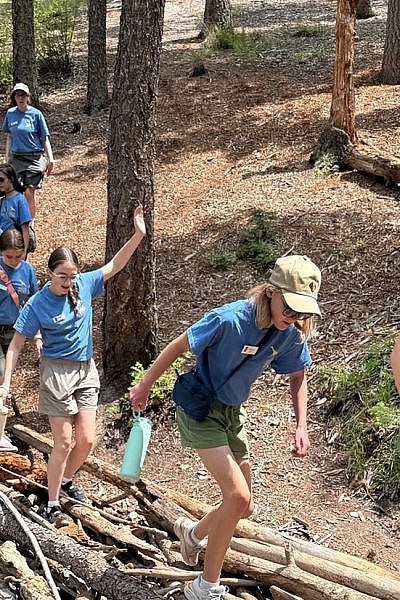
The Summer Teen Program runs from Tues., May 26 through Fri., Aug. 7, 2026. Teens will work alongside Zoo staff, engage with guests and animals, and build meaningful connections with peers who share a passion for wildlife. Teens gain hands-on experience in animal care, interpretation, public speaking and leadership, while developing real-world life skills in a supportive, mentorship-driven environment.

Beyond Zoo grounds, the program offers transformative experiences in Colorado’s wild spaces, inspiring teens to connect with nature and take an active role in protecting wildlife and wild places. Through mentorship from staff and fellow teens, participants grow in confidence and life skills, they discover their strengths and learn how to turn passion into action.

There are three opportunities during the Summer Teen Program:

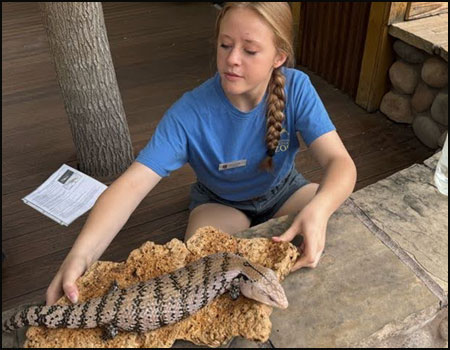
Teen with lizard
Junior Zoo Keeper
High school students work alongside animal keepers to assist with daily animal care tasks and behind-the-scenes responsibilities throughout the Zoo. This track builds leadership, responsibility and hands-on experience while connecting participants to careers in animal care and conservation.


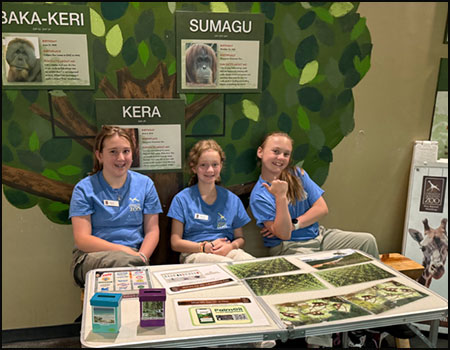
Teen Zoo Crew at education table with artifacts at Cheyenne Mountain Zoo
Zoo Crew
Middle school students develop leadership skills through meaningful work that supports the Zoo’s mission of conservation, education, and animal husbandry. Zoo Crew members gain confidence, teamwork and communication skills while engaging with guests and supporting Zoo programs.


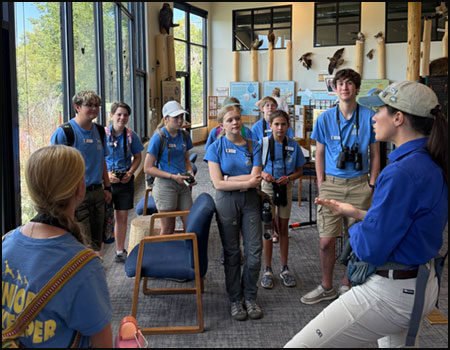
Junior Camp Educators talking to campers at Cheyenne Mountain Zoo

Junior Camp Educator
High school students support Zoo summer camps by working alongside camp staff to help facilitate engaging, educational experiences for younger campers. Participants build leadership, communication and teamwork skills while serving as positive role models in a fast-paced camp environment.

Applications are available for only 10 days and must be submitted by 11:59 p.m. MST on February 10. An application fee of $25 is required, and scholarships are available. Approximately 100 teens will be selected to participate.

Learn more and apply at cmzoo.org/teenprograms. Questions may be directed to [email protected].

Back to The Waterhole

Written by Amy Schilz, senior animal behaviorist at the International Center for the Care and Conservation of Giraffe

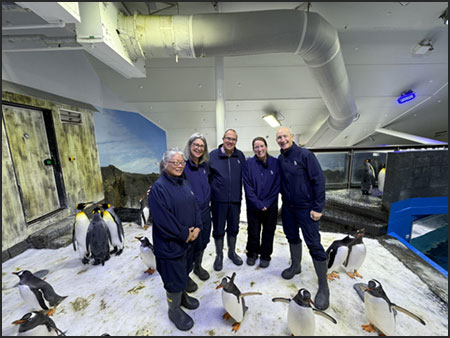
Australian penguin area visiting Australia with CMZoo Giraffe Center staff

As a senior animal behaviorist for Cheyenne Mountain Zoo’s International Center for the Care and Conservation of Giraffe (the Giraffe Center), I have the incredible opportunity to participate in a wide range of exciting and meaningful initiatives. On any given day, I might help clean a giraffe stall, assist with drawing blood from a giraffe’s jugular vein, mentor a trainer in another state via video call or help coordinate the international transport of a giraffe to support AZA’s Species Survival Plan goals. I love collaborating with others to solve the complex challenges facing giraffe conservation. Some days, I truly have to pinch myself—because this job (quirks and all!) feels almost too good to be true.

One of the things that makes this role especially meaningful is the Giraffe Center’s partnership with Behavior Works, an organization dedicated to improving quality of life for all learners through the science of behavior change. This collaboration allows us to remain at the forefront of giraffe training, using the least intrusive, most positive and most effective strategies to teach essential medical behaviors such as hoof care, ultrasounds, x-rays, blood draws and injections. For the past few years, I’ve been fortunate to serve as a dual training consultant for Behavior Works and CMZoo’s Giraffe Center. Together, we’ve helped caretakers make lasting improvements in giraffe care and training practices.

When Bianca Papadapoulos, animal training coordinator with Zoos Victoria, in Australia, and Behavior Works consultant, reached out to ask if I would present as a keynote speaker at the Australasian Society of Zoo Keeping’s Animal Training Conference, I jumped at the opportunity. I knew it would be the perfect chance not only to highlight the work being done at CMZoo’s Giraffe Center, but also to learn from an incredible community of behavior professionals in Australia.

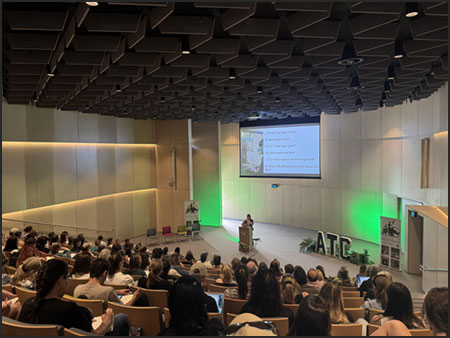
CMZoo Giraffe Center staff presentation in Australia

In November, I traveled to Sydney, Australia. I spent two inspiring weeks ‘Down Under’ with an exceptional group of conference hosts, keynote speakers and more than 240 attendees. I presented a 90-minute lecture on The Modern Approach to Animal Training and led four workshops throughout the week focused on Reading Animal Behavior. It was a true honor to present alongside fellow keynote speakers and personal training idols, including Ken Ramirez of the Karen Prior Academy, Tim Sullivan from Brookfield Zoo, and Dr. Susan Friedman from Behavior Works.

After the conference, I flew with the Behavior Works team to Melbourne, where the CMZ giraffe team has long-standing relationships with the zookeepers at Melbourne Zoo. Over the years, many of their giraffe keepers have attended workshops at the Giraffe Center or participated in extended keeper exchanges at our zoo. After more than a decade of collaboration, it’s always exciting to see what they’re working on. During my visit, I had the chance to observe their impressive voluntary head x-ray training program, which allows keepers to monitor giraffe dental health. They even invited me to practice training one of their giraffe who is already well established in the behavior.

While spending time with giraffe is always a highlight, I also had the chance to experience some truly unforgettable wildlife encounters in Australia. I saw a massive colony of flying foxes, watched a wombat forage in the wild, spotted a koala lounging in a eucalyptus tree and observed cockatoos soaring overhead. Seeing animals in the wild always inspires me to stay hard at work making animals’ lives better in human care. Many people never get to experience these animals in the wild, and it’s our honor to help them feel that same inspiration by visiting animals at CMZoo.

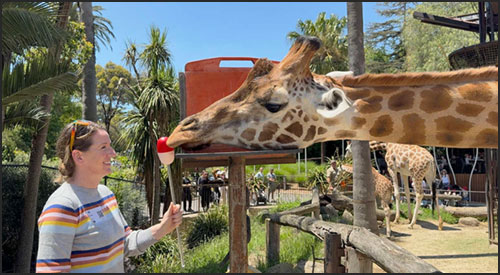
CMZ Giraffe Center staff target training giraffe in Australia

My favorite experience, though, was feeding a quokka at Melbourne Zoo. If you don’t know what a quokka is, I highly recommend looking it up immediately—I promise even a single photo will make your day.

All in all, it was an incredible experience. I’m deeply grateful to Bianca Papadapoulos, Susan Friedman and the team at Behavior Works, the conference organizers and our friends at Melbourne Zoo and Taronga Zoo for the opportunities, collaboration and warm hospitality they shared with me.

In addition, I am incredibly thankful for the constant support of my home team at Cheyenne Mountain Zoo. Every single person shows up and steps up for me, whether it’s covering my responsibilities while I’m away or leadership wholeheartedly supporting my outreach, enrichment and professional growth. I couldn’t do this work without you, and I’m endlessly grateful to call you my team. You are truly my heroes.

Back to The Waterhole

CONSERVATION

Every visit and every membership to Cheyenne Mountain Zoo is conservation in action. Between local projects supported by the annual Members-Only Conservation Vote, and ongoing global efforts supported by the Zoo’s Quarters for Conservation program. Conservation never stops at CMZoo, and here are a few highlights from 2025.

In September, Cheyenne Mountain Zoo and its members and guests celebrated a huge milestone, having raised $6 million for wildlife and wild places since the Zoo’s Quarters for Conservation (Q4C) program launched in 2008.

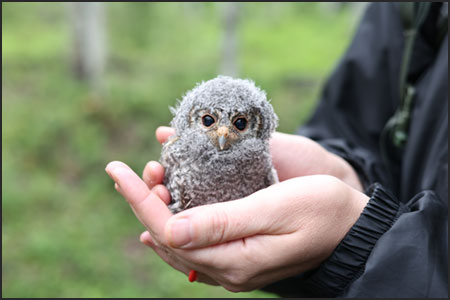
Flammulated owl being held in a human's hand

Every visitor to the Zoo receives three ‘quarter’ tokens representing the 75¢ Q4C allocation from their admission fee. They can then show support for the legacy projects they love by placing their tokens in the corresponding slots in the Q4C kiosks near admissions.

Before launching Q4C in 2008, CMZoo was supporting conservation, but at a fraction of what is possible now. As more people visit the Zoo each year, the Zoo can contribute more money to conservation. In the past few years, CMZoo has collected approximately one million dollars every 20 months through Q4C.

The Zoo’s membership, special events, admissions and EdVenture programs also contribute to conservation. CMZoo’s current Q4C beneficiary species include giraffe, Panama frogs, orangutans, black-footed ferrets, African elephants and black rhinos, Wyoming toads and Amur tigers.

In May, Q4C funding hit another milestone: surpassing one million dollars raised for orangutan conservation.

In addition to Q4C-supported staff field work releasing black-footed ferrets and Wyoming toads this year, CMZoo staff participated in flammulated owl field research funded by the Members-Only Conservation Vote. Each spring, the elusive flammulated owl returns to the quiet forests of Pike National Forest, Colorado, to raise a new generation. Thanks to the support of Cheyenne Mountain Zoo members, CMZoo staff joined Dr. Brian Linkhart — who has dedicated over 40 years to studying these owls — to continue this long-term research.

Funded by CMZoo’s annual Members-Only Conservation Vote, Motus tracking devices help researchers uncover owls’ incredible migration routes from Central America through the U.S. and Canada. This season, the team banded a fledgling after witnessing its very first flight and collected vital biological data to monitor health and population trends.

These owls face threats from habitat loss and human impacts, making member-funded conservation efforts essential to helping Colorado’s forests and flammulated owls thrive for generations to come.

________________________________________
CUTENESS

Several new faces joined the CMZoo animal family in 2025.

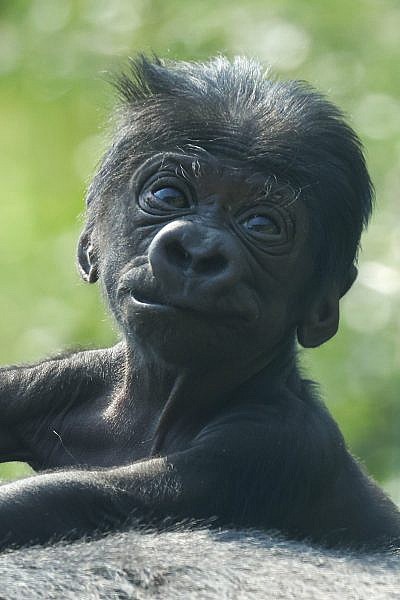
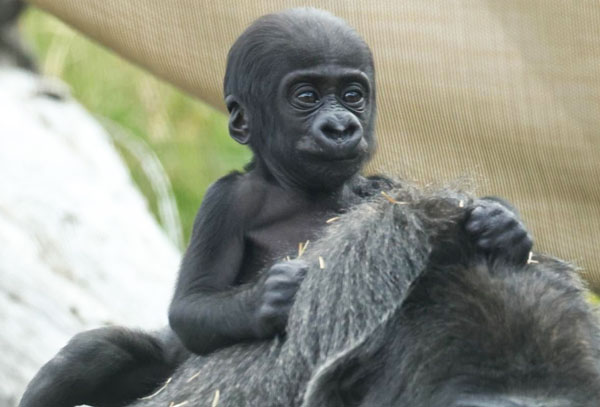
Asha's western lowland gorilla baby boy, Sully portrait

Sully, the first Western lowland gorilla baby born at the Zoo in nearly 13 years, was born on July 21, 2025 to experienced mom, Asha. Sully’s birth was significant for several reasons, including making Goma, CMZoo’s silverback and a genetically valuable member of the species survival plan, a dad for the first time. CMZoo members and supporters helped name Sully, raising $39,451 for animal care, conservation and Zoo operations and improvements.

Holmes and Keoki, a pair of lar gibbons, joined the Zoo in September and August, respectively. The arrivals of Keoki and Holmes support the Gibbon Species Survival Plan, helping to manage a diverse and healthy population in human care while inspiring gibbon preservation for their wild counterparts. Lar gibbons usually live in small family groups made up of a bonded pair and their offspring — and these two have a breeding recommendation!

Kinda (rhymes with Linda) arrived at Cheyenne Mountain Zoo in May, becoming the third member of the herd under four years old! She’s easy to spot in the herd because she’s currently the smallest, and her coat is a darker brown than others.

Sparrow, the first penguin chick in Water’s Edge: Africa, hatched in early April. Now, he’s nearly full grown, and has a young playmate in the flock! A female African penguin hatched in October, growing the flock to 18 penguins.

Olive, a 1-year-old Hoffmann’s two-toed sloth made her debut as a New Year’s baby in Scutes Family Gallery, to first-time mom, Aysan, and dad, Bosco. The public voted between three names chosen by keepers, and Olive was the clear winner.

________________________________________
CONSTRUCTION

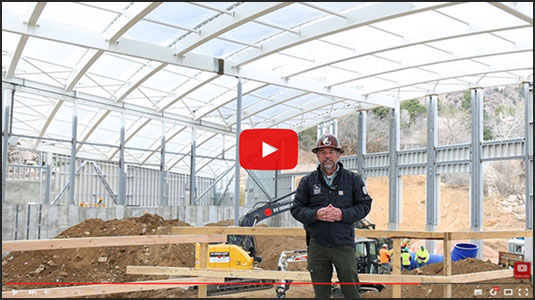
Bob inside new Giraffe Center building during a Bob's Blueprints video

Progress can be painful, but construction on the International Center for the Care and Conservation of Giraffe is entering its final phase! The roof was completed before the first big snow of the season – a major achievement for the teams working hard to create a world class giraffe center that is going to take giraffe care to the next level, AND give guests new and exciting ways to get closer (and hand-feed, of course) the giraffe herd. CMZoo President & CEO, Bob Chastain, has been keeping fans updated in a video series called “Bob’s Blueprints,” and fans can sign up to receive every update via email at cmzoo.org/bobsblueprints. Watch the YouTube playlist here.

As part of the Giraffe Center upgrades, Waffles, CMZoo’s beloved African cape porcupine got an exhibit upgrade – and moved in with Cape vultures, Hedwig and Godric.

The Giraffe Center is expected to open in summer 2026, and until then, guests can still feed the giraffe herd every day, and visit all of the animals living in African Rift Valley, including African lions, meerkats, vultures and Waffles.

Up the hill from the Giraffe Center, the Zoo’s playhill area is closed until around Spring Break for major upgrades including slides, cushier turf playhills, a guest-only sidewalk, more outdoor seating areas and a bigger-than-ever dirt hill.

The incredibly popular area was originally designed as a ‘test’ to see if guests enjoyed it, or if the Zoo should go another direction with the space. It’s clearly a hit, so this construction project will set up the space more permanently.

In addition to bigger and better play and seating areas, the playhills will get a drainage system upgrade. Because the current playhills were never meant to be permanent, there are infrastructure improvements to be made. The better drainage system should reduce puddles in the warmer months and ice patches in the colder months, improving the guest experience.

________________________________________

2025 was a memorable year for all of these reasons and more – including the highest-ever ranking in the national USA TODAY 10Best Readers’ Choice Awards for Best Zoo. CMZoo supporters made time every day to vote for the Zoo for nearly a month in February 2025, and your support earned CMZoo #2 Best Zoo in the nation!

In November, supporters showed up again, and earned CMZoo’s Electric Safari #2 Best Zoo Lights in the nation! There’s still time to visit Electric Safari! The holiday lights celebration continues nightly through Jan. 1, 2026, except Christmas Eve.

As the Zoo prepares for a big year in 2026, with centennial celebrations, the Giraffe Center grand opening, Bob Chastain’s retirement and a new president & CEO, your continued support allows us to do big things and focus on improving animal welfare, guest experiences and conservation efforts.

Thank you for an amazing year. The best is yet to come.

Back to The Waterhole

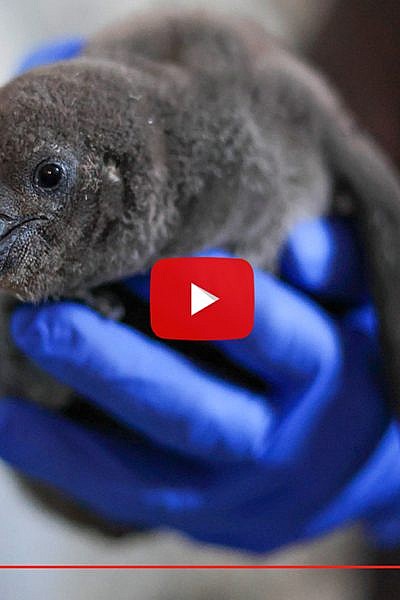
Biggs and Percy welcomed their first chick on October 18, 2025, and they’re doing a great job caring for her! She already weighs about 6 pounds — nearly the size of an adult African penguin. This adorable chick is already making a big impact as an ambassador for African penguins.

In 2024, African penguins were officially uplisted to ‘critically endangered’ on the International Union for Conservation of Nature (IUCN) Red List, with the number of wild breeding pairs falling below 10,000. If current trends continue, these charismatic birds could be extinct in the wild by 2035.

Since 2010, CMZoo guests and members have contributed more than $200,000 to Southern African Foundation for the Conservation of Coastal Birds (SANCCOB) in support of African penguin conservation. In 2020, the Zoo deepened its commitment by joining AZA African Penguin SAFE (Saving Animals From Extinction), a collaborative program supported by the Association of Zoos and Aquariums.

Every visit to CMZoo is conservation in action. Guests visiting CMZoo can see African penguins up close, including this new chick, knowing their visit helps support a future for this species in the wild.

Keep an eye (and ear) out for the chick in the penguin building in Water’s Edge: Africa! Although she usually stays cozy in the nest with Biggs and Percy, you might catch her wriggling out or hear her peeps letting her family know it’s snack time.

Stay tuned for updates!

Back to The Waterhole

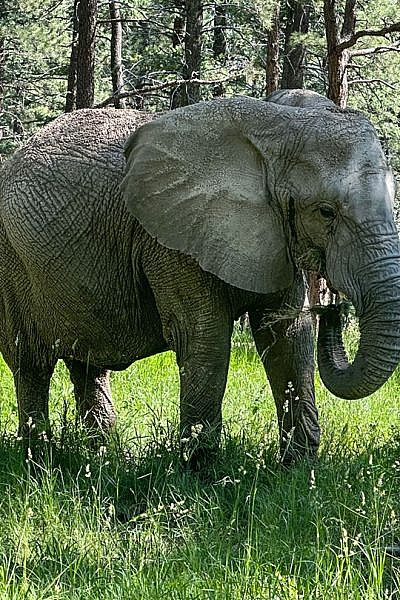
In Encounter Africa at Cheyenne Mountain Zoo, five beloved female African elephants, affectionately referred to as the Golden Girls, are aging with dignity and the support of their dedicated care team. Missy, LouLou, Kimba, Lucky and Jambo each has unique needs, care plans and preferences.
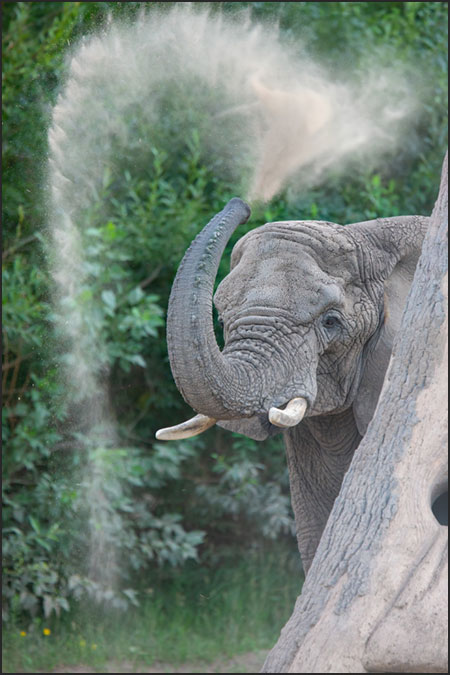
African elephant Lucky throwing dust

“Because we’re so in-tune with their subtle behaviors as individuals, we can tell what they enjoy and when they need support,” Ilana Cobban, Encounter Africa animal care manager, says. Ilana has worked with the elephants at CMZoo for 23 years. “I love how playful they still are in their old age. They like play-sparring with each other, mud wallowing, training and participating in demonstrations and feeding opportunities with guests, and engaging with enrichment regularly.”

When building the Wilgruen Elephant Center, CMZoo saw a need in the zoo community to create a program especially for female African elephants beyond their breeding years. The facility has various substrate floors, training areas and an overhead crane system that can lift an elephant to its feet if it can’t get up on its own.

CMZoo’s expert elephant care team has a combined 65 years of experience, with four full-time keepers on most days to care for the five elephants, supported by three full-time board-certified veterinarians. The herd participates in cooperative blood draws, laser therapy, tusk, tooth and foot care, and more.

“All of the girls participate in elephant yoga at whatever level is comfortable for them,” Ilana says. “They get excited when it’s their turn to train. Missy, our eldest, will trot over to participate. They do exercises like downward dog – we call it ‘downward elephant’ – and stretch their legs, heads and trunks. Over the years, we’ve seen their flexibility improve in some ways, but some of their long-term mobility issues will inevitably worsen with age. We make adjustments so they can participate comfortably. The poses are good for the elephants, and they allow us to visually check and treat any issues.”

Lucky, 46, is very playful and seizes opportunities when they arise. She’s been known to ask Kimba, who she lives with, to share her food, and will even snag a puzzle feeder from another elephant’s space. Lucky has arthritis in her right rear knee. She doesn’t always bend that knee when she walks, but she bends her knee during physical therapy. She’s developing arthritis in her front right ankle, so she cooperatively receives laser therapy to reduce inflammation and improve circulation. She also takes pain and anti-inflammation medications, and has a big sand mound that she uses to rest and lie down.
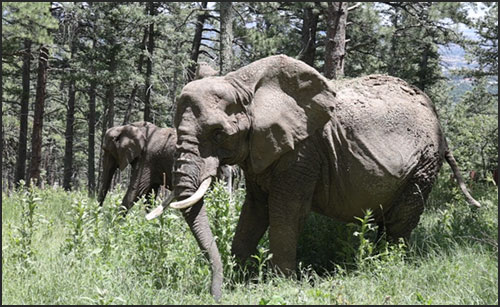
African elephants Missy and LouLou in vacation yard at Cheyenne Mountain Zoo

The team studies all of the elephants’ behaviors, tracks quality-of-life indicators and adjusts their care programs to provide more of what they positively respond to. Some of them love to wallow in giant mud puddles or get baths and others like to give themselves sand baths. Foraging for food is a big part of an elephant’s day. Their food is provided in puzzle feeders to mentally stimulate them, in addition to other enrichment, training and exploring. Their food is also hung high to encourage them to stretch, and it is dispersed throughout their yards and spaces to encourage more movement.

“They get produce and hay, but their favorite is tree branches,” Ilana says. “We have two employees dedicated to collecting healthy species of branches from our community for the elephants and other animals. They eat the leaves and branches, and they love to debark tree stumps and logs with their toes and trunks.”

Missy, 56, is the second oldest female African elephant in human care in facilities accredited by the Association of Zoos and Aquariums. She’s still the fastest to respond to enrichment and training opportunities.

“She’s fearless,” Ilana says. “She’s the oldest, but she’s still the quickest, and she doesn’t hesitate to remind the herd that she’s the boss.”
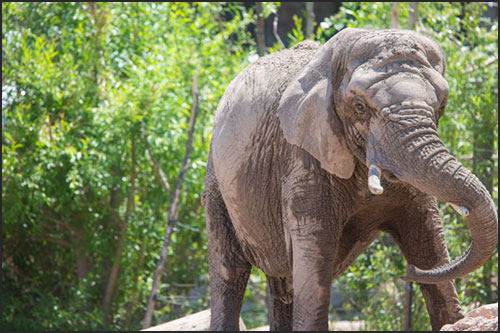
African elephant Kimba outside dust bathing in vacation yard at Cheyenne Mountain Zoo

Elephants have six sets of four molars throughout their lives. Because of Missy’s advanced age, she is on her last set of two molars, so her team brought in a hay shredder to chop her food into easier-to-chew bites. Normal for any aging animal, Missy has lost weight over the last year and experienced drier skin. She receives nutritional supplements, like beet pulp and orchard grass pellets, and participates in bubble baths, which have helped moisturize her aging skin.

Kimba, 48, is known as the ‘foodie’ in the group. She loves few things more than food. She’s also incredibly loyal to Lucky, who she has lived with for more than 40 years. Kimba has been prone to colic. Her team has tried many different treatments, but has not identified a long-term solution for her. They’re continuing to seek input from their wide network of elephant care professionals. They also try different diets, supplements, exercises and treatments, while tracking how she responds. Her colic occurs without an apparent pattern, and has increased in frequency recently. She has more good days than bad, overall, and her care team tracks data closely.

“Kimba’s body condition and bloodwork results are good, and she’s socializing with other elephants, exercising, eating, drinking and participating in training sessions, which are all good quality-of-life indicators,” Ilana says. “Her bloodwork tests for stress indicators, among other things, and we don’t see that she’s stressed in those results or in her behavior.”

As incredibly intelligent animals, elephants need diversity. Multiple times per day, the Golden Girls move between yards and indoor spaces, where they find new opportunities to stimulate their bodies and minds. They also have access to a trek walk and a ‘vacation yard’ – a 2-acre forested field they can explore for as long as they want when temperatures are safe for them to stay outside. The trek and vacation yard are away from guest areas, but are distantly visible from the elephant boardwalk. If you see trees rocking for no apparent reason, there’s likely an elephant is knocking it around.
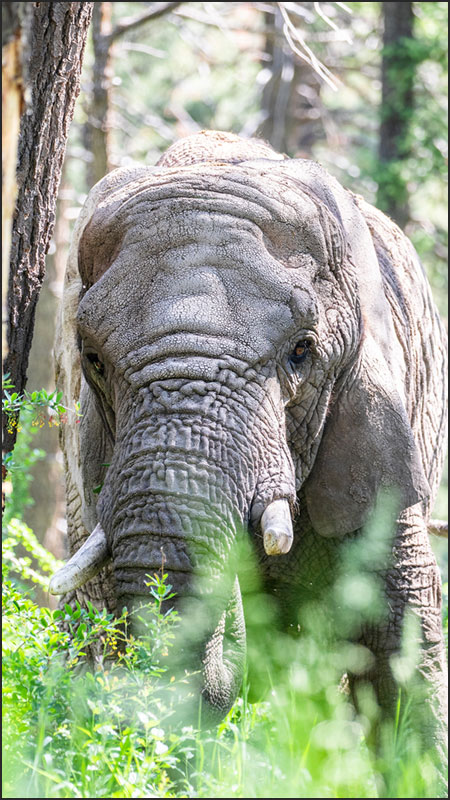
African elephant in vacation yard at Cheyenne Mountain Zoo

Wild female elephants are commonly known to live in herds, but the ladies at CMZoo have shown their team that they prefer a different setup. LouLou and Missy share space, Jambo prefers to interact with other elephants from her own space, and Lucky and Kimba live together.
“These elephants didn’t grow up in large herds, so we provide environments and social setups based on their preferences,” Ilana says. “We have offered them a variety of group settings, but this is the setup they want. We believe in customizing their care. They deserve to be given that choice.”

Jambo, 42, is an enthusiastic, large elephant for her age. Although she prefers her own space, she is incredibly tactile with other elephants. She often reaches into other elephants’ spaces to interact with her trunk, and playfully spars and flaps her big ears at the elephants. She’s been known to sneak her trunk into other elephants’ mouths to see what they’re eating. Jambo is in good health, but experiences occasional bloating. To combat it, she gets elephant-sized quantities of Gas-X: 20 cherry-flavored tablets at once.

LouLou, 43, is one of the most playful and social elephants. She is incredibly curious about Jumbe, CMZoo’s Eastern black rhino, and likes to be near him at the fence line, sometimes tossing sand in his direction. LouLou, like Jambo, also receives Gas-X as a preventative measure, because she has experienced bloating in the past. Otherwise, she seems to be in great health.

“We love these elephants, and we’ll keep supporting them, relying on what works for them as individuals, and trying new things,” Ilana says. “They’re fulfilled here, and we believe they’re living their best lives in their home. We’re realistic that all of our Golden Girls are into their bonus years, and we’re committed to their compassionate care.”

If you’ve ever visited #CMZoo and the African elephants, you can consider yourself a conservation warrior. Through CMZoo’s Quarters for Conservation program, 75¢ of every admission goes to conservation partners. Tsavo Trust – a field-based non-profit that uses aerial surveillance and on-the-ground field efforts to protect elephants, rhinos and other wildlife in Tsavo National Park, the largest national park in Kenya – is a legacy Q4C recipient. Small change makes a big difference. Since 2008, those quarters have added up to more than $6 million for conservation, with more than $1 million supporting elephant and rhino conservation.

Back to The Waterhole
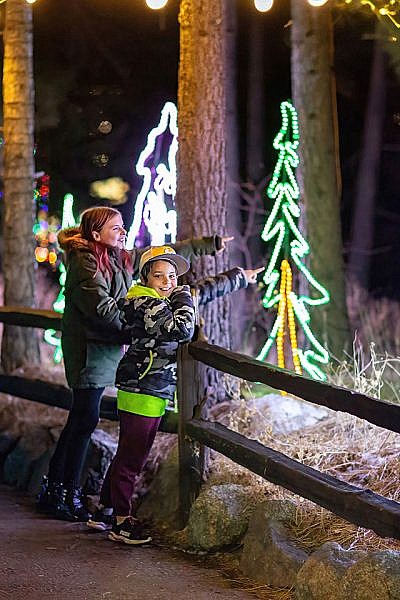
Electric Safari was voted #2 Best Zoo Lights in the U.S. — come see why! Explore our mountainside winter wonderland nightly through Thurs., Jan.1, 2026 – except Christmas Eve. Electric Safari is free for Zoo members – and members can get early entry, from 4 to 5 p.m. General admission is from 5 to 7:30 p.m. Electric Safari ends at 8:30 p.m. Advance tickets are required for members and the general public, and some nights will sell out. Get tickets at cmzoo.org/electric.

Is your preferred night sold out? Rideshare tickets are always available! Get them at cmzoo.org/electric.

Please help us thank our Electric Safari 2025 partners, Children’s Hospital Colorado, Raising Cane’s Chicken Fingers, Toyota, Sturgeon Electric Company, Inc. and US Bank.

Back to The Waterhole

IN PARTNERSHIP WITH CHILDREN’S HOSPITAL COLORADO – Two new fluffy faces are getting to know each other and learning the ropes in Primate World! Meet Keoki (pronounced key-OH-key) and Holmes, CMZoo’s new lar gibbons. While they’ve settled in since their arrivals in August and September, their CMZoo care team has been helping them adjust to their new home.

Similarly, CMZoo’s year-round partner, Children’s Hospital Colorado, offers research-backed tips to help parents and caregivers nurture resilience in their own children. Read more from their child psychologist here: https://www.childrenscolorado.org/just-ask-childrens/articles/resilience-in-children/.

Keoki and Holmes are growing in confidence as they explore new spaces, engage with enrichment and participate in training together, building positive relationships with each other and their care team along the way.

Eight-year-old female lar gibbon, Keoki, arrived at CMZoo in August, and seven-year-old male lar gibbon, Holmes, joined her in September. The two recently started sharing space and quickly took an interest in each other. Since Keoki arrived first, she’s been helping Holmes settle in exploring his new home.

The arrivals of Keoki and Holmes support the Gibbon Species Survival Plan, helping to manage a diverse and healthy population in human care while inspiring gibbon preservation for their wild counterparts. Lar gibbons usually live in small family groups made up of a bonded pair and their offspring — and these two have a breeding recommendation!

Lar gibbons, also known as white-handed gibbons, are endangered primates native to the tropical forests of Indonesia, Laos, Malaysia, Myanmar and Thailand. Similar to orangutans, lar gibbons are impacted by unsustainable palm oil production, which has led to deforestation and the loss of their natural habitat. When produced sustainably, palm oil is the most productive edible oil available. Oil palms – the trees that palm oil comes from – produce four to ten times more oil than alternatives like soy, olive, canola and coconut. Switching to these alternatives would cause even more deforestation in tropical areas.

Luckily, you can help save their rainforests from the comfort of your own smartphone. Download the World Association of Zoos and Aquariums (WAZA) free mobile smartphone app, PalmOil Scan, from the Apple App Store or Google Play today. Next time you go shopping, just open your app, scan a product’s barcode, and see how that company ranks. If they haven’t committed to sustainable palm oil, consider instead supporting a similar company that has. This app was developed under the direction of WAZA, and is managed in North America by Cheyenne Mountain Zoo. PalmOil Scan is available in the United States, Canada, the United Kingdom, Singapore, Australia and New Zealand.

Download the app today and learn more at cmzoo.org/palmoil — and stop by to welcome Holmes and Keoki next time you’re at CMZoo!

Back to The Waterhole
For nearly 100 years, Cheyenne Mountain Zoo has actively worked to connect guests of all ages to wildlife and wild places. Starting next year, CMZoo’s EdVenture team will take people into the wild to experience wildlife in a whole new way.

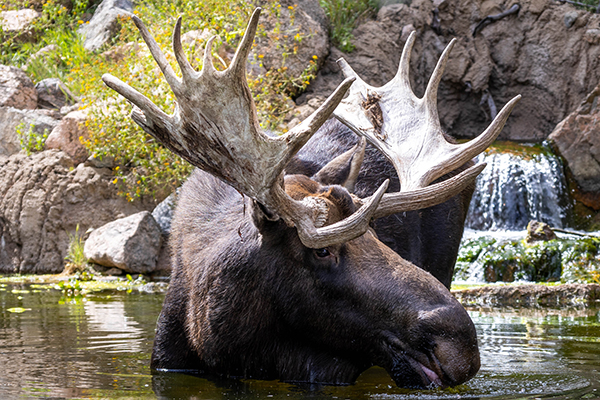
Alaska moose Atka enjoying the pond.

Experiences like feeding giraffes at the Zoo, getting to observe animal demonstrations and training sessions with keepers, and off-site ZOOMobile programs help people learn about the existence and importance of the animals that we share this planet with, and feel inspired to help conserve their wild counterparts.

Now, the EdVenture team at CMZoo is offering a new opportunity for guests to connect with wildlife and wild places, by taking them into the natural environments, with a brand-new program that launches in April 2026! Edventure Excursions will provide a fun and educational journey to local wildlife projects that they might not be aware are happening right here.

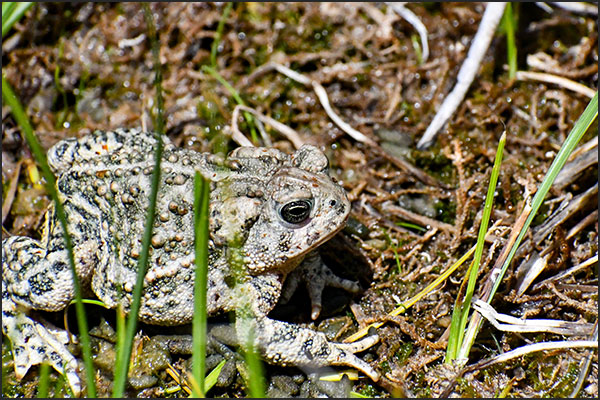
Wyoming toad in a wetland area up-close

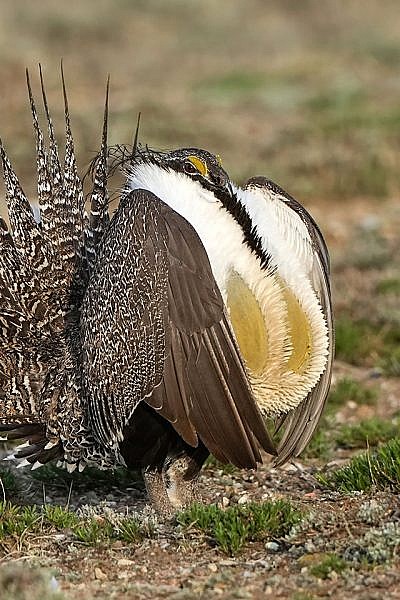
The program’s inaugural adventure into the wild is a 5-day expedition to northern Colorado and southern Wyoming to learn about the importance of prairie ecosystems and the animals that call them home. Guided by CMZoo staff, the group will explore the wild habitats of critically endangered animals, like black-footed ferrets, Wyoming toads and sage grouse.

Each reservation supports funding to provide free classroom programming for schools in the Front Range region. The EdVenture team receives dozens of requests every year to bring Zoo animals to schools, and this program will help fund even more of those opportunities.

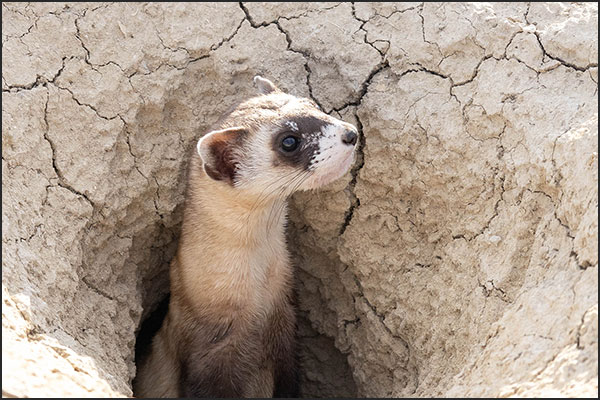
Black-footed ferret peering out

Sign up for the first-ever EdVenture Excursion, Sage Grouse Annual Display, at cmzoo.org/excursions.

Sage Grouse Annual Display Trip Details

Dates: April 20 – 24, 2026
Group size: 8
Cost: $1,250 per person / $2,100 per pair (shared bed)**
Transportation: provided; leave from Cheyenne Mountain Zoo
Not included in cost: meals


Accommodations:

● 2 nights at a bed-and-breakfast in Laramie, Wyoming (multi-bedroom house shared with other program participants)
● 1 night at hotel in Walden, Colorado (separate rooms)
● 1 night at hotel in Fort Collins, Colorado (separate rooms)

Back to The Waterhole
Written by Park Quality and Special Events Technician, Rachael Selk

Electric Safari is an event that brings together not just our local community, but even travelers from out of state who visit Cheyenne Mountain Zoo during December to experience that extra touch of holiday magic alongside the many creatures who call this place home. The Zoo has hosted Electric Safari for 35 years now, and I have been working to add to the magic for the last four years.

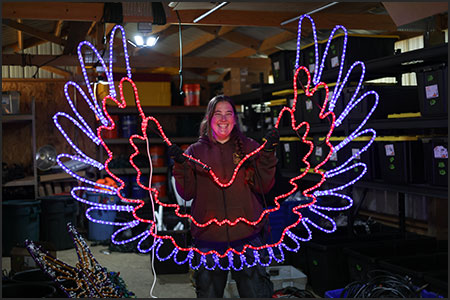
Electric Safari light sculpture wings

My name is Rachael Selk. I’m the Park Quality and Special Events Technician. You might have seen me stringing lights on trees and bushes as early as September, yet the true start of setup for Electric Safari is on August 1, when all the power and ground lights are placed. When people hear we spend four months decorating for Electric Safari, I remind them that’s just the installation. I usually have the color scheme and placement of archways and sculptures planned as early as January each year. I spend March through July creating and repairing sculptures to be ready for the next year’s event. So, for us, the holidays are a yearlong process.

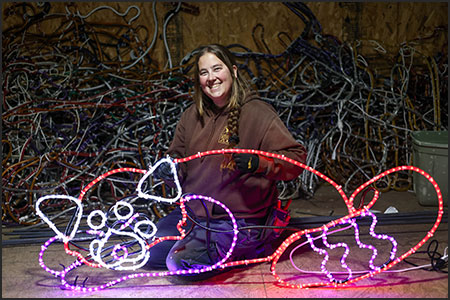
I use my artistic background to design new animal light sculptures that guests see all through the Zoo during Electric Safari. After proper training, I learned to bend the metal for the frame, weld the pieces together, seal the metal to prevent rust, then adorn the figure with plenty of zip ties and rope light. I try to keep my designs akin to creatures that live at the Zoo. People find magic in our animals, knowing their names and learning their coat patterns, so it’s only fitting to create that magic in the lights! A great example is last year, when our red panda, Cora, found a new home with us. I quickly created a red panda light figure to commemorate our new resident. This year, I created a sleepy red panda friend to accompany the first light sculpture, and people will be able to see them both in Asian Highlands.

I am also excited for something new this year. There will be several sets of wings, made out of rope light that will be mounted in various spots throughout the Zoo – perfect for a photo opportunity! People love to take pictures and videos of our animal lights already, and we purposefully created these wings so guests can stand in front of them, strike a pose and capture a special moment with wings spread behind you! The wings were inspired by a visit to Denver Zoo Conservation Alliance’s holiday lights last year. We loved the idea so much that we just had to make our own version for our community!

Electric Safari lighted sculpture

The first light figure I got to create from design to physical life was the wolf pack in 2023. Wolves are my favorite animal, so you can imagine my utter joy when that was the very creature I was tasked to create! To this day, they are still my favorite figures that I’ve made myself. When you see them nestled in the trees, surrounded by snow that catches the radiant light as it howls to the sky, I know you’ll love them too!

The fact that Electric Safari has been around as long as I have been alive speaks to not just the team that creates the event every year, but to you, the people who choose to make it a part of your year! I’ve heard many people say how it’s a tradition to see the Zoo lights. I even had someone tell me that their son proposed to his girlfriend, now wife, at the Zoo during Electric Safari. It was unplanned, but the night was so magical that the timing was perfect.

Visiting the Zoo any time of year is such an amazing experience. Combine the magic of the lights with the chance to feed giraffe, hear keeper talks about skunks and hippos and more, and it’s a perfect blend of holiday cheer and Zoo animals at the same time! And with our Zoo ranking high on USA TODAY’s 10Best Readers’ Choice Awards for Best Zoo Lights in the nation, it only inspires me even further to do my best for the Zoo and to push that standard all the higher!

[Editor’s note: Electric Safari is nominated for Best Zoo Lights in the U.S. again! Fans can vote daily for Electric Safari until 10 a.m. on Mon., Dec. 1 at cmzoo.org/lights.]

Knowing that Electric Safari is such a shared part of our community’s traditions, the enjoyment of the holiday spirit, the love of animals and the willingness to brave the cold, it fills me with joy knowing that I get to be a part of that magic. It doesn’t bother me if those who visit never see me and never know that I chose the colors, and that I bent and welded and forced that light sculpture into life. I love standing off to the side and seeing people’s faces glowing with happiness, taking pictures together, listening to the holiday music and howling with the drone show’s wolf pack in the sky.

I truly hope you enjoy this year’s Electric Safari, and know that I have many plans and ideas for more magic in the future!

[Editor’s note: Electric Safari is every night from Fri., Dec. 5 through Thurs., Jan. 1, 2026 – except Christmas Eve. Advance tickets are required. Tickets and details are available now at cmzoo.org/electric.]

Back to The Waterhole