Last year, Cheyenne Mountain Zoo joined the Rocky Mountain Wolf Action Fund (RMWAF) and other partners to collect signatures for a petition that successfully landed a proposition on this year’s general election ballot. Proposition #114 asks Colorado voters to decide if gray wolves, once native to the state, should be carefully reintroduced to the Western Slope. The plan, if approved, would be led by Colorado Parks and Wildlife with the support of other wolf and ecology experts.
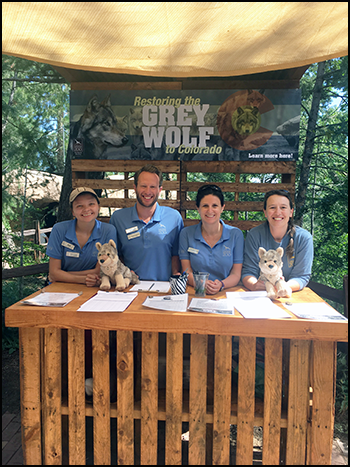
“There are a lot of issues competing for voters’ attention this November,” said Dr. Liza Dadone, vice president of mission and programs at CMZoo, who led the Zoo’s efforts to support RMWAF’s campaign to bring this issue to voters in 2020. “We have seen significant support from the public throughout this project, but voters should know this isn’t a done deal. We still need people to look out for Prop #114 on the ballot and give the experts involved a chance to restore this amazing species that is vital to our local ecosystem.”

Other than noting that Prop #114 is an issue worth voting on, there are important dates to keep in mind for this year’s election. Ballots will be mailed to Colorado voters October 9 and must be returned by November 3, 2020 – when polls open for in-person voting.

While Prop #114 is a complex and controversial question, for CMZoo it’s a simple question: do we want to live in a state with wolves in the ecosystem or not? For us, the answer is yes, no matter how hard we need to work to collaborate with all involved parties to address the valid concerns on every side of the question.

“This vote is the best chance we have had at restoring wolves to the wilds of Colorado in a very long time,” said Dr. Dadone. “For the Zoo and the 15,298 registered voters whose signatures we collected last fall, we feel obligated to see this through. The initiative outlines the reintroduction of gray wolves to include ongoing collaboration from all stakeholders, and a solid plan from Colorado Parks and Wildlife incorporating research-based findings.”

CMZoo is home to a pack of seven Mexican wolves and has a long history of working to restore and relocate species in the wild, including black-footed ferrets, Wyoming toads, Mexican wolves, giraffe in Uganda, amphibians in Panama, and more. As an organization that contributes to the survival of species around the world, we see this is an exciting opportunity for Colorado residents to help restore a species that once roamed free, right here at home.

CMZoo’s role in this issue is as trusted wolf experts and animal advocates. One way we want to help is by addressing common misconceptions about wolves, based on our extensive experiences with them.

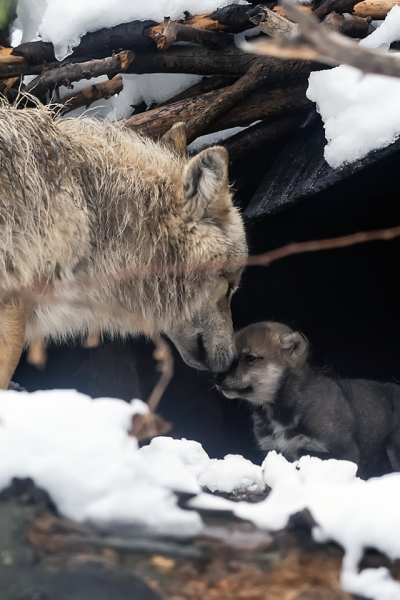
While many are excited about the chance to see wolves in the wild, popular culture has positioned wolves as dangerous and aggressive villains that could lead others to feel unsafe around them. Unlike mountain lions and other predators found in wild and populated areas throughout Colorado, a wolf’s natural reaction to human presence is to retreat.

“When Rocky Mountain Wild keepers go into the expansive enclosure with CMZoo’s pack of Mexican wolves to clean and replenish food, water and enrichment items, the wolves typically get as far away from them as possible,” said Rebecca Zwicker, Rocky Mountain Wild animal care manager. “We see it all the time. Their natural instinct is to be wary of humans. Even with our wolves in human care, we like to see that instinctual behavior intact, because the hope for our wolves is that they or their offspring are one day restored to the wild to support their dwindling wild population.”
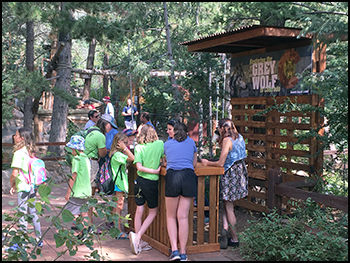
The Rocky Mountain Wolf Project reports that since 1900, there have been only two possible cases of a wolf-related human fatality in North America, and no cases in the lower 48 states.

This is a complex issue, and we recognize this restoration could create hardships for some people who live in the region where they would be reintroduced, especially for farmers and ranchers in the regions proposed for reintroduction. As caretakers of animals, CMZoo understands that farmers and ranchers care for their animals and have invested generations of energy into them. We also know that both compensation for their livestock and mitigation strategies are essential if wolves are restored to Colorado. The health of public and private lands is critical for a healthy statewide ecosystem and its wildlife. We support a bill that helps us live in balance, uses management systems that support both of those standpoints, and puts experts in charge of the reintroduction who will hear all concerns and adequately address them as they meticulously implement the plan.

There is evidence of wolves’ positive impact on restoring balance in struggling ecosystems, too. Some may be familiar with the reintroduction of wolves to Yellowstone National Park, in 1995. The National Park’s elk population had grown to levels not healthy for the ecosystem, due to the absence of predators, like the wolf. The elk drastically reduced the number of trees and shrubs that prevent erosion and serve the rest of the ecosystem.

Birds lost their habitats, as a result of the fauna’s inability to grow to maturity. The water temperature in streams rose, due to a lack of shade from trees and shrubs, which made them uninhabitable for fish and other aquatic species. Without competition from wolves, coyote populations increased, which reduced the number of small mammals in the area that served as a food source for many smaller predators, like foxes.

Since reintroducing the wolf, Yellowstone National Park’s elk population has decreased and become healthier. The wolves single out the weak, old, sick and young elk, leaving the strongest elk to reproduce and carry on healthy genetic lines. The Rocky Mountain Wolf Project also says the wolves’ presence near waterways reduced the negative impact elk had on streams, trees and shrubs and the animals that live there, simply by redirecting the elk. Coyote numbers have decreased, creating a better balance and more available food sources for dwindling numbers of foxes,
badgers, weasels and raptors, which share their prey.

Until the 1940s, when wolves were eradicated from Colorado’s wild places, wolves thrived in the Rocky Mountain State. The last wolf was shot in 1945, as a result of an extermination campaign that didn’t consider the wolves’ important role in our delicate mountain ecosystem. Today, wolves roam the Rocky Mountains from Mexico to Canada and Alaska, but not in Colorado.

“Our state is one of the last gaps in connecting these wolf packs, which is detrimental to the long-term health of the species,” said Zwicker. “Colorado’s wild places can provide additional habitat for wolves and contribute to the safe and natural ‘wildway’ (like a highway) between subspecies of gray wolf.”

A wolf pack recently confirmed in Colorado may lead some people to believe that the species doesn’t need our support to thrive again naturally.

“Although one small pack of wolves has been located in northern Colorado, there’s no way those few remaining individuals could create a healthy, genetically diverse, sustainable population of wolves in Colorado,” said Zwicker. “Thinking about the greater goal of providing positive ecological benefits of a healthy and established ecosystem, these few wolves couldn’t have an adequate impact.”

As an apex predator, their presence at the top of the food chain in Colorado is vital, as it is in Yellowstone National Park. Western Colorado, where the Rocky Mountain Wolf Project seeks to reintroduce wolves, has more than 15 million acres of public land with an abundance of wild prey for hunters and wolves.

Returning wolves to our state in adequate numbers will surely impact Colorado’s big game species, such as elk, and there are concerns that this will negatively impact our hunting economy.

“When wolves have been removed from the ecosystem, populations of elk and deer can reach unhealthy numbers which can lead to disease spread, starvation and a devastating impact on plant life and waterways,” said Dr. Dadone. “To some, wolves will make hunts more challenging. For others, their presence will create memories that make the hunt live forever in their minds. When you think of how amazing it would be to see a wild wolf pack, we lean towards the latter.”

As with all election propositions, it’s important to think critically about how the return of wolves to Colorado could impact our state in positive ways and the potential obstacles we’ll need to creatively overcome as a statewide community.
Back to The Waterhole


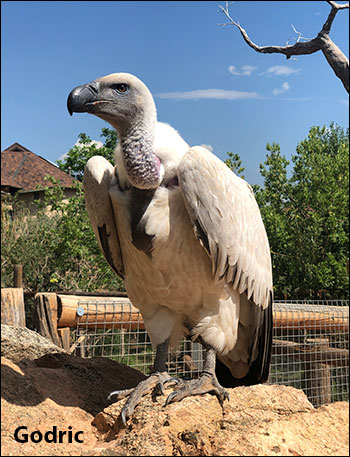
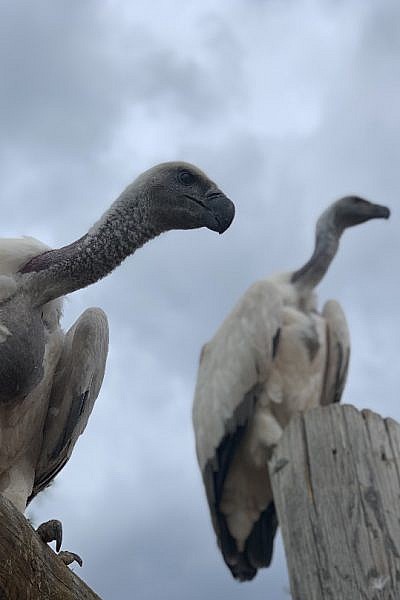
The Cheyenne Mountain Zoo family is getting excited for International Vulture Awareness Day (IVAD) on Saturday, September 5, 2020 – almost as excited as Godric, Hedwig and Nesher, CMZoo’s three vultures, get for training time.

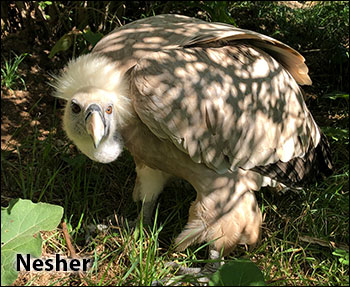
When 6-year-old male African cape vulture, Godric, and 14-year-old female African cape vulture, Hedwig, see their keepers approaching, they come running. With their enormous white wings held back in the charging position and their impressive beaks aimed low and straight forward, the raptors move at an intimidating pace with little regard for any obstacles – or guineafowl – in their way. Nesher, a 29-year-old Eurasian griffon vulture, has a more reserved approach, waiting receptively by the perching for her keepers. It hasn’t always been this way for the instinctively cautious birds, but their keepers have been working hard to earn the vultures’ trust – and it’s benefitting the vultures, the keepers, our guests and vultures in the wild.

“We’ve always interacted with them, but until recently, they wouldn’t have been comfortable with us sitting this close,” said African Rift Valley keeper Philip Waugh, as he perched on a rock about two feet from Godric. “We’ve been making opportunities to spend more time with them and to reward them for being calm with us while we calmly sit with them. We all have our stations, both keepers and birds. We just hang out together on their turf by the vulture perches, and that’s helping build our relationship of trust.”

At first, the keepers would go and find the vultures for their three-times-weekly feedings. Because they eat so infrequently, training and building relationships requires a lot more patience than it normally might with animals that eat multiple times daily. But the patience is paying off.

“Before, we could tell they weren’t huge fans of sharing their space with us, but now they get excited for training, “said Waugh. “They have incredible eyesight, so they can recognize us all the way from the giraffe boardwalk, and they start sprinting down the Safari Trail to our meeting point. They beat us there nearly every time.”

Making sure these interactions are positive for the vultures is important because keepers can provide frequent visual health checks and expand their training. It also helps keepers foster special connections between guests and the vultures, which ultimately benefits their wild counterparts.

“If you’ve ever been up-close to a bird with an eight-foot wingspan, you know how impressive it is,” said Waugh. “Just seeing them eye-to-eye makes an impact. Our goal is to find more ways for our guests to connect with them. We know that once people meet them, our vultures will inspire our guests to learn more about this amazing species and its struggles, then take action to protect their wild relatives.”

When COVID-19 isn’t an issue, the Zoo hosts IVAD activities at the Zoo throughout the day to help guests learn more about vultures. This year, to prevent large crowds from gathering during the pandemic, the team will post fun and educational materials on the Zoo’s social media pages.

Even though the Zoo can’t offer in-person IVAD activities on September 5, just by visiting the Zoo, guests are helping CMZoo protect and advocate for wild vultures. 75¢ from every Zoo admission goes to conservation through the Quarters for Conservation (Q4C) program, which has raised more than $3 million since it started in 2008.

One of CMZoo’s Q4C beneficiaries is VulPro, a nonprofit organization in South Africa working to save endangered African vultures through breeding, rehabilitation, research and education. Vultures, positioned at the top of the food chain, are an indicator of the health of the environment below them – and dependent for their survival on a healthy environment. Every visit to the Zoo supports this organization on the frontlines of vulture conservation.

“Vultures are nature’s clean-up crew,” said Waugh. “They clean up carcasses that other animals can’t. They stop the spread of disease by consuming decaying meat and bones. Thanks to their strong stomach acids, they can consume deadly bacteria that could pose a threat to animals and humans. They do so much more, but the most basic explanation is that they make the world a lot prettier, safer and a lot less smelly.”

Vultures’ adaptations help them make quick work of the world’s messiest clean-ups. Their iconic bald heads prevent bacteria from sticking to their skin, an important trait for such a mobile animal. Preventing the spread of bacteria is key for their well-being, which is why some vulture species urinate on their own legs, killing carcass bacteria in the process. Their nares, or nostrils, drip a salty liquid that helps flush out their sinuses, removing any rogue pieces of meat that may have gone up their noses during ravenous eating. Just because they’re built for devouring dead animals doesn’t mean they’re unhygienic, though. They bathe regularly, both in the water and the sun. The UV rays from the sun kill any pathogens in their feathers after feeding.

“My favorite time to see them is in the mornings when they’re open-winged, sunning themselves in the early light,” said Waugh. “I love watching them interact with each other. They all have such unique personalities.”


Godric, Nesher and Hedwig interact with toys, keepers, food and each other in distinct ways.

“Godric and Hedwig are hilarious,” said Waugh. “They’re both African cape vultures, but they’re not related. Still, they act like siblings a lot of the time. They explore new enrichment items together and if one vulture is nervous or excited, the other usually rushes to join in, whether or not they know what’s going on. They will also bicker over food or a good sunny spot, but that’s normal for vultures. Godric seems to be the most eager to approach us, but Hedwig is gaining confidence.”

Nesher, whose keepers describe her as the ‘queen bee,’ is the most confident and the oldest, at 29 years old. She prefers to spend most of her time by the vulture perching, but also has a bit of an adventurous bone.

“She recently commandeered the Okapi yard,” said Brooke Powell, African Rift Valley keeper who works with Philip and the vultures. “She also frequently ventures into the giraffe yard. Nothing scares her. This species is naturally pretty avoidant of new things, but she’s the opposite of that. She’s really bold and brave. Not a lot phases her, and she has the coolest vocalizations when I feed her and she’s excited.”

Vultures communicate about food, territory and potential threats in the wild by vocalizing.

“When Nesher vocalizes, she usually runs toward us full speed,” said Powell. “It’s really impressive. People can hear her from the giraffe boardwalk all the way across the yard, which is cool because we see people getting curious about the vultures and then come to visit them.”

Next time you’re at CMZoo, look down from the African Rift Valley ramp up to Encounter Africa, where the vultures are often perched. Supporting CMZoo is an easy way to support vulture conservation through its longstanding partnership with VulPro. The Zoo has contributed more than $90,000 to VulPro over the years.

“After VulPro rescues and rehabs vultures, they’re released into the wild, which is super important because they’re so endangered,” said Waugh. “VulPro rangers rescue vultures that have been poisoned by poachers – one of wild vultures’ biggest threats.”

The carcasses of poached animals attract vultures. A large group of vultures is easier to spot than a deceased animal, so their presence helps rangers find poached animals. Poachers caught onto this pattern, and started poisoning the carcasses to kill the vultures that eat them, thus hiding their misdeeds. Supporting VulPro’s ongoing rescue, rehabilitation and release efforts means more wild vultures can breed and thrive in the wild.

There are several ways to protect vultures here in Colorado, too. Turkey vultures are native to our region, and are just as important to our local ecosystems as African vultures are in theirs.

Pick up trash to help vultures avoid ingesting dangerous materials. Avoid using poisons for pest control or weed killer. Report roadkill to local authorities, so vultures aren’t encouraged to dine in the middle of a busy road or highway. Slow down when you see roadkill, so vultures and other scavengers have time to get out of the way. Use lead-free fishing tackle and ammunition. Dispose of fishing line properly.

To learn more about vultures, and how you can help save this incredible species, mark your calendars for Saturday, September 5, when CMZoo will share a video of up-close interactions with the vulture trio on Facebook and YouTube.

Back to The Waterhole


Every visit to the Zoo is conservation in action. Cheyenne Mountain Zoo and its guests and members are celebrating a huge milestone, having raised $3 million since the Zoo’s Quarters for Conservation program launched in 2008.

Quarters for Conservation, or Q4C, is the Zoo’s largest fundraiser for field conservation. It actively engages visitors and staff in supporting long-term projects championed by the Zoo. Known as legacy projects, these currently include biodiversity conservation on behalf of giraffe, Panama frogs, orangutans, black-footed ferrets, African elephants and rhinos, Wyoming toads and African vultures. Every visitor to the Zoo receives three “quarter” tokens representing the 75¢ Q4C allocation from their admission fee. They can then select the legacy projects they would like to support by placing their tokens in the corresponding slots in the Q4C kiosks. The kiosks record the number of tokens, so it’s easy to see how popular each project is.

“Our guests have helped us save animals from extinction simply by visiting the Zoo,” said Dr. Liza Dadone, vice president of mission and programs. “Three million dollars in conservation support is huge – and we want to thank our guests and members. Through this program, they are directly empowered to make a difference, and they did. It’s an example that no matter how small, when we all work together, we can change the world for the better.”

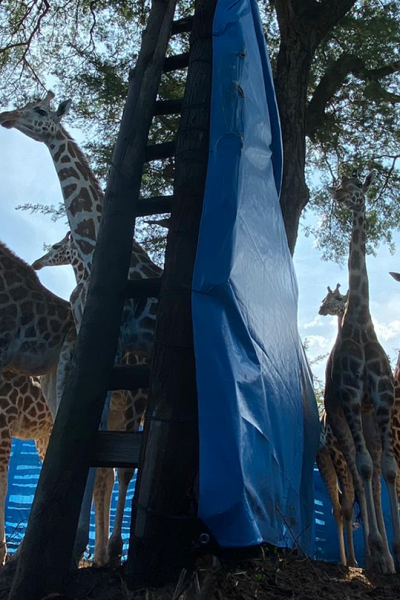
One of the projects that CMZoo recently supported and participated in on the front lines, is Operation Twiga. In November 2019, with financial support from Q4C, CMZoo staff traveled to Uganda for Operation Twiga IV. They helped transport 15 critically endangered Nubian giraffe to a safer home within Uganda, where their species has another chance at survival. As part of this project, CMZoo vet staff helped to collect important medical data for an ongoing study to help giraffe in their natural habitat and those in human care.

“We haven’t been involved in giraffe conservation that long, so this Q4c funding since 2008 has allowed us to really step up and take a leading role among Zoos in the past few years,” said Dr. Dadone. “It’s raised visibility in our Zoo community that giraffe populations aren’t safe. People see a large herd of giraffe here at the Zoo, and I think it’s easy to assume that they’re still doing okay across their native lands in Africa, but that’s no longer a reality. Giraffe are locally extinct in seven countries in Africa. Our Zoo, including our supportive community, is committed to ensuring that incredible animals like giraffe are around for the next generation.”

Q4C beneficiary species truly run the gamut, from 18-foot-tall giraffe in Africa, to tiny toads from Wyoming.
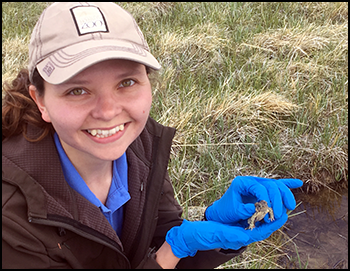
Staff member holding a Wyoming toad releasing them into the wild
“Another program I’m especially proud of is our Wyoming toad breed and release program,” said Dr. Dadone. “This species was once thought to be extinct in the wild. The only reason they exist in the wild today is because of our work and our team’s collaborations with other institutions. Some might think Wyoming toads aren’t as cute as a baby giraffe, but the toadlets are really adorable and are critical to our ecosystem and to ensuring we have a viable wildlife population in our own backyard. The research that we’ve done on headstarting [raising the toads to adulthood in the Zoo and then releasing them] and their nutrition has really improved the overall health of the last few generations of the Wyoming toad, which gives them an advantage when they are released into the wild. We’re continuing to evaluate our best practices and have an even better chance at saving this species long-term.”

Wyoming toads are symbolic of so many amphibian species in decline all over the world, including Panamanian frogs, which also receive support thanks to Q4C funds and frontline CMZoo staff support. In February 2019, three CMZoo staff members went to Panama to assist the Panama Amphibian Rescue and Conservation Project by remodifying two feeder insect pods into frog pods. For this 10-day trip, the goal was to set up two shipping containers to house and breed approximately 450 additional frogs brought in from El Valle Amphibian Conservation Center, and later released. This involved disinfecting the shipping containers, painting, installing plumbing and water filtration, assembling racks, and drilling and prepping tanks.
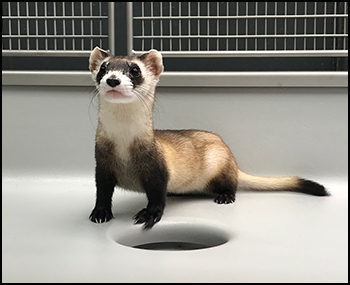
Black-footed ferret portrait
Q4C supports an in-house breed and release program for black-footed ferrets, as well. Since 1991, when CMZoo began breeding black-footed ferrets, 567 kits have been born. Roughly half of those kits are released into the wild while the others continue breeding at CMZoo and other facilities who support this recovery effort and the Species Survival Plan. This ongoing recovery effort supports the population of black-footed ferrets, who were once thought to be extinct, and which are vital to the prairie ecosystem in Wyoming.

CMZoo’s work to save habitats for orangutans through advocacy for sustainable palm oil production is largely supported by Q4C. Thanks to that financial support, CMZoo’s sustainable palm oil team consults staff at other conservation organizations on starting their own palm oil programs and recently attended the Roundtable on Sustainable Palm Oil’s (RSPO) annual conference in Thailand to represent CMZoo in the RSPO’s proceedings. Those proceedings directly impact the ways companies that use palm oil can help preserving wild lands for orangutans and other species.

Through Q4C, CMZoo also supports a conservation partner called Tsavo Trust – an organization in Kenya that works to protect the last of the big tuskers, which are African elephants with tusks weighing more than 100 pounds. CMZoo’s funds helped Tsavo Trust build permanent housing that allowed staff to live on the land where these critically endangered giants live. It also paid for pilot hours – frontline aerial surveillance that protects rhinos and elephants from poachers seeking their ivory.

The seventh Q4C legacy partner is VulPro – protectors of African vultures. The dedicated staff at VulPro, in South Africa, save vultures who have been injured as wild birds, and rehabilitates them to release. Those that are too injured to survive in the wild find a permanent home at VulPro.

Before launching Q4C in 2008, CMZoo was supporting conservation, but at a fraction of what is possible now. In the past few years, CMZoo has collected about half a million dollars per year through Q4C. Even with our three-month COVID-19 closure this year, the Zoo was able to hit this substantial $3 million milestone as expected.

“Small change pooled together makes a big difference,” said Dr. Dadone. “Thanks to our guests and members, we have been able to support this amazing frontline work. When we work together, we can make a positive difference for our world.”

In addition to contributions from admissions to every Zoo visit and special event ticket, $2.50 from each individual plus membership, and $5 from each family or higher-level membership, is allocated to Q4C. EdVenture and Animal department programs also contribute to the cause.

For more information about these projects and Quarters for Conservation, visit cmzoo.org/conservation.

Back to The Waterhole


Welcome to the official unveiling of our memorial bronze statue honoring our 200th giraffe calf, Penny. Bob Chastain, president and CEO of #CMZoo, and Antonia Chastain, manager of public art for the Zoo and the sculptor of this piece, are telling us about this special tribute to the giraffe calf who touched the hearts of so many during her brief life.

Tomorrow (Sunday, June 21) is #WorldGiraffeDay, and it is a fitting day for the public to be able to visit this sculpture for the very first time. To commemorate this special occasion, we are hosting a giveaway for one free giraffe encounter with our herd. To enter, send a photo of yourself or your family with the new statue to [email protected] by Thursday, July 30, 2020 to be entered into the random drawing. We will randomly choose one winner from all submitted photos and will notify the winner on July 31 via the email they used to submit the photo. Please, one photo entry per email address.

Visit cmzoo.org/wgd to make a donation by June 21 to giraffe care and conservation! We are incredibly grateful for the Kratt Family Foundation and their dedication to giraffe care in the Zoo and in the wild. This year, the Kratt Family Foundation is matching up to $25,000 for every dollar donated through the end of the day tomorrow (6/21/20)! Your donation supports the care of our giraffe here at the Zoo, the matched funds will help wild giraffe conservation in Uganda. Thank you for helping us #StandTallForGiraffe!

Penny’s Story:

“Giraffe Calf #200,” as she was known as at birth, came into the world on June 4, 2018. Her birth was broadcast live to global viewers. Her mom, Muziki, won the “Race to 200,” giving birth to Cheyenne Mountain Zoo’s 200th giraffe calf since our prolific breeding program started in 1954. The calf appeared to be healthy at birth, but unfortunately started having health issues on June 13. We deviated from Zoo tradition by giving her a name before our normal 30-day waiting period. Penny, as she was now known, had fans around the world falling in love with her, right along with all of us at CMZoo. But ultimately, we were losing our battle against the hidden infection that was spreading through her body. When she passed away on July 30, 2018, just shy of her two-month birthday, thousands of fans who had been rooting for her helped the Zoo staff through the difficult time with an unforgettable outpouring of support. Her legacy, and the joy she brought to so many, continue on with the production of this bronze statue.

Every membership and every visit to the Zoo is conservation in action. Although Cheyenne Mountain Zoo members can’t visit right now, they’re actively participating in important efforts to help wild animals.

Since 2015, including this year’s contributions, the Member Conservation Vote has provided $450,000 of membership revenue to support field conservation worldwide. Each year, a total of $100,000 of membership revenue is contributed to conservation in two ways:

  • $25,000 to the Quarters for Conservation program, which in total contributes half a million dollars annually to CMZoo’s legacy conservation partners.
  • $75,000 to projects voted for by CMZoo members through this annual vote.

“Over the years, members have funded projects that support organizations working to save species on the brink of extinction in places like Ecuador, Kenya, South Africa, Southeast Asia, Australia and more,” said Dr. Liza Dadone, vice president of mission and programs at CMZoo. “These grants make a huge impact for the small-but-mighty organizations that are defending animals on the frontlines. Although the Zoo is temporarily closed until further notice, in an effort to help prevent the spread of COVID-19, this is one of the ways our conservation efforts are continuing, even during the closure.”

From the safety of their homes, members participated in the 2020 Member Conservation Vote through a private link distributed to members via email. The two projects with the most votes will receive the full funding they requested. The number of votes received for the remaining four projects will help CMZoo decide how to distribute the remaining funds.

In addition to being able to support smaller conservation projects around the world, the Member Conservation Vote also allows the Zoo to support immediate needs that might not fit into our annual Quarters for Conservation funding parameters. One such project is the Zoos Victoria Bushfire Emergency Wildlife Fund in Australia.

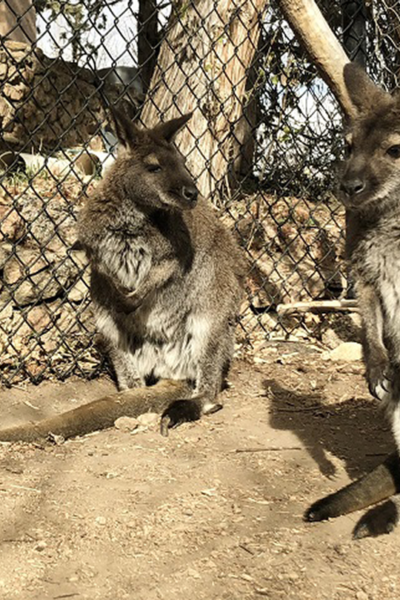
In February 2020, CMZoo members approved sending $20,000 to Zoos Victoria, in response to the devastating fires in Australia. The funds support long-term care for bushfire-impacted animals, including supplementary feeding and habitat restoration, in conjunction with the Australia Department of Environment, Land, Water and Planning, Parks Victoria, and associated recovery teams. Donations from Zoo employees, board members, docents and an internal Zoo donation matching program raised $6,900 in support of Zoos Victoria, making the collective donation $26,900.

The $20,000 donation came from the $75,000 allotted for membership conservation, leaving $55,000 for distribution among the projects nominated for the Member Conservation Vote.

This year, six projects were nominated in addition to the already approved Zoos Victoria support. Some projects, like building a wildlife corridor for lions, were brand-new. Others, like tracking mountain tapir, have received funding through this vote consistently for years.

“Considering everything going on in the world right now, it was especially important to us this year to engage our members in this vote and to remind them that they make a difference,” said Emma Repp-Maxwell, CMZoo membership manager. “We have been missing our members for more than a month, but we want them to know we’re grateful for their ongoing support, and that they’re still making a positive impact for wild animals through their memberships and through their participation in this vote.”

Drumroll, please. In order of member votes received, the 2020 projects receiving funding are:

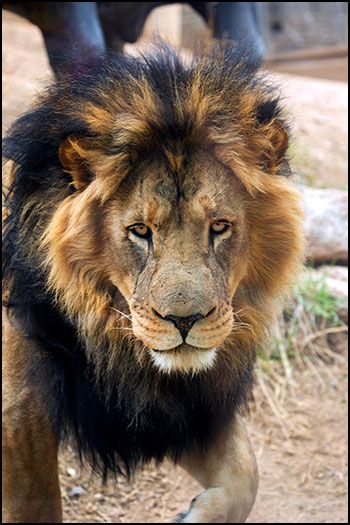
Support a wildlife corridor for African lion – $5,600 fully funded

This funding will help map developing pipelines and highways and plan animal corridors before construction begins. It will also support data analysis and stakeholder meetings to get the right organizations involved in animal protection at the right time. Longtime conservation partner, Ewaso Lions, is hoping to protect lions by establishing wildlife corridors in northern Kenya. As more highways, railways, cities and pipelines are built in the heart of lion country, they hope to create the partnerships and infrastructure necessary to protect the many species that share and roam these lands as human influence expands.

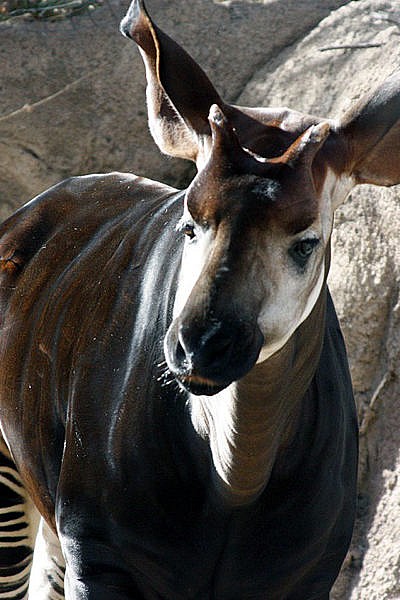
Start an agroforestry project to protect Okapi habitat – $11,000 fully funded

In a continued partnership with the Okapi Conservation Project, this grant will provide farmers with tools, seeds, natural fertilizers, and education in sustainable agriculture practices. In addition, funds would support reforestation in the region. Found in the Democratic Republic of Congo, the okapi is a mysterious member of the giraffe family that is threatened by poaching and slash-and-burn agriculture. This will empower local communities to produce food sustainably, safeguard water resources, and generate income while reducing economic dependence on mining and poaching, thus protecting okapi in the long run.

Observe tree kangaroos in their natural habitat – $7,500 fully funded

This grant will support the purchase of GPS tracking collars, camera traps and data loggers to better understand tree kangaroo behaviors, movements and habitat use. The Tree Kangaroo Conservation Program fosters wildlife and habitat conservation while supporting the livelihood of local communities in Papua New Guinea. Matschie’s tree kangaroos live high in the dense canopy of the cloud forests, hidden among thick moss that makes them very difficult to observe. The data collected through this observation project will be used to inform future habitat planning for tree kangaroo conservation.

Fund the banding and monitoring of East African crowned cranes – $11,000 fully funded

This grant will contribute to funding the first banding of 75 East African crowned crane chicks and support data collection about their behaviors and migration patterns to help inform future conservation efforts for this species. Found in Kenya, the East African crowned crane has seen a dramatic decrease in population over the last four years. The International Crane Foundation, Endangered Wildlife Trust and Leiden Conservation Foundation are collaborating to learn more about this species in order to stabilize its population.

Help track wild mountain tapir in Ecuador – $20,000 funded (partial funding awarded)

A continuation of past monitoring projects, these funds will support the GPS collaring of additional tapir in the wild and educational outreach for local schools. Found in Colombia, Ecuador, and the far north of Peru, only an estimated 2,500 mountain tapir remain in the wild. CMZoo is one of two zoos in North America that this species calls home. This project, based in Ecuador, has already yielded important data regarding the movement, behaviors and territory of this critically endangered species, which we hope will be used to protect its habitats.

For more information on CMZoo memberships, visit www.cmzoo.org/membership.

Back to The Waterhole


A team of four CMZoo staff members traveled to Ecuador in December to track critically endangered mountain tapir and speak to local school children about the native species.

They successfully studied and attached GPS collars to five wild tapir. The collars will relay data to prove the roaming ranges of tapir in the Andes Mountains, which we hope will be used to establish protections for their threatened natural habitats.

CMZoo members have voted three times to support ongoing mountain tapir research and conservation efforts in Ecuador. During the upcoming Membership Conservation Grant Vote, members will help us decide again which projects receive part of the $75,000 of membership revenue annually allocated for these grants.

https://www.facebook.com/CMZoo/videos/236694087334330/

Running a zoo requires a substantial amount of water. There are guest facilities, water features in animal habitats, cleaning and sanitation, horticulture, food and beverage services, maintenance and, of course, human and animal water consumption to consider.

Leaning on his background in horticulture, environmental education and ecology, and his involvement in global conservation projects, Cheyenne Mountain Zoo President and CEO, Bob Chastain, decided to make Cheyenne Mountain Zoo the first ‘water neutral’ zoo in the world. So, he worked with the experts at Trout Unlimited (TU) to offset the Zoo’s water usage through a unique new program.

“We use about 16 million gallons of water a year,” said Chastain. “In the last several years through our own internal programs, we’ve reduced our water usage by about half, but we still use a lot of water. We live in a drought state, so I wanted to find a way to give that water back, so to speak, to the rivers in Colorado. With Trout Unlimited’s help, we can do that.”

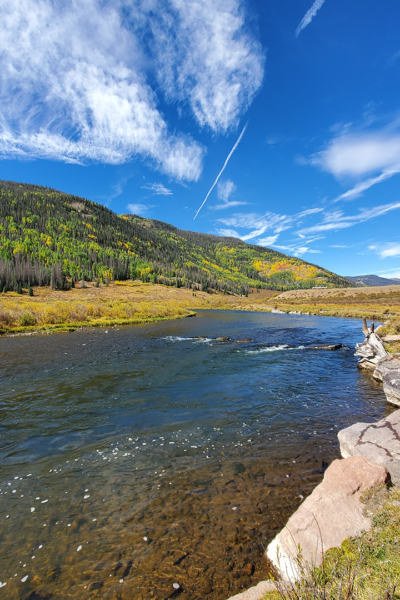
A nonprofit organization dedicated to the protection and restoration of habitat for trout and salmon, Trout Unlimited (TU) operates a program in the Rio Grande basin of southern Colorado. Under the program, TU arranges for releases of water from storage reservoirs to augment river flows for the benefit of trout populations and the riverine environment. For water year 2020, which runs from Oct. 1, 2019 to Sept. 30, 2020, Trout Unlimited will release 51 acre-feet of water from storage to the Rio Grande River or its tributaries on the Zoo’s behalf. The Zoo donated $15,000 of conservation funds to Trout Unlimited to support these releases.

Chastain is an outdoorsman. He likes to spend time rafting, fishing, hunting and hiking in the wild places along the Arkansas and Rio Grande Rivers. Over the last few summers, he has noticed a distinct decline in river water levels between early and late summer.

“I was rafting the Arkansas River late last summer and the difference in just a month and a half, since I had last rafted it, was dramatic,” said Chastain. “That got me thinking that if there was some way to contribute to water levels when they’re low during the winter months, we could make an impact.”

Roughly ninety percent of Colorado’s water supply is used by farmers and ranchers, according to Trout Unlimited, and this agricultural water use drives rural economies. Rivers also support many important functions in our state: feeding diverse ecosystems of plants and animals; generating tourism and making an economic impact on local business through its fishing, hunting, camping and whitewater sports; and transporting water from reservoirs to those who need it.

“Water rights use and administration in Colorado is extremely complex and each basin operates differently. TU’s approach is to use local staff who engage with water users and facilitate opportunities to do more with a critical and limited resource,” said Kevin Terry, Trout Unlimited’s Rio Grande Basin Project manager. “For instance, TU can inform water users on the needs of the environment and fishery, identifying partnership opportunities that farmers and ranchers can take advantage of if it works for their operations. The whole effort is like a giant dynamic puzzle, and TU brings expertise relating to specific pieces, which helps the water community of the Rio Grande be strategic and holistic in efforts to maximize the benefits of our precious water.”

Cheyenne Mountain Zoo is supporting Trout Unlimited’s program to partner with water users and incentivize them to re-time portions of their water for delivery during the winter months when possible. Restoring stream flows below working reservoirs during the winter months, while simultaneously satisfying water-user needs, creates a better balance of water delivery for the environment, and the people who rely on it.

“We are grateful for our partnership with the Cheyenne Mountain Zoo,” said Terry. “With forward-thinking partners like the Zoo, TU is greatly improving habitat conditions for trout in the Rio Grande basin.”

About Cheyenne Mountain Zoo

Cheyenne Mountain Zoological Society was founded in 1926. Today, Cheyenne Mountain Zoo, America’s mountain Zoo, offers comprehensive education programs, exciting conservation efforts and truly fantastic animal experiences. In 2019, Cheyenne Mountain Zoo was voted #6 Best Zoo in North America and CMZoo’s Rocky Mountain Wild was named #5 Best Zoo Exhibit in North America by USA TODAY 10Best Readers’ Choice Awards. It is Cheyenne Mountain Zoo’s goal to help guests fall in love with animals and nature, and take action to protect them. Of the 233 zoos and aquariums accredited by the Association of Zoos and Aquariums (AZA), Cheyenne Mountain Zoo is one of just a few operating without tax support. Cheyenne Mountain Zoo depends on admissions, membership dues, special event attendance and donations for funding.

About Trout Unlimited

Trout Unlimited is a national non-profit organization that works to protect, reconnect and restore habitat for coldwater fisheries.

Simply by visiting the Zoo, Cheyenne Mountain Zoo members and guests contribute to important global conservation work.

“Watching the devastating bushfires in Australia from our living rooms in Colorado can leave you feeling helpless and wondering what you can do to make a difference,” said Bob Chastain, CMZoo president and CEO. “It’s important to note that from every membership and every ticket to the Zoo, we set aside funds to support frontline conservation fieldwork around the world, and specifically now, in Australia. We want people to know that coming to the Zoo is conservation in action.”

Since starting in November 2019, the bushfires in Australia have devastated more than 27 million acres, claiming more than 30 human lives and more than a billion animal lives.

This week, CMZoo members voted to send $20,000 to Zoos Victoria’s Bushfire Emergency Wildlife Fund, in Australia. The funds support long-term care for bushfire-impacted animals, including supplementary feeding and habitat restoration, in conjunction with the Australia Department of Environment, Land, Water and Planning, Parks Victoria, and associated recovery teams. Donations from Zoo employees, board members, docents and an internal Zoo match program raised $6,900 in support of Zoos Victoria, making the collective donation $26,900.

“We have been closely watching the devastation in Australia and working to find the best ways to support the recovery,” said Dr. Liza Dadone, CMZoo vice president of mission and programs. “Last week, we asked our members if we could send a portion of their annual Member Conservation Grant funds to Zoos Victoria. Our members’ collective supportive response was immediate.”

Each year, CMZoo members vote for conservation projects to receive a share of $75,000 allocated from membership revenue. The $20,000 donation comes from that membership revenue. In March, members will vote to guide CMZoo’s decisions about which other projects to support, as they do every year. Since 2015, including this contribution, Cheyenne Mountain Zoo Member Conservation Grants have provided $395,000 of membership revenue to support field conservation worldwide.

“Because our members regularly visit Australia Walkabout at the Zoo, they have formed meaningful connections with the animals they’ve seen in these heartbreaking news stories out of Australia,” said Emma Repp-Maxwell, CMZoo membership and annual gifts manager. “As a leader in conservation, we’re committed to helping people make those connections, and taking it a step further by providing opportunities for our members to contribute to the amazing work being done to save and protect the animals left.”

About Cheyenne Mountain Zoo

Cheyenne Mountain Zoological Society was founded in 1926. Today, Cheyenne Mountain Zoo, America’s mountain Zoo, offers comprehensive education programs, exciting conservation efforts and truly fantastic animal experiences. In 2019, Cheyenne Mountain Zoo was voted #6 Best Zoo in North America and CMZoo’s Rocky Mountain Wild was named #5 Best Zoo Exhibit in North America by USA TODAY 10Best Readers’ Choice Awards. It is Cheyenne Mountain Zoo’s goal to help guests fall in love with animals and nature, and take action to protect them. Of the 233 zoos and aquariums accredited by the Association of Zoos and Aquariums (AZA), Cheyenne Mountain Zoo is one of just a few operating without tax support. Cheyenne Mountain Zoo depends on admissions, membership dues, special event attendance and donations for funding.

In October and November 2019, Cheyenne Mountain Zoo joined Giraffe Conservation Foundation, Colorado State University Veterinary Teaching School and other worldwide partners to support Uganda Wildlife Authority in establishing a new population of critically endangered Nubian giraffe.

CMZoo VP of Mission and Programs, Dr. Liza Dadone, traveled to Uganda to assist with the reintroduction of 15 giraffe to an historic habitat where they haven’t existed in nearly 25 years. Dr. Dadone assisted with research and anesthesia, and provided care for the giraffe during the translocation from Murchison Falls National Park to Pian Upe Wildlife Reserve.

“The reintroduction of this founding population of Nubian giraffe to Pian Upe is important because the established population in Murchison Falls is facing threats due to oil exploration, road development for drilling vehicles and other human impact issues, like snaring,” said Dr. Dadone. “The population is also dealing with a skin disease, which we have been studying and were able to do additional research on while we were there for the translocation.”

Uganda Wildlife Authority protects and monitors the Nubian giraffe in Murchison Falls National Park. When oil was recently discovered in the park and construction to support drilling began, Dr. Robert Aruho, Uganda Wildlife Authority senior wildlife veterinarian, coordinated with partners to lead the effort to establish the population in Pian Upe, a protected wildlife reserve.

Uganda Wildlife Authority identified giraffe from the population in Murchison Falls National Park that were ideal for establishing the new population. The giraffe would need to be young and healthy, but old enough that they weren’t dependent on their mothers’ milk.

After identifying key members of the population, the team went into the park to capture them. The process involves locating the giraffe, administering anesthesia, reversing the anesthesia, doing a quick health assessment, collecting blood and flies from the giraffe, and then fixing guiding ropes and a harness to the giraffe. All of this happens within a few minutes.

“Members of the team have to be quick once the giraffe is down, because it’s dangerous for the giraffe to be under anesthesia for very long,” said Dr. Dadone. “While a few members of the team hold the giraffe, others apply a blindfold and put cotton in the giraffe’s ears to minimize stimulation and keep the giraffe as calm as possible. At the same time, we administer the anesthesia reversal; take blood, fecal and skin samples; and document other measurements that we use to advance care for giraffe in the wild and in human care.”

Dr. Dadone and Dr. Matt Johnston, from Colorado State University Veterinary Teaching School, are part of a team studying a skin disease found in wild giraffe. They also expanded their ongoing studies of field anesthesia, which will be shared with organizations internationally. The anesthesia research continues to make field immobilizations safer for giraffe.

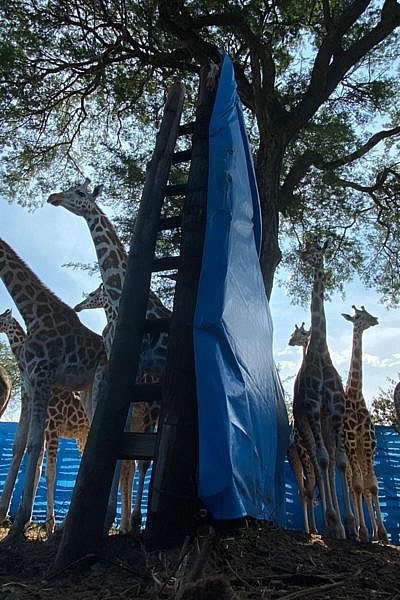
Once the giraffe wakes up from anesthesia, it is guided by ropes onto a trailer and transported to a boma – a temporary holding paddock where the giraffe are monitored and prepared for their trip to Pian Upe.

“While they’re in the boma, we’re bringing in additional giraffe to transport and are monitoring their health before the trip,” said Dr. Dadone. “The time in the boma also gives the giraffe an opportunity to bond. They’re social animals and the trip can be less stressful for a group of giraffe rather than an individual.”

One of the giraffe selected to establish the Pian Upe population is a young male named Mr. Kevin, who the team quickly realized could make an ideal founding father.

“Mr. Kevin is one of the largest males in the founding group,” said Dr. Dadone. “After a day in the boma, we saw him representing himself well with the females, so we’re optimistic he will be a great founding father for this new population.”

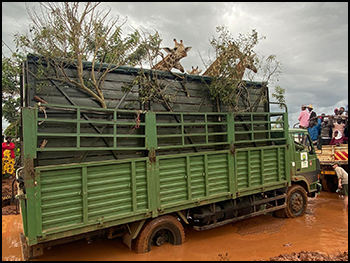
The trip from Murchison Falls National Park to Pian Upe Wildlife Reserve is about 300 miles. Because of flooding on portions of unpaved roads along the way, each of the three trips took between 12 and 16 hours.

“We experienced quite a bit of flooding along the way to Pian Upe,” said Dr. Dadone. “There were times the trailer got stuck in the mud, and we had to be towed out. The bright side was that some of the locals got more time to see the giraffe in the truck. Many people think giraffe are everywhere in Africa, but they’re not. Giraffe are locally extinct in seven countries, and a lot of local people have never seen them before, so in a way, this group of giraffe served as ambassadors for their species along the way, too.”

After the arduous travel, the giraffe were released, five at a time, into the protected Pian Upe Wildlife Reserve in Eastern Uganda.

“Watching the giraffe leave the trailer and run free into their new home was such a joyous moment,” said Dr. Dadone. “We’re hopeful this new population will thrive in their new home, providing Nubian giraffe another population and a better chance at survival.”

Having multiple populations of the same subspecies helps avoid what Dr. Dadone calls having, “all of your eggs in one basket.” Geographically diversifying populations means that if one location succumbs to disease or habitat destruction, the subspecies will live on in another region.

Our contribution to this effort is possible thanks to ongoing support from our CMZoo members, guests and donors. Through our Quarters for Conservation program, each ticket to the Zoo raises 75 cents to support wildlife conservation around the world. CMZoo guests and members contribute half a million dollars annually to critical conservation projects, like Operation Twiga, simply by visiting the Zoo.
 
Back to The Waterhole


In early December 2019, four staff members from Cheyenne Mountain Zoo will travel to the Andes Mountains of Ecuador for an important conservation expedition to help save critically endangered mountain tapirs.

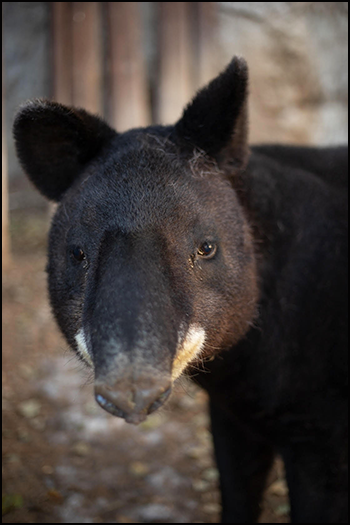
Their prehensile noses with long snouts, odd-and-even-toed hooved feet and furry, bear-shaped bodies make this unique species look like something out of a children’s book. It’s not surprising that CMZoo’s mountain tapirs, 25-year-old female, Carlotta, and 16-year-old male, Cofan (pronounced co-FAWN), steal the hearts of just about everyone who meets them. Carlotta and Cofan are two of only seven mountain tapirs in the U.S.

This will be the third mountain tapir expedition CMZoo has supported in Ecuador, thanks to annual Member Vote Conservation Grants. Each year, CMZoo members vote to decide which staff-championed conservation efforts receive support from the $75,000 of membership revenue allocated annually for conservation. Earlier this year, members voted for the fourth year in a row to support mountain tapir conservation. Aside from the three expeditions in Ecuador, the grant funded tapir conservation in Columbia.

Found in Columbia, Ecuador and the far north of Peru, it’s estimated that only 2,500 mountain tapirs remain in the wild. CMZoo is one of two zoos in North America that this species calls home. This project has already yielded important information regarding the health, behaviors and territory of mountain tapir, about which relatively little is known. The team documents wild tapir measurements, reproductive trends, biometrics and geographic data. The studies are vital in proving which areas of wilderness need protection and are important in learning about how to best care for them, if this species is to survive.

Mountain tapir in Ecuador are threatened due to loss of habitat from natural gas exploration, expanding cities, agriculture, and potential traffic accidents, due to a growing human population. One goal of the ongoing conservation efforts is to equip policymakers with complete data they can use to encourage finding compromises that protect tapir without hindering the economic and infrastructure progress being made in the country.

CMZoo Animal Care Manager, Joanna Husby, will return to Ecuador for the third time and Lead Animal Keeper, Michelle Salido, will return to Ecuador for the second time contributing to this conservation project. CMZoo veterinary technician, Brenda Cordova, and CMZoo EdVenture keeper, Bryce Oberg, are both embarking on the Ecuador expedition for the first time.

CMZoo’s mountain tapir conservation partner at Andean Bear Foundation (ABF) and Smithsonian National Zoo reported that the high-tech GPS collars fixed to tapirs on previous field projects collected more geo-data in a week than the previously used radio collars collected in five years.

“Their native habitats are being developed for pipelines, mining and agriculture. The tapirs living in those areas are considered a nuisance,” Salido said. “One morning we were there on a previous trip, it took only a matter of hours to see the difference in habitat destruction going on in the forest. Seeing their habitat destroyed in front of my eyes made our work that much more important to me.”

The team is dedicated, and with such physically demanding tasks ahead of them, it’s a good thing.

“It’s incredible to be able to see these animals in the wild, where they live natively in elevations between 6,000 and 12,000 feet,” said Salido. “Part of what makes it rewarding while we’re in the field is how difficult it is to find them.”

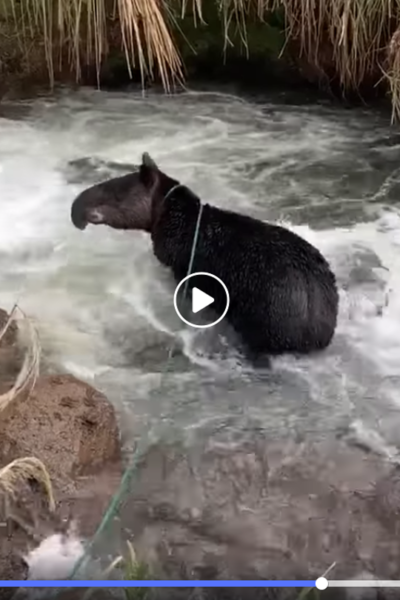
Carrying their research equipment on their backs, the team hikes with local guides and partners from the Smithsonian and ABF for hours through high-elevation mountain forest terrain. Once they locate an animal they can briefly capture (they are careful not to capture mothers with calves because there’s a risk the calf will be permanently separated from its mother), they have minutes to anesthetize the animal and gather as much information as they can.

“Unfortunately, these wild animals don’t know we’re here to help, so they can see us as a threat,” said Salido. “A threatened tapir instinctively retreats to water, which means we’re often trying to keep them out of the water before we can assess them.”

The average female tapir weighs about 400 pounds and males generally weigh about 30 pounds less than females.

“We have to attach ropes to the tapir to prevent it from wading into water as it’s waking up, and then detach them once we see it has fully recovered and won’t be in danger in the water,” said Salido. “We only have minutes to measure and document their size and other morphometrics, take blood and fecal samples, attach the GPS collar and administer the anesthesia reversal. Then, we’re monitoring to make sure the tapir is stable and ready to be released.”

The research is critical, given the limited number of animals left in the wild and the lack of available data about them. In addition to collecting data, this year, they’re expanding their efforts with an education component. The team will visit a local Ecuadorian school to talk with them about tapirs, hoping to inspire the next generation of local conservationists to take pride in this local, rare species and to take steps to protect them.

“We’re really excited about the education opportunities we have on this trip,” said Salido. “Tapirs need more local advocates, and part of the challenge is that there’s very little local pride in this awesome species. We hope that once people learn about tapir, they’ll appreciate and want to protect them the same way that we do.”

The team will spend nearly three weeks tracking tapir and raising awareness about them in their native country. CMZoo will post social media updates as the team has opportunities to relay progress from the field.
 
Back to The Waterhole