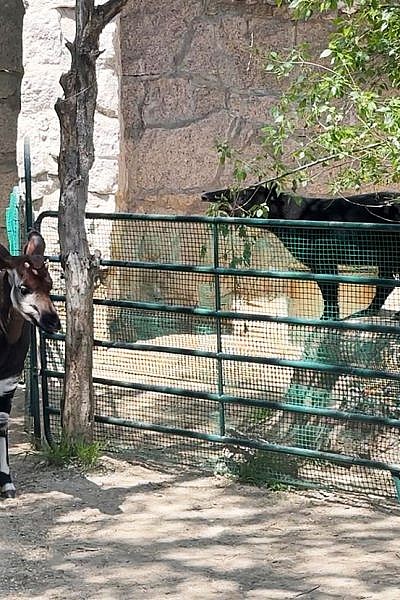
In May, Cheyenne Mountain Zoo’s 12-year-old okapi, Bahati [buh-HAH-tee], got a new home – and a new roommate – in CMZoo’s tapir yard.
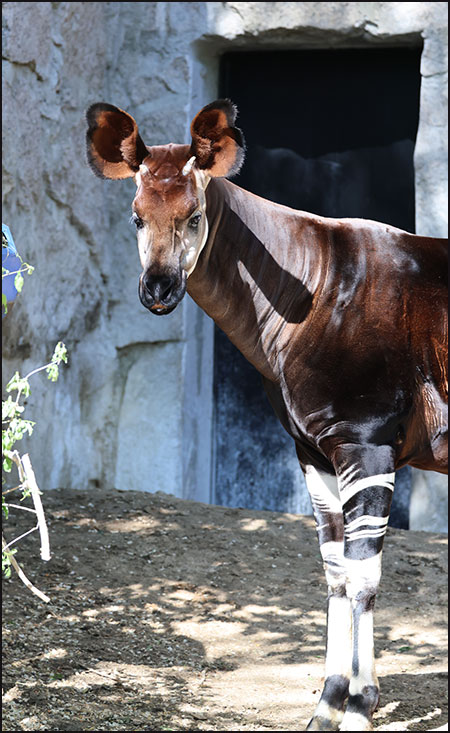
Bahati, okapi portrait

Seeing Bahati in a new and prominent location in the Zoo, visitors have better-than-ever visibility of the rare and mystical creature, who often prompts the question – “Did they breed a zebra and a horse?”

With his black-and-white striped legs and velvety dark brown coat, it’s easy to see why people might ask that. But, Bahati is an okapi, a species all its own, known to be native to only one place in the world: rainforests in the Democratic Republic of the Congo, in Africa.

“I wonder if our guests know how rare it is to see an okapi,” Rick Hester, CMZoo’s director of animal care and wellbeing, says. “I have met wild okapi researchers and conservationists who have dedicated their lives to this animal, and have never seen one in person. We’re lucky Bahati lives here.”

Because he was born and raised in human care, Bahati’s behaviors are quite different from his wild counterparts. He’s eager to approach his keepers and guests, and he’s always been inquisitive about his former neighbors, the giraffe herd and vultures.

Bahati has a reputation for being curious about giraffe calves, and he would often stretch his neck over his rock barrier to sniff a new calf, so he has a history of being calm and confident around other animals.

“We can’t say ‘all’ okapis would do well sharing space with another animal, but we think Bahati, as an individual, will do well with Mochi, our mild-mannered mountain tapir,” Rick says
.
For his first day in the tapir yard, Bahati got the entire space. His care team wanted him to explore, make his mark and have maximum space to settle in. He did incredibly well, and his team set him up for success by planting a new willow tree and hanging lots of tree branches throughout the yard, which kept him engaged throughout the day.

By the end of the day, Bahati had explored nearly everything to his heart’s content. But, one new sound and smell particularly caught his curiosity. Bahati wanted to see Mochi.
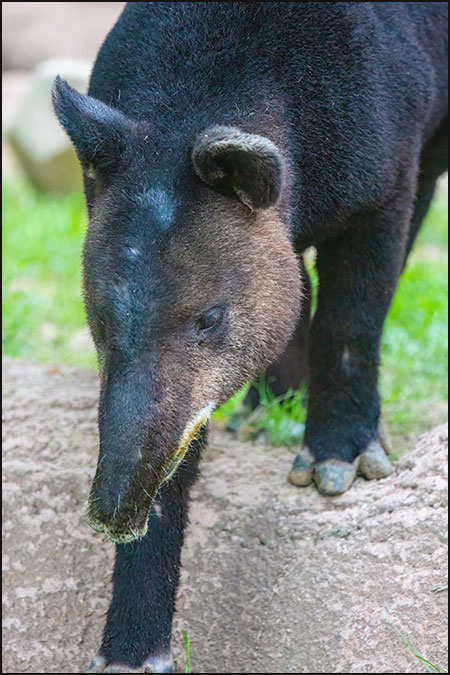
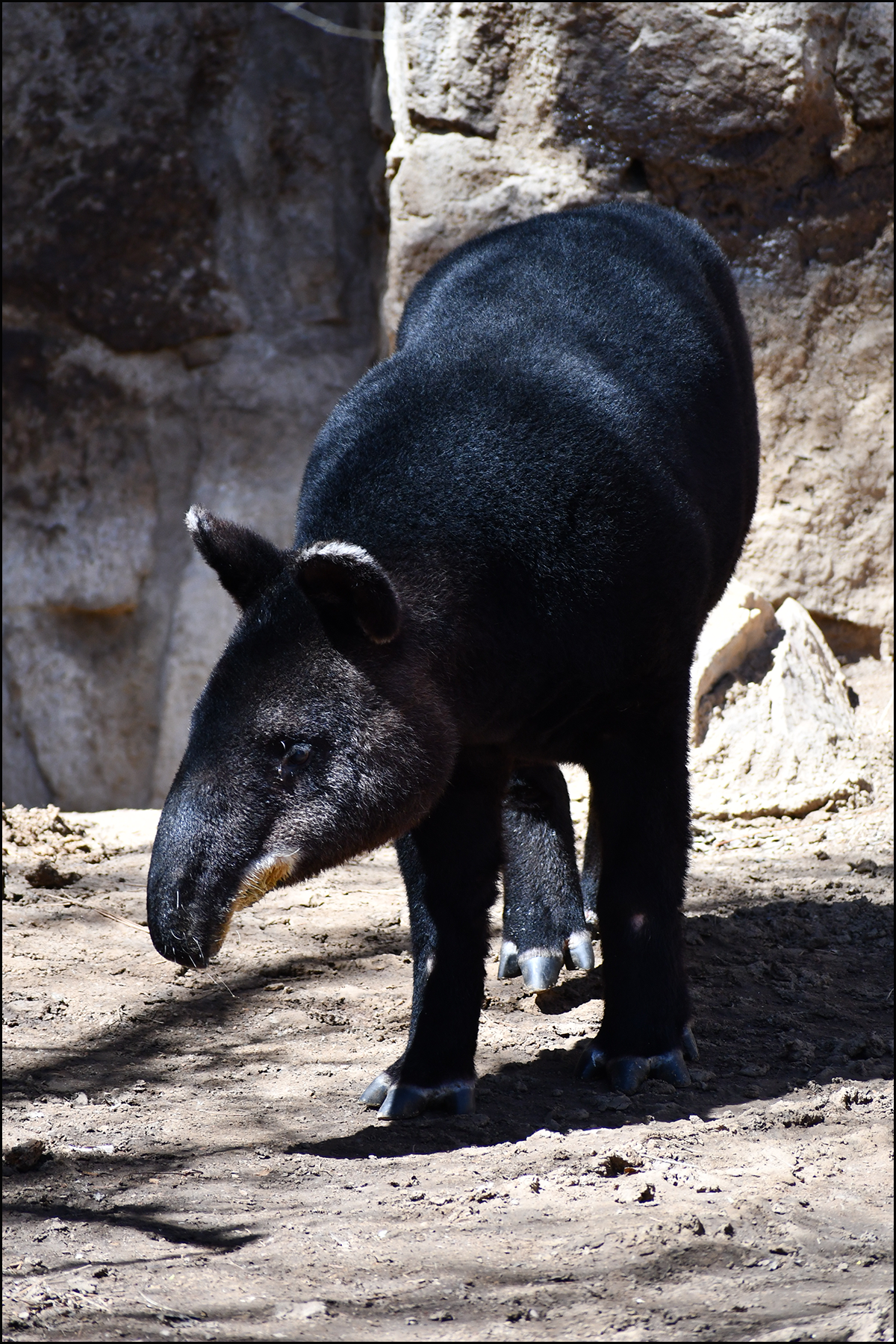
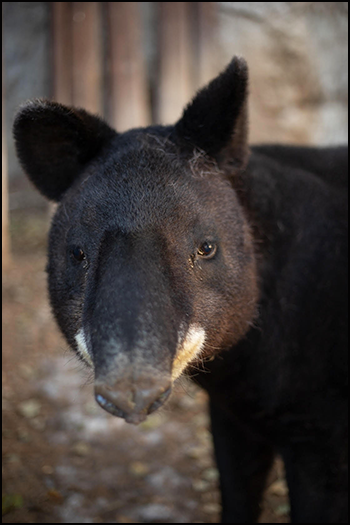
Mochi, Mountain tapir portrait

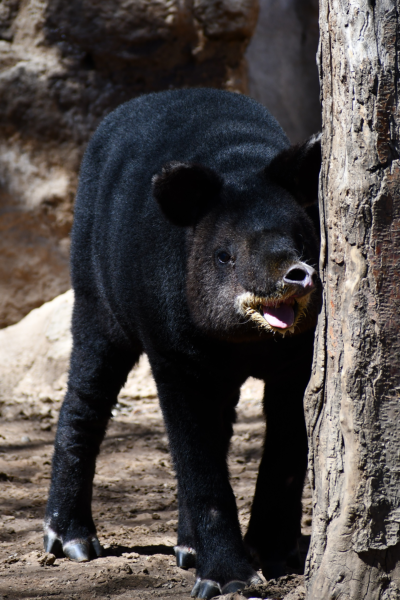
Mochi, CMZoo’s mountain tapir, is one of only three mountain tapirs in the U.S. The other two live at LA Zoo, where Mochi lived before moving back to CMZoo in 2023. They’re native to mountainous regions in Ecuador, Peru and Columbia. Mochi also prompts a question from unfamiliar onlookers. “Is that a cross between a bear and an anteater?”

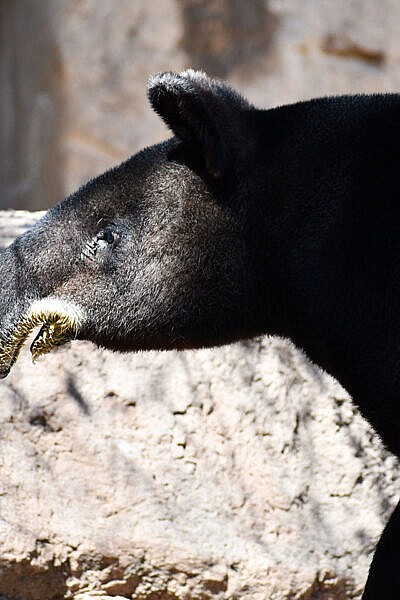
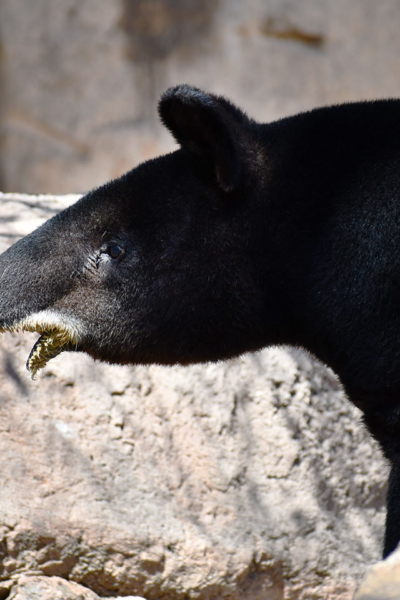
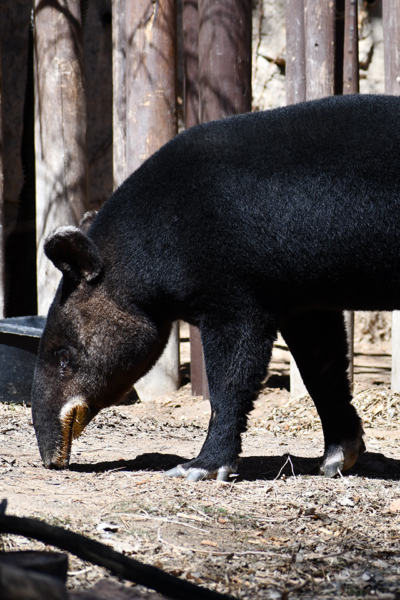
Mountain tapirs have wooly black coats, hooved toes, the body shape of a large boar and long and extremely dexterous snouts. Mochi, who was also raised in human care, is extremely outgoing. He is one of the few animals of his size (around 370 pounds) at the Zoo that are safe to share space with. When staff share space with Mochi, he usually approaches them for scratches, which they happily deliver. Scratch Mochi just right and he gets so relaxed that he usually topples over onto his side, providing the best belly-rub angles.

Okapis and mountain tapirs are not typically found in groups in the wild, and these two individuals have had their own spaces for many years. There are separate doors leading to separate dens behind the tapir yard. On Bahati’s first day in the tapir yard, Mochi was in his den and Bahati had access to the full yard and his den – separated by a den between the two boys.

At the end of the first day, Bahati’s care team says Bahati stood in the den with his ears straight forward, making little ‘chuffs’ towards Mochi. His care team hadn’t heard Bahati vocalize before, and based on the rest of his behavior, he seemed comfortable and eager to see what he was hearing and smelling. Mochi was making vocalizations, which sounded like little chirps, in Bahati’s direction, and standing at the end of his den closest to Bahati, too.

“Seeing how comfortable and curious they were with each other’s presence, we decided to accelerate their timeline, and let Mochi into the den next to Bahati,” Rick says. “Mochi reached his long snout farther than I’ve ever seen, and the two touched noses through the metal fence in between them. They seemed calm, and overall curious.”

Their nose-touch greetings continued through the night, and the two slept as next-door neighbors – all signs of comfortable behavior. The next day, the team constructed a temporary fence to split the yard, so both animals could go outside and inside as they chose. Mochi, who is about four feet shorter than Bahati, has been seen climbing up onto a rock near the fence to get closer to Bahati’s eye level. The two continue to smell each other and touch noses through the fence.

Mochi, mountain tapir and Bahati, okapi - introduction

Mochi, ever cool as a cucumber, settled back into his routine rather quickly, checking in with Bahati periodically. Bahati can’t get enough of Mochi, and follows his every move. If Mochi wants to go outside, Bahati goes outside. When Mochi goes into the den, Bahati usually follows into his side of the den.

Mochi might have a good memory, and he may remember having okapis as neighbors when he lived at CMZoo previously, from 2000 to 2014. Or, he may be ultimately confident and curious in his golden years. Mochi is 26 years old, which is considered quite old for a mountain tapir. Cofan and Carlotta, CMZoo’s two previous mountain tapirs, lived to be 19 and 26, respectively.

Bahati’s care team and Zoo leadership considered every option for Bahati’s best welfare – including finding him a home at another accredited organization. Ultimately, they decided the tapir yard at CMZoo – with plenty of shade and vegetation for the rainforest-native species – was Bahati’s best option.

“We are getting better and better at using both the natural history of the species and the behavior of the individual in front of us to inform our care,” Rick says. “Our goal is to provide animals with environments that are rich with the things that matter most to them.”

Bahati’s and Mochi’s care team will continue to monitor their behaviors closely, and make adjustments to their environment based on their needs. There’s no rush, and the future goal is to introduce the two animals without a barrier between them, so they both have full access to the yard.
Back to The Waterhole

Sun., April 27 is World Tapir Day and to celebrate, Zoo guests can meet Mochi and even give him chin scratches during a special tapir keeper talk. All you need to do is reserve your e-tickets in advance (cmzoo.org) and come to the tapir yard for scheduled events! This is an incredibly rare opportunity, since Mochi is one of only three mountain tapir in human care in the United States and wild mountain tapirs are critically endangered.
– 10 a.m. to 2 p.m. — Informational table outside of the tapir yard
– 10 a.m. — Watch Mochi enjoy some tapir enrichment (weather dependent)
– 1:30 p.m. — Keeper talk and a chance to give Mochi chin scratches (weather dependent)
Advance tickets are required and can be purchased at cmzoo.org/tickets.

MOCHI, 24-YEAR-OLD MOUNTAIN TAPIR, RETURNS TO CHEYENNE MOUNTAIN ZOO! – A critically endangered, extremely rare and iconic species, the mountain tapir, has returned to America’s mountain Zoo. Meet Mochi [MOH-chee], one of only four mountain tapir remaining in the entire country.

Longtime CMZoo members and fans may recognize him. Mochi lived at CMZoo from 2000 to 2014, when he moved to LA Zoo – where he left last month to return to Colorado.

“We are beyond excited to welcome this species back to the Zoo – and Mochi, as an individual, is going to be such a great ambassador,” said Lauren Phillippi, lead mountain tapir keeper. “He’s an older guy, but he’s really playful and curious. He loves scratches, just like our former tapir, and his brother, Cofan, did. He likes to hold his head to one side or stretch out a leg so we can get the scratches just right.”

This Monday, curious Mochi wasted no time exploring his recently updated yard, across the main Zoo road from Encounter Africa. He came straight out of his den to the yard, energetically investigating the trees, rocks, grass and snacks, with his signature tapir high-step walk. To accommodate Mochi’s advanced age, his team decided to remove a pool that was previously there, and replaced it with a comfortable sand yard. Mochi has access to a waterfall and smaller pond, where he took a brief dip.

Mochi came to CMZoo from LA Zoo, the only other organization providing homes for mountain tapir in the U.S. Because CMZoo had ample space and experience to care for another tapir after the losses of Cofan and Carlotta in 2022 and 2021, respectively, Mochi got the opportunity to live out his golden years at his former home.

“Mountain tapir are so rare – in the wild and in human care,” said Phillippi. “Last year, we didn’t know if we’d ever be able to share tapir with our community again. Mochi may be our last chance to inspire people to care for mountain tapir, and we don’t take that lightly.”

Mountain tapir need help, with an estimated 2,500 mountain tapir remaining in the wild habitats of their native Ecuador. Largely due to CMZoo’s Member Conservation Vote, CMZoo and members have contributed more than $135,000 to wild tapir conservation. Many CMZoo staff members have traveled to Ecuador to study and raise local awareness for the rare tapir.

“They’re simply magical animals,” said Phillippi. “Their physical appearances are as unique as their presence, with their prehensile snouts, hooved feet, bear-like ears and fuzzy bodies. If you’ve never seen a tapir in person, you can’t miss the chance to meet Mochi.”

Mochi will be out and about as he chooses while the weather is warm and he continues to settle in. Stop by and visit him in the Mountain Tapir exhibit.

About Cheyenne Mountain Zoo

Cheyenne Mountain Zoological Society was founded in 1926. Today, Cheyenne Mountain Zoo, America’s mountain Zoo, offers comprehensive education programs, exciting conservation efforts and truly fantastic animal experiences. In 2023, Cheyenne Mountain Zoo was voted #4 Best Zoo in North America and CMZoo’s Rocky Mountain Wild was named #2 Best Zoo Exhibit in North America by USA TODAY 10Best Readers’ Choice Awards. It is Cheyenne Mountain Zoo’s goal to help guests fall in love with animals and nature, and take action to protect them. Since 2008, CMZoo’s Quarters for Conservation program has raised more than $4.5 million dedicated to frontline conservation efforts around the world. Of the 238 zoos and aquariums accredited by the Association of Zoos and Aquariums (AZA), Cheyenne Mountain Zoo is one of just a few operating without tax support. Cheyenne Mountain Zoo depends on admissions, membership dues, special event attendance and donations for funding.

Support your favorites with digital, traditional, gift package, and group adoptions. Gifting any adopt choice is available by simply completing the gift area at checkout.

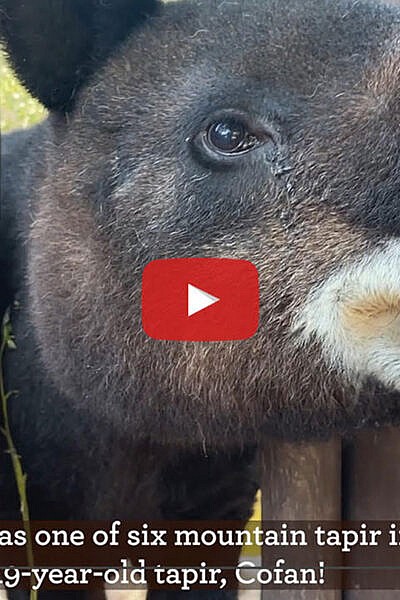
It’s time to check in on our mountain tapir, Cofan, as he lives out his golden years! In early 2021, Cofan underwent a life-saving surgery to remove his damaged left kidney. Since then, Cofan’s keepers have worked closely with him and given him extra love and scratches, which are his favorite rewards. Giving Cofan scratches puts him into a ‘tapir trance,’ allowing his care team to collect voluntary blood draws without any sedation. His post-surgery blood draw results have been encouraging and are a great way to keep tabs on his overall health.

Mountain tapir are very rare. Only six live in human care in the United States. Even though tapir look similar to anteaters or bears, they are actually closely related to rhinos and horses. Because tapir are so rare, but have the commonalities of horses, Cofan’s medical team refers to equine medicine and their own experience with tapir to give nearly 19-year-old Cofan the best care as he ages.

As Cofan gets older, enrichment is important for his health and quality of life in his golden years. Cofan loves eating lettuce, apples and fresh leaves from branches. Keepers will hang snacks from trees and bushes to encourage Cofan to problem solve and use his incredible nose. When he is not actively participating in enrichment, Cofan can often be found taking naps by his waterfall.

Mountain tapir, from the Andes Mountains in Colombia, Ecuador and northern Peru, are one of four species of tapir. Due to habitat loss, mountain tapir are endangered with approximately 2,500 left in the wild. CMZoo staff, thanks to support from Zoo members in our annual Member Conservation Vote, work diligently to save mountain tapir and their habitats south of the equator.

Easy-to-love Cofan helps his species by teaching us more about how to care for mountain tapir, and by inspiring countless visitors to learn about and protect wild tapir. You can visit Cofan living out his golden years across the road from Encounter Africa.

Back to The Waterhole

A team of four CMZoo staff members traveled to Ecuador in December to track critically endangered mountain tapir and speak to local school children about the native species.

They successfully studied and attached GPS collars to five wild tapir. The collars will relay data to prove the roaming ranges of tapir in the Andes Mountains, which we hope will be used to establish protections for their threatened natural habitats.

CMZoo members have voted three times to support ongoing mountain tapir research and conservation efforts in Ecuador. During the upcoming Membership Conservation Grant Vote, members will help us decide again which projects receive part of the $75,000 of membership revenue annually allocated for these grants.

https://www.facebook.com/CMZoo/videos/236694087334330/

In early December 2019, four staff members from Cheyenne Mountain Zoo will travel to the Andes Mountains of Ecuador for an important conservation expedition to help save critically endangered mountain tapirs.

Their prehensile noses with long snouts, odd-and-even-toed hooved feet and furry, bear-shaped bodies make this unique species look like something out of a children’s book. It’s not surprising that CMZoo’s mountain tapirs, 25-year-old female, Carlotta, and 16-year-old male, Cofan (pronounced co-FAWN), steal the hearts of just about everyone who meets them. Carlotta and Cofan are two of only seven mountain tapirs in the U.S.

This will be the third mountain tapir expedition CMZoo has supported in Ecuador, thanks to annual Member Vote Conservation Grants. Each year, CMZoo members vote to decide which staff-championed conservation efforts receive support from the $75,000 of membership revenue allocated annually for conservation. Earlier this year, members voted for the fourth year in a row to support mountain tapir conservation. Aside from the three expeditions in Ecuador, the grant funded tapir conservation in Columbia.

Found in Columbia, Ecuador and the far north of Peru, it’s estimated that only 2,500 mountain tapirs remain in the wild. CMZoo is one of two zoos in North America that this species calls home. This project has already yielded important information regarding the health, behaviors and territory of mountain tapir, about which relatively little is known. The team documents wild tapir measurements, reproductive trends, biometrics and geographic data. The studies are vital in proving which areas of wilderness need protection and are important in learning about how to best care for them, if this species is to survive.

Mountain tapir in Ecuador are threatened due to loss of habitat from natural gas exploration, expanding cities, agriculture, and potential traffic accidents, due to a growing human population. One goal of the ongoing conservation efforts is to equip policymakers with complete data they can use to encourage finding compromises that protect tapir without hindering the economic and infrastructure progress being made in the country.

CMZoo Animal Care Manager, Joanna Husby, will return to Ecuador for the third time and Lead Animal Keeper, Michelle Salido, will return to Ecuador for the second time contributing to this conservation project. CMZoo veterinary technician, Brenda Cordova, and CMZoo EdVenture keeper, Bryce Oberg, are both embarking on the Ecuador expedition for the first time.

CMZoo’s mountain tapir conservation partner at Andean Bear Foundation (ABF) and Smithsonian National Zoo reported that the high-tech GPS collars fixed to tapirs on previous field projects collected more geo-data in a week than the previously used radio collars collected in five years.

“Their native habitats are being developed for pipelines, mining and agriculture. The tapirs living in those areas are considered a nuisance,” Salido said. “One morning we were there on a previous trip, it took only a matter of hours to see the difference in habitat destruction going on in the forest. Seeing their habitat destroyed in front of my eyes made our work that much more important to me.”

The team is dedicated, and with such physically demanding tasks ahead of them, it’s a good thing.

“It’s incredible to be able to see these animals in the wild, where they live natively in elevations between 6,000 and 12,000 feet,” said Salido. “Part of what makes it rewarding while we’re in the field is how difficult it is to find them.”

Carrying their research equipment on their backs, the team hikes with local guides and partners from the Smithsonian and ABF for hours through high-elevation mountain forest terrain. Once they locate an animal they can briefly capture (they are careful not to capture mothers with calves because there’s a risk the calf will be permanently separated from its mother), they have minutes to anesthetize the animal and gather as much information as they can.

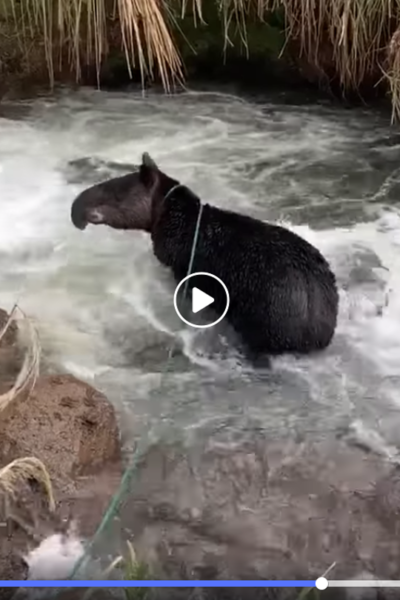
“Unfortunately, these wild animals don’t know we’re here to help, so they can see us as a threat,” said Salido. “A threatened tapir instinctively retreats to water, which means we’re often trying to keep them out of the water before we can assess them.”

The average female tapir weighs about 400 pounds and males generally weigh about 30 pounds less than females.

“We have to attach ropes to the tapir to prevent it from wading into water as it’s waking up, and then detach them once we see it has fully recovered and won’t be in danger in the water,” said Salido. “We only have minutes to measure and document their size and other morphometrics, take blood and fecal samples, attach the GPS collar and administer the anesthesia reversal. Then, we’re monitoring to make sure the tapir is stable and ready to be released.”

The research is critical, given the limited number of animals left in the wild and the lack of available data about them. In addition to collecting data, this year, they’re expanding their efforts with an education component. The team will visit a local Ecuadorian school to talk with them about tapirs, hoping to inspire the next generation of local conservationists to take pride in this local, rare species and to take steps to protect them.

“We’re really excited about the education opportunities we have on this trip,” said Salido. “Tapirs need more local advocates, and part of the challenge is that there’s very little local pride in this awesome species. We hope that once people learn about tapir, they’ll appreciate and want to protect them the same way that we do.”

The team will spend nearly three weeks tracking tapir and raising awareness about them in their native country. CMZoo will post social media updates as the team has opportunities to relay progress from the field.
 
Back to The Waterhole