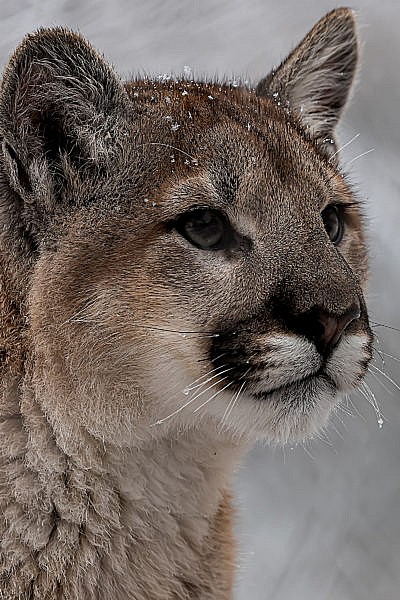
A team of eight veterinary professionals from Powers Pet Emergency and Specialty gathered in the veterinary hospital at Cheyenne Mountain Zoo on Thursday. They were eager to help remove a foreign object from the stomach of a nine-month-old female mountain lion and donate their time to save her life.

They cleared their schedules at the practice to help Adira, who has had a tough start to her life. She was orphaned in the wild at just six weeks old, along with her sister Sequoia and brother Sitka. Although they were fortunate to find a safe home at Cheyenne Mountain Zoo, their misfortune continued when Adira’s sister, Sequoia, passed away unexpectedly Sunday night while recovering from a spay surgery. Because Adira received the same surgery, the CMZoo veterinary team, led by Dr. Jon Romano, CMZoo head veterinarian, conducted an additional post-op exam on her and found something unexpected. While doing an x-ray on her, they saw a foreign object in her stomach, which was completely unrelated to her previous surgery. That unintended discovery likely helped to save her life.

The Zoo’s internal veterinary team immediately sprang into action to secure the professional assistance needed to help Adira. Dr. Brianna Backlund, a veterinary internal medicine specialist and skilled endoscopist, and Dr. Brandy Cichocki, veterinary surgeon, answered the call with their expert support teams and specialized equipment.

Cheyenne Mountain Zoo is relieved to report that Dr. Backlund’s team successfully removed a 19”-long rubber-coated electrical cord from Adira’s stomach. Although Dr. Cichocki’s surgical team was thankfully not needed, they were on hand in CMZoo’s vet hospital in case there were any complications with the endoscopy procedure.

“When I walked into the hospital, I was impressed with the medical team assembled in front of me,” said Bob Chastain, president and CEO of Cheyenne Mountain Zoo. “Watching them work with the scope and getting to see the actual removal of the cord was fascinating. I am so appreciative that partners in our community care enough about an individual mountain lion that they would devote their entire day to saving her.”

Adira’s care team traced the cord back to a scale they used to ensure the cubs were gaining weight appropriately when they were about six months old. The scale is a heavy, industrial model, and was kept in the cubs’ den with the cord secured under a fence and out of reach of the cubs – or so they thought. One night in October, the scale became a toy for the cubs, and after they dragged the approximately 40-pound scale away from the fence, they attacked the cord and ripped it apart. In the morning, keepers scoured the area and were convinced they had recovered all of the cord, but Adira obviously had one piece stashed away where they couldn’t find it. As any parent of a young child or any pet owner can attest, children and animals are prone to investigating and ingesting things they shouldn’t. When things happen that aren’t supposed to happen, we’re fortunate to have generous community partners, like the professionals at Powers Pet Emergency and Specialty, to donate their time and expertise to help.

“Dr. Backlund’s expertise in driving an endoscope allowed us to avoid a more invasive procedure for Adira,” said Dr. Romano. “It wasn’t a simple removal because the cord was quite firm and inflexible. Dr. Cichocki’s team was on standby to perform emergency surgery if needed, which would have been especially risky because Adira’s body was already trying to heal from the spay surgery. We’re grateful we could remove the cord without taking more extreme measures.”

After the cord was removed, Adira’s care team took x-rays to confirm there weren’t any additional pieces of cord left behind. They also used the scope camera to check Adira’s stomach for ulcers or lesions, which can sometimes form in the stomach after the presence of a foreign object.

“We did see some very mild ulcers, which we believe are a reaction to the presence of the cord,” said Dr. Romano. “We gave her antacids and anti-nausea medication that should clear up those minor lesions. A bit of good news is that while she was under general anesthesia, we gave her spay surgical site another inspection, and it appears to be almost completely healed.”

Adira has returned to her den in Rocky Mountain Wild and was reunited with her brother, Sitka. Keepers say Adira is calmer when Sitka is with her. Vet and keeper staff will continue to monitor Adira as she recovers from both procedures.

To see a portion of the scope video from Adira’s endoscopy, click here.


About Cheyenne Mountain Zoo

Cheyenne Mountain Zoological Society was founded in 1926. Today, Cheyenne Mountain Zoo, America’s mountain Zoo, offers comprehensive education programs, exciting conservation efforts and truly fantastic animal experiences. In 2019, Cheyenne Mountain Zoo was voted #6 Best Zoo in North America and CMZoo’s Rocky Mountain Wild was named #5 Best Zoo Exhibit in North America by USA TODAY 10Best Readers’ Choice Awards. It is Cheyenne Mountain Zoo’s goal to help guests fall in love with animals and nature, and take action to protect them. Of the 233 zoos and aquariums accredited by the Association of Zoos and Aquariums (AZA), Cheyenne Mountain Zoo is one of just a few operating without tax support. Cheyenne Mountain Zoo depends on admissions, membership dues, special event attendance and donations for funding.

About Powers Pet Emergency & Specialty

As greater Colorado Springs’ leading 24/7 veterinary emergency and specialty hospital, Powers Pet Emergency & Specialty provides a standard of care you simply won’t find anyplace else in the region. With emergency and critical care services available 24 hours a day, plus advanced care by board-certified specialists in surgery, internal medicine, neurology/neurosurgery, cardiology, rehabilitation, radioiodine therapy and diagnostic imaging, Powers is a trusted one-stop partner to pet parents and the region’s primary care veterinarians. You can find Powers Pet Emergency at 5886 Tutt Blvd., Colorado Springs, Colo., 80923. For more information, call 719-473-0482 or visit powerspetemergency.com.
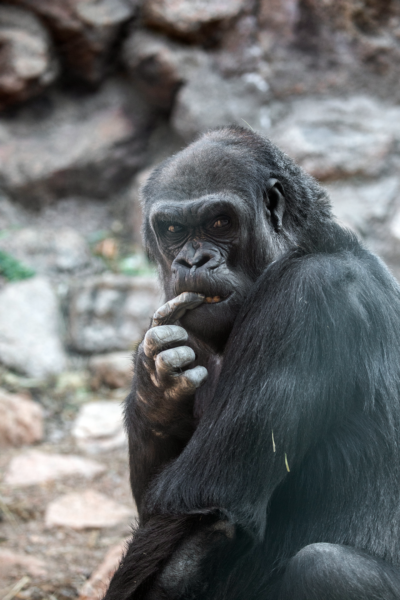
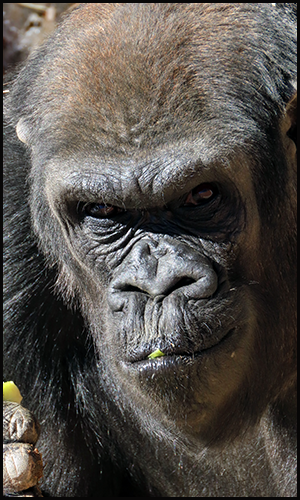
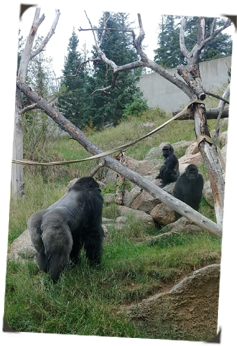
In October, we told you about a recent health scare with Roxie, Cheyenne Mountain Zoo’s eldest Western lowland gorilla. Since then, CMZoo animal care and veterinary teams have been monitoring Roxie, and making decisions about the future of her care.

The 43-year-old female became lethargic and refused to eat or drink in early October 2019. CMZoo veterinary team and keepers immobilized Roxie the morning of October 6. At the CMZoo vet clinic, Roxie’s examination included whole-body x-rays and ultrasounds. She was given IV fluids and supportive medications that helped address any infection that may have been present. The examinations revealed multiple medical conditions, the most concerning of which was a suspected infection of Roxie’s reproductive tract. Throughout her life, Roxie has dealt with kidney issues and ulcer-like cysts that have caused gastrointestinal and reproductive system complications. The exam also revealed age-related changes, including arthritis.

While she was under anesthesia, Roxie suffered a cardiac arrest and was brought back to life with CPR and emergency drugs. Since then, Roxie has been mostly stable – except for a couple of days when she had very little appetite.

“We’re taking into consideration her quality of life for her remaining time with us,” said Dr. Jon Romano, head veterinarian at CMZoo. “We don’t want her to suffer, so we’re weighing the benefits and the risks that medical procedures would have on her and the troop. Gorillas are extremely social and Roxie’s immobilizations, hospitalizations and recovery periods require separation, which can be stressful for her and her troopmates. On a daily basis, she seems active and comfortable. There’s no cookie-cutter approach. We’re taking a lot of factors into account and will ultimately do what’s best for the troop.”
Western Lowland gorilla, Roxie portrait
For now, Roxie is receiving medications to address her ongoing issues, but her care team has made the decision not to provide extreme medical intervention going forward. This is a difficult decision for her team, but is in the best interest of Roxie – one of CMZoo’s longest living and most iconic residents.

“If her episodes continue and increase in frequency, we would consider what’s best for Roxie and whether humane euthanasia is the best course of action for her,” said Dr. Romano. “It’s hard to say what our course of action will be, because it will be based on how Roxie is doing at the time. But, we’re no longer pursuing extensive diagnostic medical procedures.”

Heidi Eaton, Primate World animal keeper, has worked with Roxie for 25 years.

“She’s been doing great lately, but we’re being realistic about the fact that her condition could shift at any time,” said Eaton. “She’s on daily medication for age-related issues and the medical challenges she’s experienced throughout her life. The fact that she’s had these ongoing issues and she’s still with us is pretty amazing. She still seems to enjoy life and spending time with the female gorillas and Goma [CMZoo silverback]. As long as she’s doing that, it’s great for her and the troop. But, I also agree with the decision that there’s not necessarily a need for stressful heroics at this point in her life. She is older and it’s not worth putting her through additional testing or exploratory surgeries.”

The median life expectancy for female Western lowland gorillas is 38 years. Her team will continue their dedicated work to keep Roxie comfortable as long as possible with medical treatments that lessen the severity of her symptoms.
 
Back to The Waterhole


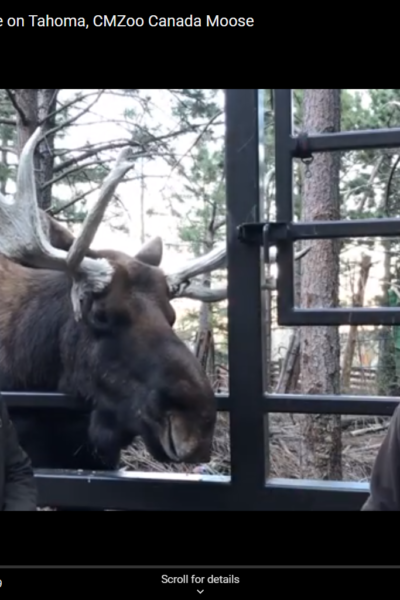
CMZoo’s aging Canada moose, Tahoma, is doing well at his impressive age. Rocky Mountain Wild Keeper, Basia Dann, walks us through some of 12-year-old Tahoma’s training and specialized care – and gives us the inside scoop on when to watch out for Tahoma’s annual antler shed.

 
Back to The Waterhole


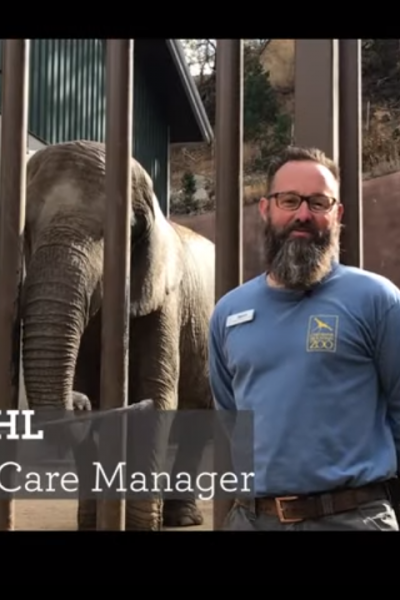
‘Golden Girl’ Malaika, an African elephant who required emergency assistance after not being able to stand up on her own earlier this year, continues to receive specialized care for her broken tusks, thinning foot pad, deformed back leg and other age-related issues.

Elephant Animal Care Manager, Jason Bredahl, gets us up close and describes the specialized care Malaika receives in CMZoo’s state-of-the-art barn, designed to provide veterinary care for our aging giants.

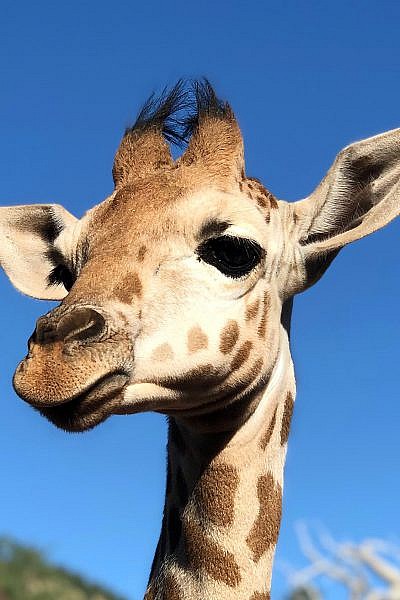
CMZoo year-round sponsor, Children’s Hospital Colorado, has created a guide to first-year doctor visits for human babies. Similarly, Cheyenne Mountain Zoo’s experience with our prolific giraffe breeding program, founded in 1954, gives us some great milestones for the first year of life for a giraffe calf. Let’s see how Viv, CMZoo’s giraffe calf born to Msitu in July 2019, compares to the average timelines.

The first day of a giraffe calf’s birth is full of important milestones. Within the first couple of hours after birth, the calf is expected to stand. It usually takes several very wobbly attempts before the calf is stable on those long legs. When calves are born, they drop about five feet from the birth canal to the floor. In human care, a birth stall usually has several inches of sand, hay or shavings on the ground to help cushion that fall. Once the calf has landed, it usually needs to ‘untangle’ its long legs and neck, and then can attempt to stand.

“Viv’s legs were wrapped up sort of like a pretzel when she landed, so it took her a few minutes to get them where they needed to be,” said Jason Bredahl, giraffe animal care manager. “Once she got those straightened out, she was the fastest calf we’ve ever seen take its first steps. She was up and walking within about 35 minutes of being born, and she really hasn’t slowed down since.”

Within the first three hours after birth, the calf is expected to nurse from its mother. It’s important for the calf to nurse within this window, because it ensures the newborn calf consumes the colostrum that contains important antibodies from its mother.

“Viv was on the slower side when it came to getting her first milk,” said Bredahl. “But, Msitu is a great mom, and she and Viv quickly bonded. Once they did, we saw her nursing a lot that first night and throughout the next few months.”

Normally, giraffe calves nurse for about four months without eating any solid foods, like leaves or grain. The average weaning period is anywhere from six months to a year. The baby usually starts investigating solid foods between two and three months of age.

Viv had other plans.

“We started noticing Viv nibbling on browse and being curious about crackers at about a month old,” said Bredahl. “She is still nursing, so she’s getting the nutrients she needs from mom, but at this point, her diet contains a lot of browse, alfalfa, grain and romaine lettuce from our guest feeding opportunities.”

Unless it’s medically necessary, CMZoo staff doesn’t intervene with animals’ births, and has found it’s beneficial to the mother/baby relationship to allow them uninterrupted time together to bond. Since Viv showed all the signs of being a strong calf, staff never took exact height or weight measurements.

On average, giraffe calves weigh between 100 and 200 pounds at birth, and measure about six feet tall.

“We guessed that she was about 200 pounds at birth and stood about six feet tall,” said Bredahl. “Since then, she’s growing and growing. As of the end of October, we estimate she’s about seven feet tall and over 300 pounds.”

The next big milestone for giraffe in care at CMZoo is to start training. Most giraffe calves born at CMZoo participate in behaviors, like shifting from one area to another, by following their mothers. This allows keepers to care for them by relying on training their mothers have received.

Not Viv.

“Viv has been a total firecracker from the very beginning, when she leap-frogged over her mom’s back as her mom was lying down only six hours after she was born,” said Bredahl. “She’s one of the most independent giraffe calves we’ve ever experienced, which is fantastic because she’s such a great ambassador for her species. She’s interested in guests, keepers and the rest of the herd. It also means she’s not necessarily interested in doing what her mom is doing. That makes shifting into the barn from the yard, or vice versa, or moving from one part of the barn to another an ‘adventure’ each day.”

Keepers rely on a calf’s interest in solid foods to train. The food is the positive reinforcement keepers need to encourage positive behaviors from an animal.

“In our experience, we usually start working with calves on trained behaviors at about four months,” said Bredahl. “Viv was a lot younger than that.”

Because Viv took interest in browse, alfalfa and other solid foods at such an early age, keepers started training with her at just a month old.

Keepers will continue working with Viv on her training, which is still largely focused on asking her to move from one location to another. Once she has mastered shifting behaviors, Viv will eventually graduate to more complicated training activities. Like her herd mates do now, she will later have the choice to participate in varieties of training that allow her to participate in her own health care.

“Our giraffe train to have their hooves trimmed and cared for, their blood drawn, their eyes examined, and of course they train to shift in and out of different areas of their yards and barn,” said Bredahl. “Khalid, our breeding bull, even trains to participate in giraffe ‘yoga,’ which helps him stretch and stay limber. Our giraffe training programs help us take great care of our herd. It also allows us to share what we learn and participate in research studies that benefit giraffe in human care and in the wild, around the world.”

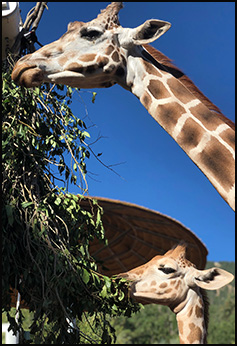
(Try to) keep up with Viv and the 16-member CMZoo giraffe herd every day of the week in African Rift Valley at Cheyenne Mountain Zoo. No matter the weather, giraffe feeding opportunities are available to guests daily from 9 a.m. to 4 p.m., either on the outdoor boardwalk or inside the giraffe barn.
 
Back to The Waterhole


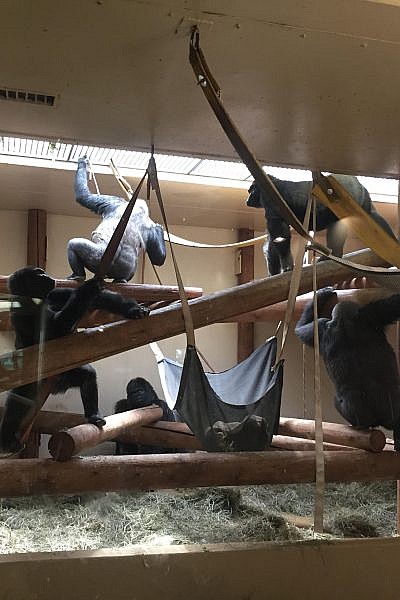
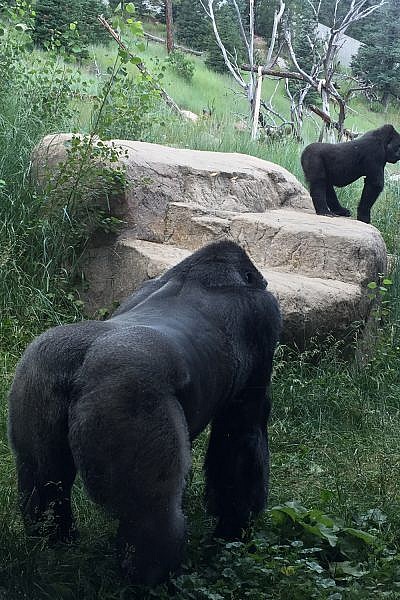
Cheyenne Mountain Zoo’s Western lowland gorilla troop of five has been working to acclimate to a cohesive living situation since Goma, a 28-year-old silverback, joined CMZoo in May 2016. After years of introductions that have taken longer than keepers anticipated, the tentative success of this summer’s introductions was critical in deciding whether to continue making efforts or to reassess if Goma could ever permanently join the troop.

“We had heard of successful introductions taking longer, but we had also accepted that there is a point at which, if Goma hadn’t adjusted to living with females, we would have to make a decision about whether we’d continue trying,” said Joanna Husby, Primate World animal care manager. “Just in the last three months, we have seen such amazing progress. It’s really rewarding to see them getting more comfortable with each other, which was our goal for this summer.”

The troop’s bonding progress was even more evident when they had to face the unexpected absence of Roxie – one of the two females Goma is most comfortable with in the group, along with Asha. The 43-year-old female became lethargic and refused to eat or drink in early October 2019.

“If Roxie feels under the weather, she’ll skip a meal, just like any of us might. But we know Roxie, and we realized her behavior this time was different,” said Husby. “After a couple of days, we knew we needed to take more aggressive steps to care for her.”

CMZoo veterinary team and keepers immobilized Roxie the morning of October 6. At the CMZoo vet clinic, Roxie’s examination included whole body x-rays and ultrasounds. She was given IV fluids and supportive medications that helped address any infection that may have been present. The examinations revealed multiple medical conditions, the most concerning of which was a suspected infection of Roxie’s reproductive tract. Throughout her life, Roxie has dealt with kidney issues and ulcer-like cysts that have caused gastrointestinal and reproductive system complications. The exam also revealed age-related changes such as arthritis.

While she was under anesthesia, Roxie suffered a cardiac arrest and was brought back to life with CPR and emergency drugs. Vet staff kept Roxie at the clinic, where they could respond immediately if necessary, for a few hours. When Roxie was stable, she returned to a private room near the troop to recover.

“Roxie has amazed us all,” said Husby. “She really scared us for a second, but she has recovered incredibly well. Within hours of returning to her den, she ate some grapes and drank some juice, which was a big relief.”

Keepers and vet staff checked on Roxie hourly overnight for the first night. The day following the procedure, Roxie was interested in training with her keepers, but she again refused food and drinks. Over the next few days, thanks to keepers’ creative solutions to hydrate Roxie by offering her different juices and foods that interested her, Roxie was able to rejoin the troop and is doing well.

Gorillas are incredibly intelligent and bonded individuals. Although Roxie’s absence could have been detrimental to the progress of the introductions, they have reunited well and continue to make progress.

“The fact that they were separated for about two weeks, during the scare and her recovery, and then had an uneventful reunion speaks to the resilience of their relationship. The female troop members are showing Goma respect by responding calmly to his presence and by following his lead upon moving to different areas of the exhibit,” said Husby. “Goma is still displaying signs of dominance, which is what we want to see. The ladies need to respect him. He’s also showing signs that he’s more comfortable, like lying down near the females and even taking naps. He’s learning that through his calmer demeanor and approach, he’s earning their trust as a leader.”

Summertime in Colorado is the optimal time to work on delicate gorilla introductions, because warmer weather means the gorillas have access to both indoor and outdoor spaces. They have more space to be together, if they want to be, while still having options to be away from each other.

For now, the troop is spending multiple hours per day together. As the weather cools down, and the gorillas don’t have as much access to their outdoor yards, keepers will work to continue providing a balance of time together and time apart for the troop.

“We’re so proud of the ladies and Goma for how much progress they’ve made this summer, even with the potential setback,” said Husby. “We’re looking for ways to continue that progress without regular use of the outdoor yards. Although the procedure with Roxie was very scary, it showed us that they’ve reached a level of comfort and confidence with each other that we hope will continue through the winter months.”

Keepers and vet staff continue to monitor Roxie’s health. We will provide updates as they are available.
 
Back to The Waterhole


In humans, physical activity not only benefits physical health but mental health as well. At Cheyenne Mountain Zoo, the training and enrichment the animals can choose to participate in are also beneficial.

Research has shown that kids who have moderate physical activity in their day show increased attention, comprehension and learning ability, as our sponsor, Children’s Hospital Colorado explains in this article. The same is true for animals, which is why CMZoo keepers and trainers make daily enrichment and training a priority for the animals in their care, all with positive reinforcement.

“When we provide specific opportunities for animals to be physically active, we often see their overall activity level increase, even outside of the opportunities that we are providing,” said Rick Hester, Cheyenne Mountain Zoo animal behavior programs manager.

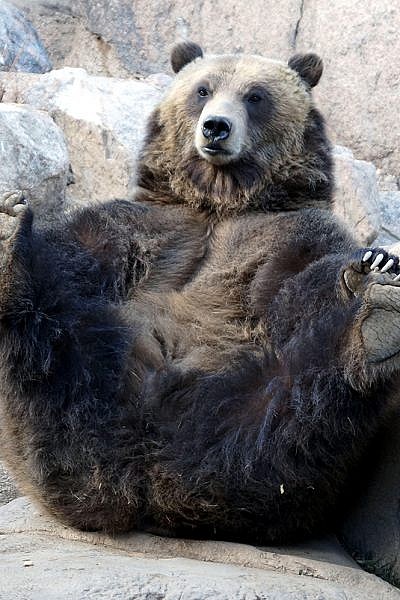
Emmett, CMZoo grizzly bear, consistently did a stretch on his own during interactions with keepers, which bears in the wild sometimes do.

“Emmett would sit down and hold his back legs with his front paws,” said Rebecca Zwicker, Rocky Mountain Wild animal care manager. “We saw him doing it so often that we started to incorporate it into his regular training and demonstrations, so our guests can see those natural behaviors. We call it the ‘yoga bear.’”

Over time, CMZoo grizzly bear, Digger, saw Emmett being rewarded for this behavior, and began imitating it, which his keepers of course rewarded.

Guests can see Emmett and Digger doing “yoga bear,” presenting their teeth for keepers to check and offering different parts of their bodies through a safe barrier, where keepers can perform health assessments and decide whether the bears might need veterinary care.

“Most of us know when our dog is excited to head out on a walk in the park, or is nervous about walking into the vet clinic,” said Hester. “Our animal keepers work hard to build trusting relationships with the animals in their care, so they also pick up on those insights from the animals.”

The African lion pride recently showed their keepers that a new and unusual enrichment activity got their approval, says African Rift Valley Keeper, Diana Miller, who has worked with the lions for six years.

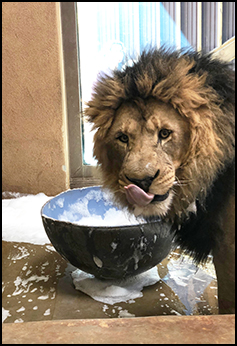
“The lions absolutely love bubble baths, and we didn’t realize that until this year,” Miller said. “It surprised us, because we know they don’t usually like getting in the water. But, because we recognize their behaviors, we realized pretty quickly that it was different when bubbles were involved. They absolutely love it. We know they love it, because they play enthusiastically for a long time whenever when we offer them the bubble bath enrichment, and it’s really fun for guests to see.”

For a full schedule of demonstrations and training sessions, visit www.cmzoo.org/shows.

Back to The Waterhole Home Page

INTRODUCTIONS CONTINUE AS KEEPERS REMAIN FLEXIBLE

Since he arrived in May 2016, Goma, Cheyenne Mountain Zoo’s 28-year-old silverback Western lowland gorilla, has been working to incorporate with the gorilla troop of four females, Juju, Roxie, Asha and Kwisha. With a focus on providing an environment which helps all of the gorillas feel safe and in control, keepers are beginning to see promising interactions.

Goma came to CMZoo on a breeding recommendation with one of the females, but the gorillas need to live as a cohesive group before bringing any offspring into the mix, so the females who are young enough to conceive take oral contraceptives for the time being.

Although introductions have been somewhat unusual and challenging, CMZoo keepers and staff continue to stay flexible and seek new ways to provide an environment that promotes positive interactions between Goma and the female gorillas. Goma, who lived with another male gorilla for about 20 years at his previous home, seems to prefer alone time more than most other male gorillas. Staff are working to set the stage for Goma to discover that life with females could be a desirable situation for him.

“He seems to like his peace and quiet, and doesn’t seem like he’s fully convinced about how these ladies can bring him value,” said Dina Bredahl, senior lead keeper in Primate World, who has worked with the primates for nearly 20 years. “We’re figuring out what’s valuable to him, as an individual. He seems to like it when his behavior and movements influence what the females do and where they go. He likes being dominant and keeping the peace among the ladies. We’re looking for opportunities to help him understand that he can have those things, as an integrated part of this group.”

Allowing Goma to have his solitude while providing opportunities for him to adjust to life as a troop with the females is a delicate balance that requires respectful patience for their process. Keepers follow the gorillas’ lead, by collecting and discussing data on the gorillas’ behavior during introductions and adjusting what they do based on that information so the introductions are as calm and safe as possible, for all involved.

Summertime in Colorado is the best time to work on gorilla introductions, because it allows the gorillas into indoor and outdoor spaces. They have more space to be together if they want to be, while having options to be away from each other.

“We do introductions based on their behavior,” said Bredahl. “If it seems like they’re acting unusual or uncomfortable, we will give the gorillas the option to separate in their respective spaces for the rest of the day and will try again the next day.”

When they’re separated, the four females live together peacefully with Goma nearby next door, where they can still hear, smell and see each other. When they’re together, keepers have found it works well to open the doors to all indoor spaces and the outside exhibit. When the gorillas have had enough time together, they have ways of letting the keepers know.

“We know these gorillas well and can usually tell if they’re feeling confident in a situation,” said Bredahl. “Sometimes Goma will move into his favorite habitat or room and pull the door closed behind him, like he’s saying to us, ‘Okay, I’m done now.’”

If a female feels uncomfortable with Goma’s presence, she will make an alarm call, which the other females respond to by defending the female who called. When keepers see this, they monitor the scenario and, depending on the situation, might encourage the troop to separate. This year the gorillas have resolved their few conflicts on their own, without staff intervening.

The list of space options and troop member combinations keepers have presented to the gorillas during introductions is exhaustive. The goal, for now, is to see the gorillas sharing a space and displaying calm and positive behaviors toward each other.

They’ve tried different combinations of female troop members with Goma, in hopes that he would feel less overwhelmed by the interactions. Barriers are placed a few feet back from the gorilla exhibit during introductions to prevent guests from going up close to their spaces, which could distract them. Keepers have found that gorillas with full stomachs tend to display calmer behavior, so they make sure the troop members have eaten well before they spend time together. They’re careful about which foods are available to them during interactions, so there’s no perceived competition among the gorillas over a favorite food item. They also have ways of letting the gorillas know what is about to happen, so the gorillas are prepared to share space when introductions begin.

This summer, with all troop members present and all of their spaces available, CMZoo staff members have seen some encouraging progress, especially between Asha, a 26-year-old female, and Goma. The two showed more promise of making a connection last year during introductions than any of the other troop members and Goma.

“We’ve been working to build on positive things we’ve seen them doing together,” said Joanna Husby, Primate World animal care manager. “We’ve seen Goma building nests, and sleeping and eating while he’s with the girls, which means he’s relaxed and comfortable around them. He’s learning how to communicate, how to lead fairly and how to accept it when the girls aren’t receptive to him.”

While these introductions are taking longer than keepers initially anticipated, they’re aware of other successful gorilla troop integrations that have taken longer. CMZoo is working with its gorilla breeding recommendation partners to keep them apprised of how things are going.

There is a point at which, if the troop hasn’t accepted Goma, organizations involved will have to make a decision about whether to continue making attempts. For now, keepers will continue providing these opportunities for the gorillas to form a cohesive troop together, and they view the progress of this summer’s introductions as a positive indication for what’s to come.

Back to The Waterhole Home Page

Back to The Waterhole Home Page

PLACENTA FROM PENNY THE GIRAFFE CALF’S BIRTH CONTRIBUTES TO GROUNDBREAKING GIRAFFE VETERINARY CARE AND RESEARCH

Waterhole picture
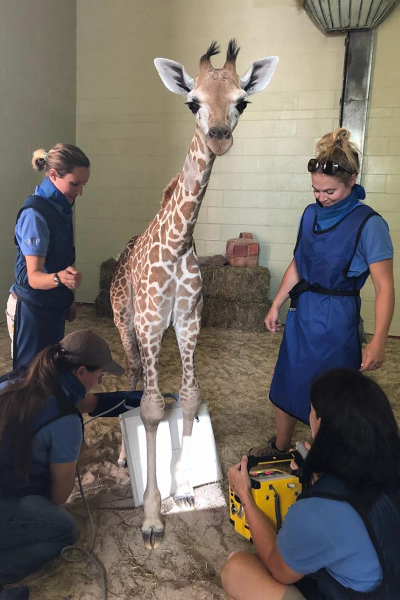
When Penny, a reticulated giraffe calf, was born at Cheyenne Mountain Zoo on June 4, 2018, Dr. Liza Dadone, head veterinarian and VP of mission and programs, couldn’t have known that the next few months of care for the sixteen-member giraffe herd would present such complicated cases. Since Penny’s passing late last summer, her legacy has continued both by helping people around the world fall in love with giraffe and by helping advance giraffe medicine in zoos.

Within months of Penny’s birth, the giraffe care team was managing unprecedented rare cases including a brand-new calf who needed intensive medical care, a chronic ligament strain in a mature male, and a mature female who would eventually reveal a false-positive pregnancy – one of only four such cases of the false diagnostic result ever documented.

Dr. Dadone did, however, know how precious a placenta could be to help improve both therapies and diagnostics for giraffe medicine. Minutes after then-20-year-old Muziki gave birth to Penny, Jason Bredahl, giraffe animal care manager at Cheyenne Mountain Zoo, picked up the placenta and handed it off to Dr. Dadone.

New Diagnostics: A New Giraffe Pregnancy Test

“I had been speaking with Dr. Priya Bapodra-Villaverde at Columbus Zoo and Aquarium about a new, more accurate giraffe-specific pregnancy test she had been working on. Although the test had been used successfully on other hoofstock species, we knew that part of the giraffe placenta could contribute to this research,” said Dr. Dadone. “We split the placenta between Dr. Bapodra-Villaverde’s team and the vet team at Colorado State University, who would use it to develop a line of giraffe stem cells that can be used to help manage arthritis and other conditions.”

In late July 2018, CMZoo had to say a heartbreaking goodbye to Penny, whose story had captured the hearts of people around the world. As CMZoo put Penny to rest, her legacy continued with her placenta’s research contributing to creating a new, more accurate giraffe pregnancy test, and to creating a giraffe stem cell line.

Laikipia was the first giraffe in our herd to be tested with the new pregnancy test. Laikipia was thought to be pregnant at the same time Muzuki was pregnant with Penny, but the fact that she never gave birth puzzled giraffe experts at CMZoo and beyond. Throughout the international network of AZA-accredited organizations with whom CMZoo shares and gains input on rare cases, like hers, she was one of only four giraffe ever known to consistently falsely test positive for pregnancy.

Ever since breeding with CMZoo giraffe bull, Khalid, Laikipia had tested positive for pregnancy – but did not test positive before breeding. The CMZoo giraffe care team used the usually reliable methods of confirming pregnancy in a giraffe, including a lack of menses and elevated progesterone levels in blood and fecal samples. They even attempted logistically challenging ultrasounds, which proved inconclusive, as they often do in giraffe.

By October 2018, Laikipia had surpassed her gestation window without signs of miscarriage and with consistently elevated progesterone levels, and Dr. Dadone and her team continued to look for ways to diagnose Laikipia’s condition.

The timing was almost perfect. The new pregnancy test, developed by Columbus Zoo’s lab partner BioTracking, Inc. was ready for real-world trials in spring 2019, after being used to successfully detect pregnancy in two giraffe at the Columbus Zoo. Knowing there was no way Laikipia was still pregnant, despite her continued positive pregnancy test results, Dr. Dadone knew Laikipia was the perfect candidate to test the accuracy of the new test.

“We thought, ‘if any giraffe could break this new test, it’d be Laikipia,’” said Dr. Dadone. “We also knew Msitu was pregnant, so we tested her pregnancy to validate the accuracy of this new diagnostic.”

The new blood test, which detects a protein only present in pregnant giraffe, called Pregnancy-Specific Protein B (PSPB), could also help confirm pregnancy sooner than traditional progesterone-detecting pregnancy tests. Even more helpful for veterinary staff and animal care managers everywhere, early results suggest it could more precisely predict when a calf might be born.

“On the anniversary of Penny’s birth, we got the news that the new pregnancy test, developed in part thanks to Penny’s contribution, appears to be a great new diagnostic tool for giraffe,” said Dr. Dadone. “Laikipia’s pregnancy test came back negative and Msitu’s came back positive. While the lab is still running samples from more pregnant giraffe, this is hugely promising. We have Penny and her mom, Muziki, to thank for helping us detect and confirm this new test can work in giraffe.”

Dr. Dadone and Columbus Zoo and Aquarium will continue collaborating on ways to better diagnose and monitor giraffe pregnancy. The new pregnancy test, once fully validated, should help the zoo community more accurately predict when their giraffe are pregnant and due to give birth.

At this stage, the vet team believes Laikipia has a hormone-secreting cyst, which isn’t life-threatening and doesn’t appear to be causing her any pain or discomfort, but can cause long-term elevations in progesterone. The team now plans to start her on hormone therapy to try to help her return to normal cycling. This is a therapy used in cattle and sometime other hoofstock, but has not been previously reported for giraffe.

New Treatments in Giraffe Medicine: Stem Cell Therapy

The second half of Penny’s placenta was sent to Colorado State University, to grow a new line of stem cells used for therapeutic purposes in giraffe.

The Zoo previously used stem cell treatments grown from blood collected from a giraffe in our herd, that already trained to donate blood. However, there was some indication that stem cell lines developed from placentas could provide even greater therapeutic benefits for giraffe with chronic issues like arthritis.
Waterhole picture
Penny’s stem cell line was used on two patients, the first of which was herself. Some of the cells were used to try to help Penny recover from a splay injury and infection. While that ultimately wasn’t enough to turn around her case, a second giraffe was also treated with stem cells grown from her placenta. At Blank Park Zoo in Des Moines, Iowa, a 21-year-old giraffe named Zuri was treated with cells to help manage her advanced age-related conditions. Following this treatment, Zuri’s coat grew in thicker and she had some clinical improvement. While Zuri passed away in May 2019, both of these cases are helping the zoo community learn more about clinical applications and potential benefits of stem cell therapy in zoo giraffe.

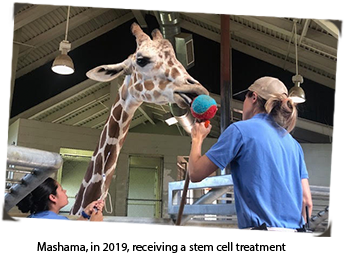
Stem cell therapy is now being used for 9-year-old CMZoo giraffe Mashama.

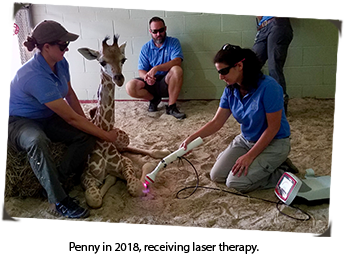
“Mashama has been dealing with sprained ligaments and a fracture in his right foot,” said Dr. Dadone. “Combine those issues with a ligament strain in his right front wrist [that looks like the right front knee], which preceded the fracture, and we have a pretty complex case to solve. We have tried therapeutic shoes, laser therapy, rest, and more. The next logical step is a cell stem treatment.”

While Penny’s placental stem cells have all been used with those first two cases, in July, Mashama was treated with a stem cell line grown at CSU. CMZoo is watching him closely and is hopeful the stem cell therapy can help him continue to heal, and help the zoo community learn more about applying novel therapies like stem cells to better manage health issues in giraffe.

The placenta from the calf born at CMZoo on July 6, 2019, will also be used to contribute to scientific advancements to make a stem cell line, like Penny’s did. Dr. Dadone and CMZoo staff will continue contributing to research and studies that will benefit the health of giraffe in human care, and in the wild.
 
 
Back to The Waterhole Home Page

– CHILDREN’S HOSPITAL COLORADO PRESENTS OPEN-TO-THE-PUBLIC BIRTHDAY PARTY, SUNDAY JUNE 30 AT 10 A.M. –

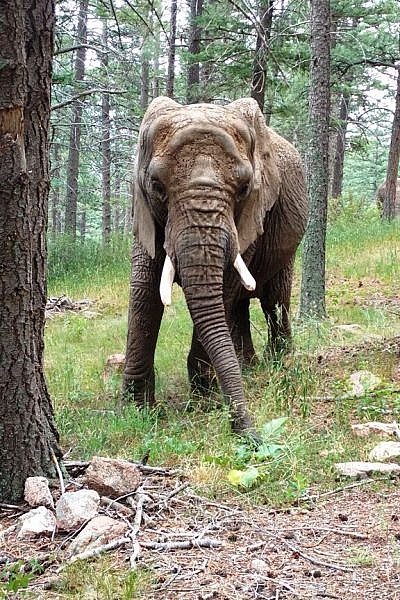
Turning fifty years old is a big deal for anyone. When an elephant turns fifty, it’s an enormous occasion. Missy, one of Cheyenne Mountain Zoo’s female African elephants, is half a century old this year, and Children’s Hospital Colorado is partnering with CMZoo to make it a momentous celebration fit for a true golden girl. Staff from Children’s Hospital Colorado will have a booth at the event, and encourage guests to stop by to say hello and enjoy some party favors.

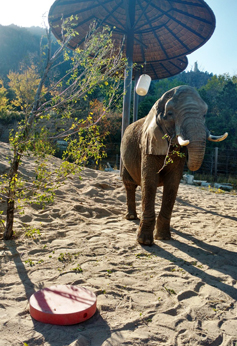
Missy, who moved to CMZoo from Lee Richardson Zoo in 2015, is one of the oldest African elephants in the country. But, according to Senior Lead Elephant Keeper, Ilana Cobban, that doesn’t slow her down.

“She’s always the first one out of the barn and into the main yard every morning,” Cobban said. “Missy’s personality is, in my opinion, like one of “The Golden Girls” characters. She does what she wants, when she wants and isn’t afraid to demand what she needs or wants.”

Cobban says that during training, Missy will sometimes misread her trainer’s request and will launch into a training routine because she’s so eager to participate.

“If she sees you move her ‘target stick,’ which we use for training, she might think it’s time to do yoga and will start offering those behaviors right away,” Cobban said. “It usually happens in the demo yard, and guests think it’s hilarious. Once we can get Missy’s attention to convey the behavior we’re actually asking her to do, she looks at you like she’s thinking, ‘Why would I not do my yoga routine right now?’”

Although blind in her left eye, Missy is in remarkably good health for her age, Cobban said.

“She’s old, but she’s in such good health,” said Cobban. “We have to train a little differently with her when we’re on her left side, but it really doesn’t impact her. She’s smart, and she’s fast. Don’t get in her way.”
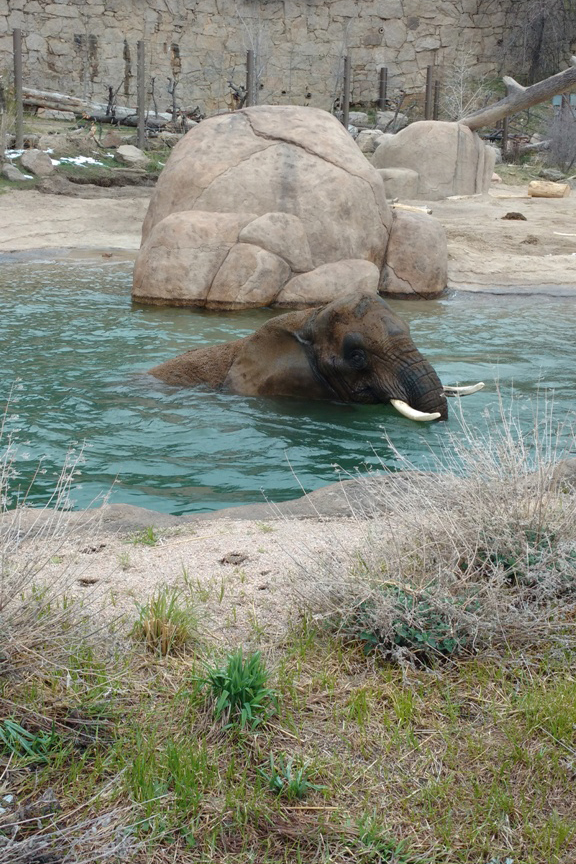
Missy the African elephant swimming in pool
When keepers call Missy’s name to shift to another part of the elephant exhibit, she doesn’t waste a moment. She does her signature ‘power walk’ on the most direct route to where she’s going – no matter what (or who) is in the way.

While younger members of the CMZoo African elephant herd may take 45 minutes to walk the quarter-mile elephant trek at the Zoo, Missy often finishes in ten minutes. While she’s patient, she seems to enjoy quickly embracing what’s next.

“Usually, during elephant feedings, we ask the elephant to ‘rest’ between each piece of produce a guest is feeding them,” said Cobban. “When they ‘rest,’ they relax their trunks on the ground. With Missy, we just stopped asking her because she never wanted to rest. She would gently take the item from the guest’s hand with her trunk, pop it in her mouth, and immediately reach her trunk out for the next piece. She doesn’t get impatient waiting for the next piece; she just doesn’t want to rest.”

Guests will have the chance to see Missy in action at her 50th birthday party, presented by Children’s Hospital Colorado, on Sunday, June 30, 2019 at Cheyenne Mountain Zoo.

The party starts at 10 a.m. in Encounter Africa and ends at noon. Guests can enjoy watching Missy and her best friend, LouLou, participating in some special birthday enrichment activities, then have the chance to feed Missy at 11 a.m. and see Missy dive into an elephant-sized birthday cake, made with her favorite snacks, at 11:30 a.m.

SCHEDULE OF EVENTS
(Subject to Missy’s choice to participate or not)

10 a.m. to 12 p.m.
Write a “Message to Missy,” take a free photo with elephant-themed props at our photo booth, and learn about African elephants from our CMZoo Docents with elephant biofacts.

10:10 a.m.
Missy and her best friend, LouLou, have the opportunity to enjoy special birthday enrichment activities in the main elephant yard.

10:45 a.m.
Keepers Caring for Elephants Demonstration

11 to 11:30 a.m.
Elephant Feeding Opportunities with Missy ($10 to $15 per feeding)

11:30 a.m. to 12 p.m.
Join us in singing ‘Happy Birthday’ to Missy, as she enjoys an elephant-sized birthday cake, made with her favorite snacks.

For more information about Missy’s 50th Birthday Party, visit our Facebook Event Page

Missy is the eldest of the six female African elephants who live at CMZoo. She’s often in the yard with LouLou, who is 37 and came to CMZoo from Lee Richardson Zoo with Missy. Kimba, 41, is the largest of the group, weighing in at just over 8,500 pounds. Lucky, 39, sometimes shares space with Kimba. She is playful and can often be seen splashing around in the water in their main yard. Jambo, 36, and Malaika, 33, are known as the sassiest and prefer to spend solo time in one of their many spaces at the Zoo. Guests can visit the African elephant herd any day of the year, in Encounter Africa at Cheyenne Mountain Zoo.