For nearly 100 years, Cheyenne Mountain Zoo has actively worked to connect guests of all ages to wildlife and wild places. Starting next year, CMZoo’s EdVenture team will take people into the wild to experience wildlife in a whole new way.
Experiences like feeding giraffes at the Zoo, getting to observe animal demonstrations and training sessions with keepers, and off-site ZOOMobile programs help people learn about the existence and importance of the animals that we share this planet with, and feel inspired to help conserve their wild counterparts.
Now, the EdVenture team at CMZoo is offering a new opportunity for guests to connect with wildlife and wild places, by taking them into the natural environments, with a brand-new program that launches in April 2026! Edventure Excursions will provide a fun and educational journey to local wildlife projects that they might not be aware are happening right here.
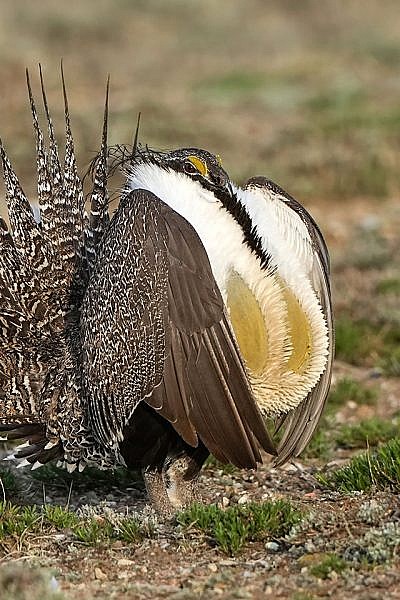
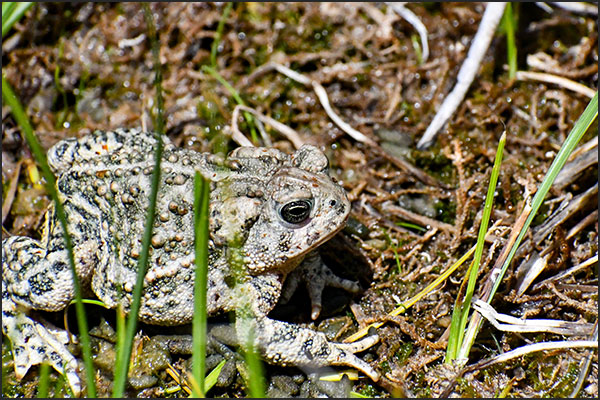
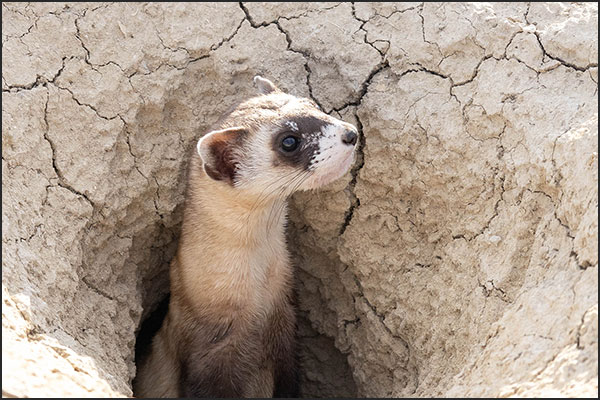
The program’s inaugural adventure into the wild is a 5-day expedition to northern Colorado and southern Wyoming to learn about the importance of prairie ecosystems and the animals that call them home. Guided by CMZoo staff, the group will explore the wild habitats of critically endangered animals, like black-footed ferrets, Wyoming toads and sage grouse.
Each reservation supports funding to provide free classroom programming for schools in the Front Range region. The EdVenture team receives dozens of requests every year to bring Zoo animals to schools, and this program will help fund even more of those opportunities.
Sign up for the first-ever EdVenture Excursion, Sage Grouse Annual Display, at cmzoo.org/excursions.
Sage Grouse Annual Display Trip Details Dates: April 20 – 24, 2026 Group size: 8 Cost: $1,250 per person / $2,100 per pair (shared bed)** Transportation: provided; leave from Cheyenne Mountain Zoo Not included in cost: meals
Accommodations:
● 2 nights at a bed-and-breakfast in Laramie, Wyoming (multi-bedroom house shared with other program participants)
● 1 night at hotel in Walden, Colorado (separate rooms)
● 1 night at hotel in Fort Collins, Colorado (separate rooms)
QUARTERS FOR CONSERVATION PROGRAM HELPS MEMBERS AND GUESTS CONTRIBUTE DIRECTLY TO FRONTLINE CONSERVATION ORGANIZATIONS WORLDWIDE – Cheyenne Mountain Zoo and its members and guests are celebrating a huge milestone, having raised $6 million for wildlife and wild places, since the Zoo’s Quarters for Conservation (Q4C) program launched in 2008.
Every visitor to the Zoo receives three ‘quarter’ tokens representing the 75¢ Q4C allocation from their admission fee. They can then show support for the legacy projects they love by placing their tokens in the corresponding slots in the Q4C kiosks near admissions.
Before launching Q4C in 2008, CMZoo was supporting conservation, but at a fraction of what is possible now. As more people visit the Zoo each year, the Zoo can contribute more money to conservation. In the past few years, CMZoo has collected approximately one million dollars every 20 months through Q4C. The Zoo’s membership, special events, admissions and EdVenture programs also contribute to conservation. CMZoo’s current Q4C beneficiary species include giraffe, Panama frogs, orangutans, black-footed ferrets, African elephants and black rhinos, Wyoming toads and Amur tigers.
About Our Current Q4C Legacy Projects
Q4C beneficiary species truly run the gamut, from 18-foot-tall giraffe in Africa to tiny toads in Wyoming.
Q4C supports Giraffe Conservation Foundation and their efforts to study, protect and grow wild giraffe populations. While CMZoo staff help raise awareness of giraffes’ silent extinction by inspiring guests at the Zoo, Q4C funds on-the-ground giraffe conservation efforts. CMZoo and the Kratt Family Fund (KFF) support efforts such as giraffe translocations to safer habitats, population monitoring and surveying, removal of illegal snare wires and veterinary treatment for giraffe and other wildlife injured by snares. They also provide veterinary support with vehicles and supplies. In addition, CMZoo’s contributions fund critical medications to treat injured animals, giving them a second chance at life.
Q4C also funds CMZoo’s on-site breeding programs for black-footed ferrets and Wyoming toads. These endangered prairie species were declared extinct in the wild in the 1980s and early 1990s, and are only around today because of decades of recovery efforts from U.S. Fish & Wildlife Service, zoos and partner organizations.
Wyoming toads are like so many amphibian species in decline all over the world, including Panamanian frogs, which also receive support thanks to Q4C funds and CMZoo staff support in the field. CMZoo staff members assist the Panama Amphibian Rescue and Conservation Project by sharing ideas and information from Wyoming toad breed-and-release efforts, and travel to Panama to help research strategies to reintroduce these endangered amphibians into their natural habitats.
CMZoo’s work to save habitats for orangutans through advocacy for sustainable palm oil production is also largely supported by Q4C. Thanks to that financial support, CMZoo’s sustainable palm oil team consults staff at other conservation organizations on starting their own palm oil programs. The CMZoo sustainable palm oil team continues to focus on international work through the World Association of Zoos and Aquariums (WAZA). The team was instrumental in the creation of WAZA’s PalmOil Scan – a global free sustainable palm oil shopping smartphone app, which allows shoppers to scan the barcodes of items to learn whether producers have committed to using sustainable palm oil – and to choose to support companies that have committed to sourcing sustainable palm oil.
Through Q4C, CMZoo also supports Tsavo Trust – a conservation organization in Kenya that works to protect the last of the big tuskers, which are African elephants with tusks weighing more than 100 pounds, and Eastern black rhinos. CMZoo’s funds helped Tsavo Trust build out their headquarters and provide a clean water source for the local community, who are partners in conservation efforts. It also paid for vital infrastructure for aerial and ground vehicles that rangers use for surveillance that protects rhinos and elephants from illegal hunting, in addition to collecting data on how these endangered giants utilize the habitat.
The seventh Q4C legacy partner is Wildlife Conservation Society, whose dedicated staff work to protect and define secure habitats for wild Amur tigers in Eastern Russia. Amur tigers, previously known as Siberian tigers, are critically endangered. Their numbers in the wild continue to be treacherously low at around 500. CMZoo supports efforts to prevent human-wildlife conflicts as well as anti-poaching efforts and funding for field conservationists to study this species in the wild.
For more information about these projects and Quarters for Conservation, visit cmzoo.org/conservation.
About Cheyenne Mountain Zoo
Cheyenne Mountain Zoological Society was founded in 1926. Today, Cheyenne Mountain Zoo, America’s mountain Zoo, offers comprehensive education programs, exciting conservation efforts and truly fantastic animal experiences. In 2025, Cheyenne Mountain Zoo was voted #2 Best Zoo in North America and CMZoo’s Rocky Mountain Wild was named #2 Best Zoo Exhibit in North America by USA TODAY 10Best Readers’ Choice Awards. It is Cheyenne Mountain Zoo’s goal to help guests fall in love with animals and nature, and take action to protect them. Of the 237 zoos and aquariums accredited by the Association of Zoos and Aquariums (AZA), Cheyenne Mountain Zoo is one of just a few operating without tax support. Cheyenne Mountain Zoo depends on admissions, membership dues, special event attendance and donations for to fund animal care, conservation, Zoo operations and improvements.
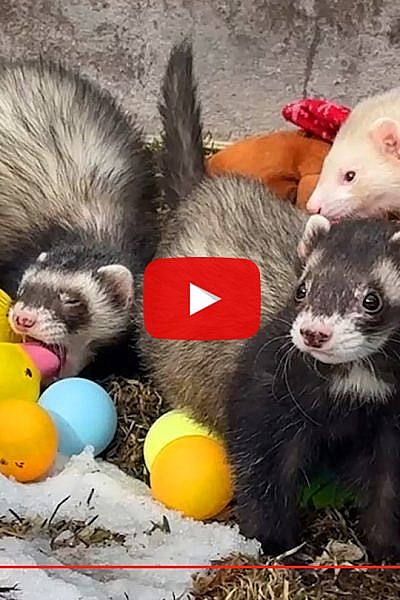
A group of ferrets is called a business! Our business is made up of Alfred, Tsunami, Cyclone, Avalanche and Blizzard! These playful, social animals thrive in small groups. A mix of ages helps the group maintain strong bonds as it evolves. Alfred, at 6, and Tsunami, almost 5, are the oldest, while Cyclone, Blizzard, and Avalanche are 3-year-old females. Though there’s no real hierarchy, Cyclone and Avalanche often lead playtime. Unlike their solitary black-footed ferret cousins, domestic ferrets have been bred for social traits, making them more interactive with humans and each other. Stop by The Loft at CMZoo to see them playing, snuggling and training together!
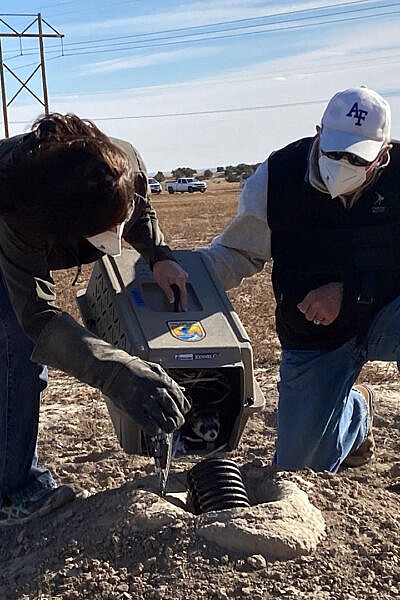
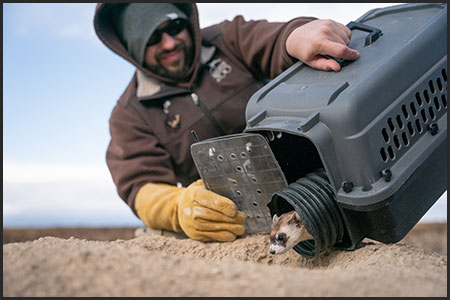
This fall, volunteers and conservation experts gathered near Las Animas, Colorado, to release 33 endangered black-footed ferrets (BFFs) into the wild, including some that were born at CMZoo!
2024 was a record-breaking breeding year for CMZoo’s BFF conservation program, with 37 kits born! It was also a pioneering year. CMZoo’s conservationists tested multi-partner breeding to see if females could conceive and whelp kits from different dads in the same litter. Out of seven females in the trial, two had litters with two fathers represented. Read more
BFFs were considered extinct until the 1980s. On Sept. 26, 1981, a ranch dog named Shep caught a BFF. Shep’s catch led to the discovery of a small population of the elusive animals in Meeteetse, Wyoming. That population became the hope for the recovery of the entire species.
Since then, zoos, U.S. Fish and Wildlife, National Black-footed Ferret Conservation Center and other organizations have banded together to breed, prepare, release and monitor BFFs to increase the population. CMZoo joined the fight to save ferrets in 1991, when its BFF breed-and-release program began. In the last 33 years, 647 kits have been born on Cheyenne Mountain. The Zoo is a major contributor to recovery efforts, releasing BFFs to protected wild places in Colorado every year.
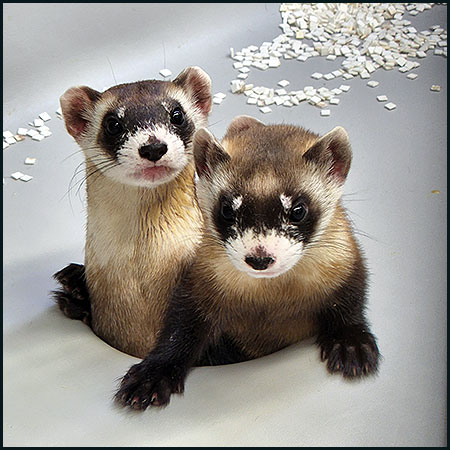
This summer, the black-footed ferret (BFF) breeding program at Cheyenne Mountain Zoo saw a record number of kits born: 37. Conservationists tested multi-partner breeding to see if females could conceive and whelp kits from different dads in the same litter, and to see if having multiple breeding partners impacted the number of kits born overall.
Out of seven females in the trial, two had litters with two fathers represented. Of the twelve breeding females in the CMZoo program, eight had babies this year.
“That’s a really high rate of reproduction, and we saw a higher rate of successful birth with the females that participated in the multi-male study, compared to those that didn’t,” says Jeff Baughman, Wyoming Toad and Black-Footed Ferret Program Manager at CMZoo. “We’re not getting ahead of ourselves, but the results are promising because there’s potential to increase the genetic diversity and sheer number of kits one female could contribute to the recovery population.”
BFFs have incredibly few breeding opportunities. Females are only typically reproductive from 1 to 4 years old, and they only breed once per year – during a 72-hour window. In human care in the past, females spent all three breeding days with the same male. In this trial, they spent the first 24 hours with one male, the second day with another, and the final 24 hours with a third male.
Because female BFFs are induced ovulators, the act of breeding with the first male could trigger ovulation that could possibly make the second and third males’ breeding more successful. However, some females successfully bred and conceived with their first partners, according to the genetic testing.
“It’s always good to replicate a study to see if you can recreate the same results,” Jeff says. “We’d want to use the same trial methods with different breeding females, and we’d want to compare several seasons’ results before we made any official recommendation for or against multi-partner breeding. For now, this is exciting because it’s the first time we can prove that female black-footed ferrets in human care can successfully conceive and whelp kits with different fathers in the same litter.”
BFFs were considered extinct until the 1980s. On Sept. 26, 1981, a ranch dog named Shep caught a BFF. Shep’s catch led to the discovery of a small population of the elusive animals in Meeteetse, Wyoming. That population became the hope for the recovery of the entire species.
Since then, zoos, U.S. Fish and Wildlife, National Black-footed Ferret Conservation Center and other organizations have banded together to breed, prepare, release and monitor BFFs to increase the population. CMZoo joined the fight to save ferrets in 1991, when its BFF breed-and-release program began. In the last 33 years, 647 kits have been born on Cheyenne Mountain. The Zoo is a major contributor to recovery efforts, releasing BFFs to protected wild places in Colorado every year.
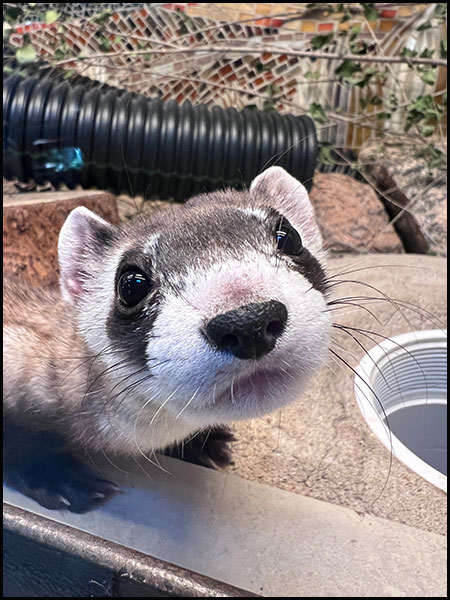
Black-footed ferret, Samosa
Some of the kits with the most underrepresented genes in the breeding population will stay in human care, as part of the breeding program, so they can pass on their underrepresented genes to another generation. Others go to boot camp, to see if they have the skills to thrive the wild. In mid-September, all surviving CMZoo kits and four adults (two of which are mothers, going to ‘boot camp’ with their kits) will start their 35-day pre-conditioning journey in a semi-wild environment at the National Black-footed Ferret Conservation Center in Fort Collins, Colo.
Of those, some are released and some – who do not prove they can hunt, seek shelter and protect themselves in the wild – return to human care, to serve their species in breeding programs or as ambassadors in zoos and other educational settings.
Samosa is the newest black-footed ferret ambassador in The Loft, where guests have a rare opportunity to see this native and critically endangered species up-close at our Zoo.
“Samosa is a great representative of the species,” Jeff says. “She’s energetic and bold, but unfortunately dental issues prevent her from hunting successfully in the wild. As she’s past breeding age, she won’t participate in the breed-and-release program, so we’ll take care of her in The Loft for her remaining natural years.”
Sept. 26, the date Shep discovered the foundational BFF population in Wyoming, was later named Black-Footed Ferret Rediscovery Day – a day BFF advocates celebrate annually. At CMZoo, guests can meet Samosa in The Loft and participate in a variety of activities from 10 a.m. to 4 p.m. on Sat., Sept. 28 and Sun., Sept. 29, 2024.
Black-Footed Ferret Rediscovery Day details:
Sat., Sept. 28 and Sun., Sept. 29, 2024
10 a.m. to 4 p.m.
Stations will be set up in Scutes Family Gallery, in My Big Backyard near the Tree House and outside The Loft. Activities will include:
Coloring stations – make a black-footed ferret mask and color a prairie scene
Prairie Jenga – learn how the prairie ecosystems depends on all its residents to thrive
Matching game – match cards representing different elements of the prairie
Board game – learn about the black-footed ferret life cycle
Scavenger hunt – locate prairie species
Keeper talk – enjoy a black-footed ferret keeper talk at 11:30 a.m. in The Loft
Advance daytime admission tickets are required, and all BFF Rediscovery Day activities are included with admission. CMZoo memberships and admission directly support black-footed ferrets through the Zoo’s Quarters for Conservation program, which, since 2008, has raised $5 million for frontline conservation efforts, including breeding and releasing BFFs.
This summer, CMZoo welcomed the most black-footed ferret (BFF) kits born in a single season: 37. It could have been luck. It could have been the crisp mountain air and a snowy winter. Or, it could have been the multiple-partner breeding trial.
“We’re trying to replicate opportunities observed in nature, when female black-footed ferrets mate with multiple mates within the same breeding window,” Jeff Baughman, field conservation coordinator at CMZoo, says. Jeff has been part of CMZoo’s black-footed ferret and Wyoming toad breed-and-release programs for more than 20 years. “Mixed paternity litters are not unheard of in various species in the wild. But, this is the first time we have tried it at CMZoo. We want to learn if it’s possible for black-footed ferret mothers to whelp kits by different fathers in the same litter.”
BFFs are induced ovulators, meaning the act of breeding triggers ovulation which lasts around 72 hours. In the past, a female has been paired with a suitable male for the full 72 hours. In this trial, a female is paired with a male for the first 24 hours, then a different male for the next 24 hours, and a third male for the last 24 hours.
BFFs have incredibly few breeding opportunities. Females are only typically reproductive from 1 to 4 years old, and they only breed once per year – in that 72-hour window.
The team hopes to run paternity tests on the kits by mid-August, because their genetics play a role in deciding which kits go to boot camp for potential eventual wild release. It’s not just for all of the potential Maury Povich ‘you are the father!’ puns, which will be admittedly hard to resist. If this trial shows that females can have mixed paternity litters, this method could be a new tool for increased diversity in critically endangered species over time.
Conservation is a commitment, a collaboration and a healthy compromise. There are many partners involved in the efforts to help BFFs recover in the wild. Led by the Association of Zoos and Aquariums (AZA) Black-Footed Ferret SAFE (Saving Animals From Extinction) and U.S. Fish & Wildlife Service (USFWS), Cheyenne Mountain Zoo is one of only five zoos in the world supporting black-footed ferret recovery. Partners at Toronto Zoo, Louisville Zoo, Phoenix Zoo and Smithsonian Conservation and Biology Institute along with the USFWS National Black Footed Ferret Breeding and Conservation Center just outside of Fort Collins, Colo., are actively involved in breeding, genetic tracking, releasing and advocating for the little weasels.
“We’re all passionate about it and when we agree, as a collective, to change methods or try new things, it’s definitely a process,” says Jeff. “Some people wonder why we invest so much energy to saving this species. They’re not only cute; they’re vital in helping secure healthy prairie ecosystems, right here in Colorado and across North American prairies.”
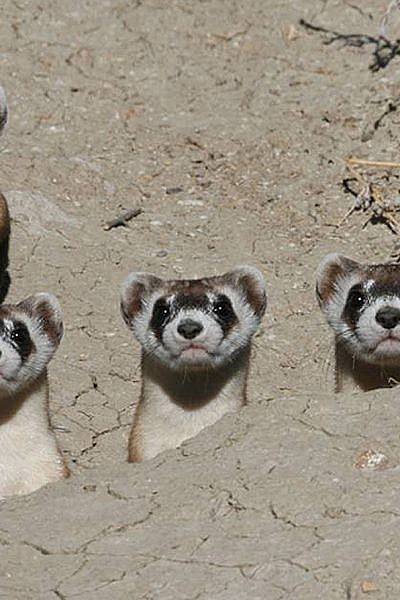
BFFs are predatory prey, so their environmental role is to help control prairie dog populations while occasionally being a food source to owls, coyotes and badgers. Designated BFF reintroduction sites are managed for fleas that can transmit plague, which supports healthy prairie dog populations. This safeguards all of the other prairie species that rely on prairie dogs (a keystone species) as well. Black-footed ferrets are rare and important because they serve the ecosystem up and down.
Native to prairies stretching from Mexico to Canada, BFFs were thought to be extinct until the 1980s. During Western frontier explorations in the early 1900s, cargo ships from Europe and Asia inadvertently brought sylvatic plague to North America. The spread of the plague bacteria by fleas among prairie dogs (and other animals), combined with poisoning and eradication programs led by newly settled farmers and ranchers who saw prairie dogs as pests, drastically reduced the prairie dog population. Because prairie dogs are their main food source, BFF populations declined dramatically along with them.
On Sept. 26, 1981, a ranch dog named Shep caught a BFF. Shep’s catch led to the discovery of a small population of the elusive animals in Meeteetse, Wyoming. Since then, zoos, U.S. Fish and Wildlife, National Black-footed Ferret Conservation Center and other organizations have banded together to breed, prepare, release and monitor BFFs to increase the population.
Since 1991, when CMZoo’s BFF breed-and-release program began, 647 kits have been born on the mountain. Some of the most genetically diverse kits stay in human care, as part of the breeding program, so they can pass on their underrepresented genes to another generation. Others go to boot camp, to see if they can cut it in the wild. Of those, some are released and some – who do not prove they can hunt, seek shelter and protect themselves in the wild – return to serve their species as ambassadors in zoos and other educational settings. Numbers fluctuate, but recent reports estimate 350 BFFs are thriving in the wild, thanks to this program.
“It’s exciting to have been involved with this program for so long, and now to be able to do preliminary trials that could teach us how we can best support black-footed ferret wild recovery,” Jeff says. “Who knows? When the paternity results come back, we could find out it was just a really good breeding year, and there weren’t any mixed paternity litters. That’s part of the excitement of a trial. What’s next remains to be seen, and we will stay inspired to continue helping restore this species to our wild prairielands.”
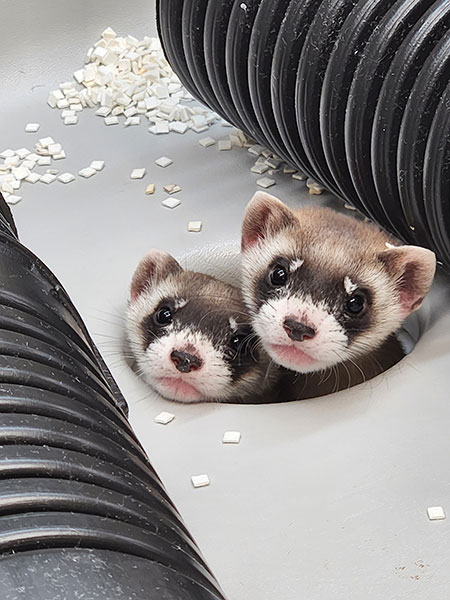
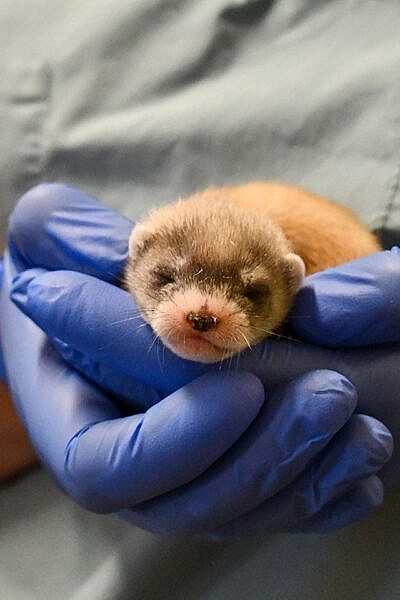
It was a big year to celebrate for black-footed ferret (BFF) conservation enthusiasts. Including Cheyenne Mountain Zoo’s kits, 417 BFF kits were born into the program. That’s the most kits born in a single year program-wide in a decade!
Led by the Association of Zoos and Aquariums Black-Footed Ferret SAFE (Saving Animals From Extinction) and U.S. Fish & Wildlife Service, breed-and-release programs at Cheyenne Mountain Zoo, Smithsonian National Zoo and Conservation Biology Institute, Phoenix Zoo, Toronto Zoo, Louisville Zoo and National Black-Footed Ferret Conservation Center work together to save the species. CMZoo contributed 21 kits this year and released 12 kits and 2 beyond-breeding-age adults into wild conservation habitats in Colorado.
Once the kits are old enough to live independently – around 3 months old – they are transported from the conservation center at CMZoo to BFF ‘boot camp,’ in Fort Collins, where they spend time in a pre-release pen that simulates the opportunities and challenges they’ll encounter in the wild. When they prove they can hunt, find shelter and survive in the pre-release pen, they are cleared for wild release. Ferrets that don’t graduate from boot camp are brought back to support breeding efforts or serve as ambassadors for their species, if they’re too old to reproduce.
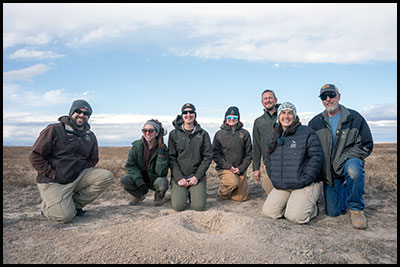
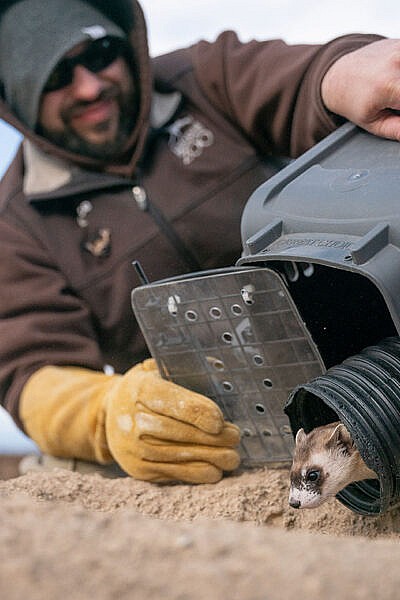
In November, CMZoo staff and board members traveled to protected prairie lands in Pueblo, Colo., to see the ferrets run free into their new home.
“We invite staff from all departments to participate in releases, and we especially aim to bring staff from The Loft and EdVenture department, who can share their inspiration when guests asks about Rouge – a BFF that lives in The Loft,” said Jeff Baughman, field conservation coordinator at CMZoo. Baughman manages the BFF breeding program at CMZoo and has attended annual releases for nearly 20 years. ”The experience is rewarding, and it inspires us to inspire others to care for wildlife and wild places, and continue our work contributing to conservation efforts.”
Native to prairies stretching from Mexico to Canada, BFFs were thought to be extinct in the 1980s. During Western frontier explorations in the early 1900s, cargo ships from Europe and Asia inadvertently brought sylvatic plague to North America. The spread of the plague bacteria by fleas among prairie dogs (and other animals), combined with poisoning and eradication programs led by newly settled farmers and ranchers who saw prairie dogs as pests, drastically reduced the prairie dog population. Because prairie dogs are their main food source, BFF populations declined dramatically along with them.
On Sept. 26, 1981, a ranch dog named Shep caught a BFF. Shep’s catch led to the discovery of a small population of the elusive animals in Meeteetse, Wyoming. Since then, zoos, U.S. Fish and Wildlife, National Black-footed Ferret Conservation Center and other organizations have banded together to breed, prepare, release and monitor BFFs to increase the population.
Because they or their offspring could be released to the wild, every effort is made to keep the BFFs born and raised at CMZoo as wild as possible. So, they are not visible to CMZoo guests. Guests can visit Rouge, a former breeding male that now lives in The Loft.
Prior to the CMZoo releases last month in Pueblo, the sites were managed for sylvatic plague through oral bait vaccines for prairie dogs living on these sites and dusting to eliminate plague-carrying fleas. Sylvatic plague transferred by fleas is now prairie dogs’ primary threat – and BFFs need prairie dogs as their primary food and shelter source. BFFs and other prairie species live in abandoned prairie dog tunnels.
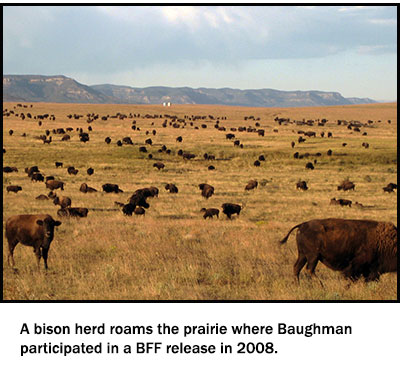
“Being in the field with people who advocate for BFFs but haven’t released them before takes me back to my most inspiring black-footed ferret release at a ranch in New Mexico in 2008,” said Baughman. “On our way to the ferret release area we drove through a huge herd of powerful bison. It helped me imagine a time when bison, swift foxes, burrowing owls, prairie dogs and black-footed ferrets were abundant together in the prairie.”
“We released them before dusk and after sunset we went back to spotlight and monitor the first ferret we had released,” said Baughman. “To our surprise, it was above ground with two swift foxes. They looked almost the same size from a distance and their interaction seemed more curious and playful than threatening. It was as if they were old friends reunited after a long time apart. It looked like they were dancing on the prairie, under the moonlight, as they have done for thousands of years. The bison, the swift foxes and the prairie were truly magical. That was a day that I will remember forever.”
Bison have a similar story to the black-footed ferret. They were nearly eradicated to extinction and are now recovering with the help of people dedicated to them. Baughman sees them as proof that animals can possibly recover, and if people work together, they could potentially bring back some of the prairie ecosystem to its original splendor.
“Zoos have been so instrumental in those recoveries,” said Baughman. “The work we’ve been doing at CMZoo for 42 years, helping black-footed ferrets recover, helps the entire ecosystem because prairie species need each other.”
At the core of the prairie’s survival is the prairie dog. Prairie experts estimate that 170 prairie species depend on the prairie dog – and bison make life richer for the prairie dogs, which in turn support the BFFs. Bison graze differently than livestock. They cut the grass instead of uprooting it, which benefits natural vegetation, healthy drainage and nutrient-rich soil for the mostly herbivorous prairie dogs. The bison’s literal heavy presence also loosens soil, which prairie dogs dig to create tunnels that house their colonies and later become homes for BFFs and other species, like box turtles and burrowing owls.
“It is a complicated balance that we want to support without getting too involved in,” said Baughman. “Ultimately, we want a future that doesn’t need our breed-and-release program because it’s sustaining itself in the wild.”
Until then, Baughman and his inspired team will continue the work with the support of CMZoo guests and members. Back at the conservation center up above CMZoo, the meticulous yearly cycle of preparing for another breeding year has already begun. They recently welcomed new breeding females and males and are moving them through the simulated light cycle that triggers their natural instinct to breed in the spring. After such a successful breeding year, program partners are optimistic about 2024.
Every CMZoo guest helps support this important program because 75 cents from every admission goes to Quarters for Conservation, which helps fund BFF conservation and other important efforts around the world. Since 2008, Q4C has raised nearly $5 million for these programs. To learn more about the black-footed ferret breeding program and CMZoo’s Quarters for Conservation program, visit cmzoo.org/conservation.
Join us on Saturday, Sept. 23, or, Sunday, Sept. 24
Time: 10 a.m. to 2 p.m. There’s no cost to enjoy black-footed ferret-themed activities, but advance admission to the Zoo is required.
Explore booths and participate in activities celebrating black-footed ferrets throughout Scutes Family Gallery, My Big Backyard and The Loft:
10 a.m. to 2 p.m.
Prairie Jenga. Play with the jumbo-sized version of the popular balancing game to learn about the prairie ecosystem. As the game is being played, guests can see which one made the tower collapse. Each game will be tallied to show that all species are important indicators of a healthy ecosystem.
Prairie Species Scavenger Hunt. Find all the animals at our Zoo that live on or near the prairies where black-footed ferrets live. Guests can pick up a list at any of the tables and collect stickers when they find the correct species.
Mazes. Learn how black-footed ferrets get to food or their burrows while avoiding dangers such as predators, diseases and human development that they may come across.
Interactive Card Game. Learn black-footed ferret fun facts through an interactive card game!
Board game. Play an interactive board game in which you assume the role of a black-footed ferret.
Coloring opportunities will be available throughout Scutes Family Gallery, My Big Backyard and The Loft.
11 a.m. and 1:30 p.m.
Black-footed ferret demonstration. Watch Rouge interact with food and enrichment items while learning more about black-footed ferrets in The Loft. There will also be a meet-and-greet with one of our domestic ferrets during these demonstrations.
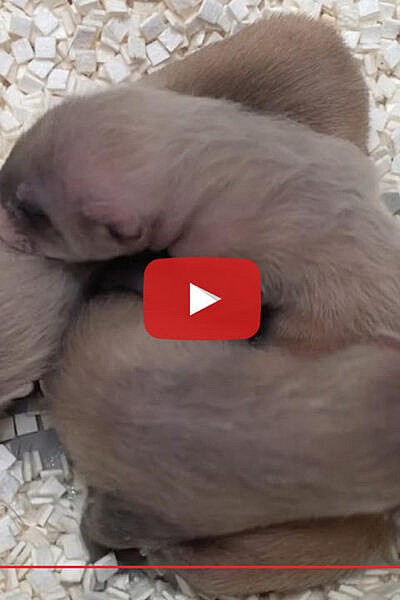
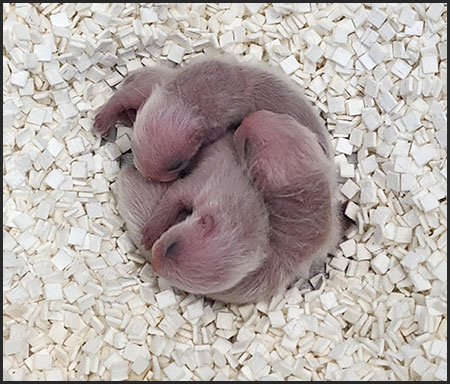
With each passing day, the development of our black-footed ferret kits seems to be on fast-forward, as they eagerly explore their surroundings and pick up new skills. Black-footed ferret (BFF) kits are about the size of a pinky finger when they are born. They experience major milestones, such as growing their baby teeth, eating meat, and opening their eyes, in their first 60 days of life.
Since 1991, we have successfully bred 605 BFF kits in our behind-the-scenes conservation center. We have partnered with other zoos accredited by the Association of Zoos and Aquariums, U.S. Fish and Wildlife, National Black-Footed Ferret Conservation Center and other organizations to breed, release, and monitor black-footed ferrets to increase their wild population.
Native to prairies stretching from Mexico to Canada, BFFs were thought to be extinct in the 1980s. During Western frontier explorations in the early 1900s, cargo ships from Europe and Asia inadvertently brought sylvatic plague to North America. The spread of the plague bacteria by fleas among prairie dogs (and other animals), combined with poisoning and eradication programs led by newly settled farmers and ranchers who saw prairie dogs as pests, drastically reduced the prairie dog population. Because prairie dogs are their main food source, BFF populations declined dramatically along with them.
On Sept. 26, 1981, a ranch dog named Shep caught a BFF. Shep’s catch led to the discovery of a small population of the elusive animals in Meeteetse, Wyoming. Since then, zoos, U.S. Fish and Wildlife, National Black-footed Ferret Conservation Center and other organizations have banded together to breed, prepare, release and monitor BFFs to increase the population.
Because they or their offspring could be released to the wild, every effort is made to keep the black-footed ferrets as wild as possible. So, they are not visible to CMZoo guests. Guests can see a BFF, named Rouge, in The Loft! Every CMZoo guest helps support this important program because 75 cents from every visit goes to Quarters for Conservation, which helps fund BFF conservation and other important efforts around the world.
The four black-footed ferret (BFF) kits born in Cheyenne Mountain Zoo’s conservation center this summer are on their way to ‘boot camp,’ a pre-conditioning center where they’ll have the chance to prove they could survive in the wild.
Boot camp puts their survival skills to the test in a contained prairie setting for about 35 days. Biologists monitor the BFFs during boot camp, and if they see any individuals are struggling to hunt, find shelter, or defend themselves, they’ll be returned to human care. Those who prove they could live wild will be released into the prairie beyond the contained boot camp setting, hopefully to breed with other wild ferrets and grow their populations.
It’s a big step for the furry ferrets, who are independent at only four months of age. Their potential wild release represents hope for their species, which was considered extinct when 18 BFFs were accidentally discovered by a sheepdog in Meeteetse, Wyoming in 1981.
From monthly lighting adjustments to reproductive monitoring and only four breeding opportunities (once per year, for four years) to pair a compatible couple to conceive, the intricacies of black-footed ferret breeding success are meticulously managed by the CMZoo conservation team. CMZoo is one of only five zoos in the world participating in breed-and-release programs to support the Black-Footed Ferret Species Survival Plan (SSP), along with the USFWS National Black Footed Ferret Breeding and Conservation Center just outside of Fort Collins, Colo.
Since 1991, CMZoo has bred 589 BFF kits in the behind-the-scenes conservation center, which is designed to keep the ferrets as wild as possible in hopes they’ll one day live on the prairie. Last year, the team welcomed 15 kits to the world, and this year, another four.
“It’s incredibly challenging work and we aren’t always as successful as we want to be, because replicating nature is really hard to do,” said Baughman.
Breeding seasons for males and females are triggered by photoperiod. they won’t breed unless their environments provide the same seasonal changes that would be activated by the changes in natural sunlight that launch that reproductive cycle in the wild.
Male black-footed ferrets start producing more testosterone during the winter months, when there’s less sunlight per day. In the spring, when there’s more sunlight, the females start going into estrous. Males and females have to be in just the right window to breed successfully, and that breeding window only overlaps from March to May each year. On top of that, they’re only typically reproductive from 1 to 4 years old, and they only breed once per year.
Sometimes, even with meticulously managed light cycles, the pairs recommended to breed are out of sync. Under the guidance of the Black-Footed Ferret SSP, conservation teams match potential parent ferrets to maximize genetic diversity, which means pairing recommendations are based solely on the genetics of the potential partners. But, just because they’re a good match genetically doesn’t mean the individuals will breed. Even if the males and females are in sync hormonally to breed, they may not accept their partner.
“This year, we had fewer kits than normal, and that’s a challenge,” said Baughman. “We will look at what we did differently this year, and we will talk to our partners and see if it’s a program-wide shift, or if it was just our facility. Sometimes there’s no clear reason why it was an ‘off’ year.”
Externally, the challenges continue. Bubonic plague is an ongoing battle in the wild. Plague is transmitted by fleas and kills prairie dogs, which black-footed ferrets need to survive. There are also challenges with acquiring and sustaining enough habitat for reintroduction. It’s another reason education is so important. Inspiring people to coexist with prairie dogs and other prairie wildlife is vital to the success of the program.
“We believe that connecting our guests to animals at the Zoo can inspire them to protect their wild counterparts, and that isn’t easy to do for a species that is intentionally kept away from guests because they need to stay wild,” said Baughman. “The BFFs are easy to love because of their adorable looks and funny antics, so they have become the ‘poster children’ of the prairie. They do a great job as ambassadors for all species who occupy the prairie ecosystems of Colorado, Wyoming, and the North American Great Plains.”
Although guests can’t visit the breeding BFFs or their kits in the conservation center, they can visit Rouge, a black-footed ferret who lives in The Loft at CMZoo. The Zoo continues working to connect guests to this species that needs local support to recover in the wild.
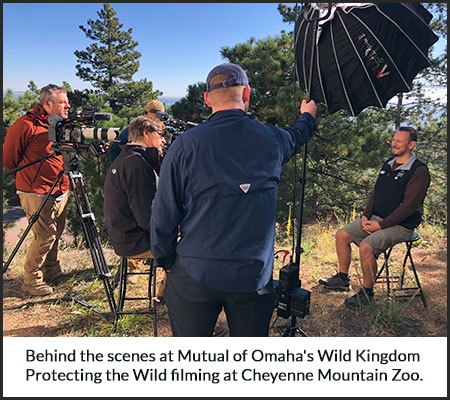
The team recently participated in the filming of a future episode of Mutual of Omaha’s Wild Kingdom Protecting the Wild, which focuses on the BFF’s struggle and the teams that band together in hopes to save them. That episode is slated to air in 2023. CMZoo will provide updates on an air date as plans continue to come together.
The conservation team also celebrated the 41-year anniversary of the rediscovery of BFFs on Sept. 26 with educational booths at the Zoo. Through social media updates, local news, and other outreach, the team continues to keep the ferrets front-of-mind for animal advocates everywhere. Learn more about BFF conservation.
Every visit to CMZoo is conservation in action. Through CMZoo’s Quarters for Conservation (Q4C) program, by which 75¢ of every admission is dedicated to frontline conservation efforts like this, guests can enjoy a day on the mountain with their favorite animals and support important programs dedicated to saving wildlife and wild places. Since 2008, when Q4C started, CMZoo’s guests and members have contributed more than $4 million to conservation projects worldwide.

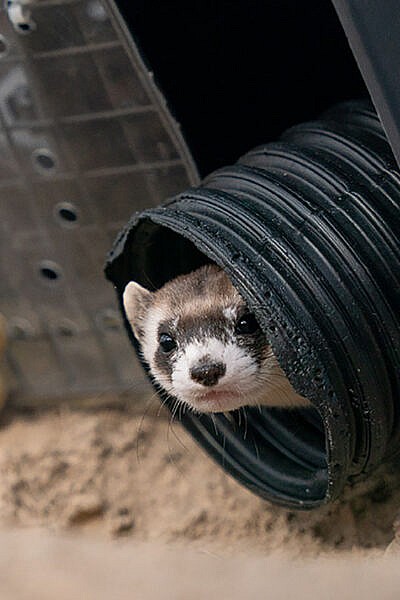
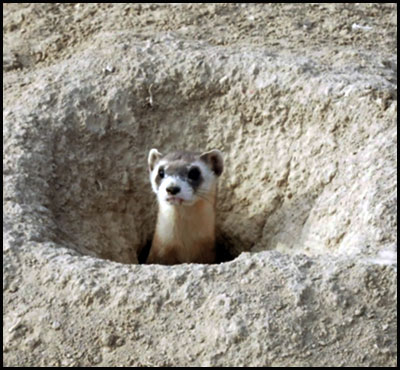 It was a big year to celebrate for black-footed ferret (BFF) conservation enthusiasts. Including Cheyenne Mountain Zoo’s kits, 417 BFF kits were born into the program. That’s the most kits born in a single year program-wide in a decade!