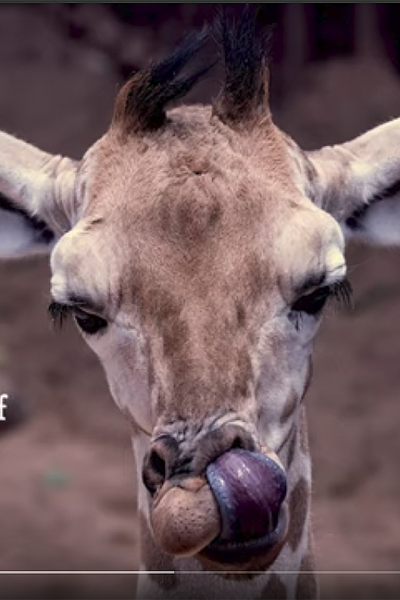
KEEPERS SAY CALF IS STRONG, INDEPENDENT, AND FULL OF PERSONALITY

July 6 at 1:20 p.m. MDT, we welcomed a baby girl to the herd! Hear from Jason, CMZoo giraffe animal care manager, about how the new calf’s first few weeks of life have been, and learn about what’s next for Msitu’s not-so-little girl.

CMZoo welcomes reticulated giraffe calf; mom and baby doing well

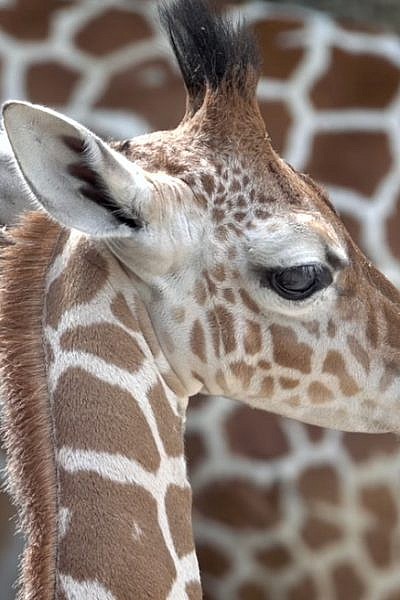
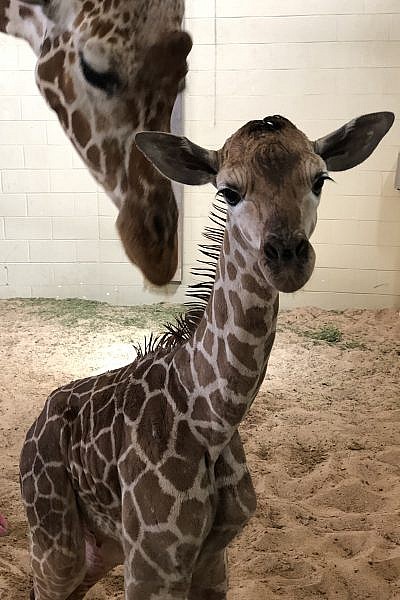
COLORADO SPRINGS, Colo – Msitu (muh – SEE’ – too), a 10-year-old reticulated giraffe at Cheyenne Mountain Zoo, welcomed a calf to the herd at 1:20 p.m. MDT. Msitu and the baby are doing well.

Quick Calf Facts

  • The sex of the baby has not been confirmed.
  • The calf appears to be about six feet tall.
  • The calf was born at 1:20 p.m. MDT.
  • First steps were taken at 1:55 p.m. MDT.
  • The calf nursed for the first time at 3:17 p.m. MDT.

Following Cheyenne Mountain Zoo tradition, the calf will be named after he or she is 30 days old. Keepers first noticed Msitu was in labor, in the outdoor main yard, at 11:10 a.m. today. Msitu shifted inside to the birth stall, where we welcomed the baby to the herd.

The calf is the sixteenth member of Cheyenne Mountain Zoo’s reticulated giraffe herd. The calf is the third offspring for mom, Msitu, and the fifth to be sired by dad, Khalid (pronounced cull-EED).

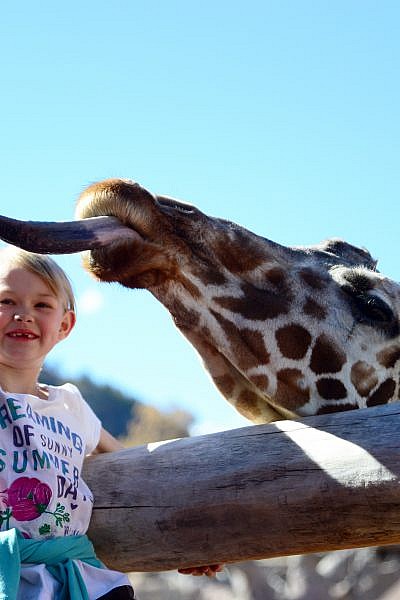
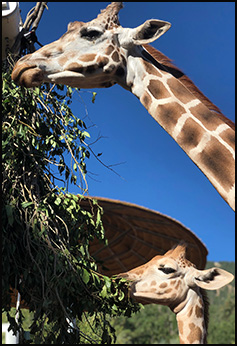
The giraffe building will be closed the remainder of today to allow mom and baby some quiet time to bond and nurse. The rest of the CMZoo herd will be available for viewing and feeding in the outside yard from elevated platforms, where guests can get eye-to-eye with and feed lettuce to the herd, weather permitting. Assuming that mom and baby are nursing consistently and doing well, the public will be allowed limited viewing opportunities starting tomorrow.

As long as keepers observe that baby and mom are doing well, they will continue to let Msitu take the lead on providing care. When they’re born, giraffe calves are typically five to six feet tall and 150 to 200 pounds. This calf appears to be within those healthy parameters. The gestation time for giraffe is a long 14 to 15 months.

Approximately ten thousand worldwide viewers witnessed the calf’s birth on Cheyenne Mountain Zoo’s live camera feed, which will continue to stream live from the sand stall, where Msitu and the calf will remain for the next few days. The live stream of the birth stall, and both outdoor giraffe yard camera feeds, are available at cmzoo.org/giraffecam. The birth stall live camera is also available through a direct link: cmzoo.org/birthcam. The Zoo will continue #MsiTuesday Facebook Live broadcasts each Tuesday afternoon, with updates on Msitu and the calf for the coming weeks.

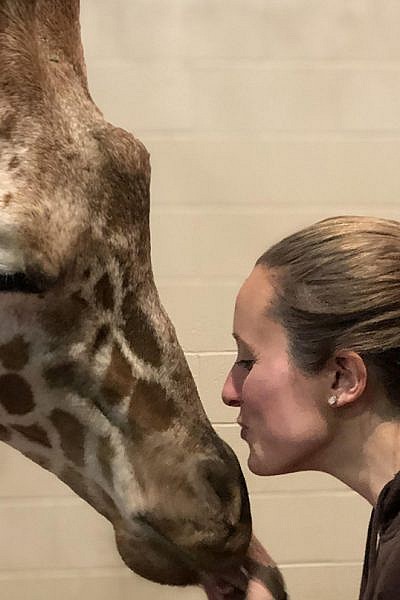
Because Msitu was also born at Cheyenne Mountain Zoo, she has grown up in the culture of voluntary husbandry training that the Zoo is known for in the industry. This means that she voluntarily participates in her own health care, which fosters a strong trust relationship between keeper and animal.

Through this training, the Zoo was able to voluntarily draw blood, confirming Msitu’s ovulation at the time of breeding, and ultimately, confirmed the pregnancy early on. The Zoo was able to get ultrasound images of the calf during the pregnancy with Msitu’s cooperation, and they were even able to bank some of Msitu’s plasma, in case the calf had needed it after birth.

Cheyenne Mountain Zoo is not only a leader in the training and health of giraffe in human care, but they are also making a huge difference in conservation of giraffe in the wild. Reticulated giraffe, the subspecies to which CMZoo’s herd belongs, are endangered. There are just over 11,000 mature reticulated giraffe individuals in the wild, and that population is decreasing. According to International Union for Conservation of Nature’s (IUCN) Red List of Threatened Species, the reticulated giraffe population has declined by 56% in the last thirty years.

In addition to keeping the species alive, by participating in a species survival plan and breeding a genetically diverse population in human care, CMZoo supports ongoing conservation efforts to help giraffe in the wild. To learn about the latest partnership effort to save West African giraffe in Niger, read about Operation Sahel Giraffe. Through Cheyenne Mountain Zoo’s Quarters for Conservation program, by which 75 cents of every Zoo admission is allocated to conservation, guests have helped CMZoo send more than $2.5 million to support important conservation efforts since 2008.

CMZoo invited the public to make its own guesses about when the newest member of the CMZoo giraffe herd would be born. The person who submitted a guess with the closest correct hour, minute and date of birth will win a behind-the-scenes animal encounter with the CMZoo giraffe herd. CMZoo will notify the winner by mid-July.

Msitu was born at CMZoo in February 2009. This is Msitu’s third calf, after giving birth to Emy in August 2013 and to Rae in April 2017. Emy, a female, now lives at Peoria Zoo in Peoria, Ill. Two-year-old female Rae was the youngest member of the herd at Cheyenne Mountain Zoo, but her new sibling, born today, has now changed that. CMZoo’s breeding program began in 1954. This calf’s birth brings the number of reticulated giraffe in the CMZoo herd to sixteen.

Photos and video of Msitu and the calf available for media use:
https://www.dropbox.com/sh/w1w9l6ajo63792b/AADhwe4WKtMPLxmYkfFnPLTka?dl=0

Facebook Page: www.facebook.com/cmzoo
Live Birth Cam (YouTube feed): www.cmzoo.org/birthcam

About Cheyenne Mountain Zoo

Cheyenne Mountain Zoological Society was founded in 1926. Today, Cheyenne Mountain Zoo, America’s mountain Zoo, offers comprehensive education programs, exciting conservation efforts and truly fantastic animal experiences. In 2019, Cheyenne Mountain Zoo was voted #6 Best Zoo in North America and CMZoo’s Rocky Mountain Wild was named #5 Best Zoo Exhibit in North America by USA TODAY 10Best Readers’ Choice Awards. It is Cheyenne Mountain Zoo’s goal to help guests fall in love with animals and nature, and take action to protect them. Of the 233 zoos and aquariums accredited by the Association of Zoos and Aquariums (AZA), Cheyenne Mountain Zoo is one of just a few operating without tax support. Cheyenne Mountain Zoo depends on admissions, membership dues, special event attendance and donations for funding.

    Once in a lifetime Opportunities

    Select your unique experience from the following options:

    • Meet & Greets – unique animal interactions year-round, with any one of our smaller animals listed below.
    • Animal Encounters – connect with amazing animals and their Keepers, plus options to feed many of the animals listed.
    • V.I.P. Tours – behind-the-scenes exclusive animal experiences that make memories for a lifetime!

    Encounters

    Opportunities to connect with amazing animals and their Keepers and a chance to feed any one of the animals below.
    Note: All Encounters do not have any age restrictions unless otherwise noted, however children under 12 years of age must be accompanied by an adult.

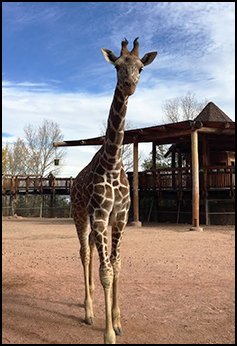
Mashama, 9-year-old reticulated giraffe, is known for his outgoing personality and energetic presence in the Cheyenne Mountain Zoo giraffe herd. Lately, though, Mashama has been dealing with some foot and leg issues.

“We’ve discovered that Mashama has sprained ligaments and a fracture in his right foot,” said Dr. Liza Dadone, CMZoo head veterinarian and VP of mission and programs. “Combine those issues with a ligament strain in his right front wrist [that looks like the right front knee], which preceded the fracture, and we have a pretty complex case to solve.”

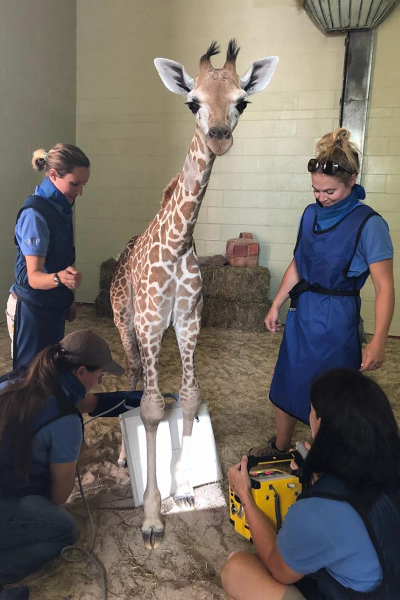
Mashama’s care team saw him limping after he stumbled during an especially playful day in the main yard a few months ago, and took x-rays of his foot. The x-rays revealed no significant damage, so his care team began to administer pain medications and moved him to a sand stall to let a perceived muscle strain heal with rest, over time. After a couple of weeks of normally effective sand stall rest for Mashama, the team noticed he wasn’t improving as much as they would have liked to see, so they performed additional testing.

Those tests revealed that he had developed a fracture in his right front foot. CMZoo’s veterinary team, keepers, trainers and animal care managers have been working together with outside partner organizations to consider every possible treatment for Mashama.

One of those treatments is a customized ”shoe” that adheres to his right front hoof. CMZoo regularly works with specialized farriers from the Zoo Hoofstock Trim Program (ZHTP), a subspecialty of the Equine Lameness Prevention Organization. The ZHTP team built Mashama a custom “shoe” in early April 2019 that seemed to help stabilize the foot fracture while it healed. Almost immediately, from the time the shoe was in place, Mashama appeared to be putting more weight on his right front foot, indicating he was much more comfortable. After several weeks of healing, he was able to access an outside side yard, which has smoother terrain than the main yard.

Earlier this month, Mashama’s shoe came unglued and had to be removed. The team built him a second shoe and applied it mid-May.

In the accompanying video from May 15, 2019, Mashama receives his new shoe. Steve Foxworth, CMZoo’s farrier expert, from ZHTP, explains the shoe’s design and material, and Mashama’s team displays his incredible participatory behaviors that allow them to care for him in situations like this.


“Two months into this path, he’s looking better and better,” said Dadone. “We are by no means out of the woods, but we’re seeing improvements and will continue exploring other options that will help Mashama address the issues in his wrist and foot. A fracture and a sprained ligament could go on to cause significant health problems for him, if we’re unable to stop their progression.”

Because Mashama is such an exemplary participant in his own health care, he is trained for blood draws. His comfort level with blood draws makes him an ideal candidate to receive IV injection treatments that could help him.

“One option we’re considering is an equine medication we’ve used in other giraffe that increases bone density,” said Dadone. “The drug is administered intravenously and must be absorbed in the affected areas for ten minutes. This drug could reverse the course of his injuries, but it’s not easy to administer.”

Staff would need to apply a tourniquet to Mashama’s leg and administer the drug through an IV into the lower portion of his right front leg – giving the most deteriorated bones the best opportunity to absorb the drug. The tourniquet would need to stay in place for ten minutes. That’s a long time to ask an energetic and curious animal like Mashama to stay still.

“Normally, we need to anesthetize an animal to administer this drug,” said Dadone. “But since Mashama is such a rockstar at training, we’re going to see if he’ll participate in training to stay still for that long. It’s always a last resort to anesthetize an adult giraffe, because there are more potential risks than with other animals, so keeping him awake for the procedure would be best.”

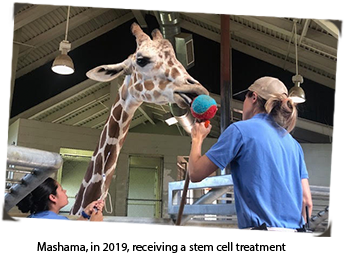
Another option is stem cell treatments to help reduce inflammation and speed healing in his foot bones and sprained wrist joint. CMZoo has successfully used this treatment with other giraffe in the herd, but again, the treatment process is complicated. Stem cells have to be administered through the jugular vein in the neck, and have to be kept at a very cold temperature, which would be an unusual sensation for Mashama.

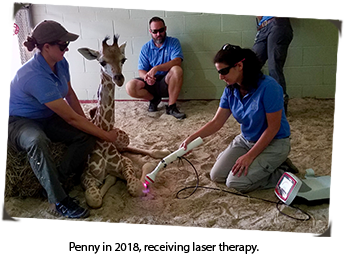
“We’re not quite there yet, but it’s an option. It’s on the experimental side, but we have seen it help in a small number of cases at our Zoo and a few others,” said Dadone. “We’ve tried laser therapy, hoof trims and sand stall rest, to no avail for him. The shoes are offering some comfort and relief, but we’re looking at all options to help him recover long-term.”

Mashama’s team of CMZoo vets, keepers, trainers and staff will continue working to test solutions for him. For now, the new rubber shoes appear to be helping Mashama walk and stand more comfortably, and he’ll return to the outdoor yard with the rest of the herd when his care team decides it doesn’t pose a risk of further injury for him.

We’ll keep you updated on Mashama’s progress, and hope to see him soon return to his former playful self with the success of these potential treatments.

— CMZoo invites public to guess birthdate of giraffe calf, expected this summer —


COLORADO SPRINGS, Colo. (May 21, 2019) – Msitu (muh-SEE’-too), a 10-year-old reticulated giraffe at Cheyenne Mountain Zoo, is pregnant, according to various test results and experts. CMZoo veterinary staff and giraffe keepers believe she is likely to have a calf in the next two months.

”We’re excited to share this news with our community and the huge group of giraffe fans around the world,” said Jason Bredahl, African Rift Valley animal care manager. “Msitu has given birth to two healthy calves, so we are cautiously optimistic about the viability of this calf.”

Cheyenne Mountain Zoo has confirmed the pregnancy with multiple screenings, blood tests and behavioral indicators. Msitu appears to be about 13 and a half months pregnant. Giraffe gestation isn’t an exact science. Giraffe pregnancies typically range between 14 and 15 months, which can make planning for the birth a bit of a guessing game. The Zoo’s records show that Msitu bred with bull, Khalid (kuh-LEED’), April 4, 2018. The 14-month mark would be June 4, 2019.

“Giraffe calves can be fragile, so we try to encourage people to be realistic about the risks while they enjoy the excitement of the hope we know giraffe calves bring to so many,” said Bredahl. “We’re optimistic that advances in medicine, like the availability of giraffe plasma and stem cell treatments, will help us navigate any medical needs the calf may have.”

CMZoo takes precautions for the well-being of mom and calf by providing a sand-floor stall for Msitu, separate from the rest of the herd. In anticipation of the birth, Msitu will be moved to a sand stall on Tuesday, May 28, 2019, which CMZoo staff anticipates is the earliest date Msitu could go into labor. During the day, when the giraffe go outside, she will remain with the herd. At night, she will move to the sand stall. The sand helps mom and baby in a few ways: by preventing injury to the calf upon the five-foot drop it encounters as it’s born, by providing a more absorbent substrate that helps prevent slips for the baby’s first steps, and by providing a cushion for the calf as it learns to walk and inevitably stumbles.

CMZoo is inviting the public to make its own guesses about when the newest member of the CMZoo giraffe herd will be born at cmzoo.org/guess. The person who guesses the correct hour, minute and date of birth will win a behind-the-scenes animal encounter with the CMZoo giraffe herd.

There are plans in the works to activate the well-known live-streaming “birth cam” on Tuesday, May 28, 2019, so giraffe fans worldwide can join in the excitement. Starting today at 2:30 p.m. MDT, CMZoo plans to provide weekly Facebook Live updates from the giraffe barn. During these weekly updates, giraffe keepers and veterinary experts will announce their own birthdate guesses, provide updates on Msitu’s pregnancy, the physical and behavioral changes she experiences as her due date approaches, and news on the baby’s first few weeks of life.

Msitu was born at CMZoo in February 2009. This would be Msitu’s third calf, after giving birth to Emy in August 2013 and to Rae in April 2017. Emy, a female, now lives at Peoria Zoo in Peoria, Ill. Two-year-old female Rae is the youngest member of the herd at Cheyenne Mountain Zoo, but a baby brother or sister may soon be changing that. CMZoo’s breeding program began in 1954. This calf’s birth would bring the number of reticulated giraffe in the CMZoo herd to sixteen.

Reticulated giraffe are endangered. There are just over 11,000 mature individuals in the wild, and that population trend is decreasing. In addition to keeping the species alive, by participating in a species survival plan and breeding a genetically diverse population in human care, CMZoo supports ongoing conservation efforts to help giraffe in the wild. To learn about the latest partnership effort to save West African giraffe in Niger, read about Operation Sahel Giraffe.


About Cheyenne Mountain Zoo

Cheyenne Mountain Zoological Society was founded in 1926. Today, Cheyenne Mountain Zoo, America’s mountain Zoo, offers comprehensive education programs, exciting conservation efforts and truly fantastic animal experiences. In 2019, Cheyenne Mountain Zoo was voted #6 Best Zoo in North America and CMZoo’s Rocky Mountain Wild was named #5 Best Zoo Exhibit in North America by USA TODAY 10Best Readers’ Choice Awards. It is Cheyenne Mountain Zoo’s goal to help guests fall in love with animals and nature, and take action to protect them. Of the 233 zoos and aquariums accredited by the Association of Zoos and Aquariums (AZA), Cheyenne Mountain Zoo is one of just a few operating without tax support. Cheyenne Mountain Zoo depends on admissions, membership dues, special event attendance and donations for funding.

Cost:

Tour prices are dependent upon the season.
Member discount: $50 off total tour cost. Group must have at least one active Zoo member on the tour to receive discount.

Summer ( May – August ) : $2,250 for up to (5) five people
Fall ( September – November ) : $2,000 for up to (5) five people
Winter ( December – February ) : $1,750 for up to (5) five people
Spring ( March – April ) : $2,000 for up to (5) five people

Share Your Prediction.

 
We’re thrilled to announce 10-year-old giraffe Msitu is expecting! When will the baby arrive? Your guess is as good as ours! Click below to guess the minute, hour and date her calf will arrive. The winner gets a behind-the-scenes experience with our giraffe herd for up to four people.

Give us your best guess: When do YOU think baby will arrive?

For more information on Msitu’s pregnancy, click here. [LINK TO NEWS RELEASE]

Details:

  • The winner will receive a free behind-the-scenes experience with our giraffe herd for up to four people!
  • You can change your guess at any time, but only your most recent guess will count.
  • You must submit a guess at least 48 hours prior to when you think Msitu will deliver the calf.

 
All form fields below are required for submission.


Support your favorites with digital, traditional, gift package, and group adoptions. Gifting any adopt choice is available by simply completing the gift area at checkout.