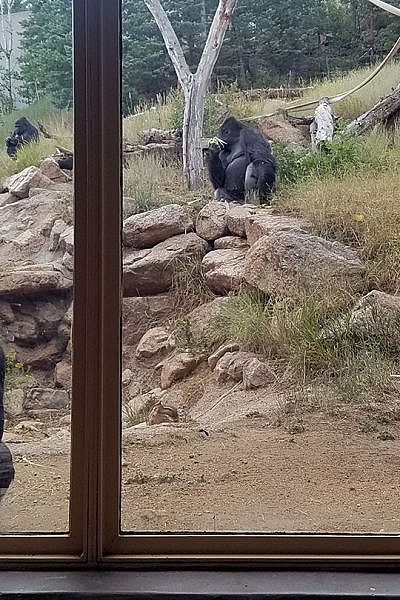
Since Goma, our 29-year-old silverback Western lowland gorilla, came to Cheyenne Mountain Zoo in 2016, Primate World keepers have worked to socialize him with the four female gorillas who live at the Zoo. Each of the ladies has her own personality, which means Goma – who came to CMZoo without much experience living in a cohesive troop – has his work cut out for him.
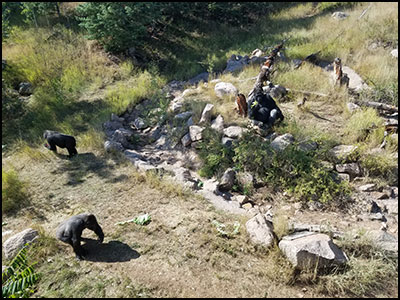
Roxie, 44, is playful and outgoing. Juju, 40, is direct and likes to push boundaries. Asha, 28, is the peacekeeper and has developed the best relationship with Goma, so far. Kwisha, 27, is confident and can have unpredictable moods. Thanks to the Primate World animal care team’s commitment and expertise with gorillas, the troop is making great progress.

Currently, Goma prefers to spend the night in his own area, but they come together for socialization most mornings. A cohesive gorilla troop will spend most of its time relaxing and foraging. So before socializations, their care team prepares their spaces with ample food and enrichment. Just like with humans, if there’s nothing to do during a potentially tense situation, things can get uncomfortable quickly.

“The last two and a half years, they had access to multiple indoor spaces and the yard during socializations,” said Dina Bredahl, senior lead keeper in Primate World. “But, this summer, we’ve seen them adjusting well to having just the outside space and one indoor space for a short time. That might not seem like a big deal, but seeing that they’re comfortable in close proximity means they’re developing communication skills and trusting relationships.”

Cooler temperatures mean big changes for the gorillas, because they won’t want to spend as much time outside for socializations. Recently, the keepers gave the gorillas the opportunity to try a new socialization setup indoors.

To avoid surprising Goma with the new scenario, keepers communicated with him and the females that this time was different.

“The first time we started the socialization indoors, there was an element of surprise because it was new,” said Amy Tuchman, Primate World keeper. “But, Goma caught on right away. The second day we did it, he was watching us and already knew what was about to happen. When the girls came in, he went to check them out and then went back to eating. It was great to see him really relaxed.

“Now, instead of asking them to go outside to see each other first thing in the morning, intros can happen comfortably indoors,” said Tuchman. “We wait for Goma to settle into the large indoor space, and then we open doors for the girls to join him in there.”

Preparing for days the gorillas won’t want to go outside because of the cold will be vital in setting the gorillas up for continued development as a cohesive troop. The gorillas are consistently showing their keepers they are ready for the next step.

“It used to be more tense with all five of the gorillas inside,” said Tuchman. “They weren’t necessarily aggressive, but they were watching each other and weren’t totally relaxed. Now, on most days, they have found a really good balance. Goma will still display sometimes, but now it seems like they’re communicating more effectively.”

When nearly-500-pound Goma displays, he usually sprints a short distance on all fours, sometimes throws an object or shoves a log, and then poses in a dominant stance with his chest pronounced. Silverbacks display for a multitude of reasons, including establishing dominance, protecting themselves or their troop from perceived threats, disrupting interactions between troop members, or changing a situation that makes them uncomfortable.

“Displaying isn’t always a bad thing, but Goma is still learning how to lead the troop,” said Tuchman. “If he displays to a point that makes the females uncomfortable, they might tell him, ‘That was too intense.’ The girls can be more reactive when communicating those boundaries with Goma. They’ll usually vocalize, band together, and chase Goma into another room. He has the right to tell them what to do and where to go, but he has to do it appropriately. He’s learned so much. I’m really proud of him.”
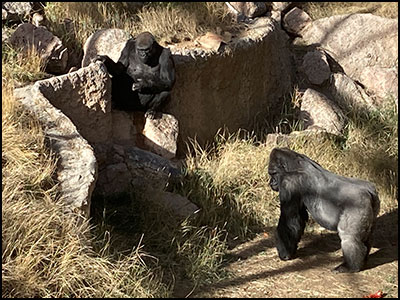
There are many factors the Primate World team considers when creating the best possible environment for gorilla socializations, including weather, relationships within the troop and the health of the individuals. If a member of the troop is ill, socializations are usually put on hold.

Last year, the troop’s resilience was tested when Roxie had a health scare. While she was treated and recovering, she was separated from the group. That could have been detrimental to the overall well-being of the group, but it wasn’t. Thankfully, Roxie’s health has been stable the last several months.

“Roxie is doing amazing,” said Bredahl. “It’s been years since she’s gone this long without an episode. When she’s been with Goma consistently, it seems like she does better! That could just be a coincidence, but it’s something I’ve noticed. She’s been on a new diet to help her gain weight and it could be coincidental that she’s feeling better, but she recently seems so happy and energetic. She’s running around with the girls and being her playful self. When she’s feeling good and sees us setting up to train with her, she gets excited and hugs herself. She has this awesome energy and kind of shimmies while she’s sitting down. It’s really fun to see.”

Roxie’s energy impacts Goma, too. Keepers have seen her scooting closer and closer to Goma until he tells her she’s too close. But outgoing Roxie keeps trying.

“When she’s getting into his personal space too much, he might stand up and purse his lips, or he’ll just give her a look,” said Bredahl. “She usually doesn’t listen at first, but he’s patient with her. She’s funny.”

Juju recently had a few days when she didn’t seem to be feeling well. She was lethargic and lost her appetite. Juju is normally physically fit and active, so when she doesn’t feel well, her keepers notice right away. After a few days of rest and monitoring, she returned to feeling well and socializations could continue. These situations and others are closely monitored by keeper and veterinary staff. Although they sometimes pause integrating the troop, CMZoo’s gorillas have overcome these challenges with flying colors.

“Over the winter months, we’re going to work hard to support their continued progress, whatever situations may arise,” said Bredahl. “We do a lot of looking back at what has worked, but it’s like our animal behavior manager, Rick, said, ‘These are different gorillas than we had last winter. They have different relationships and new skills, so we need to keep adjusting how we set them up for success.’ What was helpful last winter might not work this winter. We’re committed to helping Goma be successful as a member of this troop, and given what we’ve seen over the summer, we’re optimistic about what we can maintain for now and support even further over next spring and summer.”

Back to The Waterhole
 

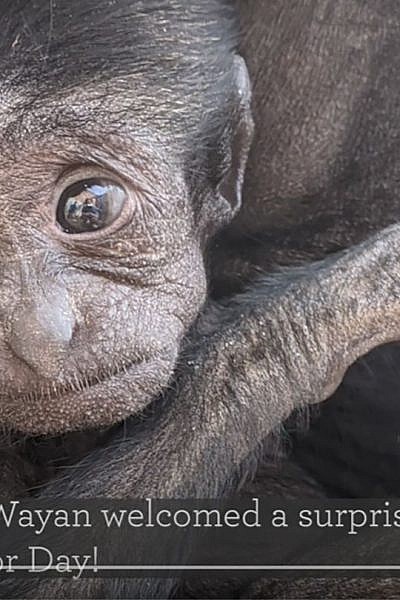
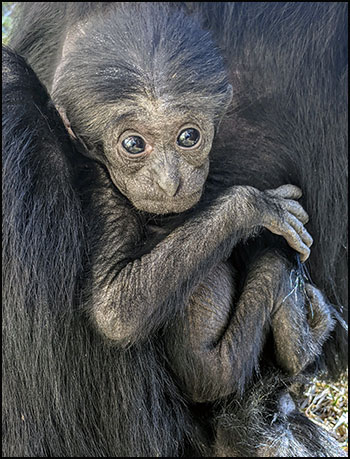
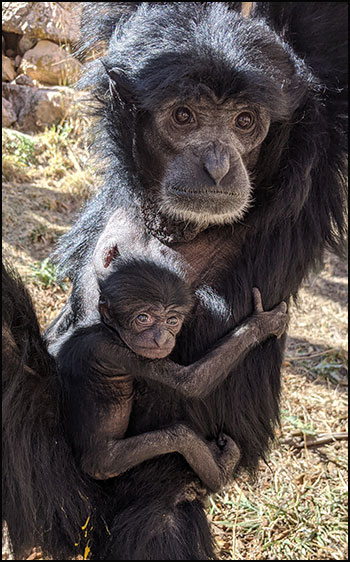
Our baby Siamang has a name, thanks to you! We received more than 4,300 votes to name this precious little girl and the resounding favorite is Rahsia (RAH’-see-uh). Over the last month, #CMZoo partnered with Children’s Hospital Colorado to invite fans from all over the world to cast their votes to help name this adorable little girl. The name Rahsia is Malay for “secret,” and keepers say it suits their surprise bundle of joy perfectly.

Keepers want to send a great, big THANK YOU to everyone who donated items from the baby registry. The Siamangs have been thoroughly enjoying the blankets, saucer swings and yummy treats you sent.

Thanks for voting to help us name Eve and Wayan’s baby! To learn more about how Rahsia, Wayan and Eve are doing since their surprise baby was born on Labor Day, read our latest Waterhole article about the family.

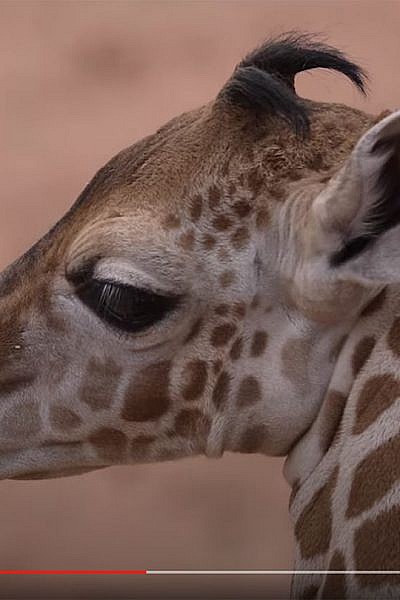
Our little giraffe calf is one month old today! Two of her keepers, Amy and Tori, are here with the update we know you’ve all been waiting for. It’s time to name the baby! This calf has the honor of being named by the care team that has helped her grow over the past month.

Cheyenne Mountain Zoo’s EdVenture Department is looking for creative ways to support our community with familiar favorites and some amazing new programs during these unusual times. From homeschoolers and scout groups, to 21-and-up evening tours and more, CMZoo’s EdVenture team is sure they have an exciting program for you, no matter your age.

Hands On Homeschool is a new supplemental homeschool program offered for kindergarteners through fifth graders, whether they’ve been homeschooling for a long time or are new to the format. The curriculum focuses on Colorado Department of Education school science standards through inquiry-based, hands-on exploration, and investigation of wild animals and wild places. If you are hoping to drop the kids off for the day, we can also schedule private “camp” days for groups of five or more kindergarteners through sixth graders.

Saturdays for Scouts is a program dedicated to helping Scout groups gain skills, knowledge, and up-close experiences to help earn badges, all while exploring CMZoo on a Saturday. Troops are responsible for signing off on badges, but Zoo educators can help provide the resources and know-how to supplement the experience. Another favorite in the Scout community is evening tours of the Zoo! Starlight Safaris are a great way to learn about wildlife, meet animal ambassadors and spend time together safely as a troop.

These are just two of several programs available, detailed at cmzoo.org/events. If an existing program date doesn’t fit your schedule, or you would rather create your own group, the EdVenture team can work with you. Almost every program can be customized and scheduled for private groups. Want to plan a girls’ night out? We can do that! Looking for a place to send a group of kids for a day? We can do that, too!

If you find a program that you want to participate in, but would rather schedule it as a private event, just email [email protected], and we can help create an activity suited to your individual needs.

Back to The Waterhole
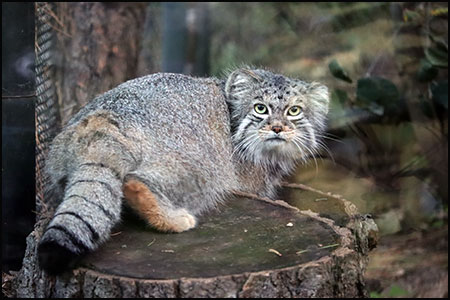


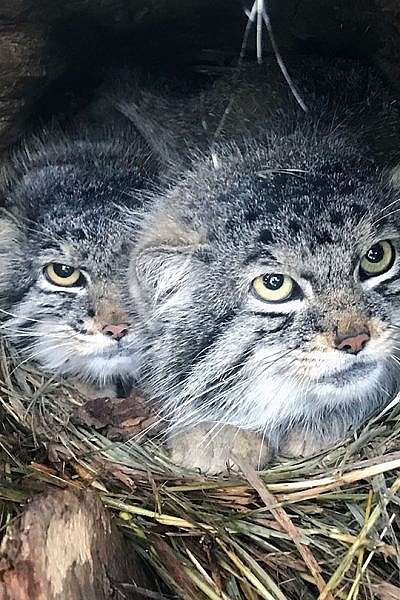
Winter is a season of opportunity for Cheyenne Mountain Zoo’s Pallas’ cats, 3-year-old female, Nancy, and 3-year-old male, Bo. The two Asian Highlands residents are often referred to as the original grumpy cats because of their intense stares, furrowed brows and downturned mouths. Their unique ears sit on the sides of their fluffy round faces, which could also give the impression they’re holding their ears back – a behavior sometimes associated with irritation with other cats. But, their appearances don’t actually mean they are grumpy!

Nancy weighs just seven pounds and Bo tips the scales at 10 pounds. Don’t let their small size and adorable fluffiness fool you. The petite Pallas’ cat commands respect. They’re mesopredators, which means they prey on smaller mammals and are preyed upon by larger predators. That middle-of-the-food-chain status requires them to be skilled hunters and defenders.

Pallas’ cats are native to central Asia’s cooler climates at elevations up to about 15,000 feet above sea level. They share these habitats with snow leopards, the swift and powerful apex predator of the Himalayas. Pallas’ cats are classified as ‘near threatened’ and snow leopards are classified as ‘vulnerable’ on the International Union for the Conservation of Nature Red List. Because they share habitat with snow leopards, which are threatened in part due to habitat loss, Pallas’ cats are also at risk for declining populations.

“Part of the Pallas’ cats’ defense is how elusive they are,” said Basia Dann, Asian Highlands keeper. “Their innate wariness makes them difficult to study in the wild, which can hinder conservation opportunities.”

Pallas’ cats in human care could one day contribute to a dwindling species in the wild. CMZoo supports Species Survival Plans (SSPs) managed by the Association of Zoos and Aquariums (AZA), which focus on species whose populations are either decreasing in the wild or whose assurance populations in human care need genetic diversity and growth, like Pallas’ cats. Based on SSP breeding recommendations for matching the most genetically diverse animals, and based on the animals’ interactions with each other, animal care teams work to provide environments that give CMZoo animal ambassadors the choice to breed and contribute to the future of their species.

CMZoo’s Asian Highlands team hopes to contribute to Pallas’ cats’ assurance population by supporting Bo and Nancy’s breeding recommendation. Bo came to CMZoo with his brother, Tate, in December 2017. Nancy joined Bo on a breeding recommendation in March 2018, when Tate moved to another AZA-accredited organization. Bo and Nancy were introduced about a month after she arrived. They were immediately comfortable together and have been seen breeding in the past. But, successful Pallas’ cat breeding requires a lot more than congeniality.

Changing seasons impact us all. For Pallas’ cats, they set in motion a whirlwind of important annual hormonal changes.

“Their opportunity to breed successfully typically takes place from December to March,” said Dann. “Female Pallas’ cats are usually only fertile for a maximum of 46 hours per year, which is really short compared to other cats and animals. We work with them all year long to give them the best chances at breeding when the very limited time is right.”

Leading up to winter solstice, when days slowly begin to get longer, Asian Highlands keepers work to make Bo and Nancy’s environment as natural and undisturbed as possible. Estrus, the short period of time that the female is receptive to male breeding, is typically triggered by lengthening days. If breeding occurs but isn’t successful, female Pallas’ cats have been known to go into estrus once more in the same season. But it would be a month later, only if still within the December-to-March timeline.

Voluntary husbandry training is a year-round focus for the keepers and cats. Keepers are continually thinking about what’s next. Part of the reason for building a trusting relationship with Nancy is in preparation for kittens. If the pair is successful, kittens could be here as soon as March. With that short timeline in mind, keepers need Nancy to trust them before she’s pregnant, in case she or any kittens need medical intervention. Pallas’ cat gestation is only 66 to 76 days, so potential kittens would likely be born before Nancy even shows signs she’s pregnant.

Pallas’ cats typically have two to five kittens per litter. This would be Nancy’s and Bo’s first adventure with parenting. Other than breeding, Pallas’ cats are typically solitary in the wild, and fathers don’t usually play a role in raising kittens.

Be sure to stop by Asian Highlands next time you’re at the Zoo to visit Bo and Nancy!

Back to The Waterhole
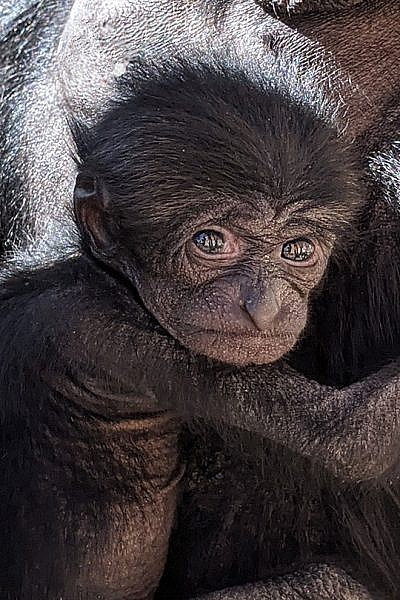


The female Siamang born on Labor Day in Primate World to parents, Eve and Wayan, is growing well and will soon get a name! Our partner, Children’s Hospital Colorado, partnered with us to invite the public to vote on four names chosen by the baby’s keepers.

The public can vote on her name through Sunday, Nov. 1, at cmzoo.org/baby.

The names on the list, chosen by the keepers are:

  • Binti, which is Indonesian for “daughter”
  • Rahsia (RAH’-see-uh), which is Malay for “secret,” since she was a surprise baby
  • Rosie, after Rosie the Riveter, since the baby was born on Labor Day
  • Naomi, the real name of the woman who became known as Rosie the Riveter

Although the baby was a surprise, she and her family are bonding and growing together as expected. As firs-time parents, Eve and Wayan follow their instincts to support their baby’s needs. Children’s Hospital Colorado compiled a list of 10 common questions first-time human parents might have.

“Not a whole lot has changed since she was born, other than she gets more and more adorable,” said Eleanor Knox, Primate World keeper and Eve’s primary trainer. “She’s still staying on mom a lot, but we’re starting to see her reach out to touch things. She seems pretty curious so far. She’ll touch my finger just a little bit when Eve comes over to see me. That’s super cute.”

Nine-year old Eve and 12-year-old Wayan are first-time parents, but have picked up parenting without skipping a beat. For about the first week, Eve would hold the baby in one arm and swing around with the other. Since then, the baby has shown Eve that she’s strong and can hang on tight – even when Eve climbs high up into the corners of her outdoor space – so Eve can use both arms to swing with confidence.

“Eve is really confident with the baby now,” said Knox. “That’s great to see because it means the baby appears to be strong and that Eve is comfortable with her. Eve has been really good with us keepers, too. She’s been coming over to us with the baby and letting us get close looks at the little one to see if she’s okay. We have a close relationship with Eve, so she’s been really good about letting us touch the baby, too, just very lightly while she hangs on to mom. That’s going to be important in developing our relationship with the baby, which will allow us to start working on voluntary behaviors that help her participate in her own care when the time comes.”

The baby will continue to nurse for up to two years, but could start tasting solid foods around three months. Her interest in solid foods helps solidify her relationship with keepers, as they can reinforce her behaviors and show her that it’s a positive thing to interact with them.

“We’re already starting working on training, but it’s a slow process,” said Knox. “We’ve started touching her a little if Eve brings her close enough to the mesh and is comfortable, so baby can get used to interacting with us. The next step will be getting her really comfortable taking food from keepers, so we can reward her. In terms of a specific trained behavior, we could start with practicing for an injection. The little guys need injections pretty early, so we start working on that relationship and behavior as soon as possible.”

Many of the primates in Primate World are trained for voluntary injections, including 2-year-old Kera, a Sumatran orangutan born at Cheyenne Mountain Zoo. Their experience training for this behavior with other primates will benefit this little one, too.

“We ask them to present their hips and start with a touch with our fingers,” said Knox. “Once they’re comfortable with that, we’ll touch them with something else, like a pencil, so they are comfortable with receiving the touch from an object instead of our hands. We usually introduce a syringe without a needle, next then a syringe with a dull needle, and finally a normal needle and syringe. It takes time and we want to make sure she’s really comfortable with every step before her first injection.”

Siamangs receive tetanus and rabies vaccines, typically. The training is helpful in case her care team needs to intervene with injectable medications to address any unforeseen medical concerns.

Wayan, the baby’s dad and the last Siamang born at CMZoo before his baby girl, is also bonding with the baby and maintaining his great relationship with Eve.

“She could start moving off of mom as early as five or six months old,” said Knox. “After that happens, the dads will usually play a bigger role in carrying the baby and playing, with mom’s permission. That timeline can really vary, though, especially with a first-time mom. For now, Wayan is grooming the baby while Eve holds her. Grooming and rest time is pretty adorable. Eve will lie down with her head in Wayan’s lap and the baby on her chest and he grooms the both of them while mom has a moment to relax. He’s been great. He sticks pretty close to them, but is respectful of Eve when she shows him she’d like a little space, too.”

Having adjusted to family life so well, the Siamangs’ new neighbors, white-cheeked gibbons Debbie and Tanh-Linh who moved to Primate World from Monkey Pavilion, have been their latest focus.

“Eve is really curious about them,” said Knox. “They can see each other from their yards and through the windows between them in their indoor exhibits. Wayan is cautious, which is just his personality. The gibbons are settling in well, and are really used to having neighbors from their previous home in Monkey Pavilion.”

Several CMZoo fans have given the family new things to be curious about, too. As part of the naming vote, people can send the family gifts from a registry listed at cmzoo.org/baby. Keepers and the animals have been excited for the support.

“We’re super excited and thankful that we’ve been receiving items from the baby registry,” said Knox. “We have received food, blankets and swings, which Eve really seems to enjoy. We see her hanging out on the swing with the baby pretty often. We were lucky to get three of the saucer swings, so we have placed one inside and one outside for the Siamangs and shared one with the white-cheeked gibbons.”

Baby, Eve and Wayan are often visible to guests, but as they continue to bond, they might choose to spend quiet time in their back den. Visitors can say hello to the new family in Primate World. CMZoo will announce the baby’s name on social media channels after voting has closed on Nov. 1.

Back to The Waterhole
 

As you may know, 8-year-old reticulated giraffe, Bailey, gave birth on Sept. 28, 2020, to a healthy female giraffe calf, who we named BB on her one-month birthday! Join African Rift Valley Senior Lead Keeper, Amy, for a recap of the littlest herd member’s first month of progress.

You can watch BB, Bailey and the rest of the 17-member giraffe herd on our two outdoor yard cameras, live daily from 8:30 a.m. to 4:45 p.m. MT, on the Zoo’s YouTube channel at or on the giraffe cam page on our website at http://cmzoo.org/giraffecam.

WATCH THE VIDEO PLAYLIST ON YOUTUBE

Join Digger and Emmett, CMZoo’s two 15-year-old male grizzly bears, and Rocky Mountain Wild Keepers, Sarah and Kristen, to get up close with the bears and learn about hibernation and torpor. Cooler temperatures mean the boys are preparing for winter, when they go into a slight stage of torpor and generally slow down a bit.

Their keepers say the seasonal change doesn’t impact Digger and Emmett as much as it affects their wild relatives, because our boys have year-round access to food sources.

Three pink-backed pelicans, Pluto, Penelope and Pandora, joined Water’s Edge: Africa at the beginning of October, and they’re settling in well sharing space with our flock of African penguins and guests!

Water’s Edge Keeper, Grace, tells us about the pelicans as we get up close with these big-beaked birds and say hello to the penguins. Pandora, who is with us temporarily while her new exhibit at another Associations of Zoos and Aquariums-accredited facility, and Penelope start the video on the guest sidewalk and then take a dip in the lower outdoor pool. Plato shows off his impressive fish-catching skills from the inside beach.

Next time you’re at CMZoo, swing by Water’s Edge: Africa, our new home for hippos, penguins, pelicans, warthogs, lemurs, guinea pigs and guineafowl, to say hello!

Rain, snow or shine, five remaining nights of Halloween festivities begin Friday, Oct. 23 – Cheyenne Mountain Zoo will feel the Halloween spirit when little ghouls and goblins attend Boo at the Zoo, resuming with its remaining five nights on Friday, Oct. 23, 2020. The event is a fun way for families to trick-or-treat and enjoy Halloween festivities in a unique environment. This year’s Boo at the Zoo started Oct. 17-18, and resumes on Oct. 23-25 and 30-31. Boo hours are 3:40 to 8:30 p.m. Advance e-tickets are required and available at cmzoo.org/boo. The Zoo will close for daytime admission on Boo nights at 3 p.m.

In addition to visiting select animal exhibits and trick-or-treating, frightfully fun attractions include a lighted pumpkin patch, a kid-friendly spooky haunted house, Ghoulish Graveyard and Pirates Cove. Attendees can also enjoy rides on the Mountaineer Sky Ride, weather permitting. The Sky Ride will be open as weather allows, providing a breathtaking view of Colorado Springs at night and a lift to two additional trick-or-treat stations at the top.

Boo at the Zoo will go on, rain, snow or shine. As an all-weather venue, refunds and exchanges will not be honored for weather-related reasons. Be sure to bundle up on cold nights and enjoy a Colorado evening on the mountain!

An elephant-sized amount of candy (4.5 tons) will be handed out at trick-or-treat stations throughout Boo at the Zoo. The Zoo’s candy supply is purchased from companies that are members of the Roundtable on Sustainable Palm Oil (RSPO), which is committed to the use of sustainable palm oil and the protection of orangutan habitats in the wild. To find your own Halloween candy that’s orangutan friendly, download CMZ’s sustainable palm oil shopping guide at cmzoo.org/palmoil.

COVID-19 spread prevention protocols are in place, including limited capacity throughout the Zoo, no off-site shuttle transportation, limited capacity in buildings, mask requirement for ages 11 and up in buildings, and more. Please visit cmzoo.org/open for a complete list of safety requirements and encouragements.

SELECT ANIMAL EXHIBITS ARE OPEN, INCLUDING:

– African Rift Valley giraffe building (be in line by 8 p.m.) In order to accommodate the maximum number of guests with our limited building capacity, your time in the giraffe building will be limited.
– African lions
– Australia Walkabout
– Encounter Africa elephant/rhino barn
– Goat Experience
– The Loft
– Scutes Family Gallery
– Water’s Edge: Africa

RESTAURANTS OPEN DURING BOO AT THE ZOO

– Grizzly Grill
– Pizza with a View
– Elson’s Place
– Cozy Goat (beverages only)

COSTUME REQUIREMENTS

For the safety of all guests, costume masks and costume weapons may not be worn by guests 12 years of age or older. Masks worn by guests 11 years of age and younger must have openings that allow the eyes to be seen and that do not obstruct peripheral vision. Balloons are not allowed inside the Zoo (even as part of a costume) for the safety of our animals and wild animals.

TRICK-OR-TREAT BAGS

Support the Zoo’s efforts to reduce waste by bringing your own trick-or-treat bags!

VOLUNTEERS NEEDED

Volunteers are crucial to the success and safety of Boo at the Zoo.
Positions include handing out or delivering candy, directing traffic and working the haunted house.
All volunteers must be at least 13 years old.
Volunteers ages 13-17 must be accompanied by a parent, guardian or school advisor at all times.
We will not assign specific positions until the evening of the event.
Curious about volunteering for Boo at the Zoo? Visit cmzoo.org/boo

FAST FACTS

Boo at the Zoo at Cheyenne Mountain Zoo
Remaining Dates: Oct. 23-25 and 30-31, 2020
3:40 to 8:30 p.m.
Advance e-tickets are required
www.cmzoo.org/boo

Boo at the Zoo is possible thanks to our generous sponsors, Children’s Hospital Colorado, Les Schwab Tire Centers, Raising Cane’s Chicken Fingers, T. Rowe Price and your Colorado Springs Toyota dealers, Larry H. Miller Toyota Colorado Springs and Larry H. Miller Liberty Toyota Colorado Springs.

About Cheyenne Mountain Zoo

Cheyenne Mountain Zoological Society was founded in 1926. Today, Cheyenne Mountain Zoo, America’s mountain Zoo, offers comprehensive education programs, exciting conservation efforts and truly fantastic animal experiences. In 2020, Cheyenne Mountain Zoo was voted #4 Best Zoo in North America and CMZoo’s Rocky Mountain Wild was named #2 Best Zoo Exhibit in North America by USA TODAY 10Best Readers’ Choice Awards. It is Cheyenne Mountain Zoo’s goal to help guests fall in love with animals and nature, and take action to protect them. Of the 233 zoos and aquariums accredited by the Association of Zoos and Aquariums (AZA), Cheyenne Mountain Zoo is one of just a few operating without tax support. Cheyenne Mountain Zoo depends on admissions, membership dues, special event attendance and donations for funding.