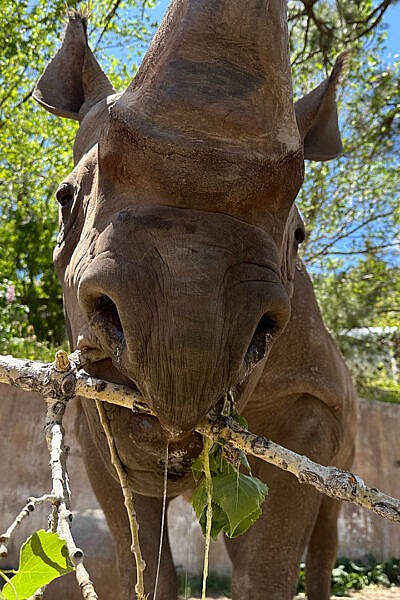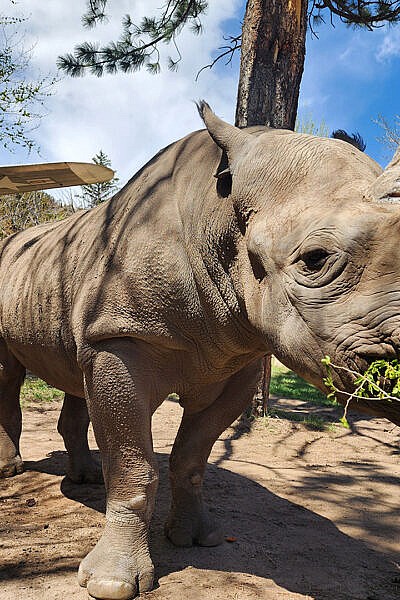
Jumbe, a 21-year-old Eastern black rhino at Cheyenne Mountain Zoo, continues to navigate a significant health challenge with the support of his care and veterinary teams. In May, a blood test revealed concerning iron saturation levels indicating a condition known as iron overload disorder.
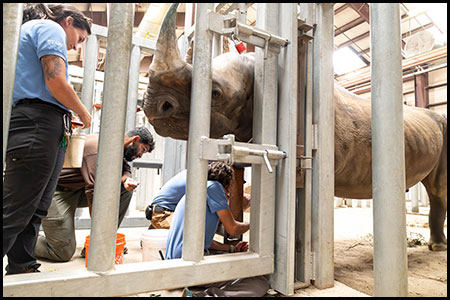
Blood draw training with black rhino, Jumbe

Despite the diagnosis, Jumbe remains in good spirits. He consistently interacts with his keepers, participates in training and daily guest feedings, and shows no clinical signs of discomfort. His liver and kidney levels, along with other critical markers, are being closely monitored and remain within normal ranges.

This ailment is well documented among black rhinos in human care, affecting about one-third of the population. However, treatment options and results are limited. Iron overload can lead to serious health issues, potentially damaging vital organs and posing a risk of fatal complications over time.

Black rhinos are particularly susceptible to iron overload due to their unique metabolic processes. Knowing this, Jumbe’s care team has always tailored his diet to minimize iron absorption. Following his diagnosis, they made further adjustments to Jumbe’s diet, with support from the Black Rhino Nutrition Advisory Group.

By June, follow-up bloodwork showed a 10 percent improvement in Jumbe’s iron levels. But, his most recent results, in early August, revealed a return to the original high levels. Unfortunately, diet controls alone don’t seem to be working for Jumbe.

So, Jumbe’s care team is focused on voluntary large-volume blood draws as a supplementary treatment, while continuing diet controls. Phlebotomy isn’t new to Jumbe or his team. He has long been an expert in voluntary blood draw behaviors.

“This is a great example of why it’s so important to establish trained voluntary behaviors before you need to rely on them,” Ilana Cobban, Encounter Africa animal care manager says. “He has been blood-draw trained for many years, so he’s comfortable and confident with the setup. When he was first diagnosed, we started increasing the frequency of his blood draw training sessions. Since mid-August, we’ve been successfully drawing large volumes of blood weekly, and Jumbe has been adjusting amazingly.”

During large-volume blood draws, the team aims to collect at least 100 milliliters (mLs)
or about 3.5 fluid ounces per session, in a carefully controlled manner. The team has to be precise with the needle and acutely tuned-in to Jumbe’s behaviors for each session to be successful. They draw multiple vials of blood during a session, but limit themselves to one needle insertion for Jumbe’s comfort. It takes three keepers, meticulous coordination and a lot of Jumbe-specific knowledge.
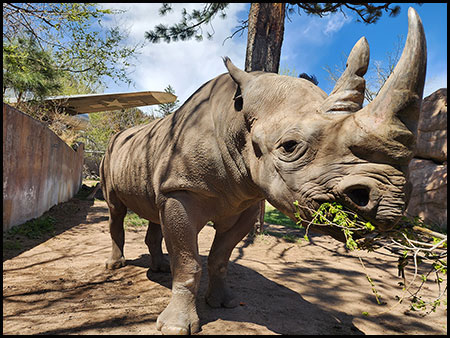
Black rhino, Jumbe up-close

“We have a trainer, a ‘brusher’ and a ‘mechanic’ during the blood draws,” Ilana says. “The trainer stands at Jumbe’s head, giving him training cues and reinforcing his participation with yummy snacks. They also watch Jumbe’s face and upper body for any behaviors – like a twitch – that might indicate we need to finish soon. The brusher is at Jumbe’s feet with the mechanic, brushing his opposite front leg, so he has a familiar and positive sensation, and a distraction from the sensation of the blood draw. The mechanic does the blood draw from underneath a metal port where Jumbe rests his chin. The three of us are constantly communicating with each other and with Jumbe about what’s happening now and what’s happening next.”

The median life expectancy for Eastern black rhinos in human care, according to the Association of Zoos and Aquariums, is 19 years, and Jumbe is 21. The team remains cautiously optimistic, exploring every possible avenue to support his health and well-being.

“We want to give Jumbe every chance to live a long, comfortable and fulfilling life,” Ilana says. “Because this treatment requires his voluntary participation, we will know if he doesn’t want to participate in a session. With a disease like this, we know it could take a turn at any moment, but for now, he’s enjoying life, and we’re determined to help him in the best ways possible.”

Guests can visit Jumbe in Encounter Africa, and participate in paid rhino feedings daily at noon through September. In October, feedings will be available on Saturdays and Sundays, weather permitting. These feeding opportunities give people a rare chance to hand-feed a rhino, and their payment supports the Zoo’s frontline black rhino and African elephant conservation partner, Tsavo Trust, in Kenya.
Back to The Waterhole

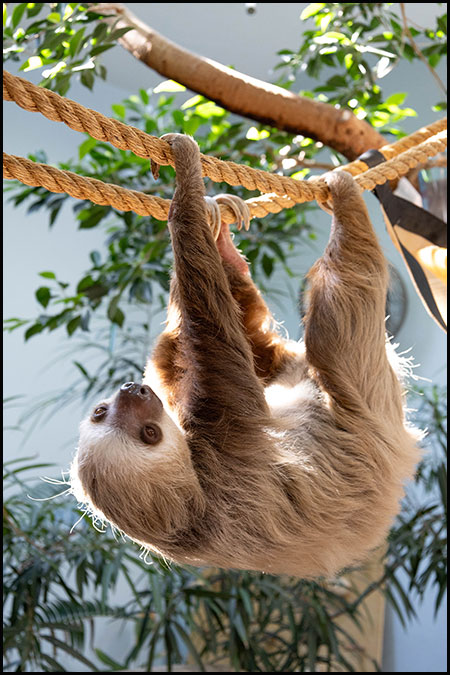
Mark the calendar for World Sloth Day and a celebration of Cheyenne Mountain Zoo’s Hoffmann’s two-toed sloths on Sat., Oct. 19. That’s when Scutes Family Gallery and The Loft keepers will host special sloth meet-and-greets and other sloth-inspired activities. The Zoo will close early at 3 p.m. to prepare for Boo at the Zoo, but guests can enjoy a memorable morning and afternoon with Bosco, Aysan and Bean.

Hoffman's two-toed sloth, Bosco
Hoffman’s two-toed sloth, Bosco

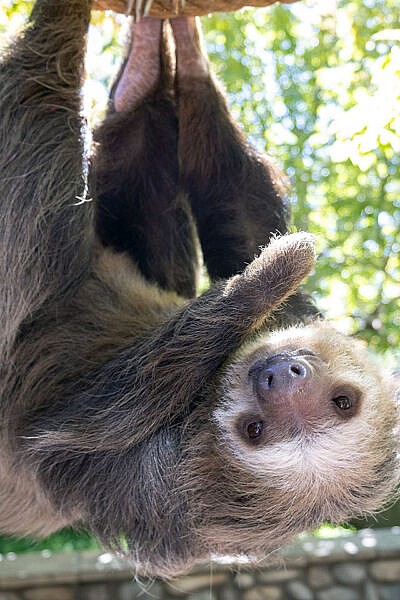
Bosco, the gentleman of the group, is Aysan’s companion in Scutes Family Gallery. He’s also Bean’s dad. Bosco is 32 years old, and although he’s slowing down in his old age, he has always been a model of patience. Bosco is known for his considerate nature, typically waiting for his female companion to finish her training sessions with keepers before joining in.

“Bosco is just the best,” Amber Callen-Ward, lead keeper in Scutes Family Gallery, says. “When we ask them to come down for a voluntary husbandry training session, you’ll see him watching Aysan decide if and when she’ll join us. If she doesn’t come down, he’ll make his way over to us. If she moves to us quickly, he watches and waits until she’s finished training and then comes over.”

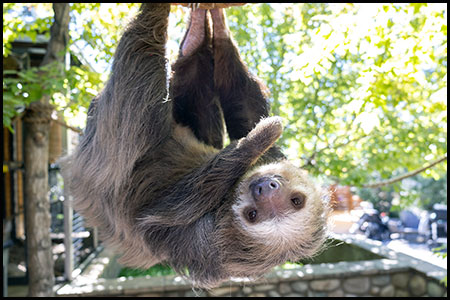
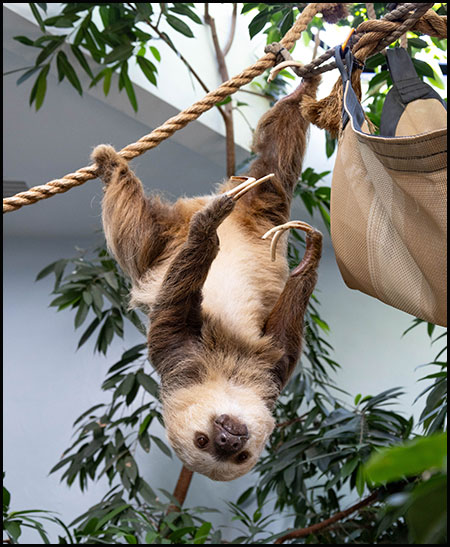
At 9 years old, Aysan is a very confident sloth. She’s quick to approach and interact with people and has mastered training sessions, including important behaviors like nail trims, targeting in specific locations, voluntary injections and even ultrasound training.

Sloth Aysan hanging upside-down
Hoffman’s two-toed sloth, Aysan

“Aysan is a really fast learner and just fast, in general,” says Amber. “She is comfortable in her environment and she knows she’s in control. We’ve been working on ultrasound and x-ray behaviors that will allow Aysan to voluntarily participate in her health care. Even cold-to-the-touch ultrasound gel does not faze her during training.”

Aysan and Bosco live in the atrium in Scutes Family Gallery, and Bosco’s daughter, Bean, lives just down the walkway, in The Loft. Bosco has darker markings than Aysan and Bean, who have similar light brown and blonde coloration. They all like fruit and vegetables. Bean, just like her dad, prefers less-sweet snacks, like cucumber and sweet potato. Aysan likes grapes, peaches and pears best.

The youngest and most mischievous of the bunch, 5-year-old Bean, is known for her curiosity, intelligence and food motivation. Bean, who was born at CMZoo in 2019, is a favorite among visitors – proven by her status as the top-requested encounter animal in The Loft.

“She’s almost always up for an encounter, and she is surprisingly quick when she’s motivated by her favorite snacks,” Jackie Watson, senior animal keeper in The Loft, says. “She has access to a huge rope and rafter system in The Loft, so make sure you look up next time you visit. She’s probably right above your head!”

While sloths are undeniably adorable, their ‘cute and cuddly’ reputations can be problematic. It’s crucial to practice ethical tourism when visiting sloths’ native homes.

“It’s important not to hold them,” Jackie says. “Sloth-holding opportunities are becoming increasingly popular. The people offering them might have good intentions and talk about conservation, but they sometimes don’t have the knowledge to do these types of encounters and consider the choices of the animals in their care.”

Hoffman's two-toed sloth, Bean
Hoffman’s two-toed sloth, Bean

Sloths that live in reputable and accredited organizations in human care were once considered untrainable because of their ‘slow’ reputations. CMZoo’s three sloths buck those outdated views daily, especially Bean. Having mastered crate, target, x-ray, and injection training (she also paints from time to time), Bean is moving on to voluntary blood draw training.

“Bean has shown us consistently that she’s capable of more,” says Jackie. “We’re working on training her to hold onto a stick and then keep her arm still for blood draws, which is a significant ask. We respect their autonomy and build relationships based on trust and positive reinforcement. We’re taking it slowly (no sloth pun intended), and I really believe Bean could make history with this training. She’s already helping sloth caretakers advocate for voluntary training and husbandry care for sloths by showing what she has learned.”

Don’t miss the chance to celebrate and learn about these fascinating creatures at World Sloth Day. All activities will be available in Scutes Family Gallery and The Loft on Sat., Oct. 19 from 10 a.m. to 2:30 p.m., including two special demonstrations:

  • 10:30 a.m. Keeper Talk and Meet-and-Greet with Bosco and Aysan in Scutes Family Gallery
  • 2 p.m. Meet-and Greet with Bean in The Loft

Advance daytime admission is required and available at cmzoo.org. On World Sloth Day (and on all days CMZoo is hosting Boo at the Zoo), the Zoo will close for daytime admission at 3 p.m. The Zoo reopens for Boo at the Zoo at 4 p.m. Boo at the Zoo requires separate admission. Details are available at cmzoo.org/boo.

Back to The Waterhole

Cheyenne Mountain Zoo’s dedicated team of black-footed ferret conservationists are helping rewrite the narrative of recovery from extinction, one litter at a time. Following last year’s record number of kits born, program-wide in over a decade, CMZoo’s conservation team is celebrating its own record year, and trying something new.

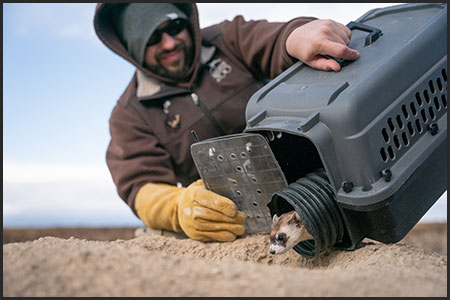
Black-footed ferret release from kennel into the wild

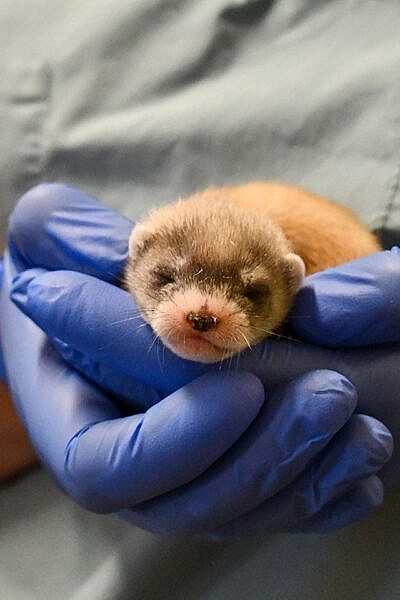
This summer, CMZoo welcomed the most black-footed ferret (BFF) kits born in a single season: 37. It could have been luck. It could have been the crisp mountain air and a snowy winter. Or, it could have been the multiple-partner breeding trial.

“We’re trying to replicate opportunities observed in nature, when female black-footed ferrets mate with multiple mates within the same breeding window,” Jeff Baughman, field conservation coordinator at CMZoo, says. Jeff has been part of CMZoo’s black-footed ferret and Wyoming toad breed-and-release programs for more than 20 years. “Mixed paternity litters are not unheard of in various species in the wild. But, this is the first time we have tried it at CMZoo. We want to learn if it’s possible for black-footed ferret mothers to whelp kits by different fathers in the same litter.”

BFFs are induced ovulators, meaning the act of breeding triggers ovulation which lasts around 72 hours. In the past, a female has been paired with a suitable male for the full 72 hours. In this trial, a female is paired with a male for the first 24 hours, then a different male for the next 24 hours, and a third male for the last 24 hours.

BFFs have incredibly few breeding opportunities. Females are only typically reproductive from 1 to 4 years old, and they only breed once per year – in that 72-hour window.

The team hopes to run paternity tests on the kits by mid-August, because their genetics play a role in deciding which kits go to boot camp for potential eventual wild release. It’s not just for all of the potential Maury Povich ‘you are the father!’ puns, which will be admittedly hard to resist. If this trial shows that females can have mixed paternity litters, this method could be a new tool for increased diversity in critically endangered species over time.

Conservation is a commitment, a collaboration and a healthy compromise. There are many partners involved in the efforts to help BFFs recover in the wild. Led by the Association of Zoos and Aquariums (AZA) Black-Footed Ferret SAFE (Saving Animals From Extinction) and U.S. Fish & Wildlife Service (USFWS), Cheyenne Mountain Zoo is one of only five zoos in the world supporting black-footed ferret recovery. Partners at Toronto Zoo, Louisville Zoo, Phoenix Zoo and Smithsonian Conservation and Biology Institute along with the USFWS National Black Footed Ferret Breeding and Conservation Center just outside of Fort Collins, Colo., are actively involved in breeding, genetic tracking, releasing and advocating for the little weasels.

“We’re all passionate about it and when we agree, as a collective, to change methods or try new things, it’s definitely a process,” says Jeff. “Some people wonder why we invest so much energy to saving this species. They’re not only cute; they’re vital in helping secure healthy prairie ecosystems, right here in Colorado and across North American prairies.”

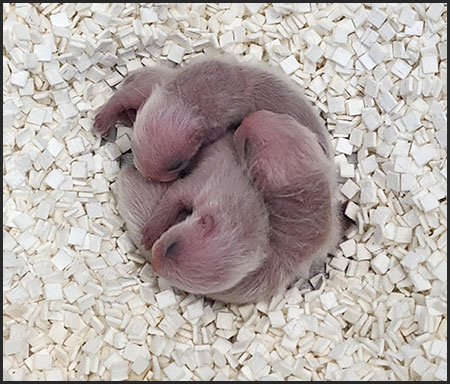
Black0footed ferret kits sleeping in a huddle

BFFs are predatory prey, so their environmental role is to help control prairie dog populations while occasionally being a food source to owls, coyotes and badgers. Designated BFF reintroduction sites are managed for fleas that can transmit plague, which supports healthy prairie dog populations. This safeguards all of the other prairie species that rely on prairie dogs (a keystone species) as well. Black-footed ferrets are rare and important because they serve the ecosystem up and down.

Native to prairies stretching from Mexico to Canada, BFFs were thought to be extinct until the 1980s. During Western frontier explorations in the early 1900s, cargo ships from Europe and Asia inadvertently brought sylvatic plague to North America. The spread of the plague bacteria by fleas among prairie dogs (and other animals), combined with poisoning and eradication programs led by newly settled farmers and ranchers who saw prairie dogs as pests, drastically reduced the prairie dog population. Because prairie dogs are their main food source, BFF populations declined dramatically along with them.

On Sept. 26, 1981, a ranch dog named Shep caught a BFF. Shep’s catch led to the discovery of a small population of the elusive animals in Meeteetse, Wyoming. Since then, zoos, U.S. Fish and Wildlife, National Black-footed Ferret Conservation Center and other organizations have banded together to breed, prepare, release and monitor BFFs to increase the population.

Since 1991, when CMZoo’s BFF breed-and-release program began, 647 kits have been born on the mountain. Some of the most genetically diverse kits stay in human care, as part of the breeding program, so they can pass on their underrepresented genes to another generation. Others go to boot camp, to see if they can cut it in the wild. Of those, some are released and some – who do not prove they can hunt, seek shelter and protect themselves in the wild – return to serve their species as ambassadors in zoos and other educational settings. Numbers fluctuate, but recent reports estimate 350 BFFs are thriving in the wild, thanks to this program.

“It’s exciting to have been involved with this program for so long, and now to be able to do preliminary trials that could teach us how we can best support black-footed ferret wild recovery,” Jeff says. “Who knows? When the paternity results come back, we could find out it was just a really good breeding year, and there weren’t any mixed paternity litters. That’s part of the excitement of a trial. What’s next remains to be seen, and we will stay inspired to continue helping restore this species to our wild prairielands.”

Back to The Waterhole

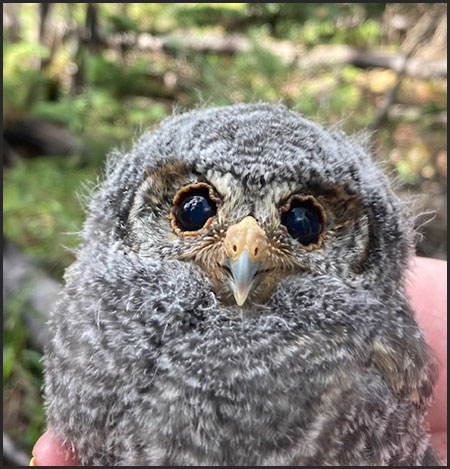
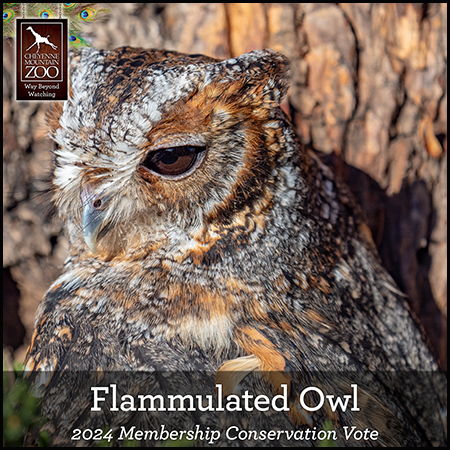
Each year, in the quiet depths of Pike National Forest, near Woodland Park, Colorado, a tiny and mysterious owl species settles in for the spring and summer to welcome a new generation to the world. Thanks to the support of Cheyenne Mountain Zoo members, CMZoo staff recently adventured into their hidden forest habitat to contribute to a 40+-year study of flammulated owls.

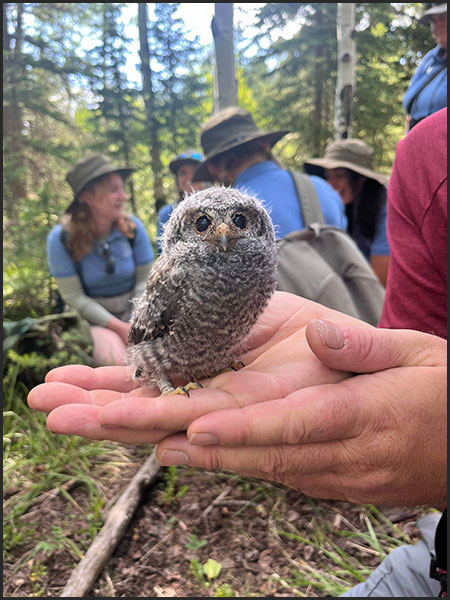
Flammulated owlet in human hand size orientation

Researchers hope member-funded location trackers will help them learn more about the migratory mysteries of these owls. That information could help establish protections for the habitats they need to breed, raise young, and make their incredible annual journeys from southern Mexico and Central America to the U.S. and southern Canada and back.

The initiative is in partnership with Dr. Brian Linkhart, a seasoned researcher with over 40 years of experience studying flammulated owls in Colorado, and professor of organismal biology and ecology at Colorado College, where he teaches courses in ornithology, ecology and field biology. CMZoo’s role was to supply member-funded state-of-the-art Motus trackers to attach to ten adult flammulated owls under Dr. Linkhart’s direction. These tiny, lightweight devices are pivotal in monitoring the owls’ movements as they navigate thousands of miles each year.

Flammulated owls are listed as ‘least concern’ by the International Union for the Conservancy of Nature. While owl numbers seem stable in Colorado study sites, their low reproductive rates and association with older forests raises questions about the stability of owl populations throughout their range, so now is the time to protect their populations. They face numerous threats during their migratory journeys, including habitat loss, pesticide exposure, and collisions with human-made structures. Understanding their migration routes is crucial for pinpointing key stopover and breeding sites and advocating for habitat preservation.

The project builds upon CMZoo’s commitment to migratory bird conservation, with the recent installation of Motus towers at CMZoo and Fountain Creek Nature Center. These towers, also funded by members through the 2023 Member Conservation Vote, are part of a vital international network that tracks the movements of various bird species wearing Motus tags, providing invaluable data for conservation efforts across the world.

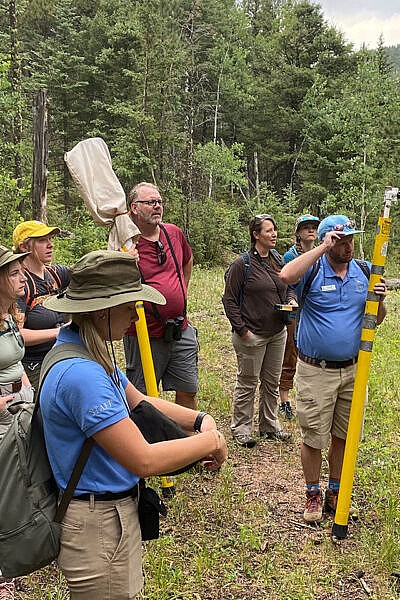
Two groups of CMZoo staff members joined the conservation field trips on Mon., July 15 and Thurs., July 18. The Monday group went during the day to see Dr. Linkhart’s work monitoring fledgling flammulated owlets and attach identifier bands to the young owls. The Thursday group ventured out at dusk to carefully secure adult flammulated owls, and attach the Motus trackers to them. ‘Flammula’ means ‘little flame,’ referring to the owls’ distinctive rust-colored feather patterns. These field trips lit a big flame of passion for owl conservation among CMZoo staff.

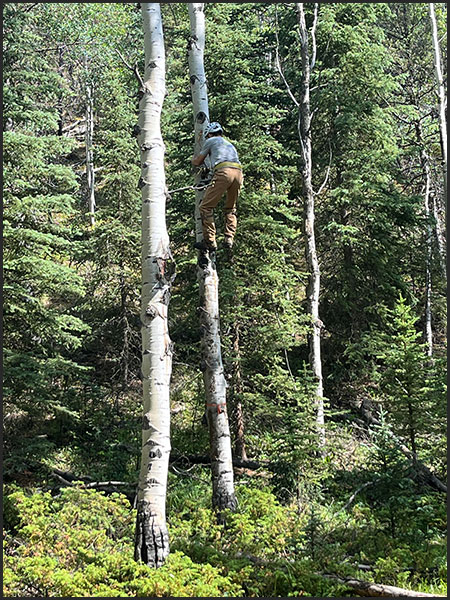
Flammulated-owlet and Dr-Linkhart-climbing a tree during release efforts

Jaymee Dietz, CMZoo veterinary technician, was part of the Monday group, and she was on the committee who evaluates the staff-championed conservation projects that members consider for support.

“We weren’t sure we’d find any owlets, but our hearts skipped a collective beat when Dr. Linkhart climbed up a tree and brought two tiny owls down, still all fluffy with some of their downy feathers” Jaymee says. “We got there just at the right time, because they were old enough to be banded and they were ready for their first flight out of the nest, probably that night. We were sitting in this silent forest, trying so hard to quiet our excitement as we worked on the little guys. Seeing them in person was so inspiring. My passion for protecting owls is at an all-time high, and I’m excited to share that with the members who made this possible.”

In addition to banding the fledglings, the team assisted as Dr. Linkhart collected crucial biological data such as weight, sex and feather measurements. While the second group wasn’t able to capture any adult flammulated owls to attach tags to this time, Dr. Linkhart will be present at the field site in the coming days and months to deploy the Motus tags.

“It’s possible that the Motus towers, also funded by members, at CMZoo and Fountain Creek Nature Center, could help track the movements of some of the owls wearing the member-funded Motus trackers,” says Nicole Chaney, CMZoo conservation and sustainability coordinator. “We’ll be keeping a close eye on those towers this fall, when the owls start heading south again for winter.”

With the Motus Wildlife Tracking System (Motus), unassuming towers and tiny bird ‘backpacks’ – the trackers – work together to collect ongoing data via radio telemetry. The lightweight and unobtrusive tracking ‘backpacks’ come in a variety of sizes fit for birds, bats and butterflies – and some are even solar powered. Conservationists just need to catch a bird once to attach a tracker that ‘pings’ the towers when it flies by.

Birders have tracked bird movements for decades by banding and releasing individual wild birds and hoping to catch them again later to document their ages and locations. While it is and has been a beneficial science, it provides data based on single moments in time, rather than providing a full picture of a bird’s migration and movements. The towers are peppered across North, Central and South America and in several parts of Europe, Australia, Africa and Asia. Because data from each tower is shared, researchers can track the entire journey of a single bird.

Flammulated owlet up-close

“CMZoo members play a critical role in shaping our conservation priorities,” Nicole says. “Through their support, we can fund projects like the flammulated owl study, which not only advance scientific knowledge but also inspire future generations of conservationists. The Member Conservation Vote allows us to focus on local, native efforts, and we’ve seen members respond to those projects by voting them the top-supported efforts over the last five years.”

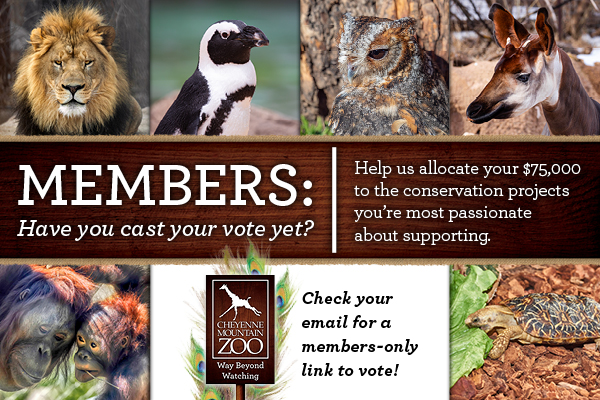
Each spring, CMZoo members cast their votes to help the Zoo decide how to spend $75,000 of membership revenue to support conservation projects championed by CMZoo staff, like this one.

Every membership and every visit to the Zoo is conservation in action. From 2015 to 2024, including this year’s contributions, the Member Conservation Vote has provided $750,000 of membership revenue to support field conservation worldwide.

Each year, a total of $100,000 of membership revenue support conservation in two ways:

  • $25,000 to the Quarters for Conservation program, which has raised more than $5 million for CMZoo’s legacy conservation partners around the world, in conjunction with funds raised through non-member Zoo admissions.
  • $75,000 to projects voted for by CMZoo members through this annual vote.

“Conservation is a collective effort,” Nicole says. “Together with our members and community partners, we can all help protect Colorado’s natural heritage and the remarkable creatures that call it home.”

Back to The Waterhole

Earlier this month, a group of volunteers and conservation experts gathered to release hundreds of critically endangered Wyoming toads back into their native habitat. Wyoming’s Laramie Basin is the only place in the world where Wyoming toads live. Since 2008, Cheyenne Mountain Zoo, along with partners from the U.S. Fish & Wildlife Service and others, has driven the year-round effort to breed, raise and release Wyoming toads.

None of this work is possible without the support of CMZoo guests and members. Over $5 million has been raised for conservation through our Quarters for Conservation program. Every Zoo guest receives three “quarter” tokens, representing the 75¢ Q4C allocation from their admission fee. Guests can show support for their favorite legacy conservation projects, including the breed-and-release program helping Wyoming toads recover in their native prairie lakes, by placing their tokens in the corresponding slots in the Q4C kiosks located in the Zoo’s admissions plaza.

Thank you for saving wildlife and wild places!

Back to The Waterhole

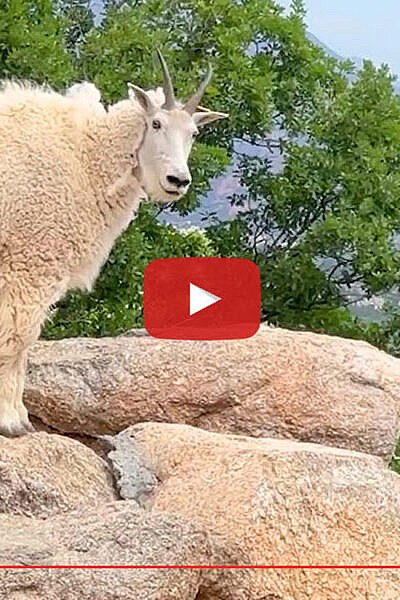
At 6 weeks old, the Rocky Mountain goat kids are hitting milestones, including eating solid foods, sparring with each other, exploring all the yards, and meeting their dad, Albert, and older sister, Blanca. They are finding their footing like little pros and learning how to be Rocky Mountain goats from their mom, Lena. Visit the twins across from the Sky Ride during your next trip to CMZoo!

Back to The Waterhole

The Zoo profession is a quickly evolving blend of science, veterinary medicine, compassion, relationships, intuition and innovation. With the well-being of its animals at the forefront, CMZoo is investing in another full-time dedicated position to increase enrichment opportunities for its scaly, furry, giant and tiny animal colleagues. As CMZoo’s Curator of Environmental Enhancements, Jason Bredahl incorporates an environments-first approach to enrich animals’ lives. Jason’s new position works in collaboration with Rick Hester, another full-time CMZoo staff member dedicated to animal well-being as the Curator of Behavioral Husbandry.

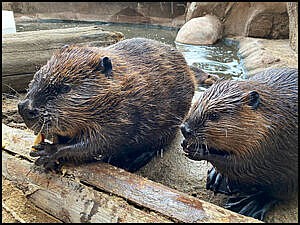
America beavers portrait

“We know that positive reinforcement training with keepers, novel enrichment activities and interactions with guests are engaging for our animals,” Jason says. “We want to fill the rest of their days with enrichment that doesn’t depend on people providing it. We want their environments to support them with opportunities that they find positively reinforcing for as long as possible.”

Before accepting this position, Jason worked as an animal keeper and animal care manager of giraffe, African lions, elephants, rhino, okapi and more at CMZoo for 24 years. Stepping into this dedicated role, he can share his vast behavioral knowledge and experience with all of the Zoo’s animal care teams. Plus, he’ll have the time, equipment and resources to lead enrichment programs for animals all over the Zoo. The goal is to provide activities the animals find reinforcing – meaning they achieve mental and physical stimulation, satisfaction and comfort – through their own innate natural behaviors.

For a grizzly bear, digging is tops. The grizzlies’ new habitat (currently under construction) will have a variety of digging locations and varied substrates where the bears can get dirty, take a comfy nap or uncover treats to their hearts’ delights. Rocky Mountain goats want to climb and survey from on high. CMZoo recently added 30 boulders to the top of their rocky cliffs, which already towered over the Zoo. Penguins want to hunt. A new trout enrichment program allows them to zoom underwater and get the behavioral and nutritional satisfaction of snagging the catch of the day. Beavers want to build dams, but their care team discovered that providing branches wasn’t inspiring them. So, now the team provides specific branches that are good for building and installed a speaker system that plays running water on a loop in the beavers’ habitat. Dams now abound in the CMZoo beaver pond.

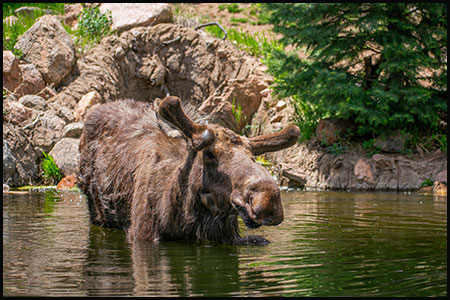
Alaska moose Atka in velvet, in his pond at Rocky Mountain wild, Cheyenne Mountain Zoo

“Herbivores’ favorite job is eating,” Jason says. “We see them seeking food over almost anything else, regardless of how much we provide. It’s a challenge to provide the quantities and right kinds of food so they can eat for the majority of the day without gaining an unhealthy amount of weight. That means we need more tree branches, just like they would eat in the wild. That’s where our browse program is really stepping up and where our community can make an impact.”

CMZoo’s browse program isn’t new, but it’s evolving. ‘Browse’ is another word for tree branches, leaves, twigs and trunks. With Jason overseeing the program, Sarah Touchton, browse coordinator, is filling her days by filling the Zoo’s pick-up truck with tree branches and solidifying relationships with local landscaping companies.

“I want to encourage our community members to ask their tree trimmers where they’re going to recycle branches, and to suggest they reach out to us,” Sarah says. “We’re trying to add a step to the tree recycling process. It will still become mulch eventually at a local tree recycling organization, but before it goes there, it could come here first and our animals could really benefit from the bark and leaves.”

The Zoo can’t accept branches that have been sprayed with pesticides or herbicides or are diseased or dead. The branches must have been cut within a day or two of the donation. Zoo animals can have elm, willow, ash and cottonwood branches and trunks. Maple and pine species are toxic to ruminants – herbivorous animals with multi-chambered stomachs.

“Donations should be at least a truckload of tree branches and trunks to make the most of our pick-ups,” Sarah says. “Once it gets to the Zoo, we distribute branches to giraffe, elephants, wallabies, our rhino, moose, and more, and they gobble it up. Other animals that don’t eat the branches might like to play with them. It’s really fun to be able to show our browse donors where their branches ended up, especially when it’s something as cute as a video of Emmett, our grizzly bear, swimming and swinging branches over his head.”

The next time a tree needs a trim, the property owner can encourage their tree trimming service provider to see if the Zoo can use the browse. Landscaping companies can also reach out to the team to set up regular drop-offs at [email protected]. Drop-off and pick-up opportunities may be limited and the team will prioritize large-volume donations.

Back to The Waterhole

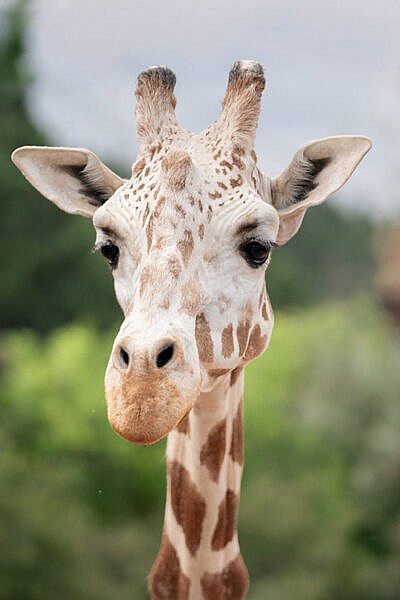
Celebrate World Giraffe Day with us, June 21, 2024!
On the longest day of the year, Cheyenne Mountain Zoo will celebrate the longest-necked animal: the giraffe! On Fri., June 21, giraffe keepers and staff from the International Center for the Care and Conservation of Giraffe (The Giraffe Center) are throwing a daylong event to commemorate World Giraffe Day.

“This is our way of thanking our community for their dedication to our herd, our Zoo and our conservation partners all year long,” says Diana Miller, giraffe specialist at The Giraffe Center. “We have a ton of inspiring activities planned!”

There will be many giraffe-themed activities along the giraffe plaza and the giraffe boardwalk, where guests can learn about CMZoo’s giraffe herd and take direct steps to save wild giraffe. From 9 a.m. to 2 p.m., several giraffe-themed activities are free for anyone with a ticket to the Zoo. Guests who want to participate in the giraffe fan parade should be sure to get a ticket for 10 a.m. or earlier. A full schedule of events is available at https://www.cmzoo.org/world-giraffe-day/.

Watch for signs on how to navigate through African Rift Valley as we embark on our exciting giraffe habitat improvements, scheduled to start in mid-June. Learn more about the giraffe herd’s future home and consider supporting it here: cmzoo.org/giraffeproject

By visiting the Zoo, guests and members can help save giraffe on World Giraffe Day and every day. Through CMZoo’s Quarters for Conservation (Q4C) program, every admission to the Zoo raises 75¢ for conservation. Since 2008, guests and members have raised more than $5 million for frontline conservation partners and projects around the world.

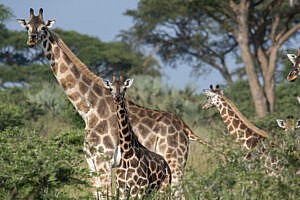
Wild giraffe - Photo credit: Musiime Muramura, Uganda Wildlife Authority
Photo credit: Musiime Muramura, Uganda Wildlife Authority

Giraffe are one of CMZoo’s legacy Q4C projects, so an easy way to support giraffe conservation is to simply visit the Zoo. Specifically, CMZoo visitors are supporting Giraffe Conservation Foundation (GCF) and their important work studying and protecting wild giraffe, growing populations, advocating government protections and policies for giraffe, and educating and empowering communities who live near wild giraffe.

“In the past year, members’ and guests’ Q4C funds supported additional anti-poaching efforts by funding a new GCF veterinary vehicle to respond to snaring and poaching,” says Diana. “We still have a long way to go, but it’s working, too. With this support, the latest surveys show that the population of wild giraffe is increasing steadily.”

With Q4C support, GCF continues to monitor giraffe populations in Uganda, in partnership with the Uganda Wildlife Authority. Recent surveys indicate that all four populations of giraffe in Uganda are increasing in number, with seven new calves reported in Lake Mburo National Park, seven calves in Pian Upe Wildlife Reserve, thirteen calves in Kidepo Valley National Park, and four hundred calves in Murchison Falls National Park.

“I keep having to tell people that’s not a typo,” Diana says. “There really are four hundred calves documented in the population in Murchison Falls National Park. That population is an excellent example of what can happen when all of the delicate conservation puzzle pieces fit together well.”

In addition to fieldwork and local communities’ buy-in to coexisting with giraffe, an important piece of the conservation puzzle is public support and funding. Zoos play a vital role by inspiring people all over the world to care for wildlife and wild places – and with programs like Q4C, zoos can connect funding from inspired people to frontline organizations who can make the impact.

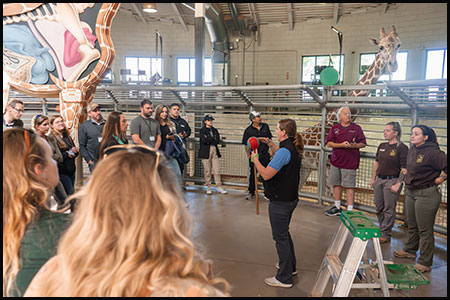
International Center for Care and Conservation of Giraffe workshop in Giraffe Barn at Cheyenne Mountain Zoo

“Nobody helps guests fall in love with giraffe as well as our herd can,” Diana says. “From confident Tumbili to curious Wednesday, sassy Azmera and wise Mahali, the giraffe at CMZoo have inspired countless people to care for their wild counterparts. They have the most important jobs here at the Zoo, and our job is to take good care of them.”

CMZoo’s herd receives top-of-the-line care with hoof care and husbandry training programs that continue to lead the profession. After more than a decade sharing methods with other giraffe care teams, CMZoo established The Giraffe Center to serve as a resource for all giraffe care professionals. The Giraffe Center offers in-person and online husbandry and hoof care trainings, as well as customized consultations for giraffe care teams all over the world.

“We love traveling to other facilities to see how they do things, brainstorm problem solving with them, share what works for us and discuss what we’ve learned from other organizations,” says Amy Schilz, senior animal behaviorist at The Giraffe Center. “But, there’s nothing like being with your home herd. Our giraffe are such rockstars at training, so our annual workshops here at CMZoo are a lot of fun.”

At the end of May, The Giraffe Center hosted another giraffe behavior workshop at CMZoo with Behavior Works. The behavior workshop is a continuation from the introductory giraffe care workshop. At the behavior workshop, Amy and The Giraffe Center team help giraffe care professionals build upon the fundamental teachings they learn from the intro giraffe care workshop by getting hands-on with members of the CMZoo herd.

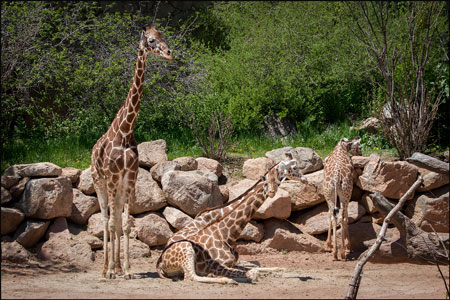
Giraffe mingling at Cheyenne Mountain Zoo

“CMZoo’s investment in The Giraffe Center has been fulfilling because we know we’re making giraffes’ lives better,” Amy says. “Seeing our workshop attendees work with our giraffe to learn how it should look to trim a hoof, and then hearing about their giraffe’s improved mobility at home after they’ve applied what they learn is so rewarding.”

The network and collaboration between giraffe organizations goes both ways. Amy and Diana have been instrumental in the design of the new barn that will soon stand tall in African Rift Valley at CMZoo. The team has traveled internationally to share best practices of giraffe care and to observe how others’ facilities and environments can best support a herd.

“We’re focused on environmental enrichment for all of our animals at the Zoo,” says Amy. “With a brand-new giraffe barn coming to CMZoo soon, we’re going to be able to fine-tune building and yard features that we’ve seen work elsewhere as we build this environment from the ground up. It’s happening soon, and we’re really excited to help it come together.”

The 10,000-square-foot giraffe barn’s design is in final considerations. Guests and members should expect to see changes to African Rift Valley start soon, and continue for the next few years as The Giraffe Center takes shape.

Back to The Waterhole

Last month, Cheyenne Mountain Zoo members cast their votes to help the Zoo decide how to spend $75,000 of member conservation funds among six conservation projects vying for members’ support. The three projects with the most votes received the full funding they requested. The number of votes received for the remaining three projects helped CMZoo decide how to distribute the remaining funds.

Every membership and every visit to the Zoo is conservation in action. From 2015 to 2024, including this year’s contributions, the program has provided $750,000 of membership revenue to support field conservation worldwide.

“I hope our members recognize what an impact they make for wildlife and wild places through these staff-championed conservation efforts,” Ashley Cioppa, CMZoo membership manager, says. “Our members’ annual investment in their Zoo memberships directly supports animals here in Colorado and all around the world. Plus, they give our staff the opportunity to reach more niche organizations and efforts that support their personal passions. Thank you, members!”

Each year, a total of $100,000 of membership revenue is contributed to conservation in two ways:

  • $25,000 to the Quarters for Conservation program, which in total contributes a million dollars on average every 18 months to CMZoo’s legacy conservation partners.
  • $75,000 to projects voted for by CMZoo members through this annual vote.

This year’s Member Conservation Vote top-ranked projects to fully fund are:

1. Track and protect FLAMMULATED OWLS in Colorado – $4,150
Purchase ten tracking tags that provide researchers with crucial migration data for these tiny owls. Migratory birds are currently facing many threats such as pollution, pesticides, habitat loss and collisions with human-made structures. The installation of two Motus towers at CMZoo and Fountain Creek Nature Center last year allows researchers the ability to track hundreds of local bird species in efforts to protect them. As a continuation of this project, a local researcher will utilize these towers to track ten flammulated owls, a species that lives right here in Colorado Springs, to learn about their migration patterns and use that information to help protect the species.


2. Support agroforestry to protect OKAPI habitat – $24,600
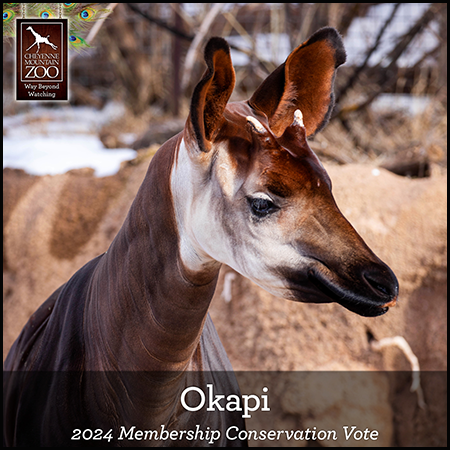
Provide farmers in the Democratic Republic of the Congo with sustainable agricultural resources. Okapi populations are facing a major threat of habit loss due to slash-and-burn agriculture and human settlement. In a continued partnership, the Okapi Conservation Project (OCP) will use these funds to provide farmers with tools, seeds, land plots and the education necessary to build and maintain sustainable agriculture and reforestation practices. In doing so, the local communities are empowered to produce their food sustainably and reduce their dependence on mining and poaching – leading to the long-term protection of okapi.


3. Help build a new island home for ORANGUTANS in Borneo – $17,642
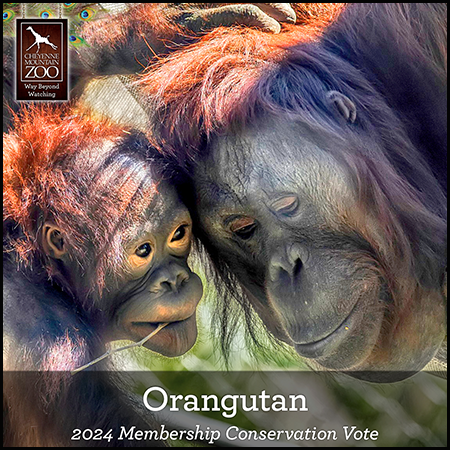
Help provide the materials to construct a new, forested island home for non-releasable orangutans in Southeast Asia. Borneo Orangutan Survival (BOS) Foundation is an established organization that rescues, rehabilitates and releases orangutans back into their natural habitat. Unfortunately, a small percent of orangutans come to BOS with injuries, illnesses or other conditions that prevent them from being released into the wild safely. BOS houses and cares for them for the rest of their lives. Member funds will help provide the construction materials for a new orangutan island that will create a spacious and enriching forever home for three non-releasable orangutans currently residing with BOS.


With the remaining funds, CMZoo has decided to partially fund:

Protect PANCAKE TORTOISES through community conservation in Kenya
Conduct community awareness training and research to protect critically endangered tortoises and their habitat. Wild turtle and tortoise species are in the midst of a worldwide extinction crisis. The African pancake tortoise faces severe threats, not only from grassland habitat destruction used for farming, but also an additional threat of poaching for the pet trade. In a continued partnership, the Turtle Survival Alliance will protect and develop research strategies for a newly found pancake tortoise population, as well as establish additional awareness for the local communities surrounding this tortoise population.

Expand AFRICAN PENGUIN chick rearing capacity
Provide construction materials and equipment to rear penguin chicks. African penguins, found mainly in South Africa and Namibia, are facing threats from overfishing and climate change, which often results in penguin parents abandoning their chicks. Due to an exponential increase in egg and chick abandonment, the Southern African Foundation for the Conservation of Coastal Birds (SANCCOB) is looking to expand their chick-rearing facility through our ongoing partnership. This expansion will double their capacity of penguin chicks and eggs that they can rescue, rehabilitate, and release each year.

Support kids’ education camps to help protect AFRICAN LIONS
Help protect large carnivores by empowering a new generation in Kenya. Human-wildlife conflicts can occur between farmers and predators, such as lions, that may threaten local livestock. The education programs that Ewaso Lions will implement through this ongoing partnership will help to shift the attitude towards predators and allow Kenyan communities to more easily and efficiently coexist with wild carnivores by reducing the frequency of potential human-wildlife conflicts.
For more information about how to become a CMZoo member, and the many benefits that memberships provide, visit cmzoo.org/membership.

Back to The Waterhole


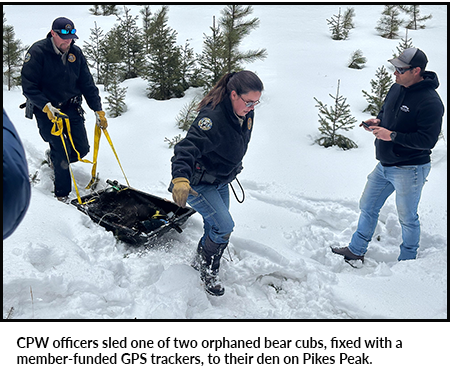
Through Cheyenne Mountain Zoo’s annual Member Conservation Vote, CMZoo members are funding an important ongoing study on the movements of wild black bears in the Pikes Peak region. In 2022, members voted to spend conservation-allocated membership revenue on GPS ear tags that Colorado Parks and Wildlife (CPW) officers use when reintroducing black bears to the wild.

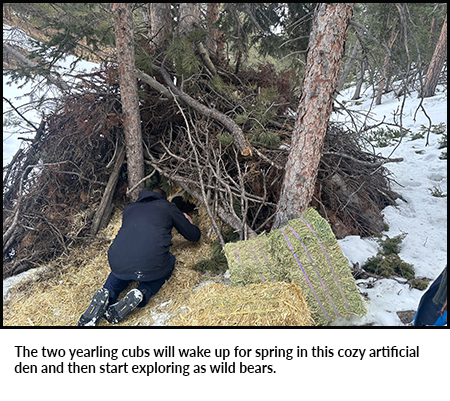
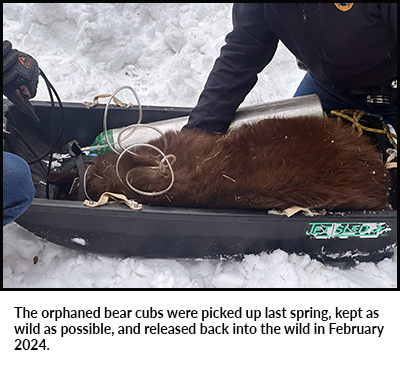
In early February 2024, CPW transported two yearling black bear cubs that were fitted with the GPS ear tags from a rehabilitation facility to an artificial den on Pikes Peak. Later this spring, they’ll wake up and start their second chance at living wild.

According to CPW, one of the bears placed in the den this month was orphaned by its sow last summer in the Broadmoor neighborhood in southwest Colorado Springs – just down the road from CMZoo. The sow had four cubs, which is extremely unusual. CPW biologists speculate she may not have been able to care for all four cubs. It’s likely that as the runt of her litter, this little one was abandoned.

The other bear wandered into the Rifle Falls Fish Hatchery without its sow last summer. It would not have been able to survive on its own in the wild at that young age, so it found a home as a surrogate sibling with the ‘Broadmoor Bear’ at the rehabilitation center.

Both cubs, about a year old now, spent the last several months together, being kept as wild as possible in preparation for their reintroduction. Earlier this month, CMZoo staff joined CPW to observe their journey back to the wild.

“CPW officers pulled the little bears – who were under anesthesia – on sleds through the snowy evergreen forests on Pikes Peak and tucked them into a nice warm den,” said Zwicker. “They’ll stay in this den for the rest of winter, and then they’ll wake up and start helping their species by giving us a glimpse into their whereabouts over the next several months.”

The GPS data uploads from the ear transmitter tags about every two weeks. CPW tracks those snapshots of the bears’ locations to help define successful rehabilitation and care for orphaned bear cubs, and where to release them.

This is the second time member-funded GPS trackers have been used to track black bear movements after wild reintroduction. The first two cubs with these ear tag transmitters were released in January 2022 to the same artificial den.

One of the 2022-released bears dropped its ear tag several months after waking up in the den, as planned, and by all accounts is still living wild on the mountain. The other unfortunately reoffended and had to be euthanized after human-wildlife conflicts.

“It’s a sad fact, but it’s also a stark reminder that we need to help bears stay out of trouble,” said Zwicker. “With this data from the GPS trackers, biologists will be able to compare what four cubs do in the same space. They can look at the rehab strategies used for each and compare their success as wild bears. It’s going to help us help more wild bears stay wild.”

CPW reports that urban bear conflict is one of their biggest issues, especially bears getting into garbage at area homes and businesses. It will be valuable to study the effectiveness of rehabilitation efforts with orphaned bear cubs and see if they really do learn to avoid humans in the future. Zwicker urges Coloradans to be good neighbors of native wildlife by following simple ‘bear aware’ guidelines.

“Working with CPW on projects like this has enhanced my understanding of the natural world,” said Zwicker. “The folks at CPW truly care about wildlife. They’re incredibly dedicated and impressive professionals fighting the good fight for our local wildlife. Our roles can be different, but we’re all passionate stewards of our environment. I’m grateful our members are funding this connection between the Zoo’s animal advocates and the animal advocates at CPW.”

Since 2015, the Member Conservation Vote has provided $600,000 of membership revenue to support field conservation worldwide. Each year, a total of $100,000 of membership revenue supports conservation projects in two ways:

  • $25,000 to the Quarters for Conservation program, which has raised more than $5 million dollars for CMZoo’s legacy conservation projects since the program began in 2008.
  • $75,000 to projects voted for by CMZoo members through this annual vote.

Next month, CMZoo members will get the opportunity to vote on the 2024 Member Conservation Vote projects. Members, keep an eye on your email for your members-only link to vote! Interested in becoming a member? Visit cmzoo.org/membership.

Back to The Waterhole